I Tried It: A Virtual Eye Exam
It was odd and time-consuming, but can serve a valuable purpose.
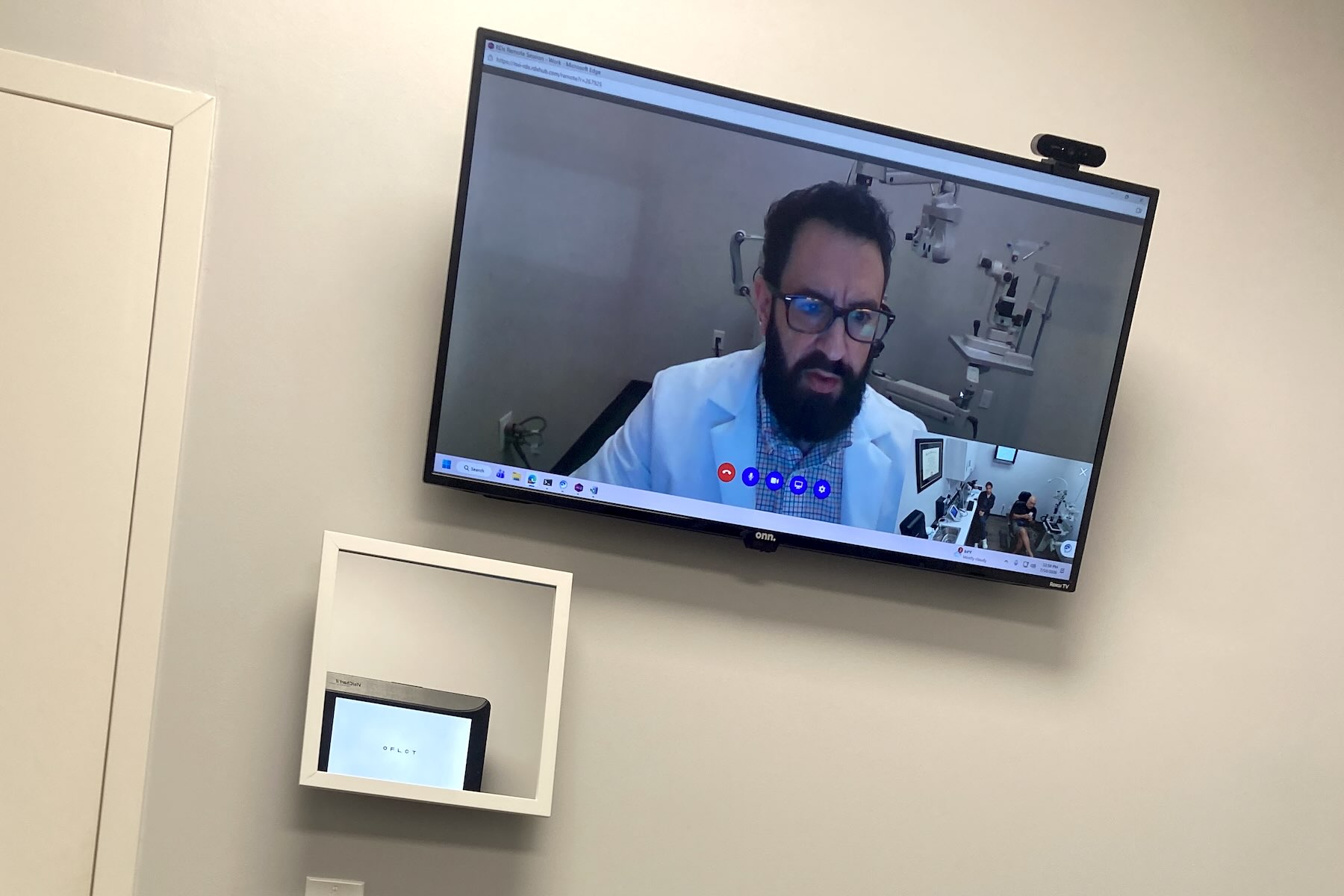
A doctor performing a remote eye exam in Delco. / Photo by Victor Fiorillo
Listen to the audio edition here:
I really needed new glasses. This wasn’t so much because my prescription seemed to have changed. But the glasses I bought at America’s Best a couple of years ago were mercilessly worn. I found myself constantly wiping my glasses, which was a completely futile proposition, because the lenses were scratched and somehow smudged with smudges that wouldn’t come off. And I realized that people looking at me weren’t really seeing my eyes. They were seeing a bunch of scratches and smudges and probably thinking to themselves, Why doesn’t Victor get new glasses?! I had become quite self-conscious. So, last month, I finally decided to do something about it.
I paid a visit to the America’s Best near my house in West Philly, with the idea that I would pick up a copy of my prescription and then use the website Zenni — as so many of my friends and family members have been doing — to order glasses online with that prescription. People have, of course, been doing this ever since Warby Parker made it a hugely popular thing in the 2010s, but it took a while for the set-in-my-ways Gen X’er and semi-Luddite in me to cross this modern threshold.
The staff at America’s Best was kind enough to provide me with that prescription, after I waited about 20 minutes for them to do so, and then they promptly pointed out to me that it had expired, rendering moot my plan to order glasses on Zenni that same day. But I was determined. I asked them if they could give me a quick eye exam (the place was empty), but they said they didn’t have any appointments there for a few days. They suggested I check their website to see what might be available at other locations. Lo and behold, the America’s Best in Broomall had an opening in just two hours. Off I went.
When I arrived at that America’s Best, they informed me that this would be a remote eye exam. (Apparently, this fact was disclosed online when I made the appointment, but who ever reads the fine print?) I had no idea that a remote eye exam was a “thing” but after they confirmed for me that I would be walking out the door with a new prescription, I decided to go for it. There was also the major curiosity — and convenience, or rather, inconvenience (for me) — factor: If it’s a remote eye exam, why was I in a doctor’s office at all?
An optometric technician soon escorted me into a room where some familiar devices were on display.
There was an OCULUS EasyField, which tests your visual field — you know, the thing you stare at and lights flash at varying distances and locations from the center and you click a button each time you see a flash.
Then I moved on to the next device, which takes high-resolution photos of the front and back of your eye, with a jarring bright flash of light.
After that, I slid over to the non-contact tonometer, which checks your eye pressure with a puff of air. For some irrational reason, this test evokes the eye-torture scene from Clockwork Orange whenever it’s performed on me.
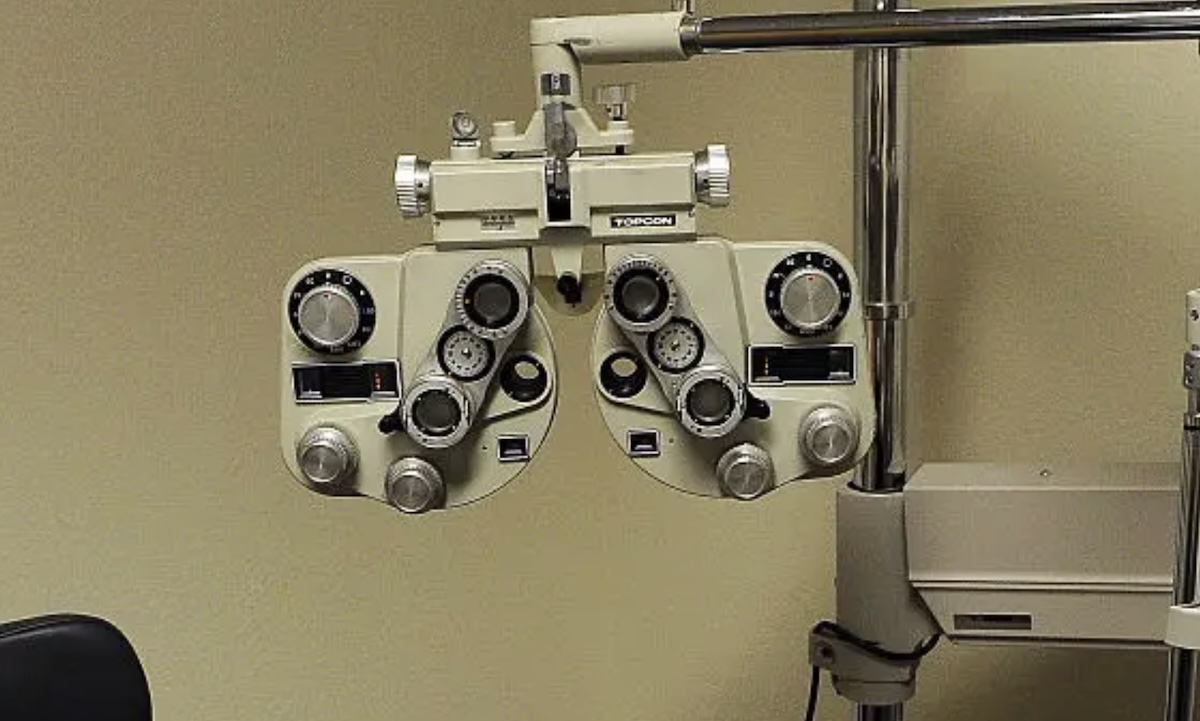
So, again, how is this remote? Not for me, surely. The technician brought me into a room that held the classic ophthalmic exam chair. You know the one — there’s an attached eye-exam device (“Which is clearer, A or B? A or B?”) that looks like it probably hasn’t changed much since Truman was in the Oval Office.
Screenshot
But the one at America’s Best had some video cameras and other wires and devices attached to it. Also in the room was a Snellen chart, the board with displayed letters and numbers that you’re asked to read — or make your best effort.
The technician explained that he had emailed the results of the tests to an eye doctor, and that we had to wait for the doc to review the results before setting up a virtual meeting — from the room I was physically in. And so we waited. And we waited some more. Still some more.
At least 20 minutes went by, and I mentioned to the tech that this all seemed to be taking a long time. “Tell me about it,” he replied, sounding positively exasperated. Eventually, he received a message from the remote eye doctor, explaining that the tech had to retake those high-res photos of the front and back of my eyes and email the new versions. So, back to the original room we went for the do-over. Then he sent the new results. We waited another 10 minutes or so for the doctor to appear on a screen in the room.
This is where the remote eye exam actually starts. The doctor reviewed the test results with me, saying that things generally looked good. Then the tech moved the device with the lenses in front of my face and the doctor controlled the lenses and other elements of that device remotely, running me through the whole “A” or “B” series of tests using the different lenses. He also peered deep into my eyes using a camera he was controlling remotely. At that point, the tech was there just to fulfill requests by the doctor to move things around a bit.
As we finished the “visit”, I wondered where the doctor was located, because, theoretically, he could have been anywhere in the world. “I’m in Glen Mills,” he told me — just 20 minutes away. Then he transmitted my new prescription to the front desk, and I went home to place an order with Zenni.
In one sense, I can’t complain. I was impatient and insisted on getting my prescription that exact day, and the remote eye exam allowed me to do that. On the other hand, I’ve never spent so long inside an eyeglass store, and — busy guy that I am — I would never do one again.
It turns out that remote eye exams first emerged during COVID to limit person-to-person contact, and, in some cases, they’ve stuck around. These days, a remote eye exam doesn’t make a whole lot of sense in a region so replete with eye doctors. But that brings up a good point about these remote eye exams: What about regions of the country — or other countries — where an eye doctor can be hard to come by? All they would need is the equipment, a tech, and an internet connection, and patients could connect with eye doctors all over the world.
They just may need to prepare for a long wait.