How Longport Became the Jersey Shore’s Quiet Luxury Enclave
It was a boring, residential beach town. That’s what made it so valuable.
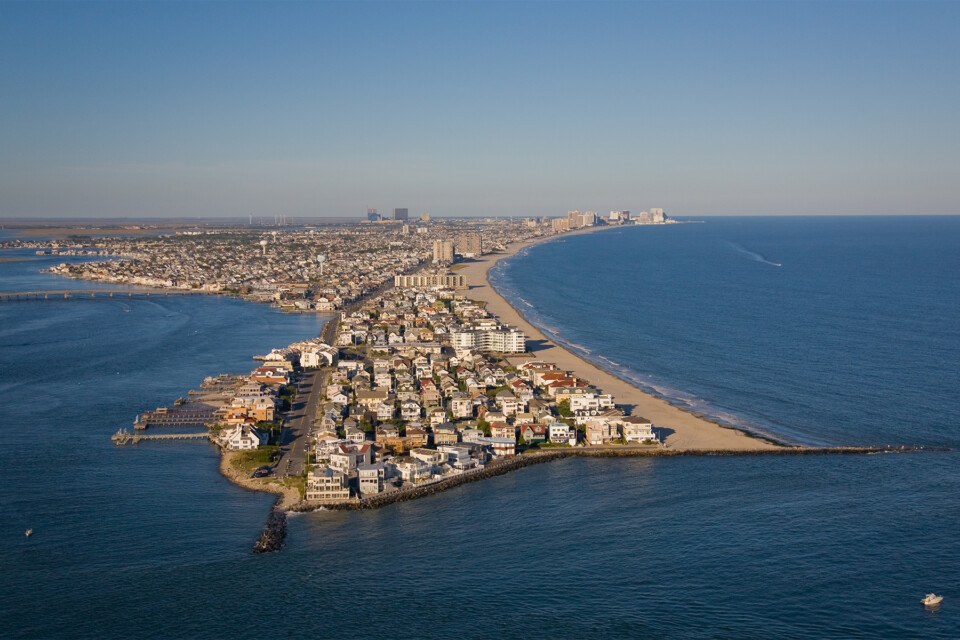
An aerial view of Longport / Photograph via Getty Images
In 1979, Billy Crystal was performing at an Atlantic City casino when the casino put him up on Pelham Avenue in Longport. The next morning, Crystal was talking to his friend, concert promoter Larry Magid, about meeting for lunch. Magid, who lived in nearby Margate, asked him, “Where’s Pelham Avenue, and what town?”
Magid had no idea: Pelham Avenue, it turned out, was in Longport. Roughly a mile from his house.
For realtor Joe DiLorenzo, the story perfectly captures Longport back then. The town was and is tiny — less than a square mile, with roughly a mile and a half of beach at the southern end of Absecon Island. Unlike its island neighbors of Margate and Ventnor (and unlike most any other South Jersey shore town), there’s no commercial corridor to attract a crowd — no shopping at Ventnor Avenue boutiques, no boardwalk, no coveted reservations at Steve & Cookie’s. I grew up going to Margate, and I can tell you that I only walked to Longport for their tennis courts.
It was … boring. (DiLorenzo more tactfully calls it “hiding in plain sight.”)
Fast forward to today, and Longport is still quiet … but it’s also now one of the most expensive residential enclaves on the Jersey Shore. It is a place where an older house can sit on land worth far more than the structure itself. Where custom-built homes often reach extraordinary sizes. And where the people who have been around longest now find themselves living on lots that would command fortunes … if they ever decided to sell.
Beachfront land can cost millions before a house is even built on it. Custom homes routinely run millions more. Some of the most expensive transactions happen privately, DiLorenzo says, without ever appearing on the open market.
Longport didn’t become valuable by turning itself into a destination; it became valuable by remaining the opposite.
The quiet resort
Longport was conceived as a resort town from the beginning. In 1882, M. Simpson McCullough, a Philadelphia lawyer, businessman, and developer, bought a large swath of the land for a song — 250 acres for a total of $150,000. The borough incorporated in 1898. In its early years, Longport was more commercially active than it is now, with hotels and other businesses serving summer visitors.
Over the decades, though, much of that commercial life disappeared. Hotels were demolished. Other landmarks vanished. The town became overwhelmingly residential. Longport’s avenues, which begin at 11th rather than 1st, are a reminder that the geography itself has changed over the years, as storms and shifting sand reshaped the Point.
Larry Magid remembers a version of Longport that feels worlds away from today’s rows of custom-built homes. As a child, he and his sister would come down the Shore with their father, who rented a room in the old inlet section of Atlantic City. As a treat, their father would take them on the trolley down Atlantic Avenue to its terminus at 11th Avenue, where the bay and ocean meet.
There was a log cabin at the Point, and its owner kept a pet seal.
Twice a day, Magid remembers, the owner would bring the seal outside and hand children little cups of fish to feed it. The seal would clap its flippers, then head out to sun itself on the rocks between the bay and ocean. “We were so excited. Year after year, we wanted to come see the seal. He would swim away in the winter, and he’d come back every spring.”
The cabin was later torn down, but it lives on in another bit of Shore history: Magid recalls that part of Atlantic City, the 1980 film starring Burt Lancaster and Susan Sarandon, was filmed there.
It just seems like the quality of existence steps up a notch.” — Larry Magid
Magid, who spent years living in Margate, eventually came to appreciate Longport’s quieter appeal. By then, Margate’s beaches were getting more crowded. After long days working in Philadelphia, he wanted somewhere he could relax, take a nap, and get away from the bustle. Around 1990 or 1991, he paid $232,000 for a Longport property and built a house.
Today, the town has roughly 600 to 650 year-round residents by his estimate, with the population multiplying many times over in the summer. Yet even in season, it’s calmer than other Shore communities. Magid can go for a walk and encounter half a dozen people who stop to say hi: “That’s one of the unique qualities of of this town that I didn’t see in Margate, and of course, you don’t see it in big cities.” New construction may have changed the streetscape, but not that calm contentment. “It just seems like the quality of existence steps up a notch.”
Joseph DiLorenzo arrived in Longport from Camden in 1983. Four years later, he opened his own company, Premier Properties. His parents had bought a Longport house in 1972 — for $22,000. He bought his own house there for $325,000 and still lives there today. He has no interest in selling.
There are still houses like his in Longport — older, relatively modest homes belonging to people who have been there for decades, sometimes generations. There are residents who could theoretically cash out for millions but have no interest in doing so. But there are fewer of them than there used to be, and the economic pressure on those properties is hard to ignore.
The making of Longport
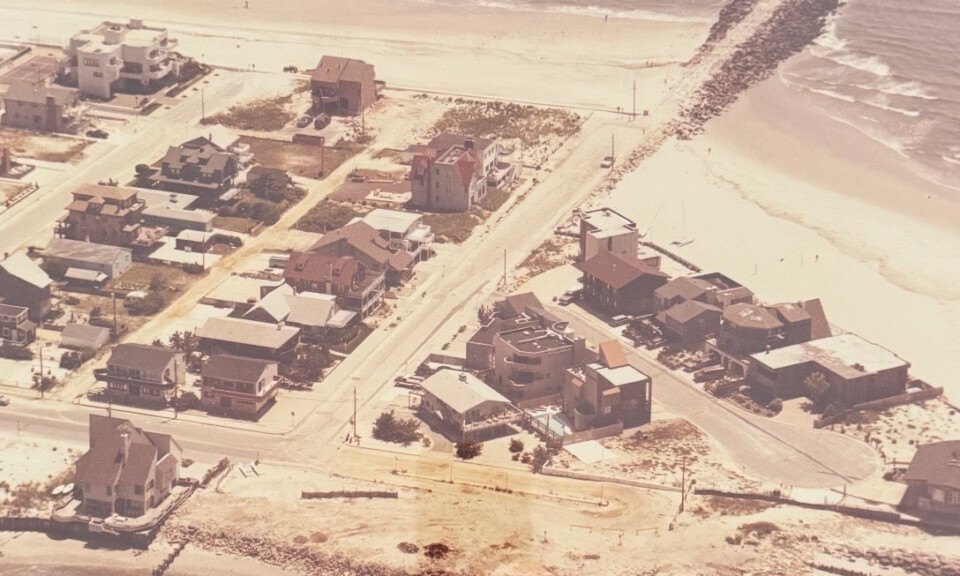
Pre-boom Longport in the 1980s / Photograph by Joe DiLorenzo
When DiLorenzo arrived, Longport was already changing. The late 1980s brought a wave of speculative residential development. Robert Johnson was, in DiLorenzo’s telling, the preeminent architect of the era, designing what DiLorenzo remembers as Dryvit-clad “Miami Vice houses.”
Several spec builders got into trouble and eventually went bankrupt. DiLorenzo acquired a large portfolio of Longport properties from National Westminster Bank, including beachfront parcels.
In 1987, DiLorenzo’s friend, prominent businessman and philanthropist Lewis Katz, introduced him to Leonard and Madlyn Abramson. Leonard Abramson, another prominent Philadelphia businessman (who co-founded U.S. Healthcare), became a mentor to DiLorenzo and began introducing him to his friends. One introduction led to another.
The Abramsons’ own purchase became an important marker in Longport’s evolution. According to DiLorenzo, they paid more than $2 million for a 143-by-125-foot beachfront lot at 20th Street and Beach Avenue in the late 1980s — the first Longport beachfront lot, he says, to sell for that much. It was an extraordinary amount of money to pay for a piece of Shore real estate at the time, and it wasn’t just the price that mattered: Instead of the vaguely futuristic houses that had come to define the previous building boom, the Abramsons chose a traditional Nantucket-style aesthetic.
Once somebody has spent that kind of money just to own the sand, the rest of the equation is fairly obvious: You aren’t going to put a tiny cottage on top of it. You build a house that justifies the price of the land.”
“The architecture began to change,” DiLorenzo says. The houses were becoming more substantial, but they were also becoming more deliberately, quietly luxurious: shingled, traditional, custom-built homes that looked like they belonged to an old-money New England beach town.
It wasn’t just the look that was evolving, either: DiLorenzo identifies the transaction as the moment when Longport began attracting people who weren’t simply looking for a summer house, but were willing to pay extraordinary sums for the land itself.
The sale helped establish a new idea of what Longport property could be worth. And the Abramsons’ purchase was not an isolated event so much as the beginning of a network. DiLorenzo’s business grew through introductions and personal relationships. The wealthy people coming to Longport weren’t strangers discovering a semi-obscure Jersey Shore town on a map; they already had some connection to the area — through family, friends, summering nearby, or their children’s social circles.
Sure, like many other Jersey Shore towns, the money of New York buyers priced out of the Hamptons eventually found its way here. But in Longport, DiLorenzo says, even those people tended to have a Philly-area connection — a spouse who grew up nearby, a family history at the Shore, or some other personal tie. People tend to buy where they already know people. It stayed small. Quiet. Tight … and, increasingly, exclusive.
The tomato garden
By the mid-1990s, the price of land had reached another milestone. In 1996, DiLorenzo says, he sold the first bayfront Longport lot to reach $1 million to Orange Glo magnate Joel Appel. The parcel, at 12th Avenue and the bay, had been sitting next to the home of Rose and “Big Al” Totaro — the late couple ran a family meat importing business for 50 years. At the time, the land was being used as a tomato garden. (“The tomatoes were free!” DiLorenzo remembers.)
It’s the kind of detail that makes the transformation of Longport from a quiet little beach enclave to a private playground for the uber-wealthy easier to understand than a spreadsheet of real estate statistics ever could. A piece of land that had once been a neighbor’s tomato patch was suddenly worth $1 million.
Today, DiLorenzo says, beachfront lots can sell for at least $4 million, depending on their size and location. Once somebody has spent that kind of money just to own the sand, the rest of the equation is fairly obvious: You aren’t going to put a tiny cottage on top of it. You build a house that justifies the price of the land.
And the next buyer isn’t comparing your house to the cottage that used to occupy the lot — they’re comparing it to the other multimillion-dollar properties in town. The process feeds itself.
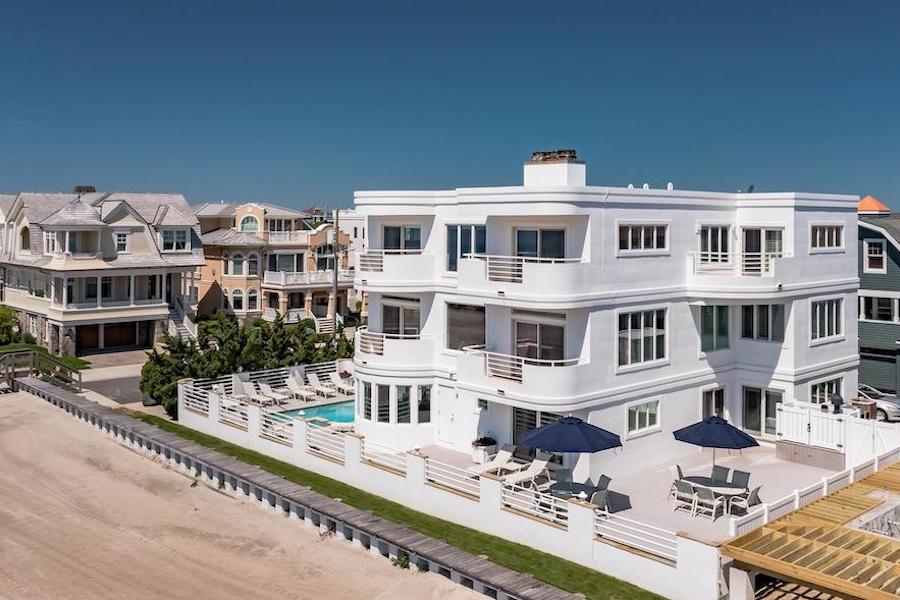
A Longport home on the market in 2022, built in 1990 / South Jersey Shore Regional MLS image via Long & Foster Real Estate
It’s an evolution that can be difficult to measure from the outside, as public real estate data don’t necessarily tell the whole story. Zillow put the typical Longport home value at about $1.55 million as of July, which is up 99 percent since Zillow started collecting data in 2018. That’s not nothing — it’s well above the nationwide appreciation rate of 60 percent during the same time period. But it isn’t particularly remarkable compared with other wealthy Shore towns. Margate’s typical value was up 133 percent; Stone Harbor, 119 percent.
But only a few homes sold in Longport in July — and Zillow doesn’t see all of them.
A review of property records for dozens of Longport parcels over the years offers a more granular look at the change. In the records reviewed, the median sale price among transactions from 1986 through 1999 was about $159,000. It rose to $561,000 in the 2000s and $868,500 in the 2010s. Since 2020, the median among the recorded transactions was about $1.52 million. The dataset is not a complete record of every Longport sale, so it should not be read as a townwide price index, but a story reveals itself lot-by-lot. Take for example 3301 Atlantic Avenue — it sold for $300,000 in 1988 and $2.3 million in 2024.
Meanwhile, at 3008 Ventnor Avenue, a property that sold for $875,000 in April 2022 changed hands for $1.25 million just three months later, then sold for $1.4 million in 2023. By 2025, its assessed improvement value had climbed from $24,600 to more than $1.57 million, reflecting the construction of a new house. In Longport, rising prices aren’t just about what an existing home is worth, but what a buyer could build in its place.
It is a familiar Jersey Shore story, but Longport’s geography makes it particularly intense. There is almost nowhere to go. The town is tiny, and its most desirable property is already occupied. The only way to create more luxury inventory is to replace what is there.
You can walk down the street and see a quiet residential neighborhood. You don’t see the millions changing hands behind it.”
But even those records don’t capture everything happening at the top of the market. DiLorenzo’s business is built heavily on private transactions. A buyer calls and says, essentially, Find me the right house. There doesn’t have to be a house on the market — DiLorenzo starts calling. He’ll ride around town, think about who might be willing to sell, and make inquiries. Sometimes a buyer gives him a number — what DiLorenzo calls a “make me move” price — and he starts asking around. In 2015, he says, he found a beachfront tear-down that way. The property ultimately sold for nearly $7 million without ever being publicly listed. At the very top of the market, DiLorenzo points to a recent purchase at the Point: a buyer reportedly paid $19.2 million for the land alone, before constructing a roughly 16,000-square-foot house.
New construction doesn’t necessarily show up as a comparable sale, because many of these houses are designed for a particular buyer and never hit the open market in the conventional way.
The privacy is part of the appeal. Some owners don’t want photographs of their homes online. They don’t want strangers studying their houses or knowing what their interiors look like. Some buyers don’t want their purchases broadcast, either. So a significant portion of Longport’s luxury market can happen through conversations that never become listings.
That makes the town’s wealth feel almost invisible. You can walk down the street and see a quiet residential neighborhood. You don’t see the millions changing hands behind it.
A tale of two Longports
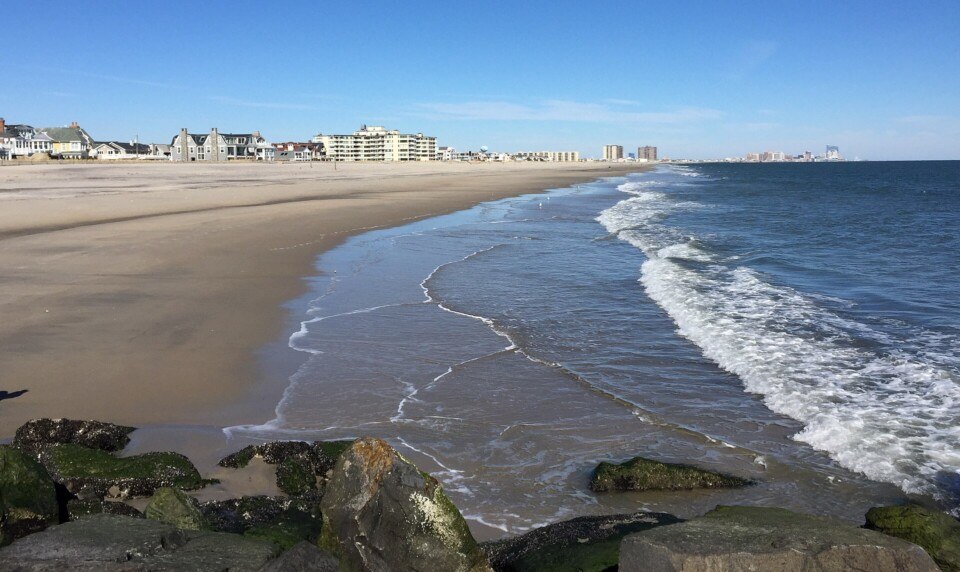
Longport Beach, looking north towards Atlantic City / Photograph by PLBechly via CC BY-SA 4.0
Walk around Longport and that wealth isn’t necessarily obvious. There are enormous new houses, yes, but there are also older homes that look like they have been there for decades. Some longtime families have held onto their properties even as the land beneath them became extraordinarily valuable. DiLorenzo is one of them.
Every morning, DiLorenzo walks his dog to the beach. He likes the quiet, the familiarity, the fact that he can be in the middle of the Shore without feeling as though he’s in the middle of anything. If he sold, he’d have to find somewhere else to live that way. “Where do I go?” is essentially the question. He talks about neighbors whose families have owned modest houses for generations. He describes the town today as having “a little bit for everybody.” Some of the old residents have left. Some have sold. Some have rebuilt. Others have simply stayed.
And, in a town where every piece of land could potentially become another multimillion-dollar home, residents have recently helped create new public parks. It is a small but telling contradiction. The Dorothy McGee Park opened after McGee left two valuable beach-block lots to the borough with the stipulation that they become public open space. Local residents, including tech entrepreneur and Pennsylvania’s chief transformation and opportunity officer Ben Kirshner, helped turn the donated land into a park. “There could have been more houses here, but Longport is a family town. Now, there are so many houses and nowhere for children to play,” McGee’s daughter Alicia McGee told Downbeach at the April 2025 ribbon-cutting.
More than four decades after DiLorenzo arrived, Longport is vastly more expensive. But in some important ways, it remains the same place.
It has almost none of the business or infrastructure that make other Shore towns feel busy. No need to come to Longport unless you have a reason. Longport didn’t become a luxury destination by chasing crowds or reinventing itself as a Shore hot spot. Instead, it became more valuable by staying quiet.
The place that once seemed boring because there was nothing to do has become desirable because there is nothing to do. For a certain kind of buyer, that’s a feature, not a bug. The result is a peculiar kind of luxury enclave — one that isn’t defined by a gate, a country club, or a grand entrance. Its exclusivity comes from what isn’t there.