
How to Analog Your Life at Work
You are a human! You are not Claude! Remind yourself of that by taking these five steps.
When I began my career as a magazine writer all the way back in the 20th century, here’s how the process worked: I would type my story on a typewriter, then mail it — via the United States Postal Service — to my editor. He or she would then edit said story (in pencil!) and mail it back to me, at which point I would retype the story and mail it back. How about that?
But here’s the thing: While today we do things faster, I’m not always sure we do them better. Which is why I recommend adding a little retro analog energy to your work life. (Or at least getting a fax machine. Man, those are truly amazing.)
1. Um, go to work.
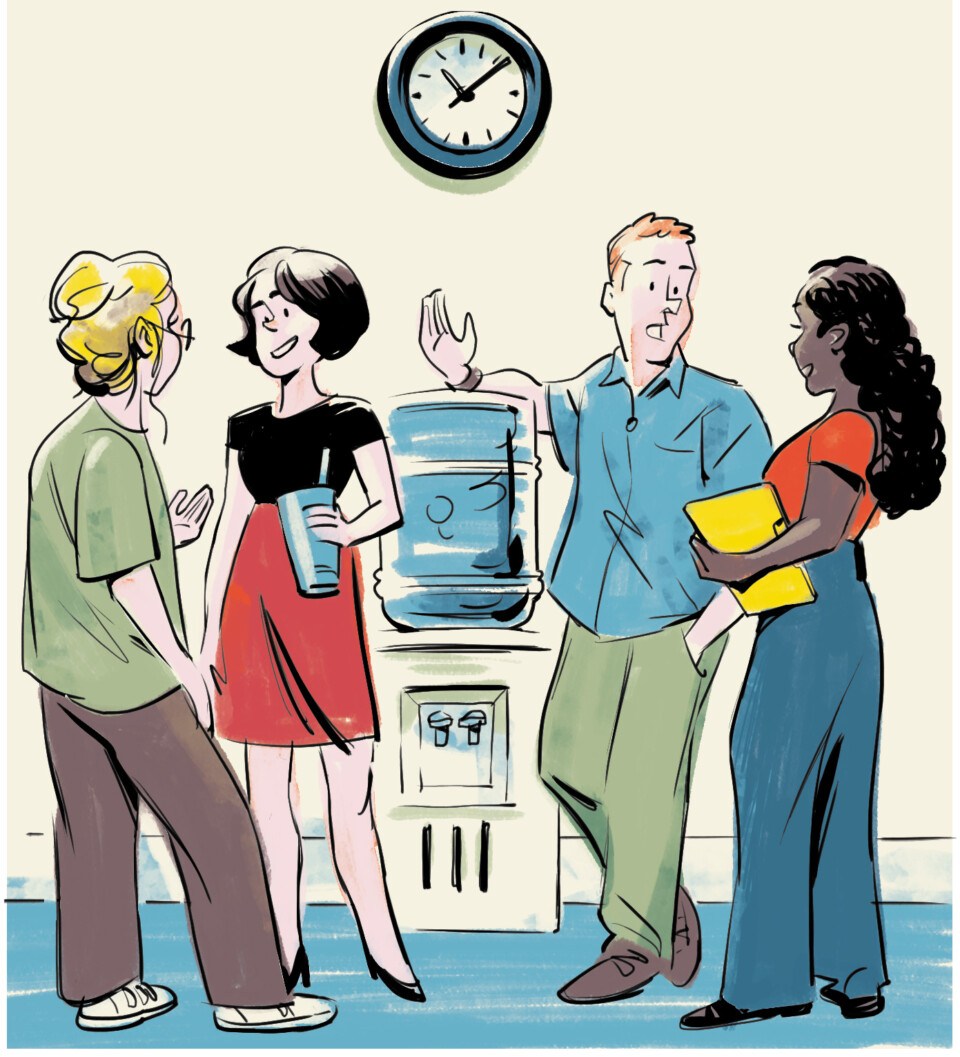
Working from home has benefits, but it also means you’re tethered to your devices all day long. The first step in going analog is taking advantage of whatever office situation your company offers. When you get there, peoplemaxx your time. Have a conversation instead of sending a Slack. Hang around the water cooler and see if you can generate some “water cooler conversation.” It’s good for your work and for your mental health — and it will give you gossip about your co-workers.
2. Use pen and paper.
For years I’ve been buying the same three-section notebook at CVS. (The price recently climbed to $8.99 — I think maybe the notebooks are coming through the Strait of Hormuz.) Daily and weekly to-do lists go in section one. Meeting notes go in section two. Half-baked ideas and harebrained schemes go in section three. However you fill yours, the important thing is putting pen to paper. Research shows it boosts memory retention, clarifies complex thoughts, and reduces mental clutter.

3. Turn off your damned computer.
You don’t let your seven-year-old spend all day on a tablet, so take the same approach with your work self and set boundaries. Even the most screen-intensive jobs have some aspects that don’t require a computer, so try this: For one hour every workday, power down your laptop and phone. You’ll lessen distractions, and your brain might even remember how to think again. (Or you could nap. Napping is good.)
4. Focus on your real network.
A few years ago I high-fived myself (painful) after I passed 500 connections on LinkedIn. I don’t really know why — 400 of those connections were strangers — but tech platforms are great at gamifying things and making you feel good. My suggestion: Gamify your IRL networking by setting a monthly goal for coffees, lunches, drinks, etc. Those interactions will pay off way more than your connection to “Joel Summer, Program Manager/Administrative Coordinator.” (Seriously, does anyone know who this is?)
5. Be the colleague who sends a handwritten note.
In the age of the AI agent, is there anything better than getting a handwritten note from someone congratulating you on something you’ve done? It says I noticed. It says I care. It says we’re both human beings. Nice, right? — Tom McGrath
How to Use AI (But Keep Your Soul)
Five rules of thumb from an expert.
So: To surrender to our machine overloads, or to shun them? For Ethan Mollick — Wharton prof, one of Time magazine’s most Influential People in Artificial Intelligence, and author of the upcoming book Co-existence: The Next Phase of AI* — this isn’t the question. In fact: “I worry that a lot of people who want to influence the future of AI are sitting it out.”

Ethan Mollick / Photograph by Jennifer Buhl
Instead of unconditionally abstaining from (or embracing) these increasingly ubiquitous technologies, Mollick wants smart, thoughtful people to use them — and shape the revolution — prudently. Selective use; selective abstention. How to do that? Mollick’s ideas:
Practice being human
Taste. Creativity. Judgment. Curiosity. Collaboration. Those aren’t the bugs in the system — they’re your competitive advantage over the machines. “If every company is just Claude, how are you going to compete?” Mollick says. “You need people in the loop.” Cultivate the most human of skills. That’s your legacy.
Use it as a tutor, not a teacher
Need to learn something? Don’t turn to AI, Mollick says — at least not at first. Go read a book. Listen to a podcast. Explore a rabbit hole. Then ask AI to guide you in new directions, create a quiz for you, or provide supplemental reading. Just don’t expect that it will help you cut corners. “One of the most annoying things to realize as an educator, after having been a student, is that, yes, homework makes a big difference,” says Mollick. “If you don’t put in the mental effort, you don’t learn anything.”
Be the boss
And think of ChatGPT as the new, talented intern. (An intern you don’t have to pay, just like the old days!) Give it the grunt work — crunching data, scouring court records — but don’t stop there. Mollick recommends commissioning projects, and then repeatedly honing your directives until you’re satisfied. “Ultimately, you get to decide what good looks like. So the real challenge becomes: ‘Can I articulate what I want?’”
Argue, argue, argue
One of AI’s biggest weaknesses is that it’s too agreeable. (Case study: Hey, Claude, is my writing original? Yes, it is! But, Claude, isn’t it also a bit derivative? Well, yes, it is that too.) To avoid obsequious, generic feedback, Mollick suggests, ask AI to embody a specific audience or constituency, like, say, a classics scholar or a skeptical teenager. “You can get it to switch up personalities on you,” says Mollick — and that can help challenge your assumptions rather than confirm biases.
Repeat this to yourself: Claude is not a human
Humans experience empathy; Claude simulates it. So as a substitute for an ear, a shoulder, or emotional support? Nah. “In the short term, it can be helpful,” Mollick says. “In the long term, it can be isolating.” Turn to friends, family, or an actual paid therapist when you need real connection.
* Mollick’s new book, Co-existence, comes out October 20th. He is the co-director of Wharton’s Generative AI Labs. — Malcolm Burnley
Illustrations by James Boyle
>> Click here to return to Analog Your Life: A Philadelphian’s Guide
Published as “Analog Your Life … at Work” in the September 2026 issue of Philadelphia magazine.