I Tried It: Getting Zapped While Exercising
I’m willing to try just about anything in the name of fitness, but voluntarily getting electrically shocked while I did squats and lunges? That’s one I had to think twice about.
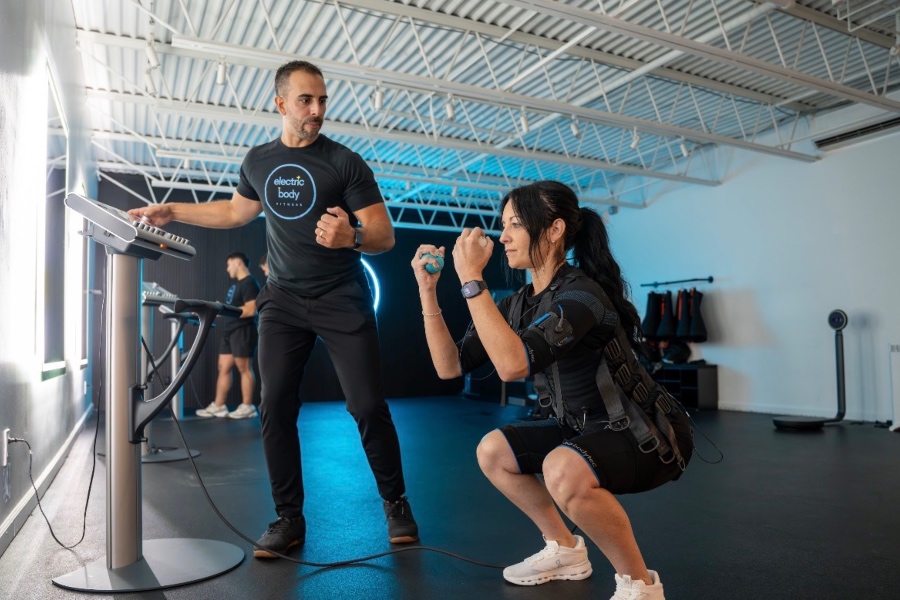
Electrical Muscle Stimulation uses electrodes to send impulses that trigger muscle contractions, so you can exercise harder, faster. / Photography by Justin Outmazgine of Maz Visuals Inc.
Listen to the audio edition here:
I was sweating when I walked up the driveway of what seemed to be someone’s Ventnor City beach house in June and entered a garage that had been retrofitted as a gym. In a few minutes, trainer Rocco Caprarella was going to strap electrodes to my body and send electrical impulses through my muscles as I exercised. That’s right: I was going to get zapped in the name of fitness. Saying I was nervous was an understatement.
Electrical Muscle Stimulation (EMS) uses electrodes to send impulses that trigger muscle contractions (up to 85 times per second, according to the equipment manufacturers), while the wearer performs exercises like squats, lunges, and curls. The technology has long been used in physical rehabilitation; now, EMS is migrating into gyms and boutique fitness studios. Caprarella offers 20-minute sessions through his company, Electric Body Fitness, which has Ventnor City and Long Island locations. His goal: to help people of all ages work out more efficiently.
It’s a little masochistic, but Caprarella says EMS is an extremely effective, progressive, and low-impact way to train hard.
“The EMS impulses make those muscle contractions more intense while you’re working out,” says Caprarella, a certified personal trainer and an EMS Master Coach, who has been offering the method for four years. “The resistance comes primarily from your own muscle contractions rather than heavy external weights, so there’s very little impact or stress on the joints.”
The result? More muscle contractions in a short amount of time. Caprarella delivers a full-body EMS workout in just 20 minutes. Research, he says, has compared 20-minute EMS sessions with high-intensity resistance training and found meaningful improvements in strength and body composition with the EMS group training in way less time.
I traded my cute leggings and sports bra for what looked like a wetsuit, designed to ensure proper conductivity and absorb and distribute the water that’s applied before the session, Caprarella explained. (His regular clients purchase their own suits because you don’t wear anything underneath. Since I was a first-timer, I was provided a freshly cleaned shirt and shorts.) Caprarella water-sprayed each piece of equipment, including straps for my arms and legs, a vest for my upper body, and a strap positioned around my glutes. I said a few prayers and put on the soaking-wet, very cold gear.
A series of test shocks determined the “failure threshold” of my major muscle groups, or at what point I’d be unable to complete another rep with proper form. (Caprarella recorded the results so we could use them as reference points to track progress in future sessions and increase the intensity over time.) The sensation wasn’t painful, but it also wasn’t pleasant: Expect a fast, involuntary pulsing that makes your muscles twitch before your brain has a chance to process what’s happening. The first few rounds took some getting used to; I had to surrender to the fact that I wasn’t entirely in control of my insides.
Squats, which I expected to be fairly easy because I exercise frequently and I wasn’t holding any weights, were tough. The sharp twinge in my glutes and quads and the intensity shocked me (literally!). I held the position for four seconds before my muscles stopped contracting when Caprarella eased off the machine, providing some brief relief.
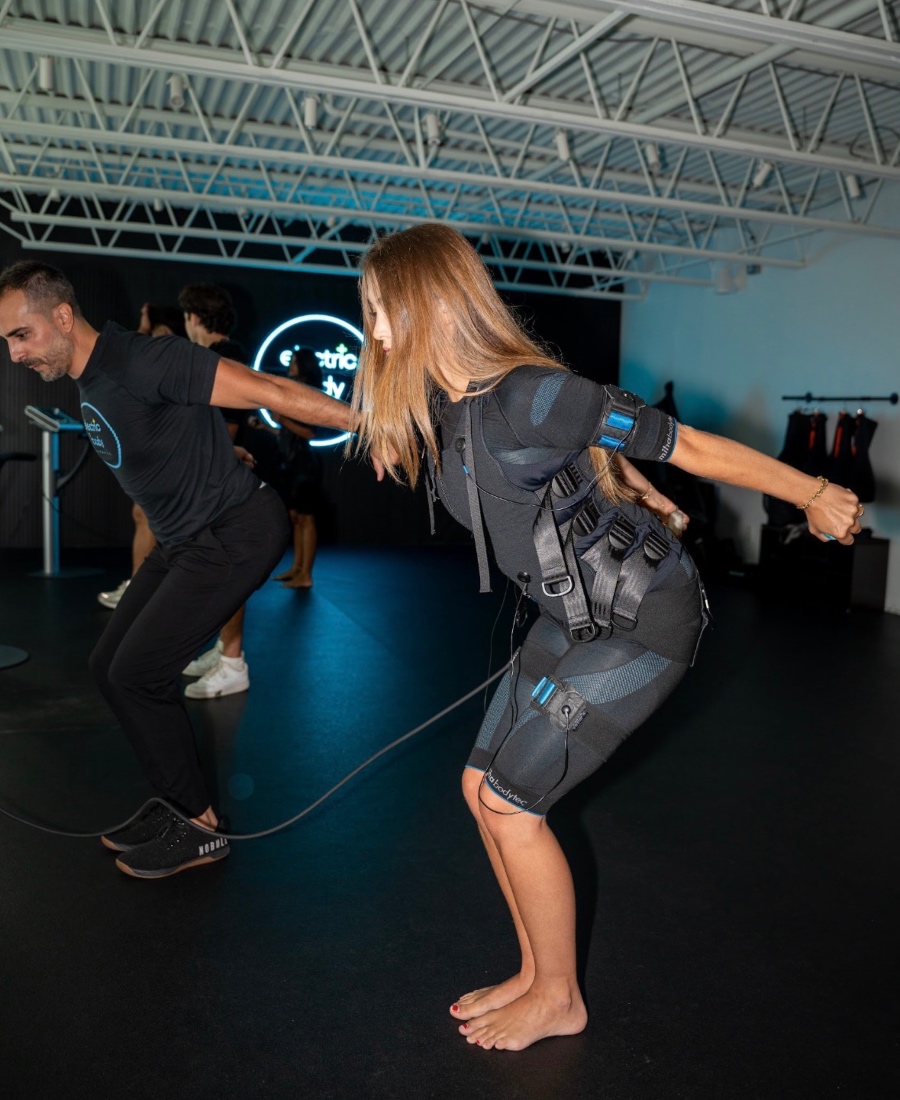
Then it was go-time again, with 10 to 12 repetitions of exercises targeting my legs, glutes, biceps, triceps, abs, chest, and back (think: bicep curls, standing crunches, and chest presses, all without weights). I was sweating a ton and couldn’t believe how challenging these movements were. My brain was telling me this should be a piece of cake. My muscles strongly disagreed. (EMS engages multiple muscle groups simultaneously, which adds to the intensity.) After about 12 minutes, I was done. The goal is a 20-minute session, but 12 felt like 112. I don’t know if I’ve ever been so excited for a workout to be over. I’m sure passersby could hear my little screams at the end of the driveway every time the EMS machine kicked in again.
But Caprarella was right: The training method is incredibly efficient. When I walked out of the garage, I felt like I had just spent several hours tackling a brutal strength-training session. And the soreness that followed over the next few days backed up that feeling. My legs felt like they had run a marathon. My triceps and abs were particularly sore because they’re smaller, more sensitive muscles. Those feelings lingered for days, and in some muscles, nearly a week — an unexpected takeaway considering I’d spent just 12 minutes doing low-impact exercises.
For people who want to build strength, but don’t want to spend hours at the gym, the appeal of EMS is obvious. The workout is quick and requires no weights, yet is surprisingly intense. But EMS is not for everyone, including those with acute illness or infection, pacemakers or other electrical implants, untreated hypertension, certain arrhythmias, severe bleeding disorders, and some neurologic or vascular conditions, as well as anyone who is pregnant or has had recent surgery. (There’s an increased risk of excessive muscle damage, including a life-threatening injury called rhabdomyolysis.)
While Caprarella and his team always collect a waiver, a review of health history, medications, injuries and physical limitations, fitness goals, and any possible contraindications are discussed before the session starts. Sometimes, medical clearance is required. Proper supervision, gradual progression, hydration before and after, and full recovery are particularly important when it comes to EMS training.
Would I put my muscles through the wringer again? Absolutely, although next time, I’d try to withstand the full 20 minutes. Once Caprarella brings the method closer to Philly — he has plans to do so! — don’t be shocked to hear I’m going to go get zapped for exercise.
Apparently, I’m into that now.
Electric Body Fitness has gyms in Ventnor City and on Long Island. A single EMS session starts at $150.