

Police Are Not the Answer at Devil’s Pool
If we really care about our environment, we should fund our parks and meet people where they are at.
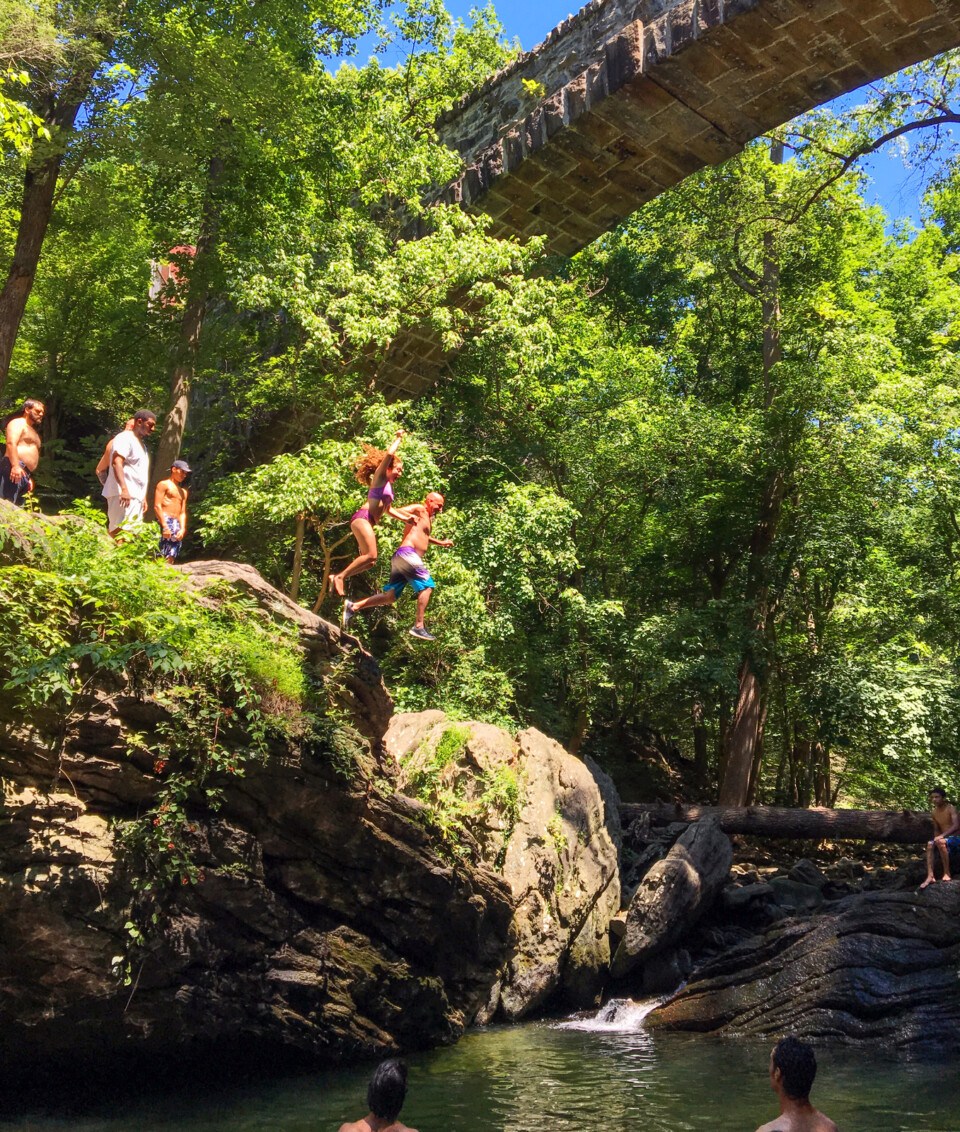
Devil’s Pool / Photograph by Bradley Maule
Summer is leaving us yet again in Philadelphia, and what parting gifts it has bestowed this year. Cool mornings, warm afternoons, balmy breezes in the evenings — weeks-long stretches of these glorious, goldilocks days.
On one such perfect afternoon, I paid a visit to the Wissahickon near Valley Green Inn, where I encountered a middle-aged man in the parking lot. He was holding a novel, staring at a map, and I asked if he needed help. He wanted to know where Devil’s Pool was, and I pointed out a trailhead nearby. He thanked me and disappeared around the bend.
A short time later, I found an idling Philadelphia Police Department SUV partially blocking that same trailhead. An officer was telling a teenager about the crackdown on swimming at Devil’s Pool, the result of an online petition calling for an end to the pollution, vandalism, and noise that hundreds of visitors bring to the site on any given summer’s day. The man from earlier had made his way to the other side of the creek, where he wandered a bit aimlessly, presumably put off by the police presence.
In the midst of all this, a pesky, intruding thought: I sometimes dip into the creek. Should I feel guilty? Or are we going about this wrong?
The answer: Philadelphia can do better.
Professionally, I’ve spent years reporting about water quality, recreation, and adjacent topics like environmental justice in Philadelphia. I’ve interviewed a lot of people on all sides of this. I’ve also spent much of my lifetime in the outdoors, learning how to swim and paddle and otherwise do my best to navigate the dangers inherent in being in and around open, moving water.
The person who made the petition and the 1,600 people who signed it strike me as well-meaning. Devil’s Pool is an ecological gem, the confluence of a creek and another creek, right out of fairy tale. It’s a bit of old magic in a digital world when precious little is left.
Devil’s Pool, and the wildlife that call it home, do not deserve graffiti, dirty diapers, broken glass, ash, and whatever else one can think of. The volunteers who show up day after day to haul all that crap out of there do not deserve the disrespect of such a Sisyphean burden. And this has all been going on long enough — newspaper archives date pollution concerns at Devil’s Pool to the 1880s, and more recent reports of recreational overuse to at least 1965.
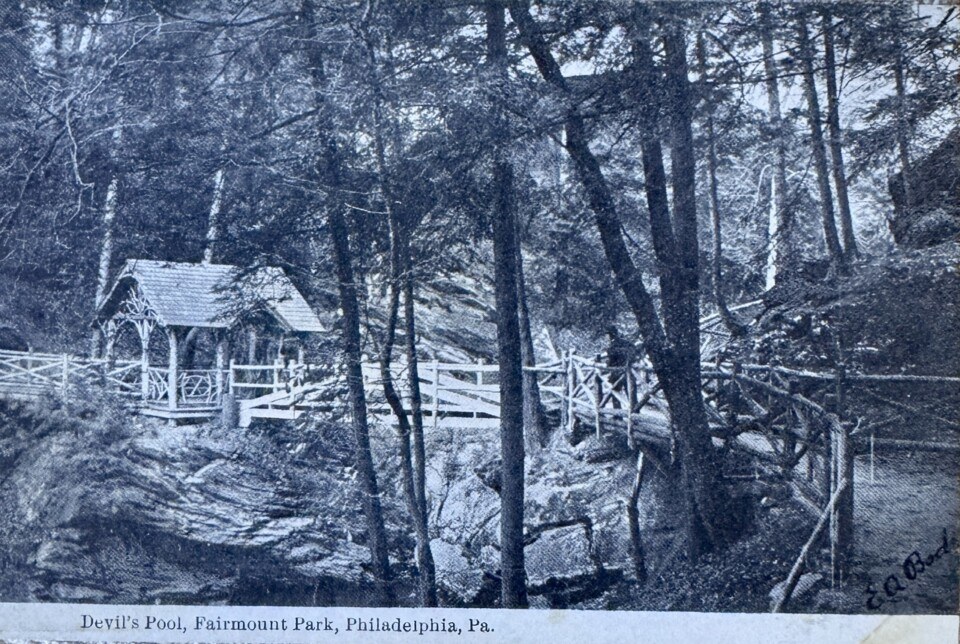
A vintage postcard shows that there were once visitor-friendly features at Devil’s Pool.
But, people — all people — deserve access to water. Have you been to Switzerland? They swim to work there. Never mind the Europeans, people swim in the Chicago River, and in Portland’s Willamette River. Even D.C. is getting close.
In Philadelphia, we used to do it all the time. Some couldn’t get enough. In 1920, Mayor J. Hampton Moore asked City Council for a quarter of a million dollars to build public bathing beaches “uptown, downtown, and on the Schuylkill, to give the children and adults who wish to wade and bathe a chance to do so.”
A quaint notion outgrown by a modern city? Philadelphia had 250,000 more people back then.
Here’s what actually happened: The rivers and creeks got filthy, so we walled them off and built swimming pools instead. Then, we forgot what it was like to wade into natural waters.
And here’s the truth: Philadelphia’s waterways are getting cleaner again, much cleaner than when we banned swimming 60 years ago. But our water quality still lags peer cities, largely due to an aging sewer system that overspills into the few rivers and creeks we have left.
The Wissahickon actually isn’t one of them. Contrary to urban legend, the creek isn’t subject to raw sewage. Sure enough, a good portion of its flow is treated water released from sewage plants upstream in Montgomery County. That’s a bit icky, but doesn’t present a public health threat.
The Wissahickon is subject to urban runoff, which is no joke: dog crap, fertilizers, motor oil. Typically though, that kind of pollution is very rain dependent, peaking in the days after a rainstorm then returning to baseline. Truthfully, we don’t have a good sense of where that baseline is. Official testing is nearly two decades old and the sporadic academic work conducted more recently suggests the Wissahickon is cleaner than many think. Indeed, perhaps even safe enough for swimming when the conditions are right.
So, once or twice a year during a run on a hot day, if it hasn’t rained, I’ll do a quick, gloriously refreshing wade, maybe even a float. I take a few precautions. No water around the face to reduce risk of infection, no sunscreen or bug spray (potential pollutants), and a thorough shower afterward at home. There’s still a risk, of course. But I also drive a car and eat oysters.
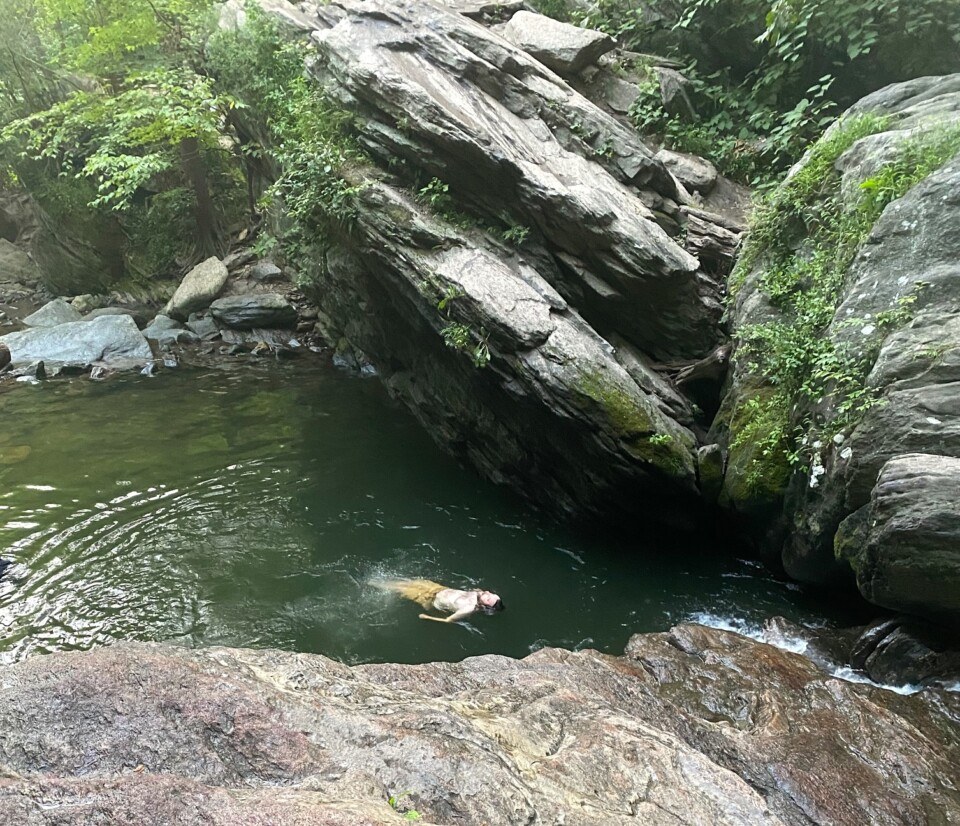
Enjoying Devil’s Pool, despite the risks, on an overcast summer day / Photograph by Liz Spikol
You can criticize me for those dips, but then you’ll have to contend with the swarms of anglers who legally wade into the creek each year during trout season, also at risk of drowning, and inevitably make contact with the water. They leave behind plastic fishing gear and sharp hooks wedged into bedrock and snagged on tree branches. You’ll also have to grapple with how many off-leash dogs inevitably poop in the park each year, almost certainly more than the humans at Devil’s Pool, probably by orders of magnitude. Speaking of, have you seen the horse poop?
So ask yourself: Why the petition to keep people out of Devil’s Pool, and not to ban anglers, dogs, or horses? Out of sight, out of mind? Public safety? Yeah, maybe.
This is perhaps getting adversarial, and it doesn’t need to be. Here’s my idea: Fund our parks and rivers, and shift our paradigm. As previously reported in Philadelphia, the city’s Parks & Recreation system is woefully underfunded. We need more public advocacy, and we need it to result in new, dedicated funding for our public spaces. The same can be said for the Philadelphia Water Department, the primary entity tasked with cleaning up our waterways.
In an encouraging note, the influential nonprofit Friends of the Wissahickon, while unequivocally urging people not to swim, recognizes that the problems at Devil’s Pool are caused by a confluence of factors that one silver bullet can’t solve.
“I see it as an inflection point,” executive director Sara Stevenson told me. “There are a lot of interconnected issues at Devil’s Pool, and I think an interdisciplinary approach is important to protecting and stewarding such an incredibly beautiful and special place.”
If Philadelphia can get more resources for its parks and waterways, it needn’t reinvent the wheel. Cities all over the world put lifeguards on lakes, rivers, and creeks. They also regularly test water to determine when it’s clean, and shut down recreation when it’s not. Commonsense infrastructure like trash receptacles, park rangers, and maybe even a bathroom could go a long way. Do that in four or five spots around Philadelphia and disburse the ecological burden more equitably. Enforce fines for littering and noise, with an option for the person to come back for a cleanup or environmental education class.
Again, where’s that petition? I’ll be the first to sign.
Maybe it’s a pipe dream. Certainly, it would take a lot of time and energy. Whether that’s worth it is a collective decision. Right now, something indeed needs to be done to protect Devil’s Pool, and calling in the police is the easiest bandaid to reach for. It will inevitably fall off.
And as it stands today, every time a kid from Camden or North Philly puts down their phone and comes to the Wissahickon, only to be ticketed or shooed away by police, it’s a lost opportunity to create an environmentally-conscious person, in a city and a world that desperately could use their help.