Is This Frigid Winter Harming Our Birds?
They’re tougher than they look — c’mon, this is Philly! But that doesn't mean they’ll all survive.
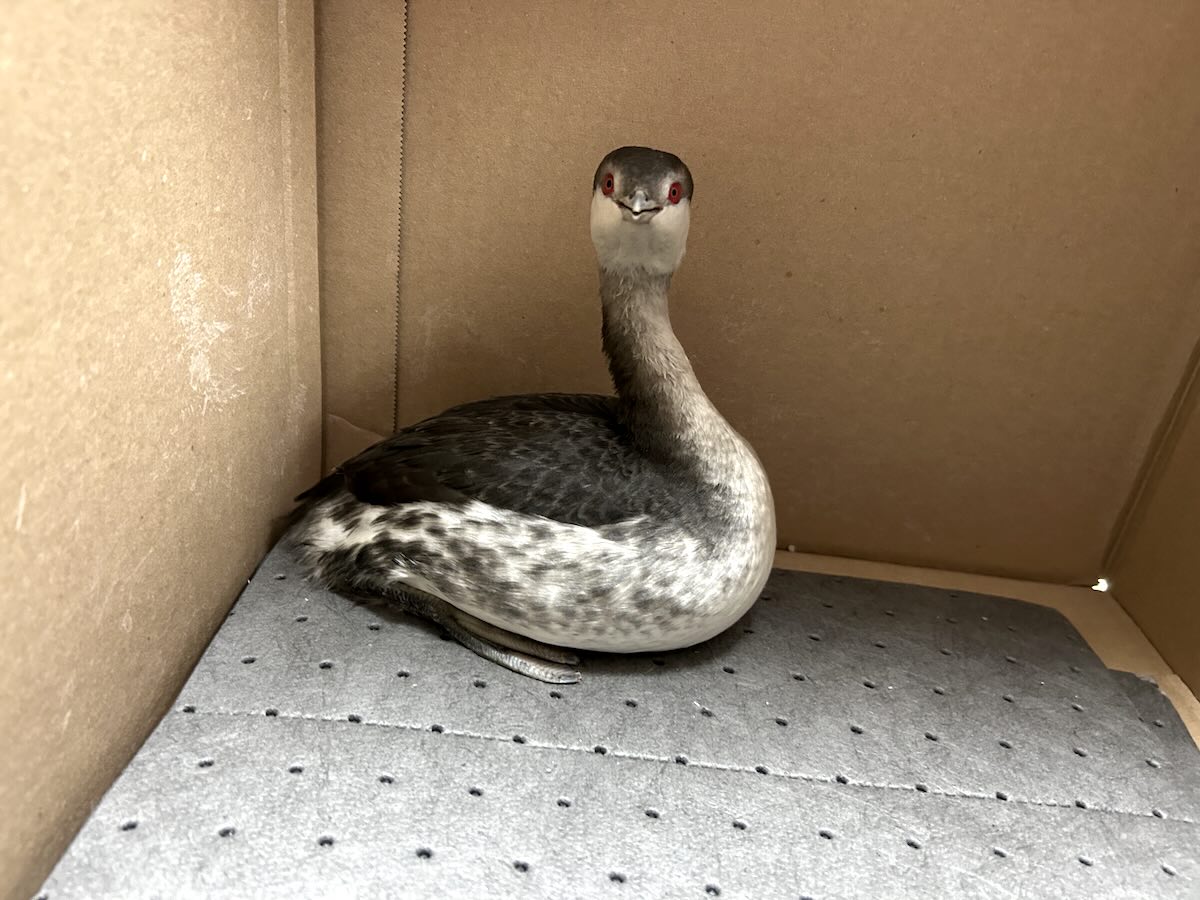
A rescued bird at the Schuylkill Center for Environmental Education after some crazy Philadelphia weather delivered lots of snow and ice last week / Photograph courtesy of Schuylkill Center for Environmental Education
We have a lovely neighbor named Carol out here on the fringes of West Philly. Whenever she makes a big pot of soup, Carol is sure to send some our way. She’s always sharing fresh baked goods with our kids. Carol is also generous with the neighborhood birds (we live close to the woods of Morris Park and have plenty of fauna afoot and above) and feeds them just as she feeds us.
This past Sunday, she began to feel concerned for her fine, feathered friends. She keeps a close eye on them, and noticed they had suddenly, drastically dwindled in number. “I am afraid they froze!” she said. “Where did this horrible Philadelphia weather come from?”
At first, I assumed that Carol was overreacting. After all, plenty of birds exist in super-cold climates. If an albatross and a kelp gull can thrive in Antarctica, surely Carol’s birds are fine, right? (This logic is why I am no ornithologist.)
Well, maybe, says Mae Axelrod, communications director for the Schuylkill Center for Environmental Education in Northwest Philadelphia. She points out that birds native to Philadelphia are, in general, capable of coping with the cold weather.
“Birds have evolved many unique adaptations that allow them to survive the harsh conditions of a brutal winter,” she told me earlier this week. “Birds have thick inner, downy feathers that trap warmth close to their bodies. The outer feathers are water-repellant and keep them dry. They also have very high metabolisms, which allow them to generate lots of body heat.”
Sure, but what about their feet and legs? They aren’t protected by feathers, downy or not.
“Birds have developed a way to pump more blood to the coldest parts of their bodies,” says Axelrod. “Countercurrent heat exchange is a thermoregulation system where warm blood flows downward to the feet. It pushes cold blood from the feet back up towards the body, where it can get warm again. This system prevents the limbs from freezing, even in the snow.”
Okay, phew! So Carol’s birds and all the other flyers in frigid Philly will be just fine?
Not so fast, says Axelrod’s colleague, Sydney Glisan, a former zookeeper and currently the director of the center’s Wildlife Clinic. She says that our harsh winter has indeed impacted area birds, though not in the way we might imagine.
“The clinic has admitted quite a few birds with head trauma,” she tells Philly Mag. She suspects the injuries were sustained when the birds were slammed into windows or other objects by the wind gusts of last week’s storm.
Plus, two horned grebes that usually call the Schuylkill Center home went missing.
She explains: “Over the years, horned grebes have adapted to live on the water. But when their water source freezes over, they face significant challenges. We suspect they went off course in the storm, could not find water, and got stuck on land.”
The problem with a horned grebe winding up on land, says Drexel University ornithologist Jason Weckstein, is that they can only take off from water. (Weckstein is also the guy you call when you find an unusual number of disembodied pigeons on the streets of Center City, it turns out.)
“When the lakes they are wintering on start to freeze up, they might fly away,” Weckstein says. “And as they are flying, they might see an ice-covered road, and mistake the shiny ice for the water of a lake and land there. But then they can’t fly away. That’s it.”
Weckstein says that these cold-weather problems are particularly evident right now at the Jersey Shore — Cape May, specifically. The American woodcocks that call the area home use their long bills to push through snow to the food that lies in the sand beneath. But our recent storm, which layered ice atop packed snow, did them in. Their bills simply couldn’t puncture the ice.
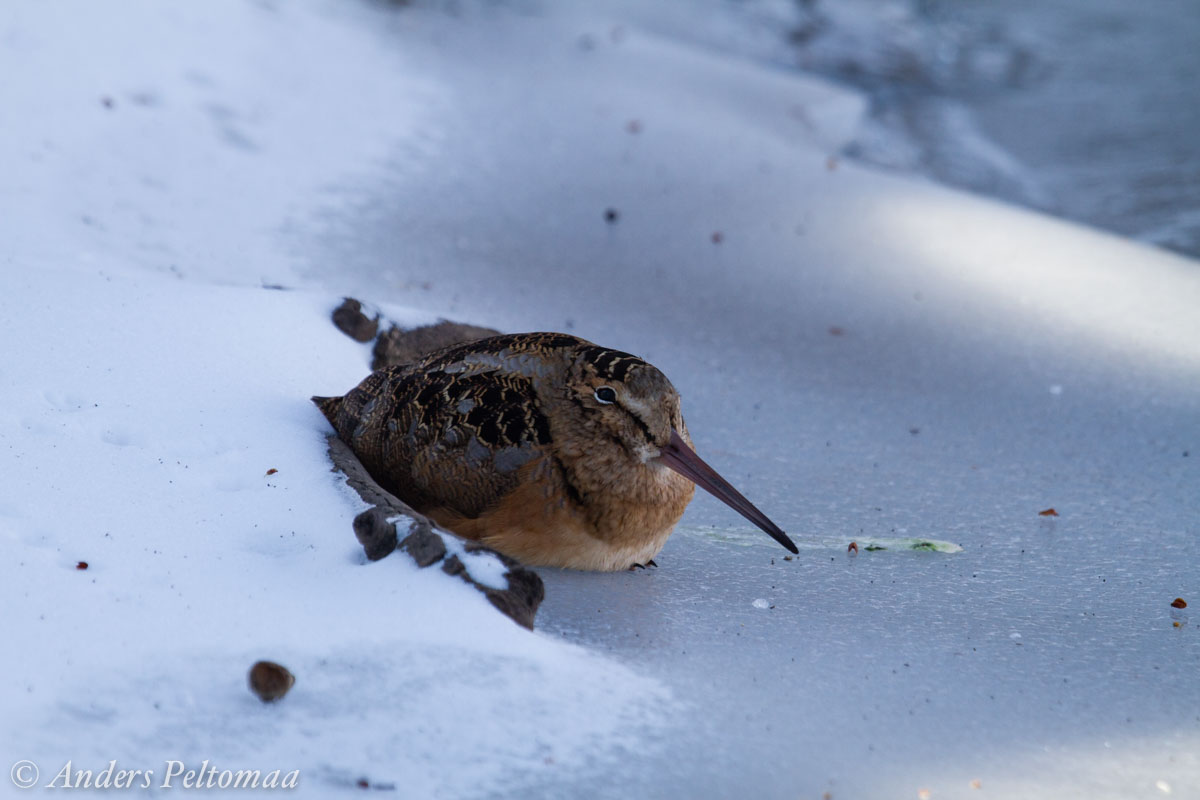
An American Woodcock in the snow / Photograph by Anders Peltomaa via Creative Commons/Flickr
“A lot of them have died as a result,” says Weckstein. “A large number.”
Land development has also made winter storms much more dangerous for birds, says the Schuylkill Center’s Glisan. As natural habitats disappear, off-course birds have fewer safe places to land, rest, or find food. “Storms have a larger impact on birds because of it,” she says. “As wild spaces are developed, animals are in danger of wandering further out of their typical range and risk getting hit by a car or simply not finding the habitat they need to survive. Injured animals are more likely to succumb if they are cold.”
How You Can Help
Here are some things that worried bird lovers like Carol can do to keep our birds safe until this blasted Philadelphia winter weather is over – and after as well.
- If you have a bird feeder, remember to keep it filled — but also clean. All the snow on the ground makes it hard for birds to forage, so your backyard bird feeder is more important than ever. “However, we encourage caution when using feeders at this time of year,” Glisan advises. “They can attract wildlife that may not normally associate with birds, which can lead to the spread of diseases.” So keep those feeders clean.
- Plant native species where you can. “And encourage the planting of native species in our public and nature preserves,” says Glisan. Our native birds and native plants have evolved together, so the birds are best adapted to survive the winter with those native plants for food. “While plants such as coneflowers may be long past their bloom time in February,” explains Axelrod, “their seeds are a popular food source for American goldfinches. In the cold weather, birds are using more energy to stay warm. Having access to the food they evolved to eat gives them a better chance for survival.”
- When you hear about wild spaces being developed, keep all of this in mind and act — by voting, protesting, and advocating accordingly. Go, birds!