
Where Is the Constitution Center When We Need It?
Jeffrey Rosen is out. Now the institution must decide whether it will remain a quiet, genteel place of scholarship or actually take on the current threats to democracy.
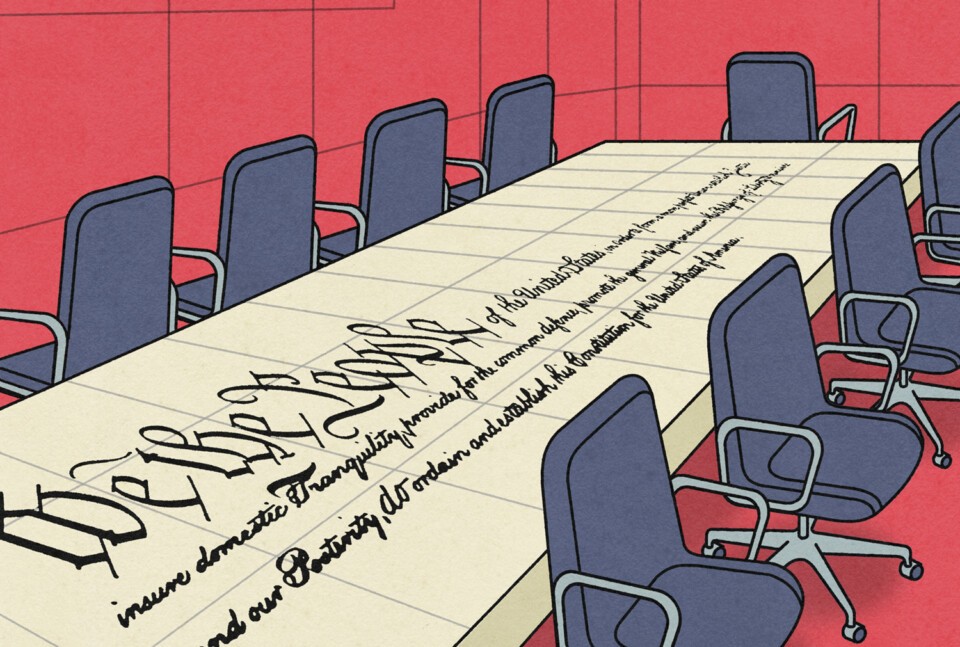
Where have you gone, National Constitution Center? / Illustration by Dan Page
Listen to the audio edition here:
In January, as 10 masked federal ICE agents maced and then fatally shot protester Alex Pretti on a frigid Minnesota street, here’s what the National Constitution Center, Philadelphia’s shrine to the values of freedom and liberty, posted on X:
Matthew Continetti of @AEI explains the emergence of conservatism in American [sic] following President Franklin Roosevelt’s New Deal.
Accompanying the post was a short video clip of the baby-faced conservative thinker.
Within a few hours, Stephen Miller was calling Pretti — an ICU nurse with no criminal record — a “domestic terrorist” who “tried to assassinate law enforcement,” while Kristi Noem was characterizing Pretti’s actions as “the definition of domestic terrorism.” In a matter of days, video proof would expose these lies. But at the time, here’s what the National Constitution Center posted:
#OnThisDay in 1979, Vice President Nelson Rockefeller dies. Hear historian Richard Norton Smith discuss the legacy of this politician’s unique position as a liberal Republican in mid-century America.
For many of us who love the Constitution and have long been inspired by the National Constitution Center, reading those posts was a gut punch. It is not partisan to speak that which is plainly obvious: When citizens of color on our streets must routinely produce their papers for masked lawmen, as in Minnesota of late, we have become Soweto in the ’60s.
The Constitution is under assault. That the National Constitution Center has not been shouting so — that it has not only declined to lead on the essential questions of our day but has essentially absented itself from the debate — is to fail at meeting this moment.
But that could change. As you might have read back in January in the New York Times, the Center has just undergone a contentious change in leadership. After 12 years, CEO and president Jeffrey Rosen is out. Trustee Judge Michael Luttig — a prominent conservative Trump critic and Rosen supporter — has stepped down from the board in protest over the change, even threatening to sue the institution.
Yes, it is another board seeming to have a nervous breakdown, as we’ve seen at the Philadelphia Art Museum, the University of the Arts, the Pennsylvania Academy of the Fine Arts, and Community College of Philadelphia. But put that aside; there is something unique about the context the NCC finds itself in. Here lies opportunity, if the boldface names on the NCC board recognize that the story isn’t about who runs the place, but about what the institution stands for.
This is not a new question for the NCC; current events just give it added urgency. Way back in 2011 — two years after the Center had featured a Lady Di exhibition and a year before one on Bruce Springsteen — the Center’s founding chairman, Ted Wolf, worried that the institution was slipping into irrelevance. He told Philly Mag it was “getting, not too conservative politically, but conservative risk-wise. There should be more involvement in some of the more dangerous, controversial matters. The Constitution Center should become involved and get its hands dirty a little bit and take some risks.”
Rosen is an intellectual giant whose books and reverence for Madisonian reasonableness make eggheads like yours truly swoon. But we’re the already converted. In the last year, as the Trump administration has sought retaliation against its critics, defied court orders, bypassed Senate confirmations, impounded congressionally appropriated funds, trampled due process in immigration, and more than chipped away at long-established free speech rights, the NCC has seemed thoughtfully bemused — willing, perhaps, to write a strongly worded letter if the mood struck.
It has become driven more by the head than the heart, not, in the words of founding CEO Joe Torsella at its 2003 opening, a place where you “enter as a visitor and leave as a citizen.”
Case in point: Gone from the NCC’s wall is this quote from federal Judge Learned Hand, which speaks to the spirit of our experiment better than any white paper ever could:
I often wonder whether we do not rest our hopes too much upon constitutions, upon laws and upon courts. These are false hopes; believe me, these are false hopes. Liberty lies in the hearts of men and women; when it dies there, no constitution, no law, no court can even do much to help it. While it lies there it needs no constitution, no law, no court to save it.
This is what Torsella meant when he suggested that, as originally proposed by then-Mayor Ed Rendell, the Center’s mission was to create citizens. The museum was designed to tell us a story, yes, but then shift the onus back onto us. Sure, having folks affix their signatures to the Constitution — or not — at the end of the Signers’ Hall tour could be seen as gimmicky. But it also asked of us: What would you do? If the vast majority of your neighbors were loyal to the crown, would you be a revolutionary? Would you face death for an idea? Perhaps confronting us with those questions might steel us for this moment, no?
If you’re not built for this moment, please tear the building down and put up a Wendy’s.” — Constitution Center founding CEO Joe Torsella
In February, the Center unveiled its new permanent exhibition, “America’s Founding,” which it describes as “a dynamic, interactive exploration of the American Revolution and the creation of the Constitution and Bill of Rights.” Sounds a little like Ken Burns for museum lovers, doesn’t it? Irony of ironies: It’s a Rosen and Luttig joint, and they’re both now outta there.
I am hopeful that it will be more than a scholarly recitation of facts, that it will be, instead, something that awakens the civic soul resting in each of us. That’s what my frequent jaunts to 6th and Arch in the mid-aughts used to do; I’d go just to watch Freedom Rising, the 17-minute, 360-degree theatrical experience that never fails to make me tear up.
It makes you realize there really is this thing called American exceptionalism, but it is by no means inevitable; it is built on the blood of patriots, a birthright we must actively claim.
That’s why the National Constitution Center ought to embrace being the antidote to what ails democracy right now. That might require some reputational risk from some on its board — a fraction of what the actual Founders put on the line.
I reached out to Torsella, the former Rhodes Scholar and state treasurer turned aspiring thespian. He’s had two stints as CEO, and he laughed when I asked if he was contemplating putting the band back together again. “No U.S. president [since FDR] has served three terms,” he said, before pausing. “Uh, yet.” He expressed his admiration for Rosen’s 12-year run but indulged my hypothetical: If he were CEO, what’s the first thing he’d do?
“I’d hold a press conference and say publicly to the slavery exhibit at Washington’s President’s House that you are homeless no more,” Torsella said. “You now have a home at the National Constitution Center.”
The purpose, he was quick to add, would not be to tussle with Trump. “But if you’re not built for this moment, please tear the building down and put up a Wendy’s,” he said.
I originally called Torsella because I thought I’d come up with a list of CEO candidates. In the scholar realm, for example, there’s Judge Michael McConnell, director of the Stanford Constitutional Law Center at Stanford Law School. He’s an impeccable jurist — impossible to pigeonhole. He once signed a petition for a constitutional amendment to ban abortion, but he’s also argued that the Supreme Court’s Brown v. Board of Ed ruling was decided in accordance with “originalism” — the Framers’ explicit intent. He lambasted the Supremes over Bush v. Gore and last year authored an influential amicus brief challenging Trump’s constitutional power to tariff.
Then there’s NYU law professor Melissa Murray, a frequent commentator on MS NOW, who, along with the more conservative but no less qualified Ilya Shapiro, was part of the NCC’s really cool Constitution Drafting Project, which featured three groups of scholars — conservative, progressive, and libertarian — tasked with drafting their ideal constitutions. (The kicker? It was funded by none other than the Keystone State’s own Darth Vader, the ever-surprising Jeff Yass.) Other names come to mind too. How cool would it be for Liz Cheney to be named CEO or at least given a board seat? That would certainly send a message that the constitutional game knows no team color.
But Torsella persuaded me that it doesn’t matter who is in charge, so long as the institution rises to the occasion, takes some risks, and dedicates itself to defending the document. It is not partisan, after all, to merely call out the fact that the Reichstag is burning.
What would that look like? Maybe, rather than the Liberty Medal being bestowed upon Hamilton biographer Ron Chernow and the cast of the Broadway play — as if long-held constitutional norms are not imperiled — it should go to those in the trenches. Imagine honoring, say, Lisa Cook, the Federal Reserve governor who has refused to succumb to bullying; or CHOP’s Paul Offit, who won’t stop speaking truth to Kennedy; or Rachel Cohen, the young associate pulling in $300,000 per year at the prestigious Skadden, Arps law firm who resigned in protest when her bosses succumbed to administration shakedowns and went on to work with a boutique firm fighting governmental overreach; or Jamie Green, the queer, progressive caseworker at a St. Louis transgender care center who blew the whistle on her employer’s treatment of kids suffering from gender dysphoria. All of these awardees would have their naysayers, which would kind of be the point. The only speech worth having is that which others are moved to answer.
Most of all, rethinking the Constitution Center’s mission would mean appealing not just to reason, but to our shared sense of emotion. You know who gets that distinction? Musicians. When I want to feel better? I stop thinking and flip on a little Al Green or Sly Stone. Which brings us to the 2007 Liberty Medal ceremony on the lawn outside the Constitution Center. That year’s recipient, rocker and activist Bono, delivered a speech that was, by turns, bawdy, mischievous, and as patriotic as anything an international rock icon from Dublin has ever conveyed. The 2,500 people in attendance that night walked away marveling at this miracle called democracy because Paul David Hewson had just recited a tone poem that went straight to their gut.
“Let me set my foot here, and say to you tonight this is my country,” he said. “Let me say, with humility and pride in my own country, that anyone who has a stake in liberty has a stake in the United States of America. For all that you’ve been through — good and bad — this is my country, too.”
And then he did something the board of the National Constitution Center and its next CEO ought to think about emulating. He wasn’t afraid of pissing anyone off, and he challenged a diverse group to rally around a common purpose. He referenced the last paragraph of the Declaration of Independence: “And for the support of this Declaration, with a firm reliance on the protection of divine Providence, we mutually pledge to each other our Lives, our Fortunes and our sacred Honor.”
You don’t hear phrases like “sacred honor” much anymore, do you? Nor do we often face the stakes the Founders confronted; they knew they were committing treason. Yet they pledged their loyalty to one another and the cause of freedom. That night, with two former presidents — Clinton and Bush the elder — seated behind him, the rock star offered an object lesson for the very institution honoring him.
“What, then, about you and me?” Bono said. “What are we ready to pledge?”
Published as “Uh … Hello? Constitution Center?” in the March 2026 issue of Philadelphia magazine.