Frank Rizzo Supporters Can’t Find Someone Willing to Fix the Statue
So says the prominent attorney representing the group that now owns the controversial bronze, which was damaged when the city hastily removed it.

The Frank Rizzo statue in Philadelphia prior to its removal and the lawsuit that followed (Getty Images)
It’s been more than five years since Jim Kenney ordered workers to rip down the Frank Rizzo statue from its longtime home outside the Municipal Services Building under the cover of night amid widespread civil unrest, thus sparking a legal battle between the city and Rizzo advocates represented by prominent attorney George Bochetto (who is also a founding donor of Citizen Media Group, Philly Mag’s parent company). The Frank Rizzo Monument Committee, which donated the statue to Philly in 1998 after fundraising and commissioning it, sued the city a month after its removal, arguing that Kenney was wrong to jettison the statue and demanding its return to the group.
The supporters won that battle, and the city transferred ownership to them in August. The agreement was that Philadelphia would pay to repair the statue, which was damaged in the removal process, and then the supporters would find a new home for the 10-foot-tall bronze. There’s just one problem: finding a foundry in the area to fix the statue has turned out to be no easy task.
“They don’t want to touch it,” says Bochetto. “We went to one foundry, and they said they wouldn’t go near it. Second one, same story. And then a third. The artistic community has put the word out there that no foundry should repair it.”
Rizzo, for the uninitiated, served as the city’s police commissioner from 1967 to 1971 and then mayor from 1972 to 1980. He died in 1991. A hero to many, he was a villain to others who considered him a symbol of racism and police brutality. The statue representing him was first vandalized in 2017. Then, in 2019, someone painted the word “fascist” across it. And after the murder of George Floyd in May 2020, the monument became the object of endless vandalism, protests, and vitriol, leading Kenney to issue the removal order. (“I never liked the statue,” Kenney said in the days that followed. “And I didn’t put it there.”)
Bochetto says he expects the fixes to the statue today to cost upwards of $75,000; the city has already placed money in an escrow account. But those funds don’t mean much if there’s no one who will accept the job.
Xenos Frudakis, the Glenside-based artist who sculpted the piece, isn’t equipped with a foundry capable of completing the repairs demanded. He says he’s heard the buzz and understands why foundries are reluctant to get involved.
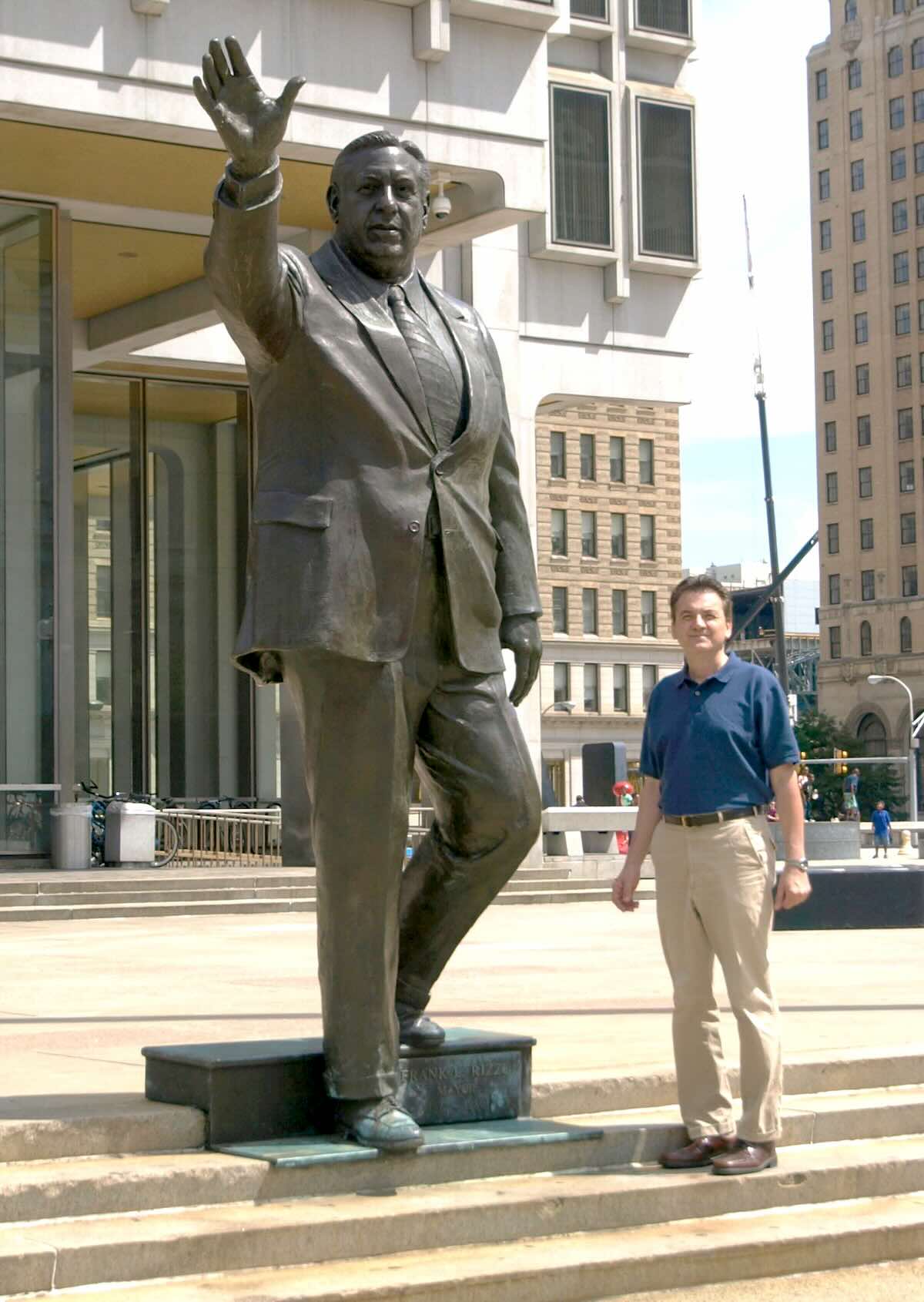
Xenos Frudakis with the Frank Rizzo statue he created (photo via Wikimedia Commons)
“It’s easily the most controversial statue I’ve ever made,” he observes. “And these days, people are crazy. Someone finds out that a foundry is working on it, are they going to vandalize it, burn it down? We live in an age where someone will show up with a gun at a pizza shop because they read on the internet that children are being held captive there.”
Frudakis thinks he does have the solution, though: Just don’t repair it. “The damage is part of the statue’s history,” he argues. “The Japanese have an art of repairing cracked pottery with gold to highlight the cracks and showcase the history. Not try to eliminate it.”
In an interview with Philly Mag prior to the statue’s removal in 2020, Frudakis argued that nixing the statue wasn’t the right thing to do. His idea was to put up a plaque adding context that explained Rizzo’s complicated and polarizing legacy and add a “contrasting” statue that would “redefine” the Rizzo statue in that space. He offered up Leon Sullivan, the Black civil rights leader and anti-apartheid activist who was prominent in Philadelphia at the same time as Rizzo, as a subject.
Bochetto believes that the group will eventually find a foundry that wants the money and isn’t afraid of being associated with the lightning-rod piece of art. Once that happens, the commission, which includes such Democratic political luminaries as Bob Brady and John Street, has to figure out where to stick the thing. The agreement between the city and the commission reportedly held that the statue could only be displayed on private property and behind a wall, so it cannot be seen by passersby. But Bochetto says that’s not quite right.
“Actually, we think it can be in public view,” he told me in an interview that appears in the November issue of Philly Mag. “It will have a very prominent, appropriate setting.” He hinted that Oregon Avenue’s Marconi Plaza, home to the other controversial sculpture Bochetto saved — a monument honoring Christopher Columbus — could be the Rizzo statue’s final resting place.