
Popular Delco Restaurant Closing One Year After Gordon Ramsay Came to “Help”
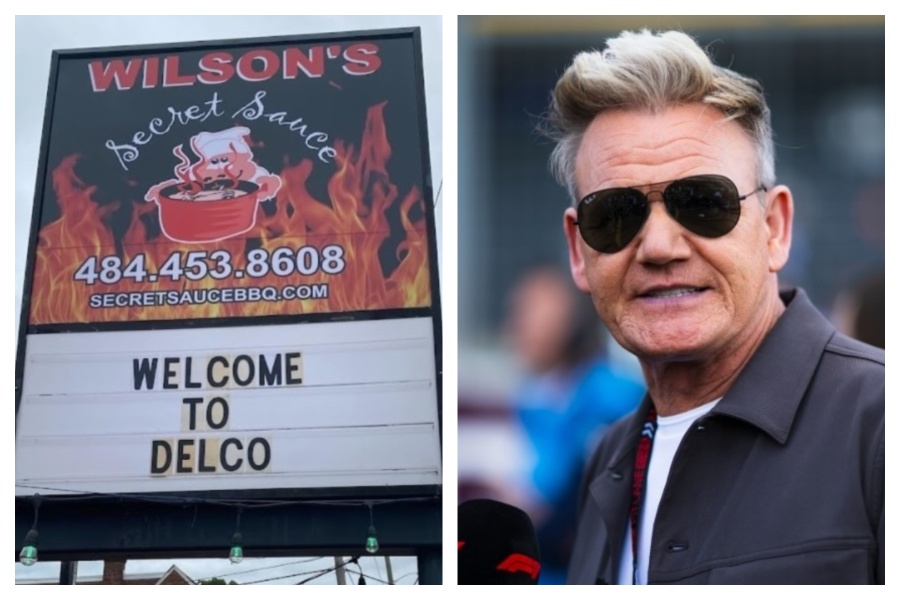
A sign at Wilson’s Secret Sauce barbecue restaurant in Upper Darby, which appeared on the Fox series Gordon Ramsay’s Secret Service. / Wilson’s Secret Sauce photograph, provided; Gordon Ramsay photograph via Getty
This time last year, Delco was all a-twitter after a resident spotted celebrity chef Gordon Ramsay walking down the street in Upper Darby. It turned out he was here to “save” popular Best of Philly-winning barbecue joint Wilson’s Secret Sauce via a new Fox show, Gordon Ramsay’s Secret Service, which was all about “America’s filthiest restaurants.” (Wilson’s turned out to be not the least bit filthy.)
One year later, after Ramsay exited the premises, Wilson’s Secret Sauce is closing its sit-down restaurant – just like Philly restaurants Zocalo and the Hot Potato Cafe closed not long after getting the Gordon Ramsay treatment years ago — and selling their building. Here, husband-and-wife team Steve and Kelly Wilson talk about their experience living through a restaurant “reality” show and what’s next for them.
Steve Wilson: I was a mechanic for many years and started smoking ribs and brisket on the side as a hobby. Garry Maddox used to have a big barbecue competition down at the ballpark, and we entered and took first in chicken and second in ribs a couple of times. This evolved into doing a bit of catering, which grew quickly to the point where we couldn’t do it out of our house.
The location you chose on Township Line Road has always seemed like a doomed address to me. Before you, nothing really took off there.
SW: Yes, it was an Indian place, it was a crab cake place, it was something else — I think a pizza place? This guy I bowled with owned the building, and he convinced me to sign a lease. Then COVID hit, and banks were like, “You really want to buy real estate right now? Sure, here’s a mortgage.” So we bought the building.
Do you regret buying it?
SW: Not at all. We’re going to set up a ghost kitchen in Delco – we have a friend who wants to open a bakery but doesn’t want to commit to her own space yet — so we can share that and just concentrate on the catering.
Why sell the sit-down spot in the first place, though?
SW: Our son is 13. He’s wrestling and playing football, and if we keep the restaurant, we’re going to miss out on so many things. Plus, it’s hard to keep staff there. It’s hard to bring in tables if I don’t have waitresses, and it’s hard to bring in waitresses without tables. And our dynamic is really about catering and events. We’re also selling it for more than we bought it for.
That’s always a good thing. So … Gordon Ramsay.
Kelly Wilson [joining the call as she’s getting her kids off to school]: Hi, Victor. It’s Kelly. Do you want my opinion or Steve’s?
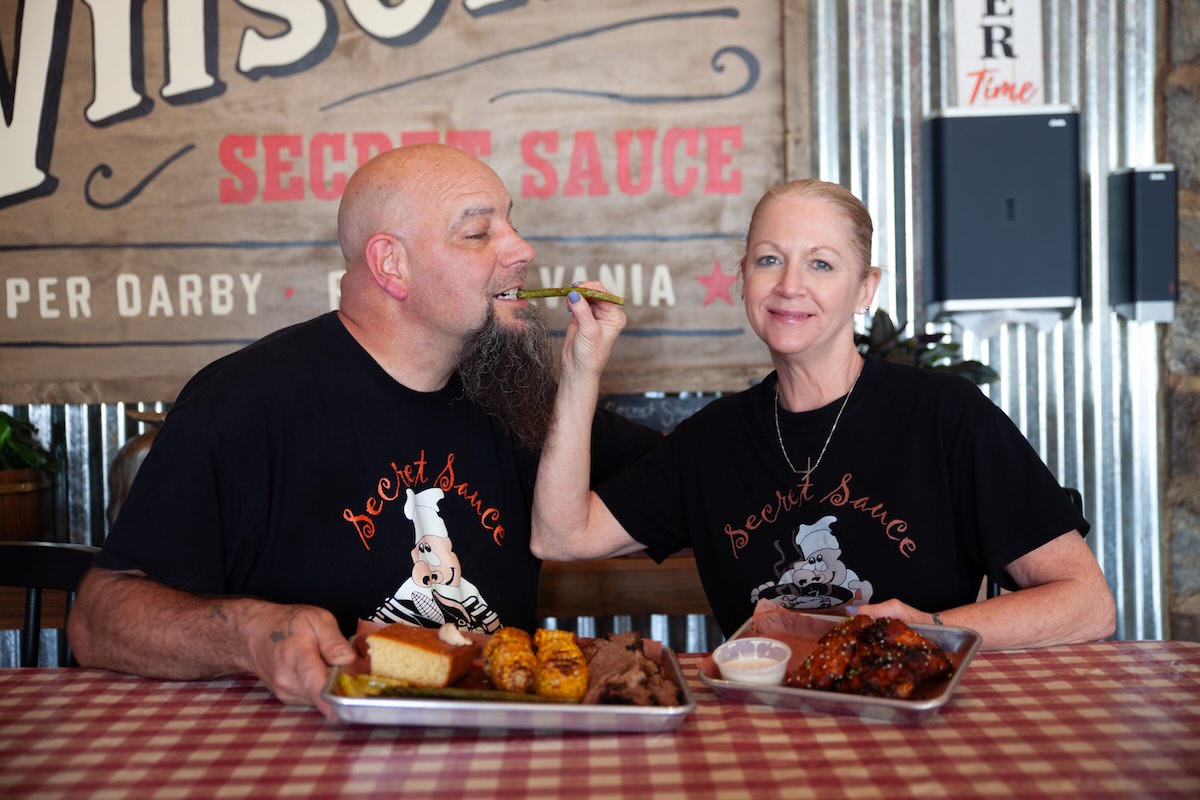
Steve and Kelly Wilson inside Wilson’s Secret Sauce in Upper Darby the week before the Gordon Ramsay’s Secret Service about them aired / Photograph by Kae Lani Palmisano
Go for it, Kelly!
SW: Just remember … It’s going down on paper!
KW: I mean, it’s not that I don’t appreciate some of the advice that he gave us. I’m sure it helped with some things. But business actually slowed down a bit since he came in.
Wow. I didn’t expect you to say that. I know the dining room isn’t often crowded when I come in, but you seem to do a heck of a lot of catering and takeout.
SW: When I look back at it and look at, “Are you still climbing, are you staying the same, or are you going backwards?” I have to say that last year was the first year that we went down year-to-year.
KW: Gordon Ramsay changed the menu. I didn’t feel like his menu … We had a lot of customers coming in from day one of the new menu begging us to bring the old menu back. We were getting lost with his menu, and our menu really worked a lot better.
SW: We had a lot of things on our menu, yes, and that drove Gordon crazy. But the thing is, our menu was just a combination of things we had in-house. We weren’t bringing in one thing to create some new dish. We are looking at a case of chickens and figuring out what new and different thing we could do with those chickens. But I think that overall, working with Gordon Ramsay was a great reality check, more than anything else. Some of the show was a little humiliating and I could have used more of a hand in the back office and less in the kitchen, but …
One of the things that came out in the show was that you are in debt for more than $600,000.
SW: Yeah, that sounds like a lot. But really, almost all of that is just two mortgages: one on our house in Havertown, and one on the restaurant. And the house and the restaurant are both worth the same amount of money or more than what we paid for them, and now we are getting out from under the restaurant. So it’s okay.
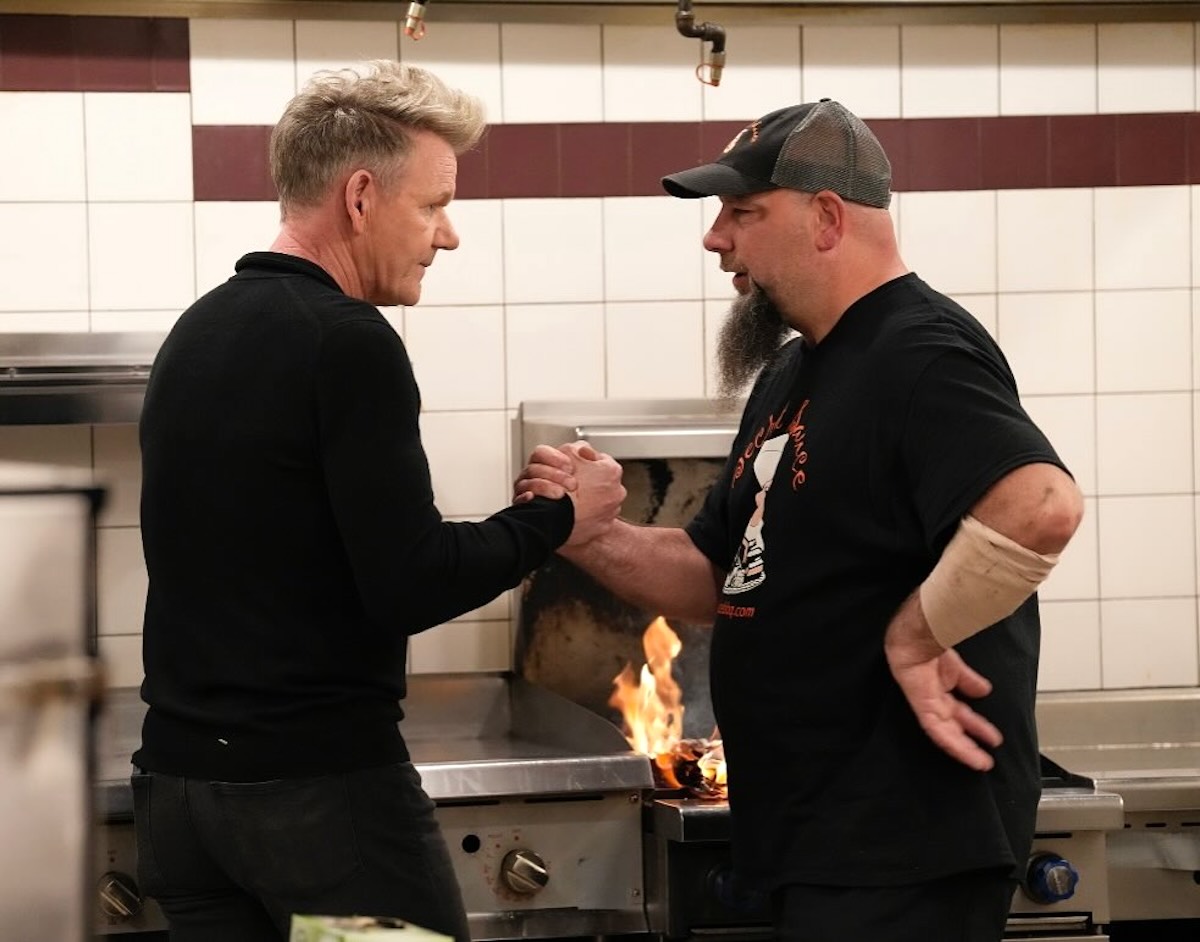
Gordon Ramsay with Wilson’s Secret Sauce owner and chef Steve Wilson in Upper Darby during the shooting of Gordon Ramsay’s Secret Service / Photograph via Fox
You mentioned being humiliated on the show.
SW: So, they basically kick you out of your restaurant. They showed up on a Friday and we had to hand over our keys and leave, and then they go in with Gordon and their cameras. So they show brisket in our walk-in, and they say, “Oh my God, they are going to reheat that brisket.” But that brisket was actually from that day and it was supposed to go to Barnaby’s in Havertown and the Greeks in Narberth. I wholesale my brisket out to them and they turn it into cheesesteak specials or quesadillas or tacos. And then, if you watch the episode, they’re watching us cook and saying, “Oh my God, he’s going to throw those burnt ends into the fryer.” They weren’t burnt ends at all. They were chicken wings.
My impression is that, at first, you didn’t realize any of this had anything to do with Gordon Ramsay.
SW: We weren’t approached by Gordon Ramsay or his people. We were approached by a network that said, “Hey, you want a makeover?”
Right, I saw that a restaurant in Rhode Island had complained that they were sold on this idea of getting a fresh new look for their restaurant, and nothing about Gordon Ramsay going undercover with infrared cameras in the middle of the night.
KW: No, they kind of tricked you about that!
SW: Well, they didn’t tell you exactly what the premise was. I wouldn’t say we were “tricked.”
But then the trailer comes out for the new series and they say it’s all about “America’s filthiest restaurants.” I can’t imagine how nervous that must have made you.
KW: I got really upset because, first of all, I take pride in keeping this restaurant clean and immaculate. I don’t want people to be skeeved touching things, to be grossed out because things are dirty and sticky. So it’s actually extremely clean.
SW: I think the production team was actually shocked they were here for the show, based on how clean the restaurant was.
KW: They really didn’t do much. The show was originally supposed to be a makeover show. They put some fresh paint up and changed the curtains and put plastic tablecloths down. We didn’t get a whole lot of new stuff like the restaurants in the other episodes.
Steve, you and I recently had a conversation about the cost of goods, where you were complaining that the price of a case of corn just went from $18 to $58. And I get that. But I also feel like there are some restaurants out there charging COVID pricing just because people are used to paying for it. I’m not going to name the spot, but I recently got a barely mediocre cheese pizza from a place in Delco, and it was more than $30 for a large pepperoni. So you’ve got some flour, some water, some low-quality cheese, and some low-quality pepperoni.
SW: Well, but you also have to keep in mind that a lot of places are paying people a much better hourly wage, because people won’t work for minimum wage anymore, in many cases. So, sure, that pizza might only cost them however much to make — but what about payroll and other overhead like rising utility costs, what about insurance that goes up and up every year? The cost of those pizza boxes went up.
KW: Well, hold on now. I do feel like there are businesses out there definitely taking advantage, like they just know people are going to pay, so they might as well just keep it that way. But Steve and I, we adjust our menu regularly. Our rib costs go up and down, so they go up and down on the menu. We were at $32 a rack, and now we’re at $28.
So you’ve opened a restaurant and now you are closing one. What advice do you have to people out there who say they want to open their own restaurant?
SW: I tell people all the time, if you are going to own your own business, whether it’s a restaurant or not, you have to own the real estate. If you don’t own, you’re just paying rent with nothing to show for it. If you buy and have a mortgage, you have that property to fall back on. You don’t want a landlord. You’re at the mercy of whatever the rent’s gonna be. Sure, you might have the benefit of more foot traffic in a mall or at a strip mall, but you’re going to get clobbered in every other way.
Kelly?
KW: [pauses] I would definitely find a mentor. Follow somebody around. Really look into it because there’s a lot more involved than you would think. Steve and I literally had to learn everything along the way. Be prepared to, if you have kids, you’re not going to see them a lot. It’s hard. [pauses]
SW: Hon, don’t cry,
KW: You miss a lot along the way. You miss weddings. And funerals. You miss your kids’ games. You miss your kids’ concerts.
I wish you a lot of luck.
SW and KW: Thank you.
Ask Dr. Mike: Why Is It So Hard to Get Men to Go to the Doctor?

Mike Cirigliano, aka Penn’s Dr. Mike, explains why men are so reluctant to go to the doctor.
Meet internal medicine physician Michael Cirigliano, affectionately known as “Dr. Mike” to not only his 2,000 patients, who love his unfussy brilliance, tenacity, humor, and warmth (he’s a hugger!), but also to viewers of FOX 29’s Good Day Philadelphia, where he’s been a long-time contributor. For 32 years, he’s been on the faculty at Penn, where he trained. And he’s been named a Philadelphia magazine Top Doc every year since 2008. Now, he’s our in-house doc for the questions you’ve been itching (perhaps literally) to ask a medical expert who’ll answer in words you actually understand. Got a doozy for him? Ask Dr. Mike at lbrzyski@phillymag.com.
When I saw the topic for this week’s Ask Dr. Mike, I knew I had to be the one to do the interview. You’ve been my primary care doc for the better part of two decades, so you know just how reluctant I am to come in for my annual. As a man, I’m not unusual in that sense, right?
Not at all. Women see a doctor about two times more than men do, and this is especially the case with younger men. You know – they feel healthy. They’re invincible! They’re tough! They can handle it! Plus, there’s historically been so much cultural stuff that men absorb from society like — well, you’re a guy, you know it — “There’s no crying in baseball. Suck it up.”
Why else might men avoid the doctor?
Sometimes, they feel uncomfortable with an opposite-sex physician. Like, “Boy, do I really need to tell her that my junk is not working?” Plus, people are busy, they’re working hard, so they’re like, “I have no time to see a doctor.”
If I psychoanalyze myself, I’d have to say I avoid doctor visits because I don’t want to hear bad news. This makes no sense, of course, because it’s better to find something bad today than two years from now.
Early is better! But, yes, a lot of studies show that guys are very, very afraid of the unknown. They’re afraid of what they might hear and just don’t want to hear it. That’s a problem, especially when it comes to something like colon cancer, which is now impacting more younger people than ever. The phenomenon is frightening. We now recommend that colon-cancer screening beginning at age 45 (it used to be 50). So you’ve got to get to the doctor for regular checkups, and you also have to tell us immediately if you’re having blood in the stools, for instance.
I would hope that somebody finding blood in their poop would call their doctor right away.
Well, you might think it’s just hemorrhoids — you know, that it’s nothing.
Many men are averse to the idea of a colonoscopy, as am I. For me, though, it’s not so much about “don’t touch my butt” as it is about the fear of being put under. So your office sent me a little kit where I could collect a stool sample at home and mail it to the lab. But is this test just as good as a colonoscopy?
It’s a very effective test. But it’s not for people at high risk for colon cancer — say, someone who has had adenomatous polyps, or a strong family history of the disease, or a genetic condition known as Lynch syndrome. This is not the test for them — they need a colonoscopy, which is the gold standard. And, to be honest with you, a little touch of propofol now and then will give you a nice sleep. [Laughs].
While on the subject of the butt, do a lot of men refuse the digital rectal exam?
Oh, yeah, absolutely. While there’s now some debate about whether it’s necessary, there’s no doubt in my mind that it’s important. I do the exam for two reasons: to look for blood in the stool and, to feel for masses on the prostate.
And to all the guys out there, I can personally tell you that Dr. Mike uses more lube than anybody in the contiguous United States of America.
Surveys show I use more K.Y. than four out of five doctors.
I know we’re mainly talking to the guys here, but any words for their partners?
Nag your men — nagging is very important! (There’s a reason why, if you’re in a long-term relationship, you live longer — the nagging can save your life.). So tell him, “You’re snoring, and I can’t stand it! You might have sleep apnea!” Nag him until he goes to the doctor. Me, I try to take care of myself. I don’t want my wife spending my money with some young buck named Rico Suave. What, I keel over and they’re toasting me in Acapulco ? That pisses me the fuck off!
From Fairmount to the Today Show: The Journey of Sheinelle Jones

Today show personality Sheinelle Jones, who is from Philadelphia / Photograph by Kyle Kielinski
Sheinelle Jones, 47, was born in Fairmount but spent much of her childhood in Kansas. She came home in 2005 when she landed a big gig: co-hosting Good Day Philadelphia with Mike Jerrick. In 2014, she departed once again, this time to New York to join the Today show. She started there as a reporter, rose through the ranks, and in mid-January became co-host of a fourth hour of the show. Her partner on camera? Jenna Bush Hager, as in the daughter of George W. Here, Jones talks about grieving her late husband, her mission to help her national audience feel good in spite of what’s happening in the world, and how she and Jerrick were “a match made in heaven.”
Hi, Sheinelle. Before we go any further, I need to ask you about the i in the middle of your name, which doesn’t seem to be reflected in how people pronounce it. It kind of doesn’t make any sense.
[Laughs] My name sounds like “Chanel.” My mom’s name is Sheila and my father is Darnell, so my dad’s sister had the genius idea, when I was born, to put the two names together and spell it Sheinelle. It’s counterintuitive. I once had a manager ask me to change the spelling to “Shenelle” to make life easier for viewers. But I said, Nah, Sheinelle is my name.
And now that name is written out next to “Jenna” in big letters at the big desk you sit at every morning to co-host Jenna & Sheinelle.
It’s funny. Fast-forward all those years from that conversation I had with the manager about changing my name, and I then walked out and saw it on the desk and had a little moment.

“Our goal is to uplift you and have a good time,” says Jones, here with co-host Jenna Bush Hager on the first day of Jenna & Sheinelle. / Photograph by Marc J. Franklin/NBC/Today
Yes, I was watching that first episode, and it all seemed to bring a tear to your eye.
It really did. I felt like I was in A Christmas Carol, where I come out of my body and watch my life. And then they were playing all these clips from my early days in TV. It was like a This Is Your Life thing. In that moment, perhaps for the first time, I really gave myself credit for the hard work I put into this.
I know you were born in Philadelphia, a city that you’d return to decades later for Good Day Philadelphia, but I read that you spent much of your childhood in Wichita. Tell us about that?
My mom and dad were college sweethearts, and they moved to Philly right after graduation. I was born here, but then they divorced. My mom was from Wichita originally, so I moved there with her and spent summers with my dad in Philly. I have so many photos from Beechwood Street in Fairmount and from Wildwood. My parents both remarried when I was little, so I have a blended family. I always joke that we are the Black Brady Bunch.
Was journalism something you aspired to from a young age?
I remember telling my grandmother, Josephine, that I wanted to be a hairstylist, and she said, “Okay, you can be like Miss Lillian,” who used to do her hair. And then I was like, “Grandma, I want to be a fashion coordinator,” and she said, “Okay, absolutely.” And then my mom would let me take clothes out of her closet and I would say, “You should wear this shirt with these pants.” Whatever I came up with, my mom and grandmother never said I couldn’t or shouldn’t. But I do distinctly remember telling my grandmother that I wanted to be a news reporter. I’d seen a woman reporter on TV and admired her, and said, “I want to be her!” My grandmother’s eyes lit up in a way I hadn’t seen before. By the time I got to Northwestern for college, I had already done some internships in media. I had all this experience. And then at Northwestern, I had another internship, and then another, and then another — climbing the ladder one step at a time. When it came time to graduate, I think I sent out 44 VHS tapes of myself to news stations all over the place and just waited for a callback. Thank God it all worked out.
You popped around media markets in the Midwest and South before landing the Good Day Philadelphia job in 2005, where you co-hosted with Mike Jerrick, who is a real character. Now be honest: What was it like working with that guy every day?
Mike is one of my best friends — I just talked to him earlier today! When we first met, we started talking about our lives. And I was like, “Wait, you’re from Wichita? So am I!” And he’s like, “I grew up on Terrace.” I grew up on Terrace! Not only did we grow up on the same street, decades apart, but our moms went to the same high school. You can’t make sense of it, but I’ve always felt it was divine. The good Lord brought me back to Philly, to live and work and be in the city that was so much a part of the fabric of my life. I started as a morning reporter, then moved to the desk one day, and the rest is history. Mike and I were a match made in heaven.

Sheinelle Jones with Good Day Philadelphia’s Mike Jerrick in 2013 / Photograph by Gilbert Carrasquillo/Getty Images
You’re in New York now. But do you get back to Philly much?
All the time. My brother and dad are there; my friends are there. I’ll go to see Mike, or someone is having a party, and it’s only an hour-and-15-minute train ride on Acela. Once or twice every few weeks, I’m in town.
I feel the need to interject some fun trivia here. Your dad, C. Darnell Jones, is a federal judge in Philadelphia. And who nominated him to the bench? None other than your new co-host’s dad, aka George W. Bush, back when he was president.
[Laughs] You’ve done your homework! Isn’t that crazy?! You know, when I got the job on Good Day, they didn’t know that my father was a judge. And I remember telling them, and they asked me why I hadn’t mentioned that in the interview. I just wanted the job on my own.
I put in this interview request several weeks ago, right after I heard that you’d be launching the new show with Jenna. Had no idea we’d wind up talking just two days after the launch, or that just this morning, People magazine would unveil their new cover with you on it. And now I’m hearing that you have a book coming out next month. Exciting times!
They are beyond. And when the head of our publicity department told me that this interview was for Philly Mag, can I tell you something? I always loved flipping through the pages of the magazine. My goal for so long was just to be invited to a Philly Mag party. So this is surreal for me. This is not lost on me. I am honored to talk with you. Philadelphia has really carried me. When people in Philadelphia love you, they love you hard. It’s where I was born; it’s where my three children were born; it’s where I was married. Philadelphia will always be such a special part of me. And so the fact that I’m talking to you during such a momentous week in my life just makes sense.

Sheinelle Jones gracing the cover of People / Photograph by Brian Doben
I’ll pass along your interest to our events department. I’m sure you’ll get a party invite right quick.
[Laughs]
When I think of the Today show, I think of the 7 a.m. to 9 a.m. portion, where you started as a reporter, and vividly remember watching Matt Lauer and Katie Couric narrate the terrible events of September 11th. Then there’s the 9 a.m. to 10 a.m. portion, which you used to co-host. And then there’s the fourth hour that you’re now permanently co-hosting, following Hoda Kotb’s departure. But I’ve also heard that you’ll still be involved with other portions. Can you explain?
I’ll be on from 7 to 9 doing reports and filling in anchoring — I’m not going anywhere from that. News is embedded in me. It’s part of my DNA. If something happens in Venezuela, I’m talking about it. Then as we get closer to 9 o’clock, you start seeing celebrity guests; we might be talking about new movies or whatever the hot show is. And then from 9 to 10, it’s like if news and a talk show had a baby. And for Jenna & Sheinelle in the fourth hour, it’s “Let’s sit down and talk a little bit and make you feel good.” We already know what’s happening in our world. We know what’s happening in our country. Our goal is to uplift you and have a good time. That’s what the last hour is all about. All morning long, I get to use both sides of the brain, the whole skill set that I’ve gained over the years. This is my dream. It’s amazing.
I’ve watched Jenna & Sheinelle and, you know, it’s very light and smiley. There’s a lot of laughs. So I have to ask you, in the context of the loss of your husband, Uche, in May — and my condolences on his passing — if people see you in this lighthearted role and assume you’re quote-unquote “all better” and done grieving, because you’re capable of having a hoot with Jenna.
I’m so happy you asked me that question. What I hope I can show for people who may not understand is that you’re able to still find joy. You’re still able to laugh in a moment or find something funny. But that doesn’t mean there’s not pain inside, right? For me, grief is like swimming through mud every day. And so if you see me on the set and we’re having a good time, it’s not because I’m “all better” or “cured” or I’m not grieving. It’s because I’m able to hold two things at the same time. For me, that is the only way to go, even if I don’t want to. I owe it to myself, I owe it to Uche, I owe it to our kids to try. There are some days where I just don’t have it in me, and that’s okay, too — I’ve learned to forgive myself if I don’t have it in me. But for the most part, you know, you push through. It’s what you have to do. It’s what I do.

Sheinelle Jones with husband Uche Ojeh in 2019 / Photograph by Bennett Raglin/Getty Images
What’s it like for your kids having a mom on TV?
It’s all they’ve ever known. I remember being in the grocery store in Philly with my son Kayin, who was maybe three at the time, and people would just come up to me. Sometimes, he would be eating a cheese stick and just smile. Other times, he’s like, “Why are you talking to my mom?” Everybody feels like they’re my friend, so they talk to me and they talk to my kids. Doesn’t mean the kids love it all the time, but they’re used to it.
You’ve been on TV for a quarter of a century. What’s the future of the industry?
I was just talking to one of my professors at Northwestern about the state of journalism, and I was telling her the one thing I think that remains true: Even though the business is changing in terms of how we consume news, there will always be a need for storytelling. Good storytelling. People will always have a desire to hear other people tell stories and to make it all make sense, right? I don’t think that will ever go away.
Speaking of telling stories, your book, Through Mom’s Eyes: Simple Wisdom From Mothers Who Raised Extraordinary Humans, comes out on April 14th, in plenty of time for Mother’s Day. Can you give me a preview?
When I started at Today, we’d obviously have so many celebrities coming through, and I had this idea to interview their moms. It became a digital series for Today. I wanted to know what they did right, what they did wrong, what they would do differently. Keep in mind I had three young kids on my hands and was juggling a lot, so this was of direct interest to me. First was Steph Curry’s mom, then Shaq’s, then Kevin Durant’s, then Lady Gaga’s, then Venus and Serena’s, then Lin-Manuel Miranda’s. They were just so delightful and had really beautiful stories to share. I would spend more than an hour with them but the final product might be only five minutes of video, and I realized I had so many more stories to share from them and from myself. So the book is what I have learned from these women and what I have learned as a mom along the way. I cannot wait for everybody to read it.
My daughter, a college freshman, sent me a question to ask you, and it actually connects with something that surprised me about the very first episode, which started with a video of you and Jenna both getting out of your beds that morning — no makeup on, your hair not done. This was a striking thing to see, in an industry that puts so much emphasis on appearance, particularly for women. And so my daughter’s question is this: How do you deal with sexism and scrutiny as a woman on national television?
It never crossed my mind for one nanosecond that morning that I didn’t have on makeup, and Jenna didn’t think about it either. Listen, I love fun clothes, I love glam, I love hair and makeup, I love “lights, camera, action.” I’m not going to report the news at 7 a.m. without foundation on, and when I go to the Met Gala, I will find the best dress and have the best hair and makeup. But there also needs to be a place for being real and authentic. If I’m talking to the camera right when I get out of bed, or if I’m doing a story about fitness while I’m in the middle of exercising and the camera is on me, no, I’m not going to put on mascara for that. Tell your daughter that the older you get, you learn that your real superpower is being yourself. Once you can step into that and wear it, you’re not going back.
This interview has been edited for length and clarity.
Published as “Morning Glory” in the March 2026 issue of Philadelphia magazine.
The Best Things You Can Possibly Do in Philly This Week
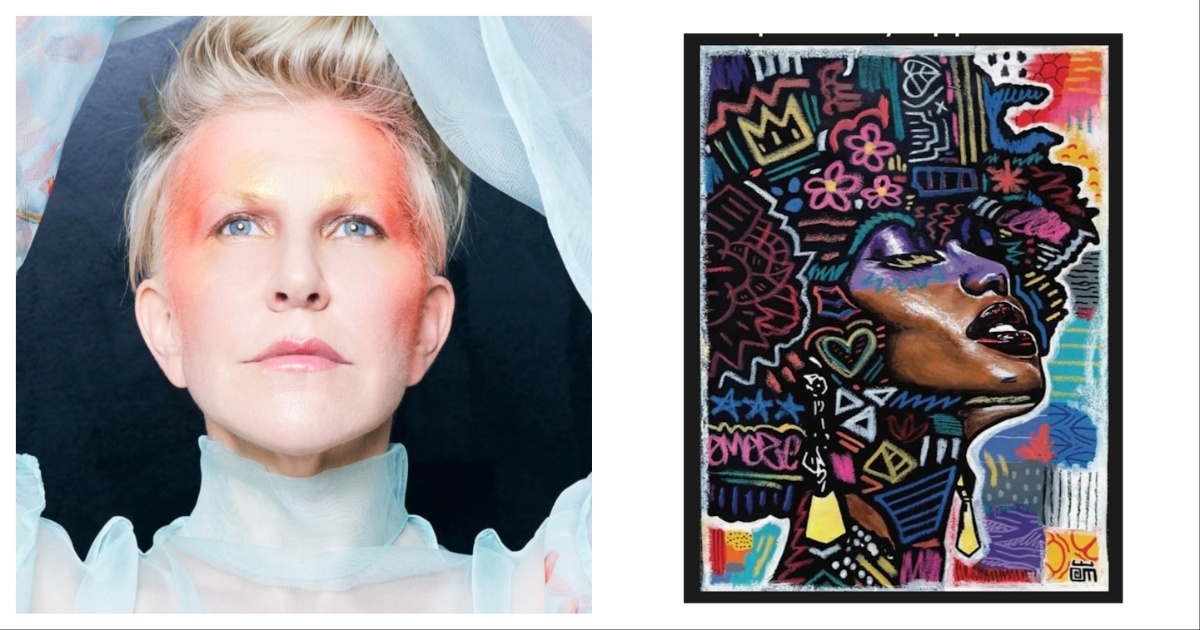
Singer Joyce DiDonato and a work by Alloyius Mcilwaine
I’m no meteorologist. Nor am I a groundhog. But I’m just going to go ahead and say that winter is over, my friends. We should hit the 70s weekend, and there’s plenty to get out and do. Whether you’re looking for a soaring soprano, lots of funky art, selfie opportunities with farm animals, or two good reasons to go to an actual movie theater (remember them?), it’s all right here in our compilation of the best things to do in Philadelphia this week, as carefully curated by Philly Mag’s arts and entertainment editor.
CONCERTS
Moe
The reliable jam band has managed to sell out all four nights, but you can join the waitlist. (I’m told that there’s a good chance you can still get in.)
March 4th through 7th at Ardmore Music Hall
Michael Shannon
If you’re thinking to yourself, isn’t there an actor named Michael Shannon?, the answer is yes, and this is the same guy. It turns out he’s also a musician and huge R.E.M. fan, and last year, he toured with singer-songwriter Jason Narducy to perform the entirety of R.E.M.’s Fables of the Reconstruction in honor of that album’s 40th anniversary. (Feeling old yet?) It was a huge success. This year, they’re back for the 40th anniversary of Lifes Rich Pageant. If my math is correct, you’ll have to wait five more years if you want to hear mega-hit “Losing My Religion.”
March 4th at Union Transfer
“Best of Gershwin”
Superstar Japanese pianist Hayato Sumino takes to the stage with George Gershwin’s classic “Rhapsody in Blue.” Also on the program: An American in Paris and selections from Porgy & Bess, as in “Summertime”.
March 5th at the Kimmel Center
The Philadelphia Orchestra
Featuring Yannick, the symphony, soprano extraordinaire Ying Fang, mezzo-soprano extraordinaire Joyce DiDonato, and the Philadelphia Symphonic Choir, all team up for Mahler’s Symphony No. 2.
March 6th through 8th at the Kimmel Center
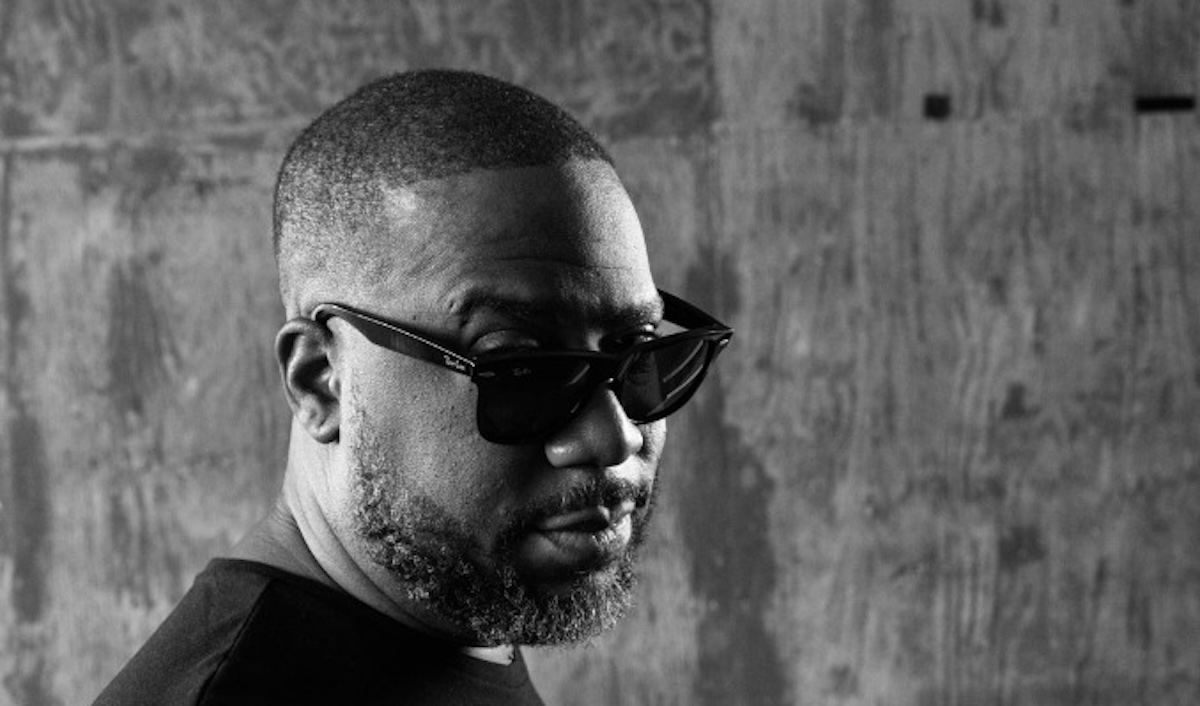
Photograph courtesy of Robert Glasper
Robert Glasper
One night with the Grammy-winning pianist, songwriter and producer, who has worked with everyone from the guy they used to call Kanye West to Mos Def to Jill Scott to Jennifer Hudson.
March 6th at Union Transfer
Cat Power
Performing her soulful The Greatest in its entirety to celebrate the critically-acclaimed album’s 20th anniversary.
March 8th at Union Transfer
COMEDY
Jo Koy
Definitely a better stage name than his given one: Joseph Glenn Herbert. For a taste of what he dishes out, here’s his Netflix special. Definitely has some strongly funny moments.
March 6th at Xfinity Mobile Arena
David Spade
Let’s not hold his performance in Dickie Roberts: Former Child Star against the six-season SNL’er.
March 7th at Ocean Casino Resort
“It’s Always Punny in Philadelphia”
A competition featuring comedians and wannabe comedians who think they are really (sorry) punny. I groan at 90 percent of all puns, but to each their own.
March 7th at Helium Comedy Club
THEATER
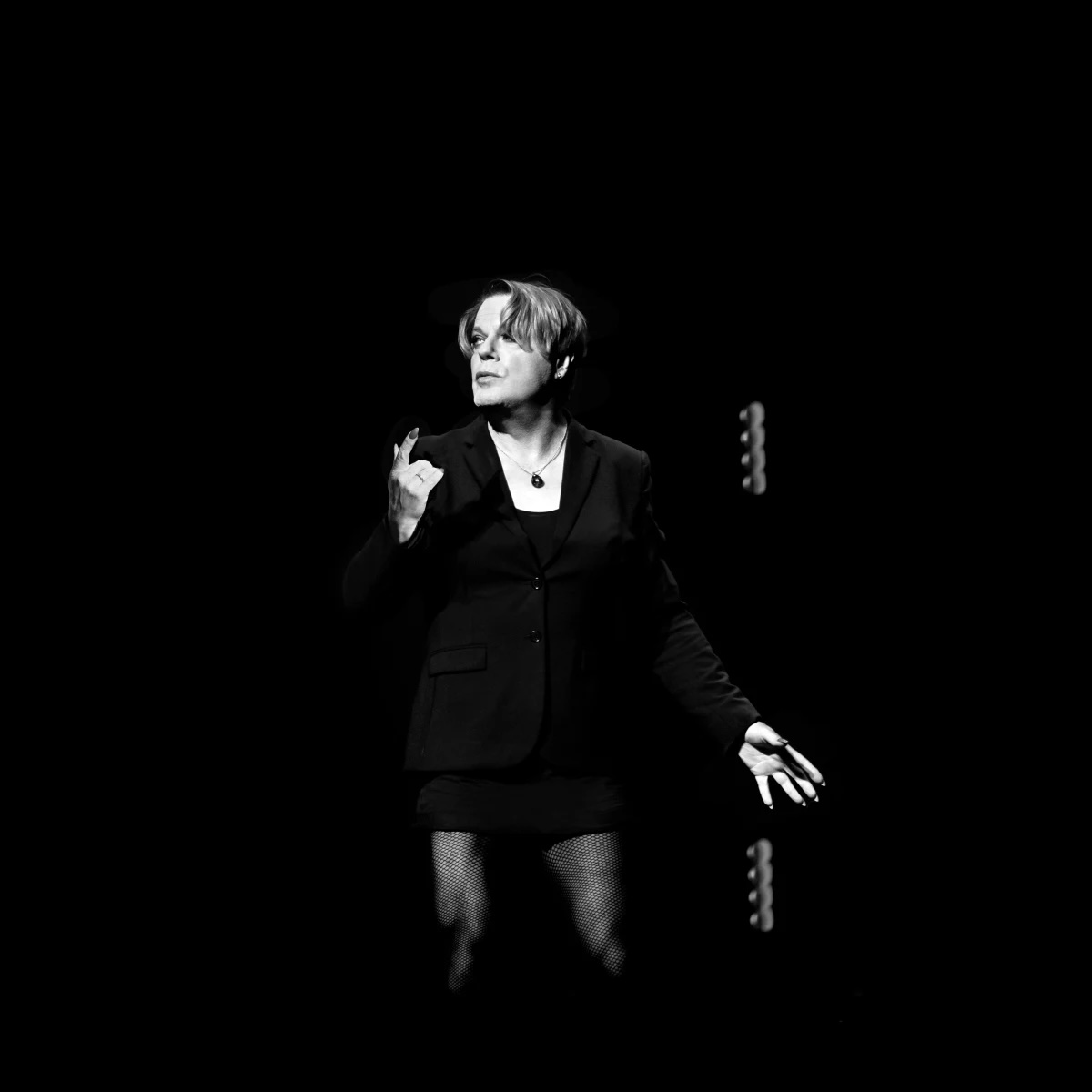
Eddie Izzard in Hamlet / Photograph courtesy of Ensemble Arts Philly
Hamlet
But this time, performed solo by the incomparable Eddie Izzard. Dame Judi Dench called a performance of it in London “spectacular,” and if you can’t trust Dame Judi, who can you trust, really?
March 4th through 8th at Suzanne Roberts Theater
Romeo & Juliet
Barrymore-winning director Amina Robinson puts her own spin on Shakespeare’s tale of romance and violence.
March 5th through April 8th at the Arden
Twelfth Night
The Bard’s tale, set at an ultra-exclusive resort for the wealthiest of the wealthy.
Through March 29th at People’s Light
Blues for an Alabama Sky
Lantern Theater Company presents a tale from the Harlem Renaissance. Look for local talents Cookie Diorio and Kash Goins to shine.
Through March 15th at St. Stephen’s Theater
Good Bones
The latest play from South Philly Pulitzer winner James Ijames. It’s about a sports stadium controversially being built in the middle of a neighborhood. Sound familiar?
Through March 22nd at the Arden
Rare Accidents: The Escapades of Prince Hal & Falstaff
Mount Airy-based Quintessence Theatre Group presents an abridgment of parts one and two of the Bard’s Henry IV.
Through March 15th at the Sedgwick Theater
EXHIBITS
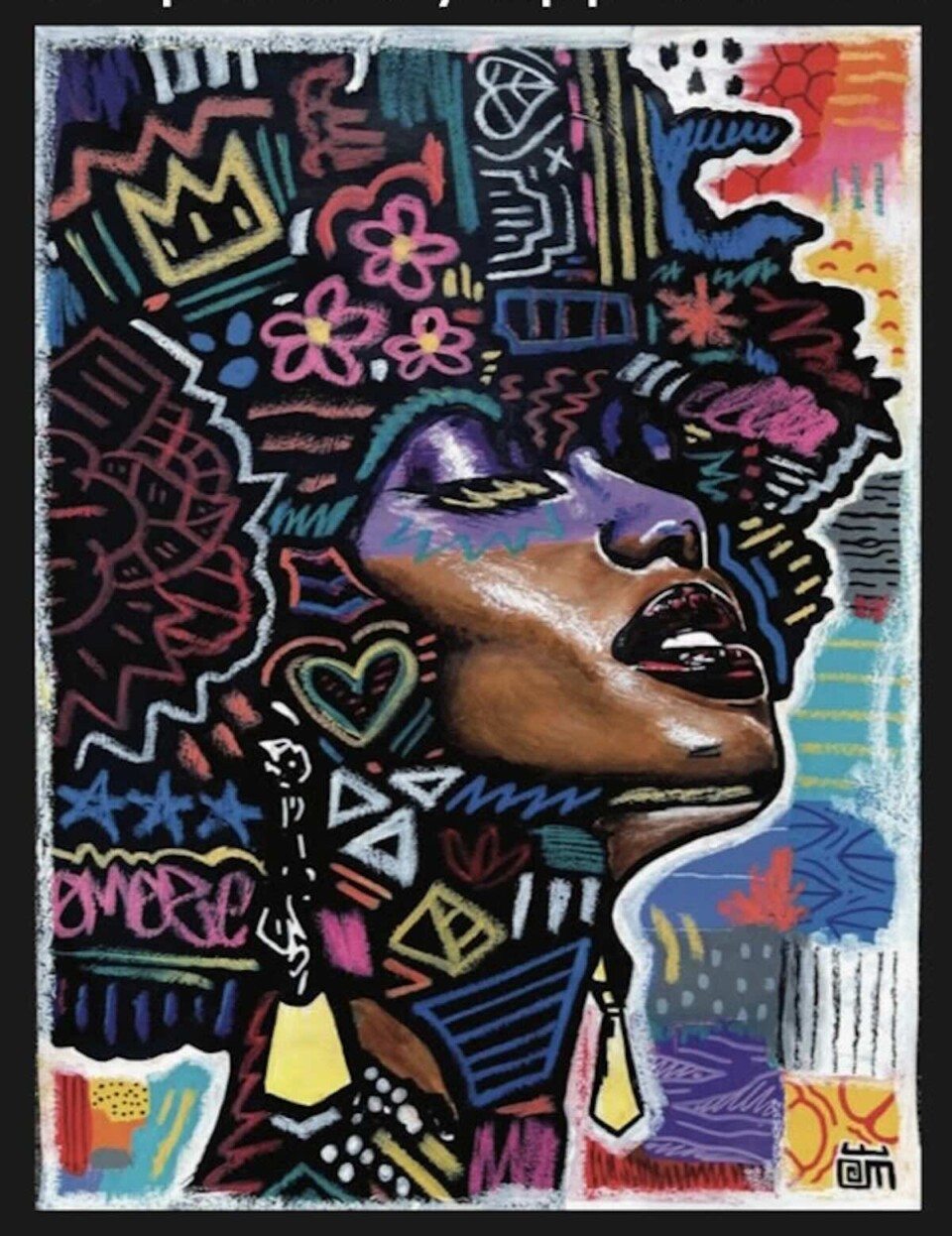
This work by international artist Alloyius Mcilwaine is one of the highlights of First Friday in Philadelphia
First Friday
When was the last time you headed out on that monthly art gallery tradition in Old City? It might hit 60 degrees that day, so just sayin’, this might be a good time to revisit.
March 6th in various locations
“Sebastian Errazuriz: Double Take”
Wild creations from the mind of the Chilean-born, New York-based designer.
Through August 16th at the Philadelphia Museum of Art
“Universal Theme Parks: The Exhibition”
For a complete rundown on this brand-new exhibit that’s really more about STEM than it is about Jaws and Jurassic Park, check out this review by my colleague Laura Swartz.
Through September 7th at the Franklin Institute
MOVIES
Thelma & Louise
A modern classic, seen the way that director Ridley Scott wanted you to see it: on the big screen.
March 4th at the Philadelphia Film Society Center
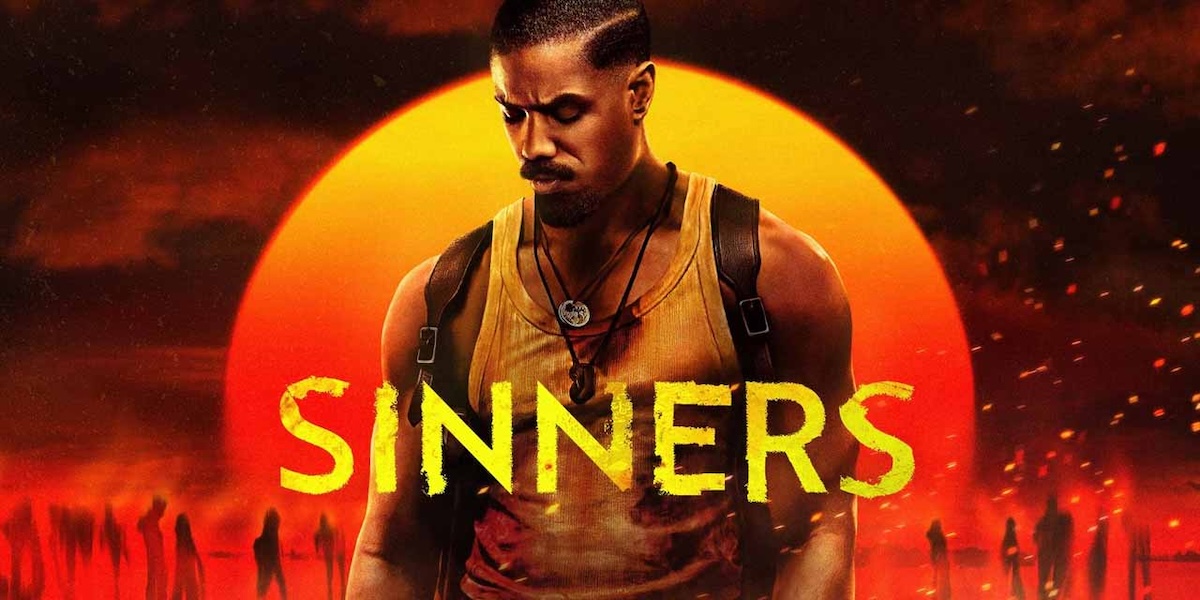
A promotional image for Sinners
Sinners
I’m fine with streaming 95 percent of the time and have even adapted to watching most things on my phone, if I am watching them alone. But this Oscar fave is one you really want to see in a theater. Fortunately, you’re getting another chance.
March 6th through 12th at the Colonial Theatre
OUTDOORS
Bird Walk
This free event is exactly what it sounds like it is. You “wike” around with some seasoned birders and try to see as many species as you can. This place is home to more than 300!
March 7th at Heinz Wildlife Refuge
Maple Sugar Day
Learn all about the process of maple sugaring and buy local maple syrup while you’re taking selfies with adorable farm animals.
March 7th at Fox Chase Farm
SPORTS
76ers vs. Spurs
In which we take on one of the best teams in the NBA. You can get in for around $40.
March 3rd at Xfinity Mobile Arena
MISCELLANY
The Philadelphia Flower Show
It’s baaaack! For a fun data-driven look at this year’s show and the shows of years past (including, yes, the abomination known as the $15 “grilled vegetable hoagie”), go here. And to see what my colleague Laura Swartz had to say after attending the media preview on Friday, check this out.
Through March 8th at the Pennsylvania Convention Center

Photograph courtesy of the Pennsylvania Horticultural Society
Women’s History Month
There’s so much going on that we’re excited about, such as the fantastic Sisterly Love Sunday Supper benefit (for which Philly Mag is a media sponsor) at Four Seasons and the Badass Women History Walking Tour. For more celebratory and educational events, check out this comprehensive guide.
March 1st through 31st in various locations
LOOKING AHEAD
- The Philadelphia Citizen’s third annual Citizen of the Year celebration and dinner is coming up in April at the Fitler Club. (In case you don’t know, Philly Mag and the Philadelphia Citizen are now sister publications.) You can see all the swell honorees here. Get tickets while you can!
- You may have seen the movie Airplane, but almost certainly not like this. For this special screening at the Miller Theater in May, co-stars Julie Hagerty (flight attendant Elaine Dickinson) and Robert Hays (pilot Ted Striker) will be on hand to answer all your burning questions and tell behind-the-scene stories.
- Nosebleeds to see the Foo Fighters at the Linc in August start at around $130. Never seen them live. Might go.
- I really don’t think that Meatloaf needed a jukebox musical, but if you disagree, they recently announced that Bat Out of Hell: The Musical will be at the Miller for one night only.
That’s it for now, Philly. See you next week!
The Philadelphia Flower Show, By the Numbers

Philadelphia Flower Show rendition courtesy of Pennsylvania Horticultural Society
The Pennsylvania Horticultural Society’s annual event — the longest-running and largest of its kind in the country — runs February 28th through March 8th at the Convention Center. Here, we break down the data.
2,157
Perennials, annuals, and grasses that make up the Forest Floor, the entrance garden at this year’s show that also includes 38 live trees and shrubs, 10,020 individual bulbs, 465 cubic yards of mulch and soil, 65 tons of natural stone and boulders, and 3,400 gallons of water.
83%

Portion of attendees who identify as women. Overall, 48 percent are baby boomers; 8 percent are Gen Z. No word on what portion of the Z’ers are dragged along by their parents.
53
Number of men (yes, all men) who came together in 1827 to show off their prized plants and quickly realized that a big flower show might be a good idea. Their first one came two years later.
$252
Cost for two adults and two kids to attend the show with a “flex pass” that allows you to pick your day and time on the fly. If you choose your day and time in advance, the cost drops to $170.
$15

Price a food vendor at the 2021 show was charging for a “grilled veggie hoagie,” which turned out to be a bunch of microwaved frozen vegetables on a limp roll. News of the culinary insult quickly went viral, earning well-deserved ridicule and a Worst of Philly award.
2,700
Size of the volunteer battalion needed to produce the show.
$4,000
The vendor fee for a 10-foot-by-10-foot booth. Not just anyone can be a vendor. (You have to apply. The acceptance rate is around 40 percent, similar to that of Purdue University.)
$0
Prize money offered to the 6,500-ish contestants in the various plant and flower competitions. A win is not about money. It’s about bragging rights. And fancy medals.
2016

Year the first marijuana-themed exhibit was expected, but leadership wound up nixing it after it became clear that the exhibitor intended to push weed legalization, as opposed to educating the public about the plant. Politics are strictly forbidden at the Flower Show.
19

Guests you can bring to this year’s VIP preview party if you signed on as a $30,000 sponsor. Vintage cocktail attire preferred — break out the spats!
$1.2 million

What the 2013 Flower Show was said to have lost due to overhyped snowstorm forecasts from Cecily Tynan, Kathy Orr, and the like. After all, who has time to gaze at geraniums when you’re panic-shopping at the Ack-a-me?
0

Knowledge of poinsettias that Americans had prior to the first show in Philadelphia, where controversial United States diplomat Joel Roberts Poinsett introduced the native Mexican plant.
Published as “The Flower Show by the Numbers” in the March 2026 issue of Philadelphia magazine.
Maiken Scott Is From Germany But Has Horrible Taste in Beer
Maiken Scott, host of The Pulse on WHYY / Photograph by Stevie Chris
The host of WHYY’s science show, The Pulse, which airs on 132 NPR stations, talks regrowing teeth, headbanging to Motörhead, and her Tilt-A-Whirl fears.
My first name is pronounced … “Miken.” A lot of people see my first name and pronounce it “Makin” like “I am makin’ eggs for breakfast.” But I’m German, so that “ai” doesn’t work the way some people expect it to.
I was born in … Karlsruhe, Germany, a planned city that has a castle — and the main streets sort of go towards the castle in a fan. It is said that Washington, D.C., is modeled after it, because Jefferson visited Karlsruhe and liked the design.
I came to Philadelphia … in 1996 because I got married very young and he was from outside of Philadelphia. It was a short-lived thing, and we divorced. I went to Temple for journalism and remarried when I was 35.
When I was a kid, I wanted to grow up to be … an actress. But in Germany, where school is free, you have to try out to get into acting school. I tried three or four times but didn’t get in. I was heartbroken! And I just can’t handle rejection.
These days, I live in … Ridley Park. I lived in the city for a long time. When I was at Temple, I lived around the corner from McGlinchey’s (RIP), which was the place to be. The waitresses were mean. But it was so cheap. And we were all broke! Plus, you could smoke. I used to smoke a lot.
I wish that scientists would figure out a way to … regrow teeth.
One of my favorite episodes we did of late … was about the crazy behind-the-scenes race to decode the human genome.
The first concert I went to in life was … Motörhead, in Frankfurt, when I was a teenager. I partially lost my hearing for a week after that. Nobody wore ear protection back then. You would have been laughed out of the arena.
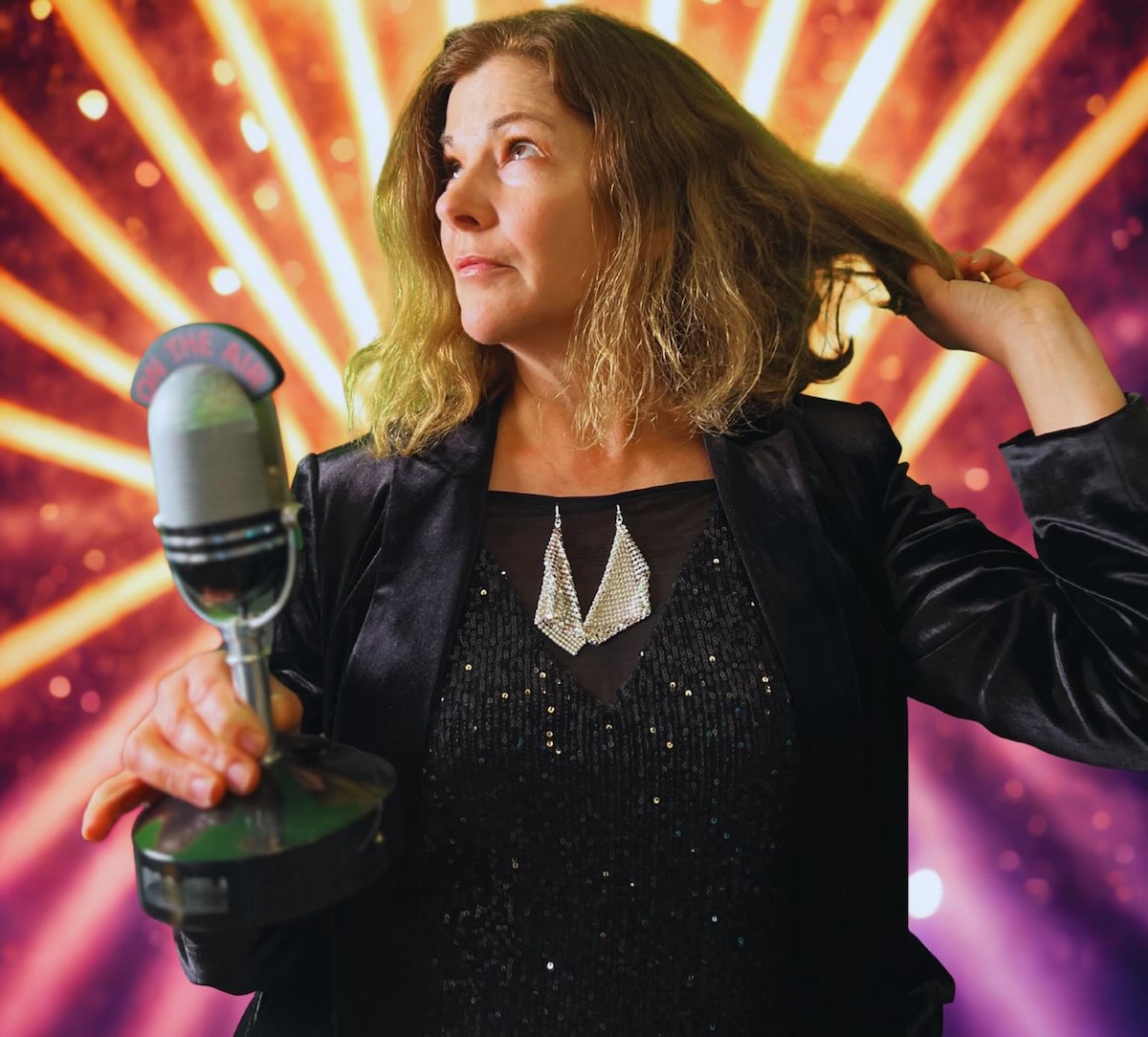
(photo courtesy Maiken Scott)
I would describe the state of the world as … interesting. Very interesting.
One thing most people would be surprised to know about me is … that for 10 years, I owned the popular Port Richmond rehearsal space Surreal Sound Studios. We had so many bands come through there.
I am deathly afraid of … amusement park rides. All of them. I don’t like heights. I don’t like spinning. And I don’t like sudden movements. We took our kids to Hersheypark and I literally didn’t get on one thing.
One non-WHYY podcast everyone should listen to is … Blink. It’s the story of Jake Haendel, who was diagnosed with a terminal brain disease and seemed to slip into a coma for more than a year. But he wasn’t actually in a coma. He was aware of what was going on around him.
I am positively obsessed with … Eurovision.
My kids are always telling me to … relax. They are 15 and 17.
If I could have dinner with one scientist from history … it would have to be Darwin. I’d love to know what he thinks about how evolution has actually played out, and where he was right and where he was wrong.
One of the most frequently misunderstood things about science is that … it is a process and changes all the time, and, sometimes, it can be wrong.
Something about me that embarrasses my friends … is that my beer of choice is Miller Lite. I mean, I’m from Germany! But it’s true.
My secret talent is … lifting weights. My best event is deadlift: 155 pounds.
One unhealthy food I can’t get enough of is … nachos. Loaded. Put everything on them. Oh, and tater tots!
My voice is … something I don’t love listening to. I was teased relentlessly for it when I was a kid. Sometimes when I listen to my show in the car, I realize that my face hurts after a while because I’ve been cringing the whole time.
Published as “One of Us: Maiken Scott” in the March 2026 issue of Philadelphia magazine.
Philadelphia Bar Bans Conservative Columnist Over Offensive Comments

Left: Fergie’s Pub owner Fergus “Fergie” Carey (photo by Steve Chris) | Right: Conservative columnist Thom Nickels, who posted “all lives splatter” among other memes on the Fergie’s Pub Facebook page, earning him a ban from the bar (image via LaSalle TV video)
Listen to the audio edition here:
Late in January, in response to the killings of Renée Good and Alex Pretti at the hands of ICE agents in Minneapolis, protesters called for a general strike scheduled for January 30th. Business owners around the country were confronted with questions from their workers about whether they would participate, as was the case at Fergie’s Pub, the popular Irish bar in Philadelphia.
Owner Fergus “Fergie” Carey considered the matter and decided to open that day, posting the following on social media:
We remain open today. However, we are in support of the strike and want to make it clear that we believe that America is a diverse, beautiful patchwork and we are stronger together. Between Fergie’s and The Jim, we have donated thousands of dollars over various events to @vamos_juntos_ and will continue to support them – they are an excellent community resource and are doing amazing work. Please check out their page and support their efforts as well, if you like. #iceout
Facebook being Facebook and 2026 being 2026, comments (many of which no longer appear) were swift to follow, some standing in solidarity with Fergie’s and the ICE protesters and some not so much. Falling decidedly into the latter category was longtime Philadelphia columnist Thom Nickels, who these days writes for the conservative Philadelphia outlet Broad & Liberty.
- A photo of Alex Pretti with the message “Staying Home Saves Lives”
- An image of a monkey labeled Renée Good approaching a sleeping lion labeled ICE with the message “Everything happens for a reason: Sometimes the reason is you’re stupid and make bad decisions.”
- A cartoon of an SUV hitting people on a road with the message “All Lives Splatter: Nobody Cares About Your Protest. Keep Your Ass Out of the Road.”
“I just very quickly tapped into my photo gallery and posted some conservative memes,” Nickels tells Philly Mag. “As I was doing it, I noticed that they kept disappearing. I thought, oh well, they don’t like them.”
They sure didn’t. The social media manager alerted Carey to the Nickels comments, wondering who Nickels was. It turned out that Carey and Nickels met, as far as Carey remembers it, long ago when Nickels wrote for The Philadelphia Irish Edition and interviewed Carey for a story. He patronized the bar occasionally over the years, and was a regular for a bit.
The name rung a bell to Carey, so he looked in his cell phone and, sure enough, “Thom Nickels – Philadelphia Irish Edition” was in there. Carey dialed the number but Nickels didn’t pick up. It went to voicemail, so Carey left him a message, which Nickels later deleted. Both men agree that the point of the message was: You’re not welcome at Fergie’s Pub anymore.
“I couldn’t believe it,” says Nickels. “I always liked Fergie. But we’re so polarized as a society. People want to turn everything into a federal case, as if I committed a horrible sacrilege.”
Nickels wrote about the conflict with Fergie’s – not naming the bar – at the bottom of a Broad & Liberty column he wrote on February 8th about the local conservative influencer Frank Scales:
Last week I came across a Facebook post from a certain bar in the city, condemning ICE and calling for its abolition. I posted my opposition with a few colorful memes from my photo gallery, all in support of ICE. This is something a zillion people do on a daily basis when it comes to debates about ICE. Now, I’ve always liked this bar. I’ve read a few poems there at sponsored gatherings, and I’ve interviewed the owner for a number of publications over the years. He has always been a fine gentleman.
A day after my post I received a phone voicemail message from the bar telling me the staff no longer wishes to serve me, and that I should not have posted such “hate.”
Hate? I love the hamburgers there, yet I confess the pub’s interior has always made me think of Mary Queen of Scots imprisoned in the Tower of London.
But “hate” in this day and age course is anything they – the left – doesn’t agree with. As Hitler said, “I want fanatics.”
Earlier this week, Carey alerted me to the Nickels column and identified the bar in question as his own.
“I don’t want him in my fucking bar,” Carey insists. “Things are too serious now for that kind of stuff. Unfollow, unfriend, fuck off.”
I asked Nickels about the “All Lives Splatter” meme, clearly a takeoff on Black Lives Matter and the post that Carey told me had him the most riled up.
“I think that’s taken out of context,” Nickels says of the reaction to the post. “All lives splatter when you put yourself in the face of ICE… The two people who were tragically killed, which was a, you know, horrible thing, um, they still interfered with ICE… It seems to me that if you interfere with ICE, if you go into the road and try to get in their face, you’re asking for the worst.”
Nickels also wondered if Fergie’s was going to start interrogating customers when they show ID: Do you support ICE? Do you support Trump? But Carey insists that all sorts of people come into Fergie’s and that he doesn’t disrespect customers because they believe differently than he does. Posting offensive memes about dead people on his social media page, though, is different, he argues.
“If Donald Trump posted that image of the Obamas as apes on my Facebook page, I would call him and tell him to fuck off too,” Carey says. “I’m sick of all this.”
All the Philly People and Places in The Simpsons’ 800th Episode

The Simpsons come to Philly for their 800th episode. (Click image above for the full map!) / Illustration by Eric Keyes. The Simpsons™ and © 2025 20th Television
This Sunday, Marge and Homer Simpson — America’s most enduring (and most chinless) animated stars — will visit Philadelphia for the first time in The Simpsons’ 36-year run, showering love on our city for the show’s milestone 800th episode.
For this you can thank Simpsons co-executive producer Christine Nangle, the Penn grad and Oxford Circle native who conceived of and wrote the installment. She’s been with the show — the longest-running scripted prime-time series ever — since 2019, prior to which she was, among other things, a writer for Saturday Night Live. These days, Nangle makes her home in Los Angeles, but “I’m 100 percent still a Philadelphian,” she says. “I wear it with pride on my sleeve.”

That’s abundantly apparent in her Simpsons plot, which — mild spoiler alert — begins when Marge and Homer journey to the city so their dog, Santa’s Little Helper, can participate in a (fictional) Philadelphia dog show. Once here, some local conspiracy theorists known as the H.O.A.G.I.E. Men (Historians of America’s Great Inventors and Enlightened Men) convince them that the dog is actually a direct descendant of Ben Franklin’s mutt, and that he holds secret abilities to find gold supposedly stashed by Franklin. (A penny saved?!) The two find themselves on a National Treasure–style adventure in search of that fortune, running into a host of icons along the way.
Not surprisingly, the Philadelphia gags come fast and furious — so here, ahead of the February 15th air date on Fox, Nangle offers up a preview of the people, places, and oh-so-Philly plot points you’re going to want to watch for.

Michael Vick Reparation Park
Fictitious … and “the best dog park in the world,” says Nangle.
Quinta Brunson
The Abbott Elementary creator/star voices a trainer charged with getting Santa’s Little Helper in shape. Alas, she meets an untimely end, falling down a hole — d’oh! — but does manage a resounding “Go Birds!” on the way down.

Hall & Oates
The dog show takes place at the Convention Hall, which is adjacent to the Oates Parking Lot. (Poor John, always the smaller spotlight.)
Whiz Wit
Cheesesteaks get a cameo, obviously, with appearances by Pat’s, Geno’s, and Dalessandro’s — the last of which Nangle says was a rec from Questlove while she was writing the episode.

Kevin Bacon
For Bacon’s first Simpsons role, he plays a clerk at the fictional Hotel Philadelphia. (“He nails the Philly accent,” Nangle says.) Marge opts for the Fresh Prince Suite over the Silver Linings Playbook Suite.
Boathouse Row
The conspiracy theorists row Homer down the Schuylkill while he slurps a water ice. (Cherry, obviously.)
Gotta Have a Wawa
One of the conspiracy theorists tries to sell Homer on the Ben Franklin theory while Homer is in — where else? — a Wawa bathroom.

Segway Tours
The family joins a Segway tour near the Philadelphia Art Museum, with a tour guide voiced by Questlove. (They eventually happen upon the Mummers Parade.)
The Rocky Statue
But not only Rocky … this version of Philly also features a statue honoring the hanging side of beef from the meat locker. There’s one for Apollo Creed. And Mr. T. And more.
The Betsy Ross House
Santa’s Little Helper relieves himself on an antique fire hydrant, releasing an enzyme that unlocks a clue to the gold that leads the Simpsons to Betsy’s house and a secret chamber holding the key from Ben Franklin’s lightning experiment.
Check out the whole map here.
Published as “Where’s Homer?” in the February 2026 issue of Philadelphia magazine.
Hey City Hall — When Are You Going to Clear the Bike Lanes?
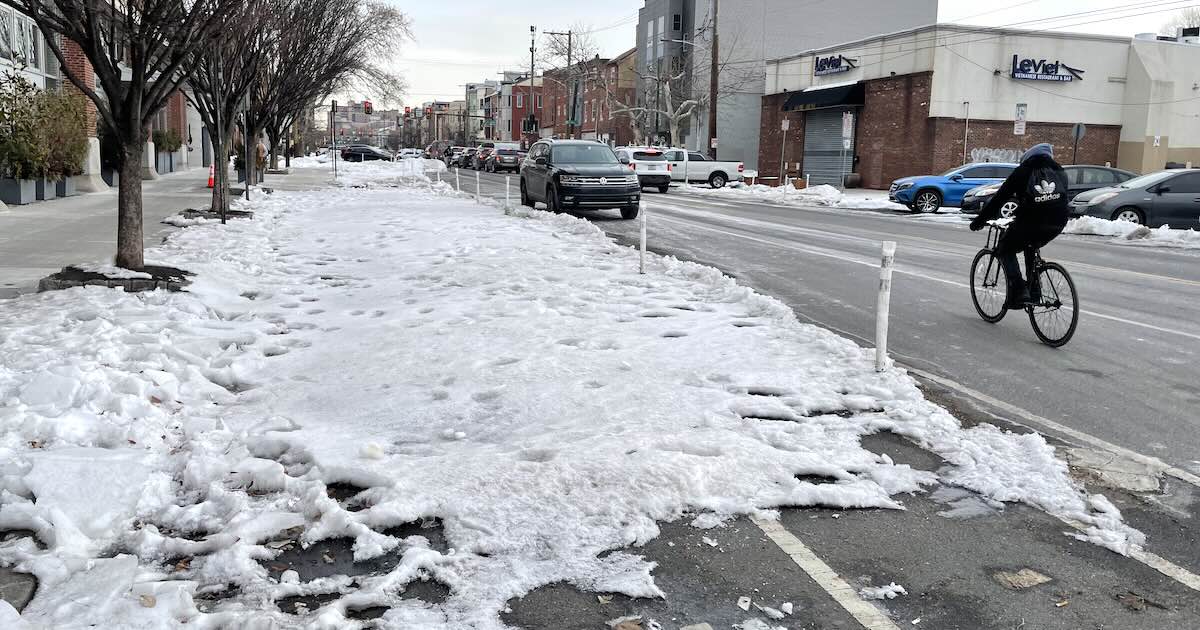
A bicyclist and an impassable bike lane at 11th and Washington, more than two weeks after a major storm brought mounds of snow and ice to Philadelphia / Photograph by Bradford Pearson
Listen to the audio version here:
Lo and behold, Philadelphia: The polar vortex is gone. The Arctic blast is no more. Two-and-a-half weeks after a major storm brought a bounty of snow and ice to Philadelphia, we are finally basking in the melty glow of highs that don’t start with the numeral one or two. We’ve heard no shortage of complaints over the last two weeks from car owners frustrated — nay, downright angry — with the condition of the roads, and it remains to be seen if voters will seek vengeance come the mayoral primary in May 2027. But if you think that car drivers had it bad, what about all those Philly bicyclists?
“For the first two weeks after the storm, I felt completely unsafe riding my bike,” says Newbold’s Zach Strassburger, who relies on their e-cargo bike to get to and from work in Center City and to transport their four-year-old and 10-year-old to school and Hebrew school. And because Strassburger relies on that bike, it means they also rely on the many miles of bike lanes in Philadelphia to keep them and their kids safe.
The problem? There have essentially been no bike lanes, because they’ve been covered with caked-in ice. After hearing a complaint on Tuesday morning from South Philly about the bike lane problem, I decided to pilot my 2004 Kia Optima from 23rd and Race to South Philadelphia to West Philadelphia to Fairmount Park and then through Wynnefield and home to my saved spot in Overbrook, and, sure enough, I saw very few useful bike lanes. What I did see were numerous delivery people on e-bikes swerving in and out of traffic because they couldn’t use the bike lanes.
“There’s nothing we can do,” says one such driver, an immigrant from the Dominican Republic who asked to be identified only as Chas. I stopped Chas outside of a restaurant in West Philadelphia on Tuesday afternoon to ask what his experience had been like. “I came out the Tuesday after it snowed and have been out every day since. It’s very unsafe but if I don’t work, I don’t make any money … I can’t ‘work from home.'”
Realizing that the bike lanes weren’t an option in the two weeks after the storm, Strassburger did their best to use unreliable and overcrowded SEPTA, but SEPTA doesn’t go everywhere, including that Hebrew school. They also had to ask their ex to step in at times for rides, which was far from ideal. The chaos and confusion of the storm’s aftermath and the logistical nightmares it wrought resulted in Strassburger’s 10-year-old walking home after dark from a school band practice and getting lost. “He ended up walking to the wrong house,” recounts Strassburger. “I didn’t have any idea where he was, and that was really scary.”
This week, Strassburger decided enough was enough. It was time to break out the bike.
“I almost crashed,” Strassburger says of their Monday ride. Then, they wound up on a street that didn’t have a cleared bike lane, so Strassburger had no option but to ride in the single lane of traffic, which, of course “the cars don’t like.” On Tuesday, Strassburger had to take their 10-year-old to middle school and read online that the bike lanes on 11th Street were bad, so they thought they would try the ones on 13th Street. “Those were utterly inaccessible,” Strassburger says.
South Philadelphia resident James Bold, a nurse at Thomas Jefferson University Hospital, has biked almost daily for the last 30 years. But given the state of the city after the storm, he made the less convenient switch to SEPTA. “I actually did ride to work one morning after waiting for the 45 bus that never came,” says Bold. “I scrambled back home and grabbed the bike and made it in. But not ideal.”
Bold says that while the frigid temperatures and uncleared lanes did affect his decision to steer clear of the bike for a couple of weeks, the main reason he stayed off the bike was all those angry car drivers.
“For the life of me, I will never understand the hostility toward bicycles,” Bold laments. “More than the snow and ice and cold, I think what kept me off my bike since the storm is knowing how aggressive everybody is driving and parking. And if they were to encounter a bicyclist on the already compromised tight roads, it’s just something I didn’t want to have to deal with.”
Lana Harshaw, executive director of the Bicycle Coalition of Greater Philadelphia, echoes Bold’s observations, saying that while obstructed bike lanes — whether those obstructions are cars parking in them or ice covering them — are a problem, the real problem is the people behind the wheel of their cars.
“The cyclists have to merge in with high-speed traffic, and a lot of the drivers are aggressive or just folks who aren’t used to sharing the road with cyclists,” Harshaw says. “I would just ask all the drivers out there to be considerate of bike riders and pay attention so everyone can be safe.”
The good news? We’re supposed to touch 50 degrees one day next week. The bad news? There’s still more than a month of winter left. Be safe — and nice! — out there.
UPDATE: We received the following from the Streets Department the day after we published this story.
Making our streets safe for cyclists is always a City priority. The bike lanes have been affected because of below-zero temps for an extended period, and we are addressing the situation. The City has been focused on clearing curb ramps and bus shelters along priority transit routes over the last two weeks and has now cleaned over 2,200 intersections along transit routes. With this work wrapping up and the weather warming, the City is now going to be tackling priority bike lanes. Some of that work has already started. We thank cyclists for their patience.
Is This Frigid Winter Harming Our Birds?
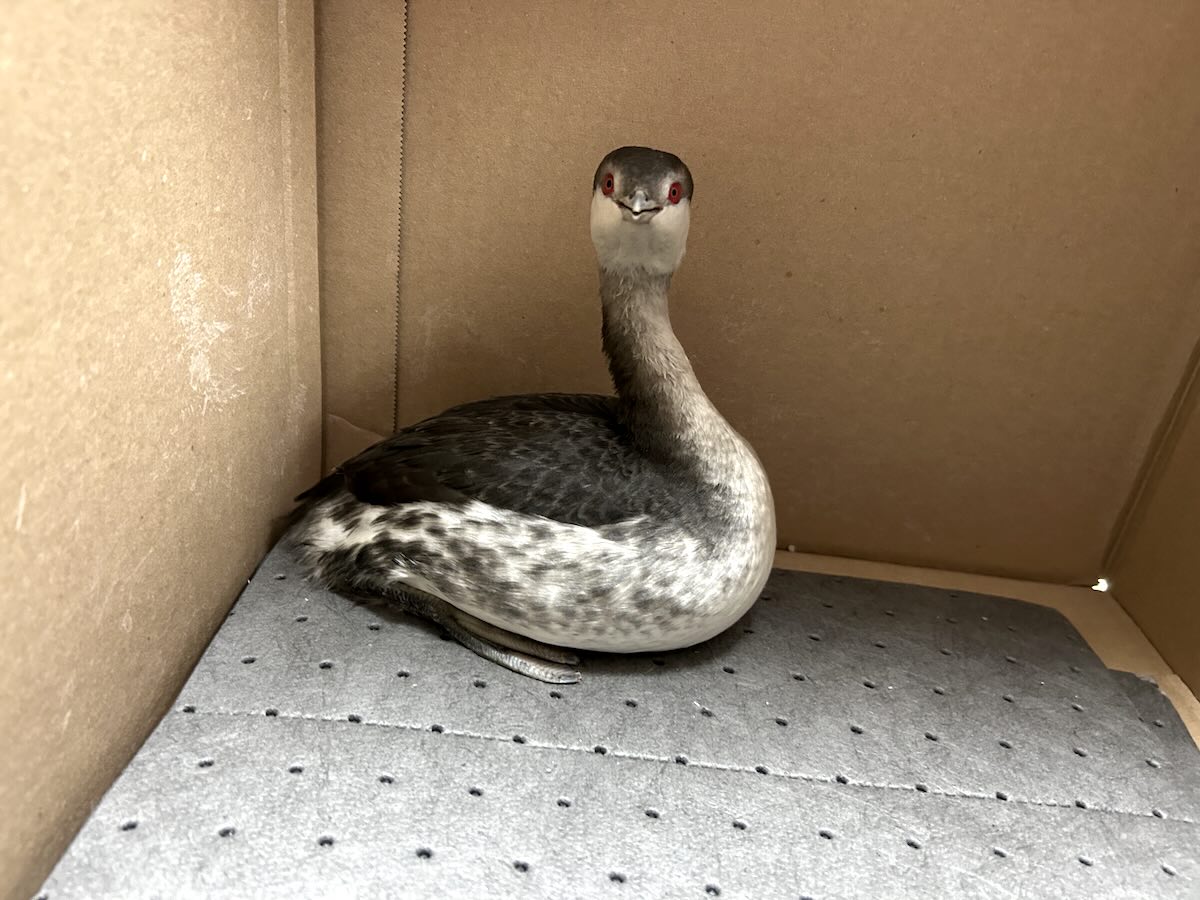
A rescued bird at the Schuylkill Center for Environmental Education after some crazy Philadelphia weather delivered lots of snow and ice last week / Photograph courtesy of Schuylkill Center for Environmental Education
We have a lovely neighbor named Carol out here on the fringes of West Philly. Whenever she makes a big pot of soup, Carol is sure to send some our way. She’s always sharing fresh baked goods with our kids. Carol is also generous with the neighborhood birds (we live close to the woods of Morris Park and have plenty of fauna afoot and above) and feeds them just as she feeds us.
This past Sunday, she began to feel concerned for her fine, feathered friends. She keeps a close eye on them, and noticed they had suddenly, drastically dwindled in number. “I am afraid they froze!” she said. “Where did this horrible Philadelphia weather come from?”
At first, I assumed that Carol was overreacting. After all, plenty of birds exist in super-cold climates. If an albatross and a kelp gull can thrive in Antarctica, surely Carol’s birds are fine, right? (This logic is why I am no ornithologist.)
Well, maybe, says Mae Axelrod, communications director for the Schuylkill Center for Environmental Education in Northwest Philadelphia. She points out that birds native to Philadelphia are, in general, capable of coping with the cold weather.
“Birds have evolved many unique adaptations that allow them to survive the harsh conditions of a brutal winter,” she told me earlier this week. “Birds have thick inner, downy feathers that trap warmth close to their bodies. The outer feathers are water-repellant and keep them dry. They also have very high metabolisms, which allow them to generate lots of body heat.”
Sure, but what about their feet and legs? They aren’t protected by feathers, downy or not.
“Birds have developed a way to pump more blood to the coldest parts of their bodies,” says Axelrod. “Countercurrent heat exchange is a thermoregulation system where warm blood flows downward to the feet. It pushes cold blood from the feet back up towards the body, where it can get warm again. This system prevents the limbs from freezing, even in the snow.”
Okay, phew! So Carol’s birds and all the other flyers in frigid Philly will be just fine?
Not so fast, says Axelrod’s colleague, Sydney Glisan, a former zookeeper and currently the director of the center’s Wildlife Clinic. She says that our harsh winter has indeed impacted area birds, though not in the way we might imagine.
“The clinic has admitted quite a few birds with head trauma,” she tells Philly Mag. She suspects the injuries were sustained when the birds were slammed into windows or other objects by the wind gusts of last week’s storm.
Plus, two horned grebes that usually call the Schuylkill Center home went missing.
She explains: “Over the years, horned grebes have adapted to live on the water. But when their water source freezes over, they face significant challenges. We suspect they went off course in the storm, could not find water, and got stuck on land.”
The problem with a horned grebe winding up on land, says Drexel University ornithologist Jason Weckstein, is that they can only take off from water. (Weckstein is also the guy you call when you find an unusual number of disembodied pigeons on the streets of Center City, it turns out.)
“When the lakes they are wintering on start to freeze up, they might fly away,” Weckstein says. “And as they are flying, they might see an ice-covered road, and mistake the shiny ice for the water of a lake and land there. But then they can’t fly away. That’s it.”
Weckstein says that these cold-weather problems are particularly evident right now at the Jersey Shore — Cape May, specifically. The American woodcocks that call the area home use their long bills to push through snow to the food that lies in the sand beneath. But our recent storm, which layered ice atop packed snow, did them in. Their bills simply couldn’t puncture the ice.

An American Woodcock in the snow / Photograph by Anders Peltomaa via Creative Commons/Flickr
“A lot of them have died as a result,” says Weckstein. “A large number.”
Land development has also made winter storms much more dangerous for birds, says the Schuylkill Center’s Glisan. As natural habitats disappear, off-course birds have fewer safe places to land, rest, or find food. “Storms have a larger impact on birds because of it,” she says. “As wild spaces are developed, animals are in danger of wandering further out of their typical range and risk getting hit by a car or simply not finding the habitat they need to survive. Injured animals are more likely to succumb if they are cold.”
How You Can Help
Here are some things that worried bird lovers like Carol can do to keep our birds safe until this blasted Philadelphia winter weather is over – and after as well.
- If you have a bird feeder, remember to keep it filled — but also clean. All the snow on the ground makes it hard for birds to forage, so your backyard bird feeder is more important than ever. “However, we encourage caution when using feeders at this time of year,” Glisan advises. “They can attract wildlife that may not normally associate with birds, which can lead to the spread of diseases.” So keep those feeders clean.
- Plant native species where you can. “And encourage the planting of native species in our public and nature preserves,” says Glisan. Our native birds and native plants have evolved together, so the birds are best adapted to survive the winter with those native plants for food. “While plants such as coneflowers may be long past their bloom time in February,” explains Axelrod, “their seeds are a popular food source for American goldfinches. In the cold weather, birds are using more energy to stay warm. Having access to the food they evolved to eat gives them a better chance for survival.”
- When you hear about wild spaces being developed, keep all of this in mind and act — by voting, protesting, and advocating accordingly. Go, birds!
The Man at the Forefront of the Battle Over Philly’s Slavery Memorial Tells All
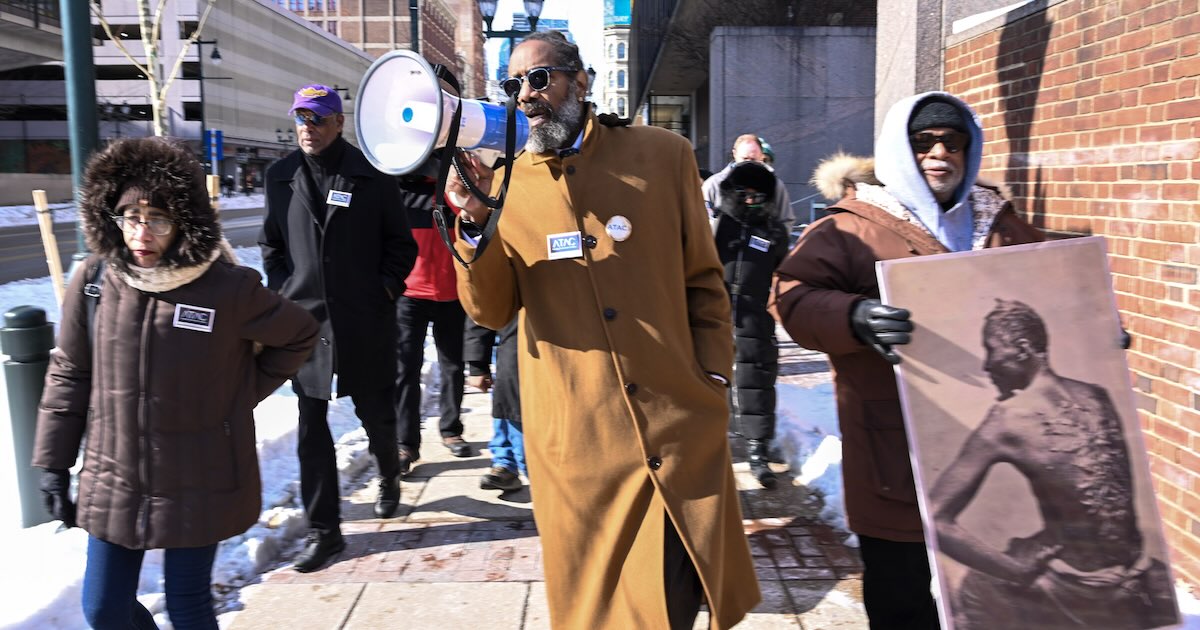
Michael Coard, the Philadelphia attorney and activist at the center of the battle over the slavery memorial and exhibit that the Trump administration removed / Photograph by Joe Piette
On Monday, Philadelphia attorney and civil rights activist Michael Coard was granted access to the secret location where the federal government has stowed away “Freedom and Slavery in the Making of a New Nation”. That’s the acclaimed, outdoor exhibit that the feds stripped away on January 22nd, without warning or public discussion, from the grounds of the President’s House and Liberty Bell Center on Independence Mall, a site visited by millions each year in search of the American origin story. The removal of the exhibit was swift, quiet, and, to many Philadelphians, an outrageous erasure in the very place that markets itself as freedom’s birthplace.
The exhibit stood on the footprint of the nation’s first White House, where George Washington lived while Philadelphia served as the temporary capital — and where nine enslaved men and women were forced to work in the shadow of freedom’s most powerful symbol. For more than two decades, Coard, co-founder of the Avenging the Ancestors Coalition, has been at the center of the fight to make that history visible. He helped lead the effort to create what became the first slavery memorial on federal land in U.S. history.
In this conversation, Coard walks through how the exhibit came to be, why its removal matters far beyond Philadelphia, what he saw when he was finally allowed to view the removed exhibit pieces in storage — and why he believes this fight will ultimately be won not just in courtrooms but in the streets.
Michael, before we get started, I imagine there are a lot of people reading about the exhibit removal who weren’t previously familiar with it. What’s the backstory?
Back in 2002, a newspaper article indicated that the Liberty Bell Center, which was then at 5th and Market, would be moved one block west to 6th and Market, because the original location was too cramped, too crowded, and too congested. When they decided on the new space, they realized that, hey, this is where America’s first White House once stood, back in 1790.
So the White House in Washington D.C., was not the first?
No. The first one was here pursuant to the Federal Resident Act of 1790, which basically said, hey, we want to build the capital in Washington, D.C., but right now it’s swampland. We have to pave it over and get everything together. In the meantime, we’ll make Philadelphia our temporary capital and have a house for the president at 6th and High Street [which later was renamed Market Street]. The home was one of the most majestic houses in the city.
And what we learned as this project moved along was that George Washington held slaves at this house, correct?
That’s right. I knew he enslaved hundreds of Black men, women, and children at Mount Vernon [his Virginia plantation], but we knew nothing about the nine slaves held here in Philadelphia. I went on WHAT-AM radio and spoke about it. The radio’s audience, who at the time were primarily African American, were as livid as I was to learn this. In response, along with others I formed the broad-based Avenging the Ancestors Coalition. Our goal was to spread the word about these nine slaves and create a memorial for them. We drafted letters and sent them to each elected African American official in Philly. If you were a City Councilmember, you got a letter. If you were a state senator, you got a letter. Mayor. Congress. We also included Bob Brady, despite him being white, because he was a very influential congressman. I should say that we later learned that some officials from the National Park Service did find out about the slaves, in the mid-’70s. But they kept it quiet, because it would have been “embarrassing” to the government. You know, slavery in the shadow of the Liberty Bell.
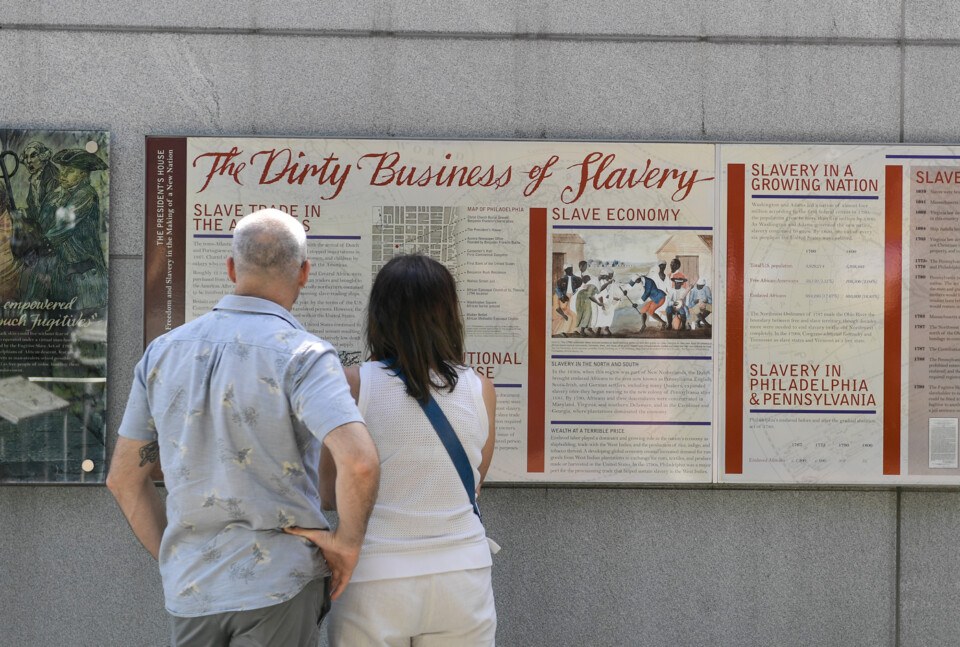
Tourists inspect “The Dirty Business of Slavery” at the President’s House / Photograph by Matthew Hatcher/Getty Images
What was the response to your letter campaign?
Well, Mayor John Street got back to us quickly. He said he knew nothing about the slaves at the President’s House and was going to officially jumpstart this idea of making a slavery memorial there. He kicked in $1.5 million, and we were on the map. Later, Congressman Bob Brady and Congressman Chaka Fattah kicked in $3.5 million. And all of this was to develop a slavery memorial on that space, which would be the first slavery memorial of its kind on federal property in the history of the United States of America. It opened on December 15, 2010.
Everything was great … until last year, when the new guy in the White House began to issue executive orders. And then last month, the slavery exhibit was removed.Back in 2002, when you undertook this project, had the federal government been receptive to the idea?
Everybody agreed that the story needed to be told, but there were discussions about the matter of degree. To them, this was going to be a George Washington memorial with a very small slavery component. From our standpoint, it was going to be a slavery monument with a small George Washington component. We made an argument about equity, the idea being that there were more statues and memorials and monuments to George Washington than to any other human being in the country. There were literally none, on federal property, that memorialized the slaves.
And you wound up with an open-air exhibit with 34 panels and interactive components that dug deep into the history of slavery.
Yes — as well as a glass enclosure where visitors could stand and look down back in time to 1790 where the foundation was for the kitchen of the President’s House and then look across the President’s House site over to your left on the street level about 30 feet ahead and see the slave quarters, which I would describe as akin to a large doghouse structure. When you walk toward the heaven of the Liberty Bell Center, you literally have to cross the hell of slavery to get into it.
Take us to the present. What exactly happened on January 22nd?
At about 3 p.m., like a thief in the afternoon, vandals assigned by the White House came and stripped down all the interpretive panels. They stripped the monument of its essence. Picture what a giant, magnificent house looks like with lots of luxury furniture in it — and then what it looks like if you remove the furniture. All you have is this shell. Some people say they “peeled” the displays off of the walls. I say that they pried them and put them in storage at the National Constitution Center.
This isn’t just a matter of destruction. This is not just a matter of defiling. This is desecration in the true sense of the word.”
My understanding is that you were able to view them this past Monday along with a handful of other viewers, including the federal judge presiding over the city’s lawsuit against the Trump administration regarding the removal.
Yes. We were allowed to do that, but under the agreement that we could not disclose exactly where the panels are being stored inside the center. But I can say this: While they are on the grounds of the Constitution Center, the particular grounds where they are located are not actually owned by the Constitution Center. I can say that.
I’m imagining them in some kind of temperature-controlled archival room, like a piece of art in storage at a museum.
That’s what I expected, too. But, no. Imagine taking the Liberty Bell and throwing it into some guy’s garage. What they basically did was throw these 34 pieces into Uncle Sam’s garage. They certainly haven’t been destroyed, and I cannot say that they were damaged, but they are in a large garage-type structure. No carpeted floors. Not wrapped in bubble wrap. Cement walls. Cement floors. Disgraceful. This isn’t just a matter of destruction. This is not just a matter of defiling. This is desecration in the true sense of the word.
In its lawsuit against the federal government, the city is arguing that the National Park Service violated an agreement NPS had with the city over how the memorial would be managed and over its very future. That agreement held that the NPS couldn’t just do whatever it wanted with the memorial. But the government seems to be claiming that the agreement no longer applies.
The agreement in question says that the NPS can’t just up and do whatever it wants with the exhibit without collaborating and discussing it with the city. The government owns the exhibit, but not with king-like dictatorial powers. While the case moves through court, the judge has ordered the federal government to make sure the pieces are properly taken care of and not damaged in any way. Meanwhile, the government came up with this ridiculously technical reason that they claim the agreement has expired [city officials are challenging the federal government’s understanding of that agreement] and anytime you are relying on a ridiculously technical argument, it means you have bullshit.
Let’s say the city wins its case. Do the panels go right back up?
No. If the city wins, the government will take the decision to the Third Circuit Court of Appeals, and if it loses there, it would go to the United States Supreme Court.
Is there any kind of potential compromise on this? Or is the only resolution that you and your group will accept the return of the panels to their proper place?
We don’t just demand that the site be restored, we want the site enhanced. More space. More information. And then? Then we want to replicate these all over the country. So in a word, Victor, no, there is nothing we will agree to as a compromise. Based on the public outrage — the public will, the public agitation and the public resistance — we are going to mount such an irresistibly powerful campaign that the federal government will be forced to return the items. People power will reach a resolution. We’ve always had a two-pronged approach based on the lessons learned from the Civil Rights struggle. You need people raising hell in the streets and lawyers raising issues in the courtroom.
What can the average Philadelphian who is horrified by this do to help?
I’m gonna quote this famous philosopher-slash-poet-slash-godfather of hip-hop, the great Gil Scott-Heron. He said, just because you can’t do everything doesn’t mean you shouldn’t do anything. It can be as little as going to the Avenging the Ancestor Coalition’s social media pages and clicking “Like.” Sign our petition. Become a member. Join one of our action teams, like our phone bank or email teams. Join us in the front lines protesting and demonstrating. Fill up the courtroom during hearings. Do whatever you can do. Fight.
To learn more about the Avenging the Ancestors Coalition and upcoming actions to fight the slavery memorial’s removal, visit their Facebook page.
This Is the Philly Bar for Seahawks Fans (or Just Patriots Haters) This Sunday
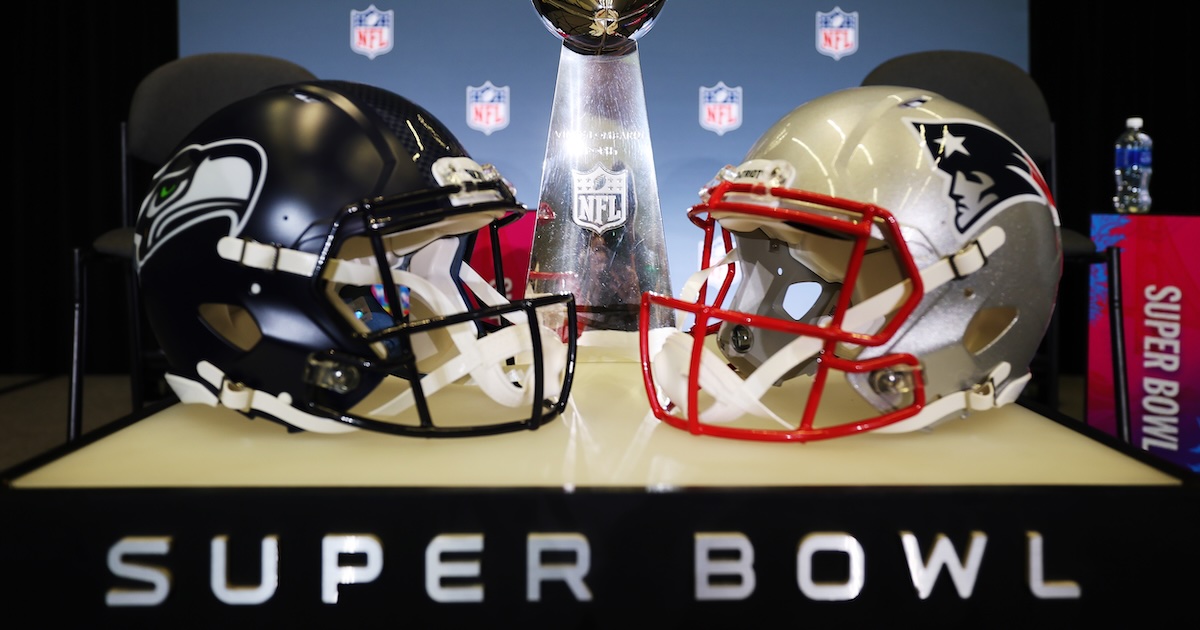
This Sunday, it’s the Seattle Seahawks vs. the New England Patriots in Super Bowl LX, and Philadelphia bar Sonny’s Cocktail Joint is going all-in for the Seahawks (Photo by Chris Graythen/Getty Images)
This Sunday, the Bad Bunny concert — otherwise known as Super Bowl LX — will start at 6:30 p.m. in lovely Santa Clara, California. The Seattle Seahawks (14-3) are set to face off against the New England Patriots (also 14-3), 11 years after the one and only other time that the two teams played each other in the Super Bowl, a game that saw the Patriots victorious with a final score of 28-24. And one Philadelphia bar owner is taking this opportunity to show just how much he, like many of the rest of us, hates the Patriots.
Best of Philly-winning Sonny’s Cocktail Joint (yes, this is the bar across from Bob & Barbara’s that has in its short history a fire that closed it followed by a flood that closed it after it reopened) has decided to go all-in for the Seattle Seahawks on Sunday, declaring itself a Seahawks bar — notably, for that one night only.
“I fucking hate the Patriots,” says Sonny’s Cocktail Joint co-owner Chris Fetzfatzes, who is also behind South Philly’s Grace & Proper and the late brunchery Hawthornes (RIP). “Tom Brady is a wiener. The whole franchise is a wiener. The Patriots beat us. And the Patriots beat Seattle. So always, always, always, it’s fuck the Patriots.” (Former Patriots quarterback Tom Brady is, of course, no longer involved with the Patriots, but the hatred for the Patriots will linger for years to come thanks to the team’s previous association. In point of fact, Brady is now a minority owner of the Las Vegas Raiders and says he is not rooting for the Patriots in this Super Bowl.)
A coaster at temporary Seattle Seahawks Super Bowl bar Sonny’s Cocktail Joint (photo by Laura Swartz)
So what does becoming a Seattle Seahawks bar for the Super Bowl and only for the Super Bowl mean exactly? Fetzfatzes explains that there will be Seahawks colors represented by balloons and other decor. Plus, Seahawks swag and some relevant menu additions.
In the cocktail realm, you can enjoy a 12th Man-hattan (at their stadium, Seahawks fans are known as the 12th man), a Darnold Palmer (the last name of the Seahawks quarterback is Darnold), or an Emerald City Last Word (Seattle is nicknamed the Emerald City thanks to all that rain-fueled greenery), each $12.
For food, there’s a Seattle-inspired pizza, “Pike Place Chowder”, and a “Seattle dog.” Hot dogs are already a popular choice at Sonny’s, so Fetzfatzes investigated what the Seattle version of a hot dog is. And it turns out that it involves Philadelphia cream cheese smeared onto a toasted bun. Who knew?

The Seattle Hot Dog at Sonny’s Cocktail Joint, with some optional additions (photo courtesy Sonny’s Cocktail Joint/Peter Breslow Public Relations)
I asked Fetzfatzes if his servers and bartenders would be donning Seahawks caps, shirts and other gear in recognition of the bar’s support for these West Coast birds. He paused for a moment. And then offered: “I think that would be going too far.”
Pat’s Steaks Owner Frank Olivieri Reveals the Truth About His Late Father

Left: Frank Olivieri Jr. with Frank Olivieri Sr. in front of Pat’s Steaks in South Philadelphia in the early 1980s; Right: Frank Olivieri Sr. in his obituary photo
Last week, longtime Pat’s Steaks owner Frank Olivieri Sr. passed away at the age of 87. Here, his son and Pat’s Steaks heir Frank Olivieri Jr. shares memories of Frank Sr., aka the guy who wouldn’t give the Pope a free cheesesteak.
Frank, condolences on the loss of your father. When he died last week, I saw some posts on social media saying that the “inventor of the cheesesteak” had died. But that math doesn’t make any sense. Your father did not, in fact, invent the cheesesteak, right?
No, it was my great-uncle, Pat Olivieri, and my dad’s father, Harry Olivieri, back in 1930. Well, that’s when they came up with the steak sandwich, and years later, someone at Pat’s added cheese to it. My dad never really intended to get involved with the business. Like me, he started working at the store when he was 11 or 12 years old. But he wanted to be a lawyer. He wanted to go to Penn Law. But then Pat, when he was on his third marriage, went out to California and decided to purchase all these tracts of land there, and my father and Harry bought the business. I became a full partner in the ’90s and, about 10 years ago, sole owner of Pat’s.
And it was really under your father’s watch when the cheesesteak entered the modern era, when it became a “thing.”
Exactly. Cheesesteaks found their way onto the world stage after the first Rocky movie, in 1976. Pat’s was always popular, but after that, it became a destination, a place where famous people just had to go.
What else changed about the business during your father’s time there?
Cheez Whiz. A lot of people don’t realize this, but my dad was the first one to put Cheez Whiz on the sandwich. That was back in 1957. That was at a time when people would still socialize at home. You’d always have friends coming over the house, and they would bring snacks and dips. And someone brought over Cheez Whiz, and he tried it and realized it would be the perfect thing for the steaks. The customers loved it. We always had a vat of Cheez Whiz, and one day, someone dipped a French fry in it, and cheese fries were born.
Also born: high cholesterol.
[laughs] Pat’s Steaks is a vegan’s worst nightmare and a cardiologist’s wet dream.
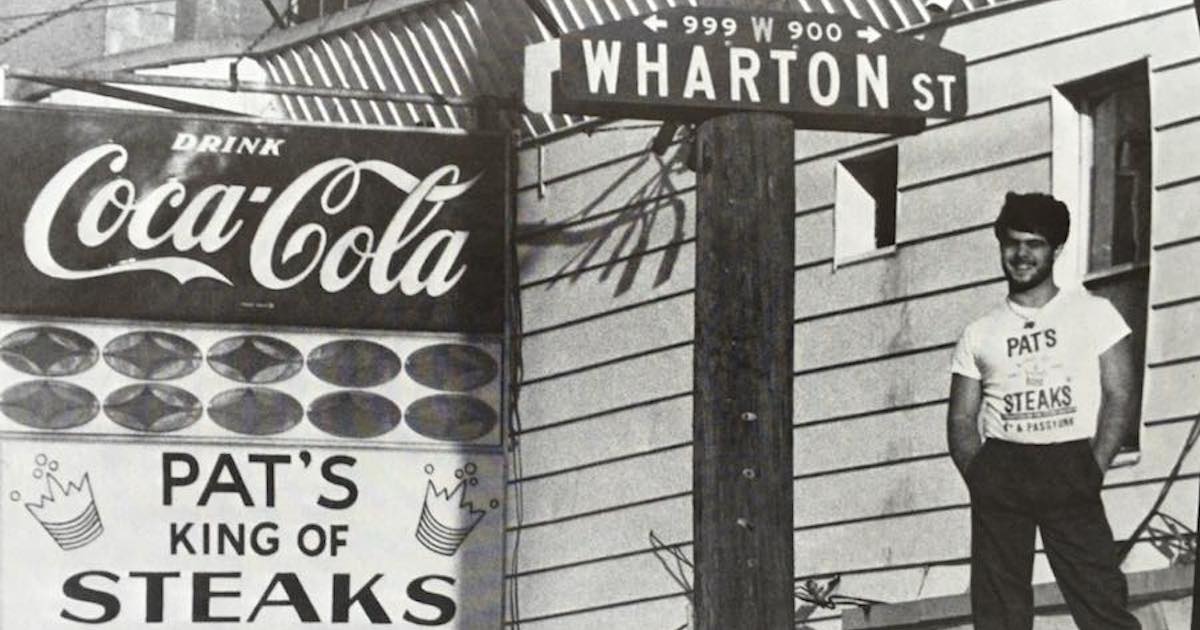
Frank Olivieri — the current owner of Pat’s Steaks in Philadelphia — standing on a roof at the cheesesteak shop in 1982. / Photograph courtesy of Frank Olivieri/Pat’s Steaks
What was he like as a boss?
Oh. My. Gosh. He had an iron fist. He carried a key chain with maybe 7,000 keys on it, so we would hear him coming from the back office, and suddenly we’d pick up rags and start wiping things down, because you did not want him to catch you doing nothing. Oh, and he was really, really good at making sure everybody got charged for their sandwiches. When the Pope came to town last, his valet came to give us some Pope swag and pick up some sandwiches, and my father said to me, “You’re charging them for the sandwiches, right?” And I told him that they were for the Pope. And he said, “I don’t care who they are for: You charge them!” And I said, “Okay, dad. I’ll see you in hell, I guess.”
Oh my!
And I remember this time when I was 15. I was cutting bread. And you have to keep in mind that this building was pretty much exactly the same as it was in the 1800s. My father didn’t do any renovations. He didn’t make any upgrades. So I’m cutting the bread and all of a sudden I fall through the floor in the back. My knee is bleeding, and my father hands me a screwdriver and a pair of pliers and points to the stop sign at the corner and tells me to take the bolts off and bring it to him. So I do. As I’m bleeding. And then he screwed the stop sign to the floor to cover the hole. I’m not kidding! And there were also all these Cheez Whiz can lids covering all these other holes in the floor. He had screwed them all on there.
Much has been made about the rivalry between Pat’s and Geno’s. Did that begin when your father had the shop?
You bet. It started in the ’60s when Geno’s opened. Not because they were competition. My father didn’t mind the competition. Competition is a good thing. But Geno’s would put up these signs degrading Pat’s, like “You don’t have to order double-meat at Geno’s to get a real sandwich.” (My father was famous for putting barely any meat on the sandwiches.) Or “Geno’s is the Ace of Steaks,” the idea being that an ace beats a king. He never liked that kind of stuff. So it became a battlefield for a while. But later, they maintained the idea of the rivalry but were secretly friends. And they would get together and discuss raising prices together. I wouldn’t go so far to say that they were price-fixing, but … they’d both raise the price a nickel, and people would just go nuts. People still go bananas when I raise the price 20 cents. “Do you really need another house?” Yeah, I’m going to buy another house with your fucking 20 cents. Just look in between the cushions in your sofa.
I’ve had cheesesteaks with you before, so I know that you’re a meat, fried onion, salt, pepper and hot sauce kind of guy. What about your father?
Fried onions, dill relish, and Gulden’s spicy brown mustard.
My kids yell at me for putting Gulden’s on my cheesesteaks, so I’m glad I’m in good company. But I never tried relish.
I’m actually going to put it on the menu and call it the “Frank Sr.” Put on your snowshoes and come and get it.
Busy down there amid all this snow?
I’m in Palm Beach. But I can see the shop from the cameras, and all my employees are either eating or playing sudoku.
South Philly’s Pulitzer-Winning Playwright James Ijames Loves Trash TV Just As Much As We Do
James Ijames / Photograph by Justin DeWalt
South Philly’s Pulitzer-winning playwright James Ijames returns with not one, not two, but three local shows this season – one starting at the Arden this Thursday. We caught up with him to learn about life, love and his strange relationship with The Secret Lives of Mormon Wives.
My last name is pronounced … like times without the t.
I grew up in … Bessemer City, North Carolina. Everybody knows each other.
I came to Philly in … 2003 to get my MFA at Temple. I just moved to Manhattan in July, in part because I’m now tenured at Columbia, where I’m the new head of playwriting. But I still have my house at 4th and Wolf, which is where I stay when I’m back in town.
My first theater role was … as Hamlet, when I was a 19-year-old student at Morehouse.
My desire to return to the stage is … zero, zilch. It’s too anxiety-inducing for me to be an actor. And I just don’t enjoy it enough to suffer through that anxiety. Writing and directing is where I belong.
When I’m in Philly, I always go to … as many restaurants as I can. You have to work real hard to find a bad meal in Philadelphia. For quick bites, I regularly do Federal Donuts and P’unk Burger. And I do a lot of shopping at Head House Books. I love that store, and it’s on my walk from my house to the Arden.
My relationship status is … married. My husband is an educator who works for the Philadelphia School District.
When I won the Pulitzer for Drama in 2022 for my play Fat Ham, I celebrated by … having cake and lots of champagne at my house in Philly with my husband and two friends. It was actually quiet. Nice.
The most famous friends in my cell phone are … Cynthia Erivo and Colman Domingo, both of whom were producers of Fat Ham.
James Ijames (center) with theater director Saheem Ali (right) at a pre-Tonys party hosted by actor Colman Domingo (left)
The most beautiful space in Philadelphia is … my living room. It’s so maximalist. There’s way too much art on the walls. As soon as people walk in, their shoulders drop. And I love 30th Street Station, a relic of another time. I admire the grandeur.
My current bingeing obsession is … The Secret Lives of Mormon Wives. It’s fascinating for me to look at such a, um … homogenous environment. It’s just insane. I can’t justify anything they do or so. I violently disagree with so much of what they do and say. But it all helps me understand something about the world. I only watch garbage TV. When I watch prestige TV, that feels like work, because it’s something I very much want to be writing myself in the near future.
This season, I am … having three plays produced by three different Philly theaters, something I had to leave Philly to have happen. The Arden is doing the regional premiere of Good Bones, the Wilma is doing a revival of The Most Spectacularly Lamentable Trial of Miz Martha Washington from 2014, and Philadelphia Theatre Company is presenting the world premiere of Wilderness Generation.
My parents taught me to be … honest, on time, hardworking, and just.
If you really want to annoy me … approach me with small talk.
If you’re pouring me a cocktail, I’ll take a … Boulevardier, please.
One bad habit I cannot break is … ordering in. They make it way too easy. I need to get back to cooking.
When I want to relax … I walk for hours.
The thing I love most about South Philly is … that if anything is going on in front of my house, my neighbor will let me know about it. Immediately.
Since winning the Pulitzer, my life has become … busier! But the nice thing is that being a writer, you get to hang on to a kind of anonymity. Most people have no idea what you look like.
My current playlist includes … Ariana Grande, Minnie Riperton, Teedra Moses, vintage Toni Braxton, Kehlani, Stevie Wonder, and Aretha. I’m a 45-year-old Black gay man, and everybody you expect to be here is here. I am a cliché.
Published as “One of Us: James Ijames” in the February 2026 issue of Philadelphia magazine.
FringeArts Finally Lives Up to Its Destiny

We Come to Collect: A Flirtation, With Capitalism / Photograph by Courtney Charles
There was much fanfare in 2013 when FringeArts opened in an early 20th-century pumping station — a massive $7 million renovation that included a sizable bar and restaurant and a 300-seat state-of-the-art theater. The vision for the space was clear: It would be the permanent headquarters of the beloved Philadelphia Fringe Festival, which had run (without a theater of its own) every September since 1997, as well as a destination for the live arts throughout the year. Alas, the venue had fallen woefully short of that latter goal. But that’s all changing now, thanks to Nell Bang-Jensen, who in September 2024 became the organization’s CEO and producing director.
In December, FringeArts announced its first-ever winter-spring season, which launches this week with a darkly funny exploration of American consumerism, We Come to Collect: A Flirtation, With Capitalism, from the mind of Obie-winning West Philly theater creator Jenn Kidwell (lauded as a “comic genius” by the New Yorker).
Later this month, local performer Lee Minora revives her saucy, satirical 2025 Fringe Festival hit Baby Everything, followed in March by an avant-garde work from Japanese choreographer Hiroaki Umeda.
And what would a Fringe season be without the gender-bending Bearded Ladies delving into the cult of American Girl dolls? They’ll present an irreverent world-premiere musical on the subject in May, closing the season.
Our responsibility at FringeArts is to create more opportunities for the next generation of Philly artists — shows that start at a grassroots level. In short, we’re all about new stuff.” — Nell Bang-Jensen, FringeArts CEO
“There are lots of amazing arts organizations in Philadelphia producing lots of great works,” says Bang-Jensen, a Swarthmore alum whose résumé includes stints at Pig Iron Theatre Company, the Wilma, and the late University of the Arts. “But our responsibility at FringeArts is to create more opportunities for the next generation of Philly artists — shows that start at a grassroots level and that we can hopefully get to travel the world. In short, we’re all about new stuff.”

Nell Bang-Jensen, head of the Philadelphia theater venue FringeArts (photo courtesy FringeArts)
Part of generating that “new stuff” includes a just-announced residency program: Fringe will offer funding and other resources to a number of artists each year, selected from a bevy of applicants by a panel of Philly artists. And then there are the monthly pay-what-you-can Scratch Nights, in which local performers are invited to present works in progress for theatergoers.
“It’s now more important than ever for people to see arts and culture,” observes Kidwell, who has been working on her show for several years. “People need to engage their imaginations. That’s the beginning of ending the politics of the moment – to spectate and to lean into imagination and to reflect.”
Bang-Jensen says she knows the audience is out there for year-round programming, based on festival turnout of late. “The last two years saw record-breaking ticket sales,” she says, “plus a record number of artists performing and a 17 percent increase in unique ticket buyers. And, for the first time ever, more than 50 percent of our audience was Gen Z and millennial — the new generation of patrons. Audiences are here for this. So we’re going to give it to them.”
Published as “Full-Blown Fringe” in the February 2026 issue of Philadelphia magazine.