
Angela Duckworth on Her New Book, Grit Controversy, and Parenting in a Digital Age
The Penn professor and bestselling author just released Situated.
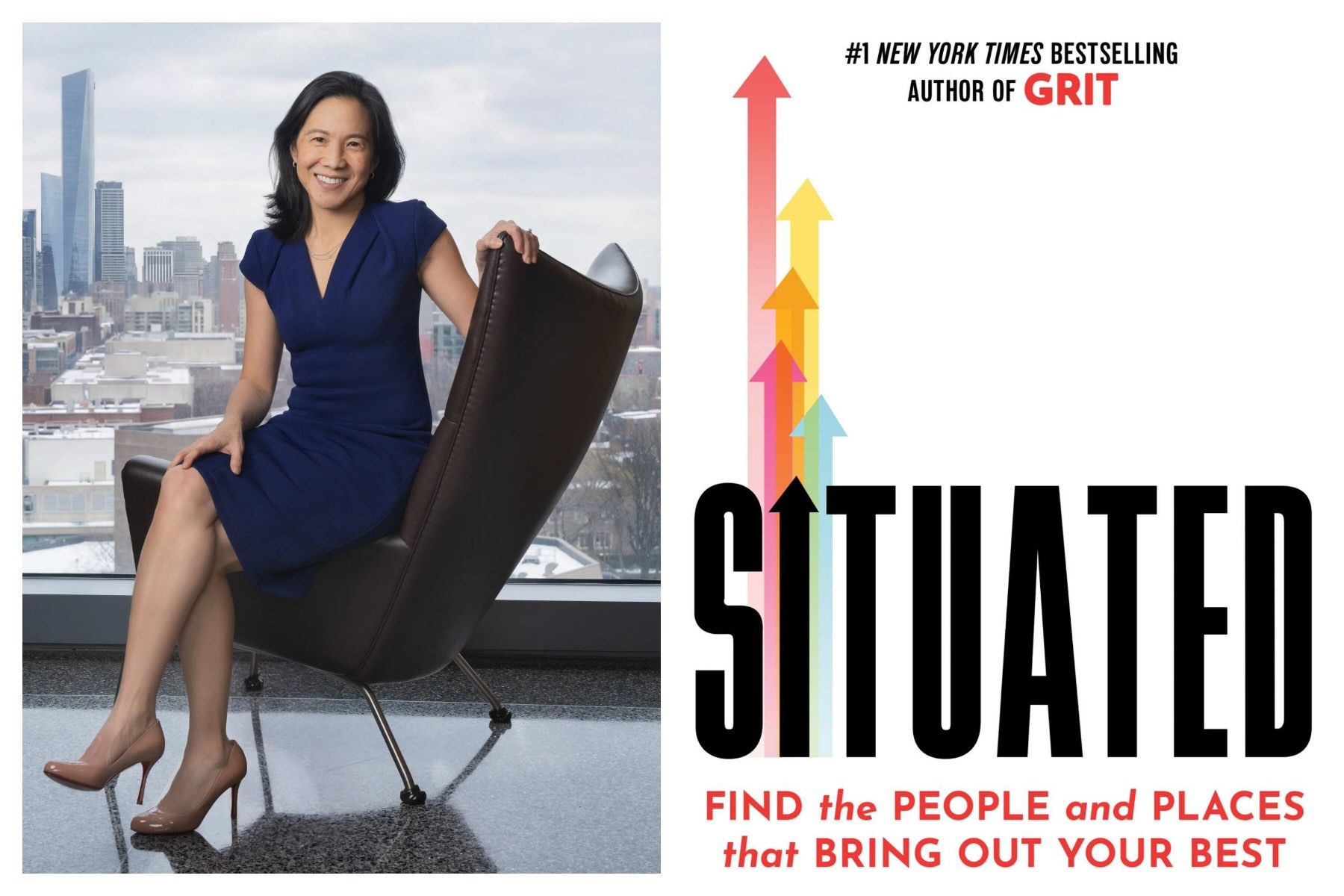
Left: Grit author Angela Duckworth | Right: Angela Duckworth’s new book, Situated
Listen to the interview edition here:
Ten years ago, psychologist and Penn professor Angela Duckworth, a 2013 recipient of the MacArthur “Genius Grant,” released her bestselling book Grit, which argued that success was not about innate talent or genius but the combination of passion and perseverance, or grit. That book was variously lauded and criticized, with one of the main complaints being that Duckworth was suggesting that all a person had to do was work harder, ignoring the fact that some people don’t have the same opportunities to thrive, no matter how hard they work. On Tuesday, Duckworth released her followup, Situated: Find the People and Places That Bring Out Your Best. We caught up with her while she was in Cambridge to launch her book tour, which stops in Philadelphia on September 24th.
Angela, I’m a little frustrated. For the last 10 years, I thought all I needed to succeed in life was grit, which I have plenty of. And now I learn that’s only part of it. Can you explain what you mean by being “situated”?
Happy to, and I hope this comes across as a both/and not an either/or. To be situated is to be in circumstances where all that individual effort that I wrote about in Grit pays off, and that’s not a given. When you have mentors, for example, or when you are part of a group as opposed to doing everything on your own. There are also your physical circumstances. All of these elements of your situation matter, and I think the first place I look as a psychologist and as a striver myself is within, to your mindset, your attitude, and your ability to control your individual effort. But much of human behavior and motivation is actually rooted in our immediate circumstances, and so to ignore the situation because we think it’s all will is a profound mistake.
You got plenty of criticism for Grit. Did you write an incomplete book or make a mistake by ignoring situation?
I got criticized by some that Grit was a “pull yourself up by your bootstraps” book. And I think an easy narrative would be that the critics were right and that I was now having my come-to-Jesus moment, my redemption moment. But that’s not quite accurate. But I knew when I wrote Grit that I wanted to focus on the thoughts running through the minds of people who work incredibly hard. And I wanted to talk about the difference between, say, high-quality practice and how that’s different from the mindless practice that kids put in at pianos and violins everywhere. But for Situated, I looked at successful strivers and high performers and found that all of those I interviewed have a suite of mentors who are guiding them in their decision-making and encouraging them when they’re discouraged.
So Situated is not a direct response to the Grit critics?
I guess that would sound good, but it’s not quite true. I spent the first half of my career and a lot of money looking at the common denominators inside the head. That’s where I went first. And the common denominators of situations is where we look second. This is where my attention turned. I will say that I had my eyes opened to the power of the situation. So instead of just forcing yourself to wake up earlier, stay up later, and work harder in between, you can put yourself in situations where passion and perseverance make sense and where there’s a return on your passion and perseverance, where passion and perseverance pay off.
You talk a lot in your book about mentors and asking for help and collaborating. But we’ve become such a DIY culture.
It is such a DIY culture, Victor. Let’s look at the 20-year trends on how Americans spend their time. We are spending less time with other people and more time alone. We are spending less time outside of the house and more time in it. We’re not going out to eat. We’re not going out to exercise. We’re not going out to work. We’re not going out to socialize or worship as much as we used to. People are alone in their homes. This book isn’t just about social connection, but it is about taking stock of our situations and not just as a society but individually; drawing attention to your current situation is something people don’t do enough of. “You can’t change your situation but you can change how you respond to it” is the received wisdom, and I want to challenge that. It’s a heroic thing to take stock of your situation and ask how it can be better. In American culture, it’s considered cowardly, like almost cheating, to try to create a situation where things are easier and not harder. If you’re trying to do something new like start a company, become a writer, get more exercise, run a marathon, we ask, How do we do this? And the tendency in our culture is to think, What YouTube video can I watch? But I think it’s better to find a group of people that are not necessarily your best friends but a group of fellow strivers who are like-minded and start there.
Are there exceptions to this — successful people who just do it all on their own? I think about a person like Elon Musk. Did he have mentors?
I don’t know a lot about Elon Musk and his mentors or lack thereof or his peers or lack thereof, but I see why you would bring him up. It’s not abundantly clear that he’s got an Obi-Wan Kenobi lurking in the background giving him wise advice, but he might be better off if that were the case. I do think it’s part of human nature, though, that we are social animals and that we tend to think better together than alone.
In Situated, you talk about three different “boxes”: Situation, thoughts and response. Most self-help books focus on the second two. Is that a mistake?
The first self-help book and so many since tell us to look within for strength and not without. There’s so much about will. There are so many poems about will. Modern self-help is all about the second box, changing your thinking. That has been the focus of advice that has been historically given. But my advice is to trace those thoughts to the situation. And that is an unheard message. I wrote this book because I thought it had to be written. I wrote this book because I felt like people needed to know that if you feel like your thoughts are the problem, you should ask yourself, When do I have these thoughts? What situation am I in? Someone might ask, Why can’t my boy concentrate? What I would say is, When can your boy concentrate? What is that situation? And who can help you change it? People I studied who work really hard want the best coach possible to make them better. Every CEO I interviewed has some kind of executive coach or advisor. Every athlete is asking, “Is this the right coaching team?”
What does the research say about willpower?
In surveys, Americans will trot out willpower as why they didn’t follow through on their New Year’s resolutions. When I was a PhD student, a lot of the research energy around behavior change was on willpower and whether you could build it like a muscle, and if you did really hard things and you suffered, then your muscle would be stronger and the rest of your life would go better because of course you need willpower. But it has become abundantly clear that willpower is the absolute worst way to change your behavior. When people exercise willpower, they feel exhausted and depleted, so that’s one reason why willpower isn’t great. It’s a terrible feeling when you have to force yourself to go to the gym. I don’t want to go to the gym. But I’m going to make myself go to the gym. And the other fly in the ointment for willpower is that it’s fallible. Eventually, people cave into temptation. Sure, you can force yourself to go to bed at 10 p.m. and stay off your phone just through the act of will. But eventually, you are going to stay up past 10 p.m. and it’s really smarter to just physically put your phone in a place that is inconvenient to get around the time that you go to bed. Keep it in the kitchen instead of on the nightstand. Change that situation.
If someone reads your book and wants to make one change immediately, what’s the highest-leverage thing they can do to engineer a better situation for themselves?
The most immediate thing anybody could do is audit and edit their person space, whatever is within three feet of you. Whatever is in sight and within reach is going to disproportionately influence what you think about and then what you do. So this would mean frictioning up temptation, like move things that you don’t want to eat or drink. Move them farther away from you. Out of sight. When students are asked a simple question about their studying habits — where do you keep your phone when you’re studying? — they are given five multiple-choice options, from “right next to me with the screen and notifications on” to the phone being in another room all together. When we match their responses to their academic performance, it is a clear monotonic trend that the farther the phone, the higher the GPA.
How does this book relate to parenting?
There’s a part of the book that is all about situational responsibility, and that’s about changing situations for other people, including and most importantly, the people who cannot change their situations for themselves. That’s where children come in, because when you are two years old, you cannot decide what food is served or how often you are on your screen or whether there are books in the home or whether you are taken to a library. I write about Debbie Phelps, mom of Michael Phelps. Michael has ADHD, and he did as a young boy. He had a situationally wise mom who knew that in the right situation, Michael wouldn’t be a pain in the butt, as many teachers were writing notes home to tell her about. So she decided to take Michael to the pool seven days a week. Good parenting isn’t just asking your kids to be a certain way but to put them in situations that encourage them to be that way.
You’re a mom. I’ve met your daughters, and they are both incredibly impressive. What is it like being the daughter of Angela Duckworth?
I don’t think I ever asked about a report card. We also weren’t the kind of family that gave out $5 bills for As, and we also weren’t the family that meted out punishments for A-minuses. But I was a big part of their situation. Children model the values and behaviors that their parents are embodying, and when you grow up in the Duckworth home, a lot of work is getting done. It’s in the air that if you’re going to do anything, you’re going to do it well. Some of this can be explicit like values you put on a wall and some of it is implicit. So my daughters were raised not explicitly but implicitly to be strivers. I hope we haven’t taught them that you can get everything you want in life by just trying harder. If I’ve raised my girls to think that grit was everything, then I would not be setting them up for a life of success and happiness. I want them to believe in hard work and I want them to find situations that make their hard work easier.