Ten Years Before You Can See Everything, Elizabeth Holmes Came to Philly
This 2016 video offers a very different look at the Theranos CEO.
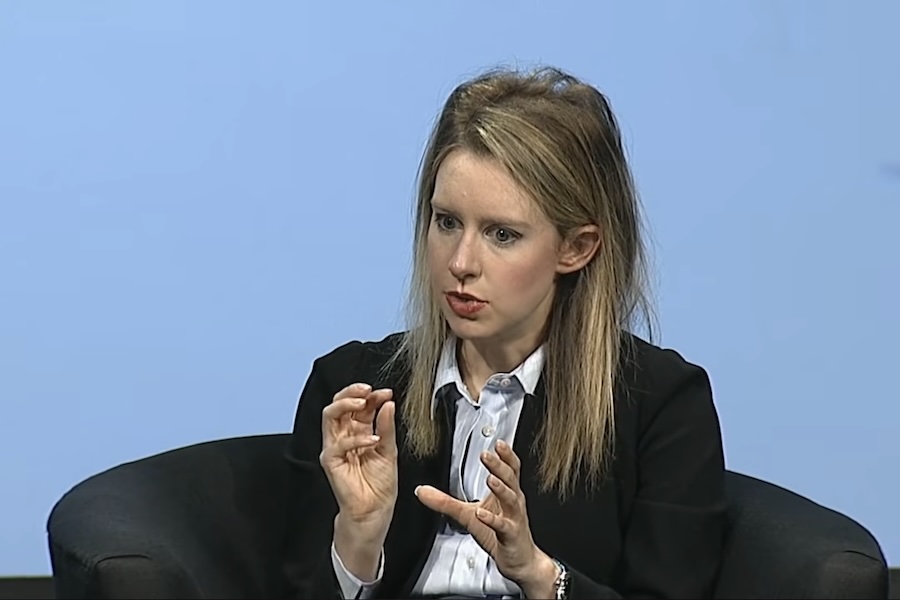
Theranos CEO Elizabeth Holmes tried to sell her new miniLab at a conference in Philadelphia in 2016. / Image from Holmes’s presentation “Theranos Science & Technology: The Miniaturization of Laboratory Testing”
Listen to the audio edition here:
It was August 1, 2016, and Theranos was already in big trouble. In one calendar year, the company had been exposed by the Wall Street Journal and other publications for using deceptive methods, and federal investigators were investigating. Theranos had also lost its two big-money deals with Safeway and Walgreens, and endured major shakeups in its board of directors. President/COO Sunny Balwani had stepped down in May.
Meanwhile Elizabeth Holmes, company founder and CEO — who’d been hailed as the 110th richest woman in America according to Forbes magazine in September 2014 — was now said to be worth exactly nothing.
Just a month before she came to Philly for the annual meeting of the American Association for Clinical Chemistry, Holmes was banned from running a laboratory in California for two years. Very bad news for the head of a biotech company based in Silicon Valley. (BTW: Holmes has since been slapped with a 90-year federal ban.)
So her appearance at the Pennsylvania Convention Center that muggy August afternoon might have seemed like her last best chance to save the company (possibly by selling it).
Not everybody in the AACC wanted her there.
“The invitation the association had extended to Holmes was highly controversial among its members,” wrote Pulitzer Prize-winning journalist John Carreyrou in his best-selling page-turner Bad Blood.
“Some had argued forcefully that it should be withdrawn given the events of recent months. But the association’s leadership had seen a chance to generate publicity and buzz for the normally staid scientific conference. It was proven right in that regard: several dozen journalists had made the trek to Philadelphia to watch the spectacle.”
Those in attendance likely expected some sort presentation on the company’s scientific discoveries or conclusions, but Carreyrou said it was more of a “new product exhibit.”
Holmes began with a one-hour slideshow (see video below) about the merits of the new and unproven miniLab. After that came a panel discussion during which she and her product were the subject of scrutiny and subdued mockery. She’d lost the room, inside and outside the convention center. Still, she persisted.
The miniLab — touted by Holmes as the portable version of the O.G. Theranos device — was supposedly “capable” of doing fancy medical stuff, like DNA tests and cell counts.
If you’ve seen You Can See Everything, you already know that “capable” is in the eye of the beholder. (Theranos whistleblower Tyler Shultz notes that this Theranos 2.0 unit is the one Holmes showed Fielder in the movie, as opposed to the original device that was used during the fraud.)
Nathan Fielder and Lance Oppenheim’s three-hour documentary may have felt exhaustive, but it is purposely light on archival footage, and doesn’t much dwell on Holmes’s unusual brand of cool. In her heyday, she used to put on a turtleneck, lower her voice, and charm investors into giving her billions to play with.
By the time she got to Philly in 2016, the turtlenecks had been mocked out of existence, but you could still see how she built an empire out of thin air.
Writes Carreyrou: “The odds that Holmes could pull off this latest Houdini act while under criminal investigation were very long, but watching her confidently walk the audience through her sleek slide show helped crystallize for me how she’d gotten this far: She was an amazing saleswoman. She never once stumbled or lost her train of thought. She wielded both engineering and laboratory lingo effortlessly and she showed seemingly heartfelt emotion when she spoke of sparing babies in the NICU from blood transfusions. Like her idol Steve Jobs, she emitted a reality distortion field that forced people to momentarily suspend disbelief.”