
How On Earth Did Live Aid Even Wind Up in Philadelphia?
And how the Eagles could have prevented the whole thing from happening.
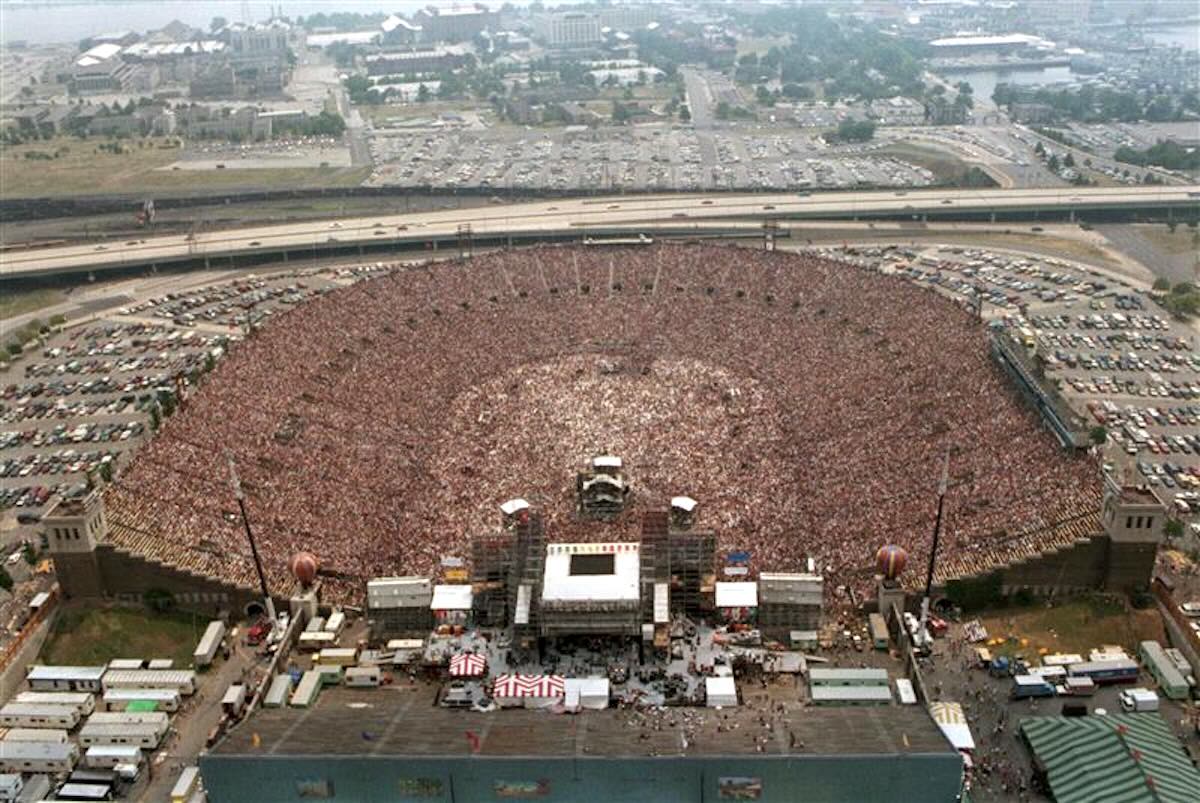
An overhead shot of JFK Stadium in Philadelphia during Live Aid (Getty Images)
This story is part of our continuing coverage in honor of Live Aid Week in Philadelphia. Check back daily for more Live Aid fun.
Back in 1985, Philadelphia wasn’t exactly the hot spot it is today. This was long before national publications recognized our food scene. This was long before Lonely Planet would declare Philadelphia the fifth best place to travel to in the world. Neighborhoods now considered highly desirable (say, Fishtown and Northern Liberties) were considered by many to be desolate in 1985. Philadelphia was headed in the direction of bankruptcy. And let us not forget that in May of that year we gained the dubious distinction of becoming the only American city to bomb its own citizens. So it was by no means a no-brainer to pick Philadelphia for Live Aid.
When promoters announced that the U.S. portion of Live Aid would take place here, observers scratched their heads? Philly? Really?! A reporter for Scranton’s Times-Tribune newspaper put it this way in June of 1985: “There are 100 U.S. cities that would have died to be the American standing grounds for Live Aid.” So how did Philly wind up with the prize?
Concert organizers had two main requirements. First, they wanted a central location. Second, they wanted the ability to accommodate the largest ticketed crowd possible in a contained, controlled setting. In other words, they weren’t looking to re-create the free-for-all known as Woodstock.
Put those two conditions together in 1985 and you get JFK Stadium. The ancient 1926 concrete bowl was on its last legs, literally falling apart. But central it was, positioned nicely between Washington D.C. and New York and with an international airport just 10 minutes away. And it sure was big, one of the largest stadiums in the country with a capacity of 102,000. (Wembley Stadium, the host for the European portion of Live Aid, held a paltry 72,000. Pffft!)
Beyond the vastness of the stadium, Mayor Wilson Goode offered JFK to Live Aid for free. He even threw in traffic police and cleanup crews. And he agreed to keep the city’s hands out of the lucrative Live Aid souvenir-sales piggy bank. (The city did, however, take a cut of food concessions and parking; Philly’s gotta Philly, starving people in Africa be damned.)
A stadium on the West Coast made a comparable offer, but the three-hour time lag didn’t fit very nicely with a two-continent, 16-hour simultaneous concert extravaganza. Had organizers chosen that West Coast stadium, the U.S. portion would have started at 6 a.m. instead of 9 a.m. That time difference would also have made it nearly impossible for Phil Collins to jet from one stadium to the other, as he did for Live Aid, though with regrettable consequences. (More on that here.)
The Philadelphia Eagles could have prevented Live Aid from using JFK Stadium. The team rented JFK as its practice field and had exclusivity on it for the entire summer of 1985. They didn’t want rambunctious concert crowds tearing up their field. But Goode and his cohorts were able to smooth over the team’s concerns, in part by laying a special polyester geotextile fabric over the natural grass in an effort to protect it.
So JFK it was – not that legendary West Coast promoter Bill Graham, a driving force behind the Philly edition of Live Aid, was all that thrilled about it. “What a fucking dump” is what WMMR DJ Pierre Robert recalls Graham saying upon seeing the stadium. Mayor Goode apparently agreed. He condemned JFK Stadium four years later, and workers demolished it in 1992 to make way for what is now known as the Wells Fargo Center.
“The stadium was falling apart before demolition,” the person in charge of demolition told the Inquirer in April 1992. “It scares me to think that there were 100,000 people in here.”