Michael Solomonov and Steve Cook Talk Success, Failure, and How to Get a Table at Zahav
Plus, the South Philly restaurant they eat at all the time.

Michael Solomonov (left) and Steve Cook at Zahav in Society Hill / Photograph by Kyle Kielinski
Owning a restaurant isn’t easy. Owning 13? Plus a sprawling Fishtown event space? Sheesh. Just over 20 years after they first started working together and 17 years after opening Zahav in Philadelphia, Steve Cook and Michael Solomonov open the books — and tell us where to get the most amazing cookies and pho.
Steve, I think your casual diner knows the name Michael Solomonov and what he does, but … what exactly do you do on a day-to-day basis?
SC: [Laughs] That’s the question I ask myself every morning. That’s the hardest thing about being an entrepreneur. Nobody is sitting there telling you what to do. You just figure it out. You just do it. But, in general, I manage all the development work. I handle kind of big-picture operations. Mike and I work together on culinary concepts. I guess I do a little bit of everything, which keeps it interesting.
Is there anything you can cook better than Mike?
SC: A lot of things! [Laughs]
MS: He’s a really good cook, and nobody knows that about him. For most of the projects, he actually led the culinary development much more than I did.
You’re not going to tell me that Steve is secretly the one behind the award-winning, world-renowned hummus, are you?
MS: We actually did develop that together! But by default, I’m the hummus guy. We come up with basically everything together. But Steve is actually the one behind the famous Jaffa burger, the French fries at Laser Wolf, and the tehina shakes at Goldie.
Steve, what were you doing before you met Mike?
SC: Well, I was the chef at Marigold Kitchen in West Philly. Actually, let me take a step back. I originally met Mike through my wife, Shira. They grew up together in Pittsburgh. And then when I was at Marigold, I hired Mike to replace me in the kitchen. That was when we first worked together. Marigold was a great restaurant made better by Mike’s arrival, but never an extremely busy one, so we had a lot of time to get to know each other and to see where things might lead. It was on the back steps of the Marigold Kitchen at 45th and Larchwood where the idea for Zahav was originally developed.
Correct me if I’m wrong, but one of the most unusual things about Marigold was that there were upstairs tenants who had to walk through the dining room with all their groceries, backpacks, bikes, whatever, in order to access the stairs to their apartments.
SC: [Laughs] That’s exactly right. You have a good memory. Marigold was first opened in 1934 as a boarding house. When I bought the restaurant from the previous owner, I inherited his tenants. We’d have pizza delivery guys coming through the dining room, tenants rolling their bikes through. I was secretly happy when, a couple of years in, our insurance carrier told us they would no longer insure the restaurant if we had tenants upstairs.
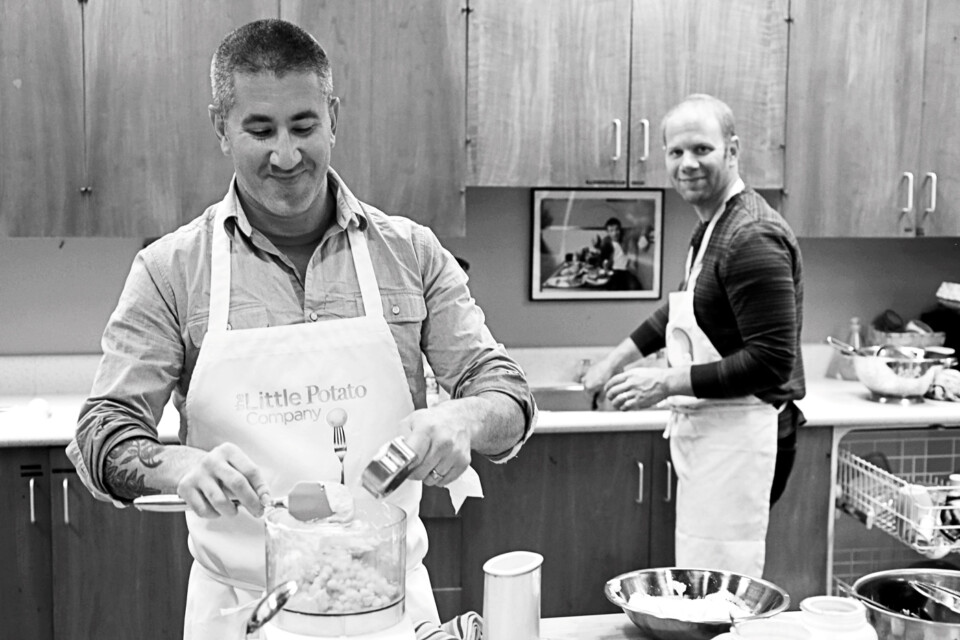
Michael Solomonov and Steve Cook making Zahav hummus from scratch in October 2015 / Photograph by Andrew Francis Wallace/Getty Images
Mike, you of course worked in the kitchen of Vetri. Who was the tougher boss, Marc or Steve?
MS: It’s so hard to say. At this point, Steve and I are brothers, and Marc is one of my closest friends in the world and also mentored me. But excellence — and I’m rolling my eyes as I use that word — does come with pressure. A lot of pressure. With Steve and I, things are a bit different, because we’ve been through a lot together, we’ve collateralized our homes, we’ve seen a lot of scary times. With Marc, the first day at Vetri, he sat me down with a cappuccino and we talked about great books. I’ve been lucky to work with great, supporting people.
Steve, when did you know you’d found something special with Mike?
SC: Right away!
MS: He treated me like a partner. We weren’t partners, but I was certainly making more money than him, because he owned the place and it wasn’t all that busy.
SC: One of the pieces of advice Mike likes to give to young cooks and chefs is Act like an owner and you will become one. Mike embodied that from day one at Marigold.
So, I’ve kind of lost track. What exactly do you two own nowadays?
SC: Let’s see, you have Zahav, Jaffa Bar, K’Far, Dizengoff, Laser Wolf, five locations of Goldie, and Lilah, our event space. We sold the Federal Donuts business to a private-equity firm a few years back, but we still sit on the board. Out of town, we have Laser Wolf and K’Far in Brooklyn, Aviv in Miami.
On to the important business: What’s the secret to getting a table at Zahav on a Friday night at 7 o’clock?
MS: I’ll give you Steve’s cell phone number after this. Call him whenever you want. [Laughs]
I already have both of your numbers! I was just having a conversation the other day about palm-greasing, the idea of slipping a host at Zahav $50 to get myself a seat on a busy night. Will that work?
MS: [Laughs] You don’t even need $50. I say $25 per person and you’re good.
I’ve breezed into Stephen Starr restaurants with six people at $10 per.
MS: That seems like good economics to me! In all seriousness, we tell people to email us at Zahav, because we do respond to emails, and we do actually wanna get people in. It’s just limited real estate. But for special occasions or special circumstances, we’ll do whatever we can. We want to make people happy. That’s the business.

Laser Wolf in Kensington / Photograph by Daniel Knoll for Visit Philly
You opened Zahav in 2008 in the middle of the Great Recession. I think that people who love Zahav today probably assume it was packed from the start. But that wasn’t really the case, was it?
MS: We didn’t know what we were doing, the restaurant was slow, the economy was, like, kind of falling apart, and we were legitimately scared that the business was going to go under. I think we just sucked at what we did and weren’t resonating with guests. And then Steve driving me to drug rehab a few months after we opened. It was awful. Awful! Am I missing anything, Steve?
SC: [Laughs] Uh, no, that would do it.
Did the heavy drug use predate Zahav?
MS: My addiction predated Zahav, and it’s a progressive disease. So it was just … it was just really bad timing.
That was a long time ago, relatively speaking. What is recovery like today? Do you go to meetings?
MS: Yeah, I do meetings, and I have a couple sort of like mantra things I do every day, and I talk to a lot of people in recovery that I’m either trying to help or that are helping me. Every day.
Mike, the last time I properly interviewed you was in 2017. I asked you what you would be doing in 10 years. We are two years away from that point. You said you wanted to be chilling, relaxed, sleeping eight hours a night. How close are you to that goal?
MS: It’s so funny you say that. The last two months, I’ve started a routine that involves sleeping more.
What’s your secret to better sleep?
MS: I can’t eat that much very late. Certainly easy on sugar. I try not to have caffeine after 4 p.m. Drinking water constantly helps. And any screens before bed … that’s a really bad idea.
So many people have a hard time breaking the bed-phone habit.
MS: You have to be really diligent. I set the alarm on my phone, but then I have a little drawer, and my phone goes into the drawer, so it’s not, like, out. There are a couple of steps I would need to take for me to get my phone, and that has been really good. I was toying with the idea of getting an alarm clock and sleeping with my phone in a different room but … I’m not there yet.
I’m nowhere close, so congratulations. In terms of your relationship, how often do you two have major disagreements?
SC: We used to get into fights, but it has been probably 10 years. I think we are each very comfortable telling the other when they have a shitty idea. And I think that level of trust … I’m a big fan of partnerships like this. They can be life-saving or career-saving or both. There has to be trust. A lot of trust.
The COVID shutdown happened more than five years ago, and much has been said about the workforce problem since then. What has your experience been? Have things normalized?
MS: This was always a moving target. Maybe it’s a little bit harder to find employees, but I don’t know if that’s actually the case. Things are just more competitive. It’s just a reality we live with. Steve, I’m not sure, but I think if he asked a similar version of this question 10 years ago, we would have had the same response.
SC: Yeah, I think that’s right. I think if you ask any restaurants before COVID, what’s your biggest challenge? The answer would be people. All we can do is try to be a good place to work.
How are economic changes of late impacting business?
MS: The cost of goods, the cost of labor, and the rents continue to climb, and there’s more competition. So I just kind of feel like, post-COVID, some of our daytime more lunch-y places, the concentration of business is a little bit fickle. If people aren’t exactly in the office five days a week still, it’s a little bit weird and people’s eating habits are different. Third-party delivery is much more of a thing, obviously, than it was a few years ago. That kind of thing is always changing. And it’s too early to understand and analyze the tariff stuff.
I recently interviewed the Shark Tank Scrub Daddy guy and asked him for an example of a product that wasn’t quite so successful. He told me: “The Scrub Daisy. It turned out nobody wanted to spend $40 on a really elaborate dish wand that looked like a flower sitting in a vase.” Do you guys have a Scrub Daisy story?
MS: We’ve made a ton of very expensive mistakes. But we haven’t exactly had a Scrub Daddy level of a hit, either. Steve?
SC: I can’t think of a specific product that people hated, but we have had some huge failures. Our first foray into New York was a very expensive lesson in failure. So was our first attempt at Miami back in 2015.
MS: Oh, God. And Percy Street Sandwiches in the Comcast Center. What a fucking, fucking disaster.
SC: Ugh. I forgot about that one. It was a satellite location — we prepped everything off-site and brought it over. It was kind of hollow, and it was in a basement food court.

Michael Solomonov and Steve Cook / Photograph by Kyle Kielinski
Mike, Steve mentioned earlier that you grew up in Pittsburgh, but I read somewhere that your family moved back to Israel when you were in your mid-teens. Why did they do that?
MS: In the ’70s, my mom moved to Israel and met my dad. He wanted to leave. She wanted to stay. They ended up leaving and wound up in Pittsburgh. She always wanted to go back, and for whatever reason, my dad eventually wanted to go back too. They thought they would be happier there.
I’m imagining a teenager just changing schools or districts. That can be brutal. But another country? That must have heavily affected you.
MS: It did. I was so distraught. I was so angry at them. And I was so pissed off. Like, yeah.
How long did you stay?
MS: One year. I was in this boarding school that had an American program. And then I had enough and wanted to move back to the States. The agreement I had with my parents was that I would do my junior year in Israel, and then I would go back if I wanted to and live with family friends for my senior year. And I moved back to Pittsburgh and later realized that I had the most formative, most important, most incredibly special year of my life in Israel.
Finally, this interview falls in our annual Best of Philly issue, wherein all of us at the magazine find the best this and the best that. What are your favorite restaurants these days — other than your own, of course?
SC: I’m so bad at this stuff.
MS: The one restaurant that Steve and I eat at the most is Phở 75. It’s impossible to not always wanna shout out Phở 75. And, oh, fuck. Steve … what’s that coffee place the Bloomsday people opened?
SC: Oh, Lenora’s! No, Loretta’s! Yeah, it’s Loretta’s.
MS: That’s it! It’s a fucking awesome coffee shop, and their cookies are sick. They have this walnut snickerdoodle cookie that’s so out-of-control good. Oh, and the Caesar salad at Homeroom in Gladwyne. Unbelievable!
This interview has been edited for length and clarity.
Published as “Good Taste” in the August 2025 issue of Philadelphia magazine.