I Tried It: Screaming Out My Stress
How participating in a primal screaming club helped life feel a little less heavy.

Scream out your stress with primal screaming. / Photograph by Andrea Piacquadio
Listen to the audio edition here:
I’m standing on a snow-covered bridge over a river in the middle of a Downingtown park with three people I’ve never met. It’s frigid — a condition that would normally keep me under blankets at home. But I’ve driven an hour here from my home in Grad Hospital to do an unusual — and, it would turn out, incredibly satisfying — thing: Scream my lungs out.
There’s a lot to scream about right now. The state of the world feels like an out-of-control dumpster fire that gets bigger by the day. The pace and intensity of bad news from TV and social media are absolutely relentless. And in my personal life, chronic health issues and the growing pains of new parenthood (and the struggles that emerge when they intersect) have weighed me down immensely this past year.
But one day a few months ago, my doomscrolling led me to something that felt like a possible antidote to the heaviness: a post about a “primal screaming club” in Downingtown. Wait, what? I had thought. A meet-up where you just … scream?
“Come as you are & leave a little lighter,” the Facebook post promised, striking a chord in me that felt a lot like YeAHHHHHHHH! I knew this was something I had to try.
Babies and toddlers can scream and cry all they want — this mom of a nearly two-year-old would know — but that’s obviously not acceptable behavior for adults. Social conditioning teaches us to keep loud, unabashed expressions of rage, fear, anxiety and other negative emotions politely bottled up, especially in public.
What if we’ve been getting it wrong?
The concept of screaming out pent-up anguish is not new. In the late 1960s, American psychologist and psychotherapist Arthur Janov created what he called “primal therapy,” a form of psychological treatment based on expelling neurosis and healing repressed childhood trauma through emotional expression, mainly screaming. His 1970 book, The Primal Scream. Primal Therapy: The Cure for Neurosis, was a global best-seller, attracting the attention of mega celebrities, including John Lennon and Yoko Ono, who sought to release their “primal pain” under Janov’s guidance. (It’s believed that Lennon’s album Plastic Ono Band was inspired by his experience with primal therapy.)
Though it’s unclear if Janov’s method actually works — there’s little scientific evidence to prove its effectiveness — there is something to be said about the benefits of releasing bottled-up negative emotions.
“All emotions come with a physiological component,” says Lillian Dunn, a West Philly-based somatic therapist. (Somatic therapy is a type of psychotherapy that works directly with the body — through exercises like movement, breathwork, and tracking of bodily sensations — to help heal the mind.) So, when you’re frustrated, your cheeks might flush. When you’re frightened, your breath might quicken. “Therapeutically, screaming can be a way of completing an emotional reaction like anger, distress, or powerlessness.”
When you scream, she explains, you’re activating and then calming down both your sympathetic and parasympathetic nervous systems. (The former is responsible for your fight-or-flight response; the latter, for rest-and-digest.) Screaming can also help ease high levels of adrenaline and cortisol, which Dunn says are results of “the repetition and the density of what we’re collectively experiencing right now, and the constant stimulation of consuming it all.”
The problem? We don’t always get to make external what’s going on internally, whether that’s due to our environment — you can’t just scream while at work, for example — or safety concerns. With no pause to let out the “chemical cascade of emotions,” Dunn says, people are left “incredibly jacked up.”
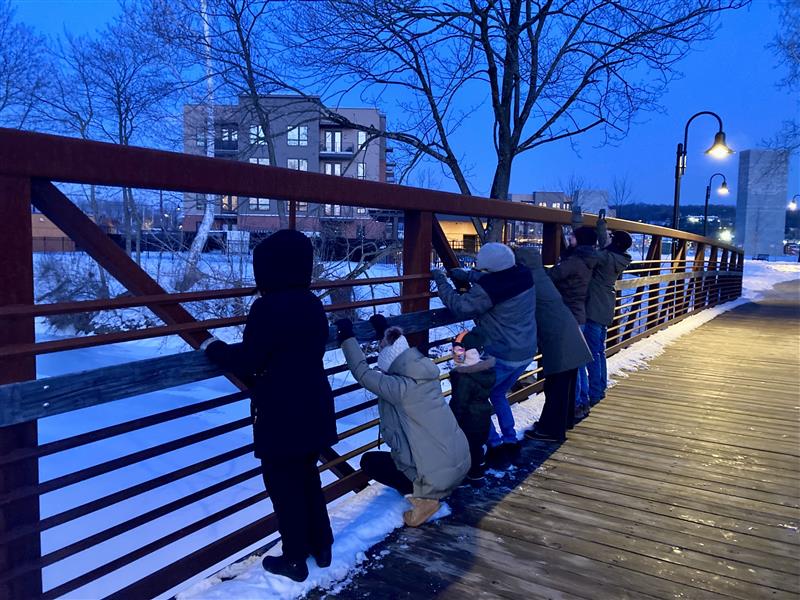
Attendees gather on the bridge for primal screaming club in Downingtown. / Photograph by Annie Kozicki Arba
Communities across the world have historically used bodily expressions like dancing, singing, and wailing to regulate their emotions, give praise to higher powers, and even prepare for combat. And now the act of screaming for the sake of relief from negative emotions or stress is entering the American mainstream. Primal screaming clubs are popping up across the U.S., including in D.C., Chicago, and Austin. The average scream-club attendee is likely not letting loose with the goal of healing childhood trauma. Rather, they just want relief from feeling the worry and stress that pervades our daily lives and a break from the troubling state of the world.
In that way, collective screaming can be a form of self-care, a way to let your guard down with others (even if they’re strangers), and feel a smidge more at peace.
Or so, at least, says Annie Kozicki Arba, founder of the Downingtown club, which is the Philly-area’s first primal screaming club with a consistent schedule. (There appears to be no other recurring gatherings across the region, though there have been sporadic meet-ups, like one for moms and another that sees you howling at the moon.)
“The world feels so fast, overwhelming, and intense right now,” says Kozicki Arba, an occupational therapy assistant, yoga teacher and energy-work practitioner. “There’s a lot of heaviness, grief, despair — a whole range of emotions that we’re carrying but maybe haven’t felt we could fully express. There needs to be more outlets to do so, and I wanted to make sure people had a space to let it out safely and with care.”
The Downingtown club’s first gathering, last October, was humbling, she says. “I walked around the park with a sign asking people to scream with me if they needed to let out some energy. Everyone said no,” she laughs. “Then, right when scream club was about to start, two women walked up saying they just saw something about it and needed to be there. Afterwards, they hugged me, saying they were so grateful for the experience. That solidified it for me: No expectations, no assumptions — just show up and be a space for people who need it.”
Since then, her club has met weekly to scream on the bridge between Johnsontown Park and River Station. Starting in April, it will move to monthly.
My experience on the bridge was brief, but powerful. Kozicki Arba began by leading our small group in a mindfulness exercise, prompting everyone to focus our thoughts on the thing we no longer wanted to hold onto — i.e., the thing we came to yell about — and exhale that intention into a natural object, which we’d then throw into the river. (For us, it was a snowball.) This would start the process of letting go of whatever has been weighing us down. For me? My short fuse with both chronic illness and parenting.
Then, on the count of three, came the fun part: We all faced outward, took a big inhale, and screamed as loudly as we could, for as long as we wanted. My scream seemed to want to keep going and going and going — I was the last person to stop — which assured me that the body, indeed, keeps the score.
In the quiet that followed, Kozicki Arba encouraged us to consider something we’re grateful for — to let go of the bullshit and embrace the beauty, if you will. I quietly thanked myself for showing up to do something for me. (Other parents, especially moms, know prioritizing your own needs can often be challenging.)
The entire process took just 10 minutes, but I felt noticeably lighter, more at ease. My shoulders softened and my cortisol seemed to settle down. I actually teared up from the positive shift — physical, mental, and emotional — that one raucous moment had set into motion.
After our big howl, I walked with a fellow first-time screamer back to our cars. She had learned of the group from a friend and decided to give it a try after experiencing a very traumatic event. While she was still in search of a therapist, she figured that a loud, raw, scream would be cathartic. “I’m trying to do things out of my comfort zone that will also help me process my trauma,” she said. “Tonight was definitely one of them.”
I may never again cross paths with her or the others I met on the bridge that night. But I’m grateful that, for a brief, wild moment, we trusted one another with our vulnerability and dredged up our “stuck” emotions.
And that we screamed like hell together.
Downingtown Primal Scream Club meets monthly on the bridge between Johnsontown Park and River Station. It’s free to attend. Stay updated via their Instagram.