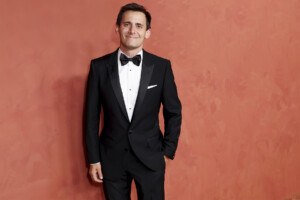

From Rocky to Rizzo: Monument Expert Paul Farber Talks Statues and Public Spaces
The founder of Monument Lab just opened a new exhibit at the Art Museum that explores the concept of public commemoration.
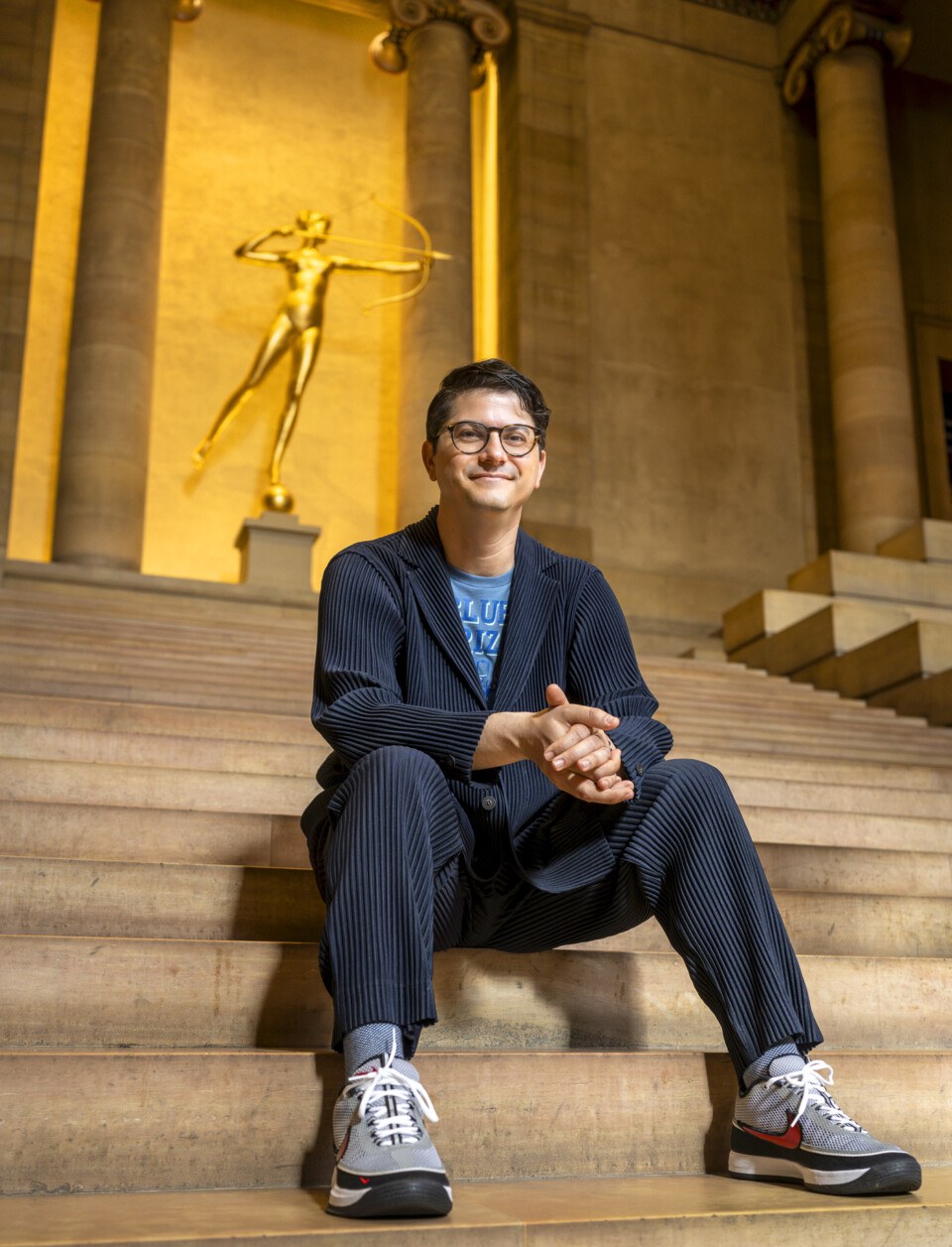
Paul Farber, who just moved the Rocky statue inside the Philadelphia Museum of Art / Photograph by Kyle Kielinski
Few people know more about monuments than Paul Farber. He’s the founder of Monument Lab, a Philadelphia-based public art and history organization that studies how monuments shape our understanding of the past — and how communities can rethink them. His new exhibition at the Philadelphia Museum of Art, “Rising Up: Rocky and the Making of Monuments,” sees the Rocky statue moving inside the museum and examines how a statue of a fictional boxer became the city’s most famous work of art — and what that says about our collective memory. Here, the Mount Airy resident talks about our obsession with a movie prop, the dismantling of the Frank Rizzo statue, and how all of this relates to the Berlin Wall.
Paul, how is it that a kid from Mount Airy became one of the nation’s leading experts on monuments?
Victor, first, I need to thank you. A few years ago, you wrote something previewing my WHYY podcast about the Rocky statue, and you said of me, “He’s no schmuck.” I keep meaning to put that on my business card.
I do what I can.
But to answer your question, I graduated from Penn with a degree in urban studies and then received my PhD in American culture at the University of Michigan. The whole time, I knew I wanted to do the work of social change, and I needed to find a pathway for that, which became monuments. I didn’t really find monuments. They found me.
How did that develop?
I wrote my dissertation about the Berlin Wall and kept bumping into pieces of the wall displayed across the country — in a presidential library, in subway stations, in a casino, in a food court. And I wondered, if these pieces of the wall have been displaced from Germany and are now popping up all over the United States, how does that help us understand our monuments? Then I taught a class at Penn on monuments in urban spaces. And I founded Monument Lab in 2012.
And when it comes to the Berlin Wall, how does that fit into the world of monuments? It certainly wasn’t built as a monument.
Right, it’s what we call an “unintentional monument.” It was set up as a physical barrier but became very much a part of the cultural imagination. For example, when Robert F. Kennedy went to Berlin in 1962 (one year before his brother would say “Ich bin ein Berliner”), he said, “We have a wall of our own: a wall of segregation.” So the Berlin Wall became a part of political discourse in that respect but over time also turned up in Alvin and the Chipmunks and Golden Girls episodes and in poetry written by Michael Jackson.
So I think this is a good place for you to define monuments, because it’s clearly much broader than Frank Rizzo and Rocky.
Well, at Monument Lab, we define a monument as a statement of power that has a public presence. But broadly, there is no single definition of monument in our culture. After conversations with literally tens of thousands of people in public spaces over the last 15 years, especially outside of City Hall and in public parks in Philadelphia, it’s clear that people think of the bronze and marble figures towering over them as monuments. But they also use the word to talk about historic sites and spaces, murals, mosaics, archaeology, museums, as well as acts of protest — ways they see history making an imprint.
I’m pretty sure I’ve never known someone to get so excited about monuments.
[Laughs] I’m actually very ambivalent about monuments. I believe it’s really important to have symbols that last beyond your own generation, but I don’t think that a monument alone saves us. Monuments are both at the center of cultural conversation and also really hard to understand. If you want to know the history of a place or person, you look for a documentary, you read a book, you talk to local residents to find out the narrative. You don’t go to a statue and read a plaque or stare at a figure frozen above you.
In preparing for this interview, I was thinking about my own experience with and memory of monuments, and one image that kept returning to my mind’s eye was that of the Saddam Hussein statue in Baghdad being toppled two years after 9/11.
The tearing down of monuments dates back to antiquity. Gestures of the new power. Monuments are built with an intention of permanence, but that often isn’t what happens. The first monument takedown in the United States was in July of 1776. Upon the reading of the Declaration of Independence in Lower Manhattan, people pulled down the statue of King George III and melted it, in part for Revolutionary War bullets.
In 2021, Monument Lab conducted the first-ever audit of America’s monument landscape, looking at upwards of 50,000 monuments across the country. Give me one point of data that stood out.
There are way more monuments to mermaids than to U.S. congresswomen who actually lived. The audit gave us a lot of insight into what we choose to remember and how we choose to remember it.
The conversation surrounding monuments seemed to take a major turn in the 2010s when people started tearing down Confederate monuments.
That’s right. And before long, it reached a fever pitch.
Prior to the 2020 removal of the Frank Rizzo statue in Philly, I spoke with the sculptor who created it. His thought was that instead of removing the bronze, why not add features and exhibits that put the statue in historical context, that explain the various controversies surrounding Rizzo.
The problem with that is in how monuments communicate. They communicate often beyond language and from a distance. Most monuments in public spaces are meant to be seen from hundreds of feet away, so the addition of a plaque or a QR code doesn’t do the job. Maybe you could have a sign as big as a billboard, maybe projections, maybe local students as live interpreters. But that requires three things: maintenance, money, and mindsets.
What was your reaction to seeing the so-called Gravy SEALs come out with their AR-15s to “protect” the Columbus statue in South Philly?
It was upsetting but not surprising. We’ve seen similar armed patrols with Confederate monuments around the country. But, yes, what do we do with all the Columbus statues? It’s hard, because it’s viewed as a zero-sum game; it’s “us versus them,” like there just isn’t a path forward. Christopher Columbus has become a symbol, including in places he never set foot or could ever have dreamt of. The armed patrols certainly don’t speak for every person, but they do communicate the loudest. We need to find the in-betweens and find coalition. I’ve seen it work. It just takes focus, purpose, and resources to really try to knit together understanding.
I’ve been closely watching the work of Avenging the Ancestors and Michael Coard surrounding the opening of the slavery exhibit at the President’s House in 2010 and, more recently, Trump’s attempts to remove that same exhibit. What are your thoughts?
Avenging the Ancestors are among the most important monument builders and advocates that this country has seen in a long time. They epitomize what history can be for us: telling the full truth. You can’t separate freedom and enslavement; they go together. In a moment of what is a relentless attack on history and truth, you now have people fighting both in the courts and out in public space. And now Philadelphia is in the headlines for standing up for what is right.
And now for a far less serious matter: Is it fair to say that the most internationally famous monument in Philadelphia is, in fact, a movie prop?
[Laughs] Here you have an object that was made for a movie, specifically for Rocky III, that has become the most visited and renowned monument in Philadelphia. Four million people visit it every year. Those are Statue of Liberty numbers! There are many, many other statues that have been movie props that don’t get elevated to monuments, and there are also other statues depicting figures from pop culture that are largely ignored. There’s something so fascinating, beautiful, strange, and meaningful about the way that this statue has become a monument.
What is your reaction to people who roll their eyes at Rocky?
I admit that I was initially dismissive of the Rocky statue as a monument. I scoffed at its significance as a cultural artifact. It was my mom, Ruth, who called me out on this. She pointed out to me the line that forms to see it, every day of the year. No matter the weather. No matter the time. And she said there’s a lot to be learned from that line. So I spent a number of years just spending time at the line and talking to people. And what really struck me was the blurring of art and life. Monuments can be in the eye of the beholder. Also, the Rocky statue could have been made out of Styrofoam for the purpose of the film, but it wasn’t. It was commissioned as a real fine-art sculpture in bronze from a real artist. So it’s been a growing process, and when you see it now, the way it’s risen to the level of symbolism both on and off the site, it’s deeply interesting. But it’s not lost on me that this is a statue to the most famous Philadelphian who never lived.
So just to catch readers up: Sylvester Stallone said last year that he wanted the original Rocky statue back and gave a bronze copy to the city. That copy is sitting at the top of the Art Museum steps. But then he relented and said the city could keep the original and that he would take back the copy. That original is now inside the Art Museum for your just-opened exhibit, “Rising Up: Rocky and the Making of Monuments,” after which it will go on top of the steps. Meanwhile, the Joe Frazier statue that was erected down by the Sports Complex in 2015 will be installed at the site of the original Rocky statue at the bottom of the Art Museum steps.
Phew! There has been a lot of back and forth.
I don’t mind telling you that I am not a fan of this plan, that the fake boxer should not look down from above on the actual Philly man who was one of the greatest heavyweights of all time.
When we have interviewed people over the years about monuments they would like to see in Philadelphia, Joe Frazier’s name comes up consistently. In our exhibition, Joe Frazier is a major protagonist, and part of that is actually the entanglement of his story with the Rocky franchise. Before Rocky became a Hollywood character, Joe Frazier ran up the Art Museum steps, he ran through the streets of Philadelphia, he worked in a Kensington slaughterhouse where he trained by punching raw sides of beef.
In one of Rocky’s more memorable scenes, Stallone himself punches beef in a slaughterhouse.
Originally, Stallone actually wanted Joe Frazier to be in Rocky III, with Frazier playing Clubber Lang. But as part of the audition, Frazier and Stallone had a sparring session, and Frazier hit him so hard that, as Stallone put it years later, it felt like having a piano fall on him. He said he was reminded that actors act and boxers box. You simply cannot tell the story of Rocky without telling the story of Joe Frazier.
Would you agree that the Art Museum steps themselves have also become a monument in a way that the museum itself is not?
Yes. How many people run up those steps each year? People flock there. It’s this pilgrimage where people really lay down their burdens. They come almost as a civic sacred offering. And there is something legitimately extraordinary happening there in our understanding of monuments. At the same time, when you stand at the Joe Frazier statue or in front of his shuttered gym in North Philly, you feel a lack of will regarding the preservation and acknowledgment of real-life boxers — especially Black boxers — that marks a disparity in resources and spotlight. And that is something that is very ordinary in our monument landscape. If I had a magic wand, I’d make sure there was real investment in Frazier’s gym itself.
What are you trying to say with this exhibit?
When you go to the Rocky statue, appreciate that there are protagonists all around us, some historic, some still living. Look around you and see all the stories but also see the gaps in how we translate these stories into real-life commemoration. We have over 150 pieces of artwork and artifacts that cover thousands of years of human history.
Will I finally understand Philly’s Rockymania after seeing “Rising Up”?
The question at the center of this exhibit is this: Why do millions of people each year visit the Rocky statue? And in each gallery, we kind of answer that in a different way. It’s a show about monuments through the framework of what is fascinating and meaningful and strange about this monument — while also taking seriously people’s engagement with it and opening up a broader conversation.
Beyond the Rocky Statue
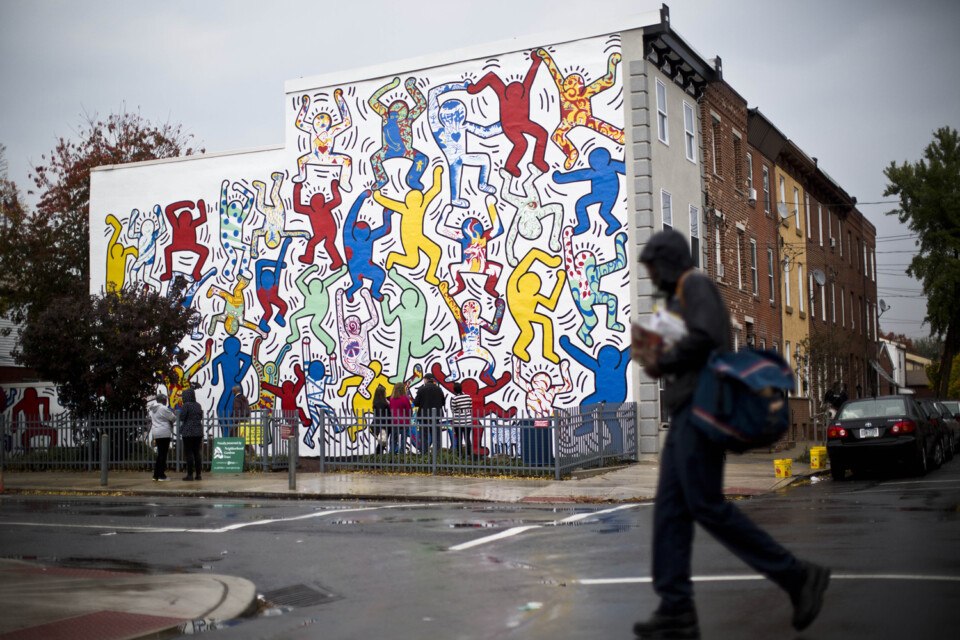
Keith Haring’s We the Youth mural / Photograph by Matt Rourke/Associated Press
Paul Farber picks his three favorite less-recognized monuments.
Underground Railroad Site
William and Letitia Still were huge figures in the Abolitionist movement, and their rowhome still exists, as does the original marble stoop over which Harriet Tubman, who took more trips to Philadelphia than did William Penn, often passed.” 625 South Delhi Street
Keith Haring’s We the Youth Mural
Philadelphia has one of the few surviving Keith Haring–created public murals, and this is one he painted with local children in 1987. It is a true rarity, an international treasure that is constantly under threat by developers and needs our protection. Many people have seen it, but too many of us take it for granted.” 22nd and Ellsworth streets
Pro Bono Fountain
There was a time when the public didn’t have access to free, safe drinking water, and this was the first public fountain of its kind in Philadelphia, presented to the Fairmount Park Commission in 1854 by a local paper-mill mogul. The spring-fed fountain itself was sealed in the 1950s due to pollution and water-safety issues, but the carved white marble and granite are still there, looking like an entrance to a temple. The inscription on it reads Pro bono publico, which translates to ‘for the public good.’ And then underneath it is inscribed Esto perpetua, which means ‘let it remain here forever.’ The model proved successful, and, by 1890, there were 50 such fountains in Philadelphia.” Forbidden Drive between Margarge Dam and the Rex Avenue Bridge
This interview has been edited for length and clarity.
Published as “From Rocky to Rizzo” in the May 2026 issue of Philadelphia magazine.