7 Reviews That Defined Philly Dining in 2025
This was the year when Philly's restaurant scene found its soul.

Spread at Little Water and Amá’s wood-fired octopus / Photography by Gab Bonghi (originally published in “Little Water: A Poetic Exploration of Land, Water, and Comfort Food)” and Bre Furlong (originally published in “This New Philly Restaurant Is Raising the Bar for Mexican Food“)
2025 was Philly’s year.
In terms of dining, anyway. In professional kitchens and dining rooms, at barstools and banquettes, 2025 was the year that Philly came to play. And even if, in our hearts, we will always be the underdogs — even if (and I hope this remains true) we will never, ever care what the rest of the world thinks of us — Philadelphia’s chefs and restaurateurs and everyone who fills the seats every night knows that this moment? It’s special.
So how lucky am I that I got to spend my year eating my way through what will likely be some of the most remarkable seasons in Philly dining history? It was a year that began with cheesesteaks, had cheesesteaks in the middle, and kinda ended with cheesesteaks, too. It had everything in it that comprises the complete Philadelphia food pyramid: Pizza, genius, comfort, tacos, pasta, hot dogs, sushi, fish caramel, and Wawa. And my reviews covered everything from heavy metal corndogs and Georgian khachapuri to brilliant tasting menus, killer cocktails, and a Wes Anderson version of a French grocery on East Passyunk.
It was a really good year for eating, is what I’m saying. And looking back on it now, I think there were a few distinct moments that really explain what it was like to dine out in Philly in 2025. And it all began with …
An Octopus in Ambler

Carnitas de pato and ravioles de aguacate con cangrejo from La Baja / Photography by Breanne Furlong (originally published in “La Baja Is Chef Dionicio Jiménez’s Best Cooking Yet“)
“On a freezing night in Ambler, deep in the post-holiday slump, I slide alone into a two-top table at Dionicio Jiménez’s new restaurant to eat roasted baby beets sprinkled with pistachios in a homemade crema called jocoque — brought to Mexico by Lebanese people fleeing the Ottoman Empire in the late 19th century — and a chile relleno stuffed with scallops and chorizo under a blanket of melted queso asadero and swimming in a pool of Thai green curry. On the wall above me, there’s a sculpture that I love. It’s big, garish, weird — an elephant head with blue butterfly wings and an octopus body, arms writhing against the whitewashed brick in the main dining room.”
That’s how my year started — alone in the suburbs eating a remarkable dinner under the gaze of the alebrije that watches over Dionicio Jiménez’s dining room at La Baja. We may have lost Jiménez’s beloved Cantina La Martina this year, but I spent most of 2025 telling anyone who would listen that La Baja — with its chimeric menu of duck bao and corn ribs and ramen dust — is actually the restaurant that we should really be paying attention to when it comes to what’s coming next, both from Dionicio and the food world as a whole.
Fire and Metal

A seafood tower at Jaffa and a mapo chili dog and the Gintonic at Doom / Photographs by Ed Newton (originally published in “The Jaffa Paradox: A Buzzy, Bright Space That Feels Surprisingly Hollow“) and Courtney Apple (originally published in “Doom: Where Metal Meets Corn Dogs and Cosmic Brownies)“
Jaffa, March 2025 and Doom, April 2025
“There is a part of me that always believed I would find myself alone at a metal bar drinking gin at the end of the world. There is, maybe, a part of all of us that believed that. Some piece of our collective consciousness, steeped in the opening montages of a hundred different post-apocalyptic films, that knew this moment was coming and was just waiting for it to arrive.
What’s surprising, though, is that the hot dogs are so good.”
These two reviews — of Michael Solomonov’s Jaffa in Kensington and Justin Holden’s Doom on 7th Street in Callowhill — ran in back-to-back issues, and they were both, in their way, about size. Physical, emotional, psychological — they were about the kind of real estate that a bar or a restaurant can take up in your head before you even walk through the door. The Jaffa review was about an oyster house, but it was also a meditation on expectation and disappointment. On the dissonance of competing visions. Doom was mostly about hot dogs, cosmic brownies, D&D, and where we want to be when it feels like the world is coming apart around us. Separately, they are just reviews of two very different restaurants. But looked at together, they say something about Philly’s growing pains and how to stay true to yourself and the things you love in the face of success.
A Fish in the Clouds
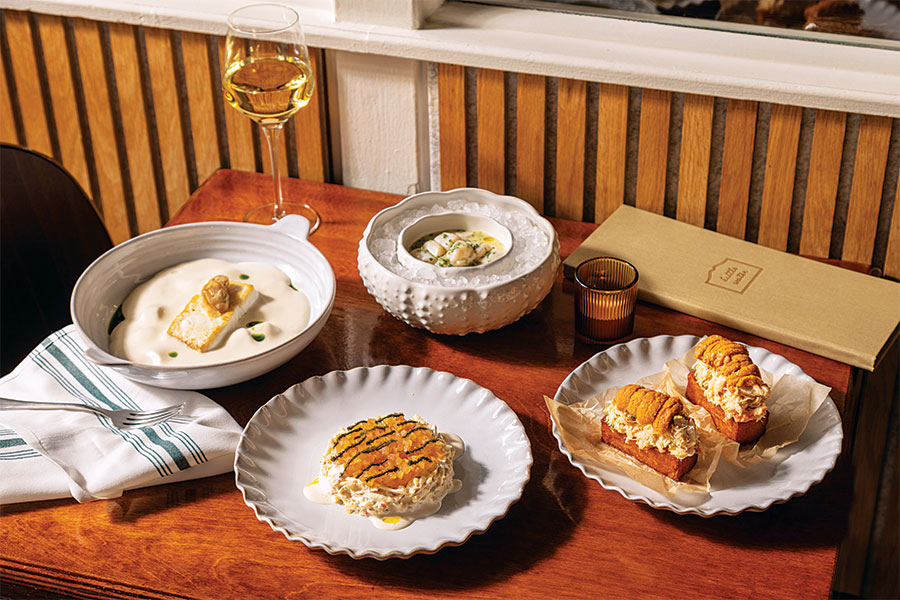
Spread at Little Water (clockwise from left): Halibut; raw bay scallops; hash browns with crab and uni; peekytoe crab salad. / Photography by Gab Bonghi (originally published in Little Water: A Poetic Exploration of Land, Water, and Comfort Food)
A piece of halibut, some potatoes, a couple clams, and a lifetime of practice: That’s all it took to assemble the plate that stands as the single most memorable dish I had in 2025.
“There is nothing in the world more comforting to me than fish and potatoes. In my worst moments, that is what I’ve craved. In my best, that’s how I’ve wanted to celebrate. A simple piece of fish, a little starch, warm and filling. It says sunlight and the sound of water to me. It speaks of a friend’s bar in the mountains where my comfort order was a piece of sole, a white wine beurre blanc, and mashed potatoes. And I suspect it says something similar to the Ruckers. That somewhere, they’ve felt that same comfort, and here, on this single plate, have chosen to glorify it with a simple fish and gorgeous technique. That, at its heart, is what all of Little Water is about.”
At Little Water, Randy and Amanda Rucker served me what was probably one of the two most moving plates I had all year. They also served me one of the most beautiful. And what’s amazing is that they weren’t the same plate, but they arrived during the same dinner — just one random evening in Rittenhouse, in the spring of this notable year.
Green Is the New Black

The dining room at Emmett / Photograph by Ed Newton (originally published in “Inside Philly’s Most Inventive New Restaurant“)
“I know this place. I’ve been here before. The longer I spend eating my way through this city — the longer anyone does — the more things repeat. The more I end up sitting in dining rooms, sharing space with the ghosts of meals gone by.”
I ate here once without really thinking about it. Then I came back because I couldn’t stop. There’s something about the way chef Evan Snyder’s Emmett is, in its own, quiet way, defining an entire sector of Philadelphia’s dining scene right now: a kind of soft, easy, customer-focused (rather than ego-driven) experience that stands just outside the bright spotlight of glossy acclaim (though that may change now that tastemakers outside of Philly are starting to notice the place). I’d get there soon. And don’t sleep on the prix fixe.
Changing the Game

Amá’s wood-fired octopus / Photography by Bre Furlong (originally published in “This New Philly Restaurant Is Raising the Bar for Mexican Food“)
“There’s no time to eat everything I want to eat, no space here to tell you about the custom roasting and smoking grill Ramirez had installed in the kitchen, or the charmingly awkward first date at the table in front of ours, or how Ramirez brought his mom in from Mexico just before opening to teach him how to nixtamalize corn, or even about the brilliant tequila- and mezcal-heavy cocktails with their tomato shrubs and chapulin garnishes. But I tell myself that next time I come here, I will get an Uber so that I can drink my way down the list without having to worry about finding my car. I tell myself that next time, I will come late when the lights are low, close the place, and walk out into a city and a neighborhood that will be defined by food exactly like this in the future, that will remember Amá maybe not as the start of something, but absolutely as a continuation of an edible conversation Philadelphia has been having with itself for the past 20 years.”
If you want to understand anything about where Philly’s food scene is headed in the future, Amá is where you should start.
The Stories We Tell

Cybille St. Aude-Tate and Omar Tate at Honeysuckle / Photograph by Gab Bonghi (originally published in “Why Honeysuckle Is the Most Important Restaurant in Philly Right Now“)
At Honeysuckle, Omar Tate and Cybille St. Aude-Tate are using their space to tell a multi-layered (and multi-media, and multi-generational) story of Black foodways that speaks very loudly to this particular moment in Philly. All its recognition aside, Honeysuckle is a beautiful example of how dedicated artists can use every piece of their restaurant and every part of themselves to tell the story they want to tell — from jumped-up Big Macs that tell about burning money you don’t have, to vegetable boards that serve as lessons in geography, history, horticulture, and cuisine all at the same time.
Mostly, though, the place is just good.
“Not every dish is a manifesto. Not every dish needs to be. The hush puppies? They’re merely delicious: golden brown, set in thick dots of Cajun holy trinity relish (onion, bell pepper, and celery, which reappear as a digestif soda at the end of the meal), wearing marbled pink hats of country ham. And the seafood Alfredo is pure ego from the kitchen in the best possible way — edible proof that in this town where Alfredo is the mother of a thousand menus, their version (smooth as easy listening, rich as a crooked minister, made with crème fraîche, local shellfish, hand-cut tagliatelle, and a custom Bay spice blend they call New Bay Spice) can compete.”
I called Honeysuckle the most important restaurant in Philadelphia right now. And that may be true, but it has a lot of competition.
Philly is about the big and the small, the fancy and the plain. It is equal parts tasting menu and Sunday gravy, cheesesteaks, and caviar. And I wouldn’t want to live (or write) in a place that was any other way. This year gone by might stand as one of the most important, most formative, most definitional in the history of Philly’s modern restaurant industry, but 2026 is already peeking ’round the corner. And speaking as one of those guys who tracks chefs and restaurants and the energy of this industry, like that one weird friend you got who just can’t stop talking about crypto, I can confidently say that next year is already shaping up to be a banger, too. Maybe we get even bigger. Maybe it all falls apart. Maybe we never see another year like this one ever again.
2026 is where we’re all going to find out.
See y’all there.