Phila and Rachel Lorn’s Trick to Success? Desperation
In 2022, Phila Lorn was making hoagies. Rachel Lorn was a banquet director. Now, three years later, the Mawn chef is a James Beard Award winner, and they’re sitting atop a growing food empire. And it all started with one thing.

Rachel and Phila Lorn / Photography by Stevie Chris
I.
This one time, not too long ago (but also kinda forever ago), Phila Lorn was in Idaho. In Sun Valley, Idaho, which is not the farthest he’s ever been from home, but is still pretty fucking far, both physically (2,400 miles, give or take, from 7th and Jackson in South Philly, where he grew up) and, you know, spiritually. Mentally. Psychologically. Whatever.
He was in Sun Valley because he was attending the Global Foodservice Hospitality Exchange conference, and he was attending the Global Foodservice Hospitality Exchange conference because Jose Garces, Mr. Iron Chef himself, had brought Phila there as part of the residency he’d done back in the winter of 2022 at Volvér, Garces’s late, lamented showstopper restaurant at the Kimmel Center.
“Man, everyone was there,” Phila tells me. Chefs, owners, celebrities. “Captains of fucking industry and shit.” With his eleventy-billion current and former restaurants, his TV appearances, polished smile, bankruptcy lawyers, and endorsement deals, Garces was absolutely in his element. With his glasses, South Philly accent, big dreams, and fuck-all else, Phila was absolutely not.
II.
This was before Mawn, Phila and Rachel Lorn’s anarchic Cambodian noodle house on 9th Street, in the old Kalaya space in Bella Vista. That’s important. It was before the crowds, the lines. Before all the awards. This was before Phila was anyone, really — just another cook, another industry brat, hungry for attention and trying to make his way.
But he had a lanyard. A laminated pass with his name on it. And standing there, in that place and among those people, Phila understood that this was one of those things, you know? One of those moments that can define you or alter the course of your entire life. A canon event, in the language of the comic books and superhero nerds, that has to happen in order for the timeline to proceed in an orderly, sensible fashion.
Most of the time, you don’t see a moment like that coming. You can’t recognize it as being important until you’re already looking back at it. But Phila knew. He could see it coming a mile off.
Which is why he’d come to Sun Valley fully prepared to lie.
III.
I ask Rachel later if she remembers this story, and she totally remembers this story. She laughs about it, saying Yeah, yeah, that’s just how he is in this way that only a person who knows another person’s biography intimately ever really does.
More, she says it in the way that only someone who has fully leaned into another person’s mythology ever really does. She and Phila are partners the way Butch and Sundance were partners. The way Calvin and Hobbes are. They’ve been married for eight years. They have a son named Otis who’s four now, born less than two years before their first restaurant opened. The two of them grew up in restaurants. They met in restaurants. They fell in love in restaurants. They’re both industry lifers, Philly born and Philly bred with all the pride and baggage that comes with that. Late one night, Phila will brag to me that in two decades of restaurant work, he’s never had a job that was more than three miles from where he grew up, except once, during the pandemic. Rachel will tell me how, on their first night back in town after going to Chicago so Phila could collect his James Beard Award (he won this June for Emerging Chef after 20 years on the line), they went to celebrate at Saloon on South 7th, ordered drinks, and toasted each other, clinking glasses and saying, “Here’s to no college!”
The story of Mawn is a lot of things. It’s a food story, an immigrant story, an industry story, a Philly story.
Mostly, it’s a love story.

IV.
“It was crazy,” Phila tells me. “CRAY-zee.”
We’re talking about Sun Valley again. The conference.
“Hold on, hold on … let me send you some pictures.”
And he does. They ding into my phone while he’s talking.
He says, “You see that? That’s me, Kiki [Aranita, who also had a Volvér residency back in the day, and also had come to Idaho], Jose. I love Jose, man.”
He sends pictures of himself and then of all of them, standing together. Phila looks young. Nervous as hell. The last photo is a screen grab: a partial lineup of speakers at the conference. Garces is on it. David Gibbs, CEO of Yum! Brands. Dayna Eberhardt, chief people officer at MOD Pizza. Dan Rowe, founder and CEO of Fransmart (a franchise development company) and managing partner at Kitchen Fund. And Phila. He’s listed as “Chef Phila Lorn, chef and owner of Puck & See.”
I ask him, What’s Puck & See? because, at this point, I’m pretty sure I know every place Phila has worked. I’d certainly know if he’d opened another restaurant before Mawn.
“It’s nothing!” he tells me, hitting the last word hard: NU-thin. “Didn’t exist. I made it up.”
Because of course he did. Because fuck those guys with their fancy titles and hundred-million-dollar portfolios. Not Jose, obviously, because Jose had always believed in Phila. And not Kiki, who was just there hustling, same as him.
But the rest of them? Fuck those guys. They weren’t going to make Phila — a kitchen veteran, son of Cambodian genocide survivors, ride-or-die Philly kid to his bones — feel like he was less. Like he, somehow, didn’t belong.
Even if he kinda didn’t belong at all.
And not only did he show up in Sun Valley as the imaginary owner of an imaginary restaurant, he got up on stage with Jose and David and Dayna and Dan and he talked about his imaginary restaurant. He was on a panel discussing inclusiveness and diversity in restaurants. He shook hands and introduced himself as the owner of Puck & See, and carried on as if all of this were real because Phila knew it didn’t actually matter if it was real then. Because it was going to be real someday. And even if it wasn’t Puck & See (or the seafood and oyster bar he was dreaming of opening, or the walk-in hand roll joint called Handstand that he briefly considered), it was going to be something. And it was going to be good. So good. In his head, it already was. And once he finally found his space, his concept, his team, the money — all those things he knew he needed but didn’t have — it was going to be great.
V.
“Being hungry, that’s the most dangerous thing,” Phila says to me.
We’re talking about food. But we’re also talking about something more than food. We’re talking about wanting and not having. About seeing the things we desire right in front of us and not knowing how to get them. We’re talking about need.
“Being hungry? That’s when violence happens.”
Phila’s family are Cambodian refugees. Buddhists. Genocide survivors. He’s the youngest of five, the first one born here, and that’s how he got his name: Pee-la.
“I am this place,” he says, pride beaming off him like radiation. “At the end of the day, I’m named after the fucking city.”
His memories are a South Philly kid’s memories overlaid with the sounds and smells of growing up in a family of immigrants. He remembers the old Sicilian lady making water ice in her basement in the summer, selling it for a quarter to all the kids in the neighborhood, and how it was the best water ice ever. He remembers sitting in his kitchen at home with the back door open, watching his mom roast peanuts. “Raw peanuts,” Phila says, “over her old four-top South Philly-ass stove.” She’d dump them into a blue plastic strainer, shake them until the skins came off, and then hold them over the flame. He remembers that blue plastic strainer so vividly.
“I’m still chasing it,” he says. “That smell. That’s the first hit of crack that I’m always chasing.”
In that kitchen — his mother’s kitchen — he learned his first lessons about cooking. The family was poor, so they got government assistance: boxes of food, welfare cheese that always tasted like someone trying to re-create actual cheese using only vague memories, sour milk, and yellow crayons. But he learned that you could make that government cheese taste better if you cooked it. If you grilled some bread and made a sandwich. He learned that you can take something cheap and make it taste okay just by adding a little fire.
“My mom taught me things. Not because it was something I wanted to learn, but because it kept me from drawing on the walls.”
He tells me about growing up. How, in some families, in some neighborhoods, the parents say things to their kids like Oh, why can’t you be more like James down the street? He’s going to be a lawyer. But in his neighborhood, it was the opposite. It was always Don’t be like Nathan. He’s a bad man. Don’t be like Joe. He shows his dick to people in the park.
“First time I ever saw someone put a gun in someone’s mouth? It was in one of those parks.”
In the kinds of places where Phila grew up, everything was a cautionary tale. Everything was a lesson: Don’t be this, don’t do that, and if you see that guy coming, run. “I know I come from a loving family,” he tells me. “That’s how I know.” Because he had people who wanted the best for him, and who wanted him to rise, but not forget where he came from. To make it out, but never stray too far. “Like, I definitely grew up poor. But this isn’t just a Cambodian story, right? I guess it’s a 7th and Jackson story. Everyone was poor. No matter who you were. And our parents LOVED us. We were loved. But some nights, we had potato chips for dinner. There were nights when I really wanted a pizza, and I’d beg. I’d be like, Mom, can we just get a pizza from Antonio’s? And she’d say no, and I’d be so pissed. But now, I realize it was because we couldn’t. She just didn’t have the $10.”
So there’s that kind of hungry. And then there’s the other kind. The kind you feel like a weight on the back of your neck, that makes you desperate for something more or something better. That makes you do stupid shit.
Phila started working in kitchens when he was 19. Right out of high school, he went to 1225 Raw in Midtown Village, got a job as a food runner. One day, there was a no-call/no-show on the line and he got thrown into the kitchen. He never looked back. He liked the fire and loud noises of being a working cook on the line. The ready access to drugs and bottles of whiskey and sharp knives; the adrenaline spike and machine-gun chatter of the ticket printer. The camaraderie and the chaos. He fell for the lifestyle first, the craft later, and that’s so often the way it goes. This industry, it needs young men to fall in love with it as cooks so that there’s always a healthy supply of old men to go broke as restaurant owners. It doesn’t work any other way.
He did four years at Raw then left, signing on with the late Hiroyuki “Zama” Tanaka at Zama, who he considers his mentor. “Zama-san,” he says. “That man taught me so much. Like, okay, there was this one time …”
Phila loves telling stories. And he’s good at it too. Outlaw tales of kitchen debauchery and small-time drug dealing; funny stories about people he references by first name only, by nicknames like these are people he and I have been hanging out with for years; sweet stories about his mom, his crew, Rachel — and always in that tough-kid accent, always punching the words that matter, filling every air gap in the conversation with patter, digressions, shit talk, noise.
Anyway, the story was, one day he was slicing vegetables and his fancy Japanese mandoline broke. Phila told Zama that he needed a new one and Zama kinda snapped at him, told him he’d get a new one when he could, but in the meantime, the line still needed vegetables so Phila had better learn how to use a knife. The point was that a cook needs to learn the basics. That conveniences are nice, when they work, but you always need to know how to get the job done without them because every night, that door is gonna open. And every night, you gotta be ready when it does.
Phila moved to Zama’s second restaurant, CoZara, to help get it set up, and ended up staying for four years, then went to Will as Chris Kearse’s sous chef, sharing the line with Bobby Saritsoglou and chasing after Chris’s vision of French deconstructions, skate with artichoke and Burgundy snails served over grits. After that, it was the kitchen at Stock in Fishtown for Lao curry, $10 pho, and khao soi noodles, then Barbuzzo with its pizzas and panzanella salads, homemade meatballs and gnocchi with mushrooms and pancetta every night. Phila was working. He was learning. He was partying enough that he ended up diagnosed with gout.
“I did a lot of drugs,” he tells me. “That, and all the cheesesteaks, the whiskey, all that shit. One day I just stopped and said, Shit, I think I got gout. So I went to the doctor and the doctor took one look at me and he said, Man, you got gout like a motherfucker.”
And then Phila just laughs. At himself, mostly. Because there’s being hungry and then there’s being hungry. And if you know what hungry feels like, you know you stuff yourself when times are good. Because who knows how long the good times will last?
Then 2020, the pandemic year. From inside the industry, it looked like the end of all things. Restaurants closed, kitchens went dark, everyone was out of work. And with the city shut down, people did what they had to do to pay the bills. For Phila, that meant taking a job out in Glen Mills at Terrain because he couldn’t find work closer to home. And soon after that, he took a gig at Mighty Bread because the pay was decent and the hours were flexible and, at that point, that’s what mattered most to him because, at that point, he was already dreaming about owning something of his own. And he was trying to figure out what he might have to do to make that dream real when he had no money, no collateral, no connections.
If you want to put it kindly, it was a journeyman’s career, with all the expected ups and downs. A hustler’s career, chasing dollars and experiences in expectation of something better just over the horizon. If you want to be less kind about it, you can see the notable downward trajectory. The sense of a guy who’d risen now stumbling.
Phila, unsurprisingly, takes the latter view.
“It was the fucking pandemic, man,” he says. “I felt like I’d wasted 20 years cooking and now it was all going to be for nothing? What else was I gonna do? I had to do something.” His residency with Jose Garces at Volvér was over, and the industry he saw post-lockdown didn’t look anything like the one he remembered from nearly 20 years on the inside. But he had an idea for a restaurant now. He’d borrowed some money from his family, from Rachel’s family. He’d been looking at spaces when he wasn’t working, driving all over the city, and he thought he’d found one — a Chinese restaurant in the neighborhood that he thought would be perfect, even if the current owner didn’t seem quite ready to sign.
“Rachel allowed me to repeatedly roll the dice,” he says. She had a real job, working as the banquet director at the Logan Hotel. She wore suits to work. Shook a lot of hands. “And I was the fucking hoagie boy at Mighty Bread.”
There were other spots, other possibilities, but Phila was hungry. He was desperate. Starving. He felt like this was the spot. It had to be.
So he took the owner’s son out for a drink. Phila tells me he had a piece on him that night.
“I wanted to make him sign,” he says.
But that’s not how things worked out.

VI.
“Fucking hoagie boy …” Rachel says, laughing. “It wasn’t really like that. I mean, it kind of was. But not really.”
This is a few days later. It’s July now. The first time I talk to Phila, it’s June. His James Beard Award is still new. The opening of Sao, their second restaurant, on East Passyunk, is still months off. Real, of course, but not immediate. Phila and I talk a couple of times before I reach out to Rachel. I don’t know why I waited. I guess maybe I’m intimidated a little. Phila talks about her all the time; there are times he can barely go a sentence without saying her name, talking about how important she is, giving her credit for every success. Pissed sometimes, too, that she doesn’t get looked at like she’s an equal partner in everything that has happened. Talking about service at Mawn, he tells me, “I could step away. Fuck, I could just walk out and nothing would happen. But Rachel cannot go to the bathroom without telling people. She leaves and it all falls the fuck apart.” And so I worry, what if I don’t see it like he does?
“But that’s the thing,” she continues. “I feel like people who get into this now, they have money. And back then, we have no money. Our credit is shitty. And I’m the one who’s nervous. I’m the one who’s worrying about everything, and [Phila’s] just like, fuck that. You’re never going to get anywhere if you don’t try! And then I was like, fuck it. Okay.”
If anything, Rachel is even more of a product of the industry than Phila is because she was born into it. When she was growing up in East Falls, her mom was in the hotel business, working for the Inn at Penn, and her dad was a photographer. She says, “My mom was always kinda talking about service because that was her life, you know?” So it made sense that she followed that path. She knew what it looked like. She could see where it led.
She tells me she was terrible in school, almost didn’t graduate, never went to college and never thought she would. She already had a job in the industry before she even finished high school — serving at the long-gone Solaris Grille on Germantown Avenue in Chestnut Hill.
She had no interest in the kitchen or the back office. She wanted to be on the floor. “I just wanted to …” She pauses, considers her words. “I wanted to hang out, right? I’m very social.” And for a while, we talk about that: how certain people, they’re just made for the restaurant industry. Built for the jobs they find their way into, however they come to them. Restaurants teach people a certain way of thinking, a certain way of approaching situations. They teach people a certain way to move through the physical world, and — like ex-junkies or ex-dancers — you never really lose that. She says, “You either have it — it — or you don’t. And when you meet someone who has it, you know.”
Rachel left home in July of 2004, just a month after high school graduation. She got an apartment at 11th and Moyamensing, and even if she couldn’t quite spit and hit Phila’s old neighborhood from her front porch, she wasn’t far off.
Her mom had a connection at Washington Square, one of Stephen Starr’s old restaurants, and that got Rachel in the door for an interview. There were no open positions there, but she ended up scoring a gig at Starr’s University City spot, Pod, back when it was still weird and packed all the time. Michael Schulson was the exec chef, but behind the sushi bar was a young Japanese guy everyone called Zama.
She stayed at Pod for seven years. Zama eventually left to open his eponymous sushi restaurant, and about a year after the opening, Rachel went to work with him. And working at Zama was how she met Phila.
VII.
There’s an interview that Phila and Rachel did for Visit Philly about the first time they met. She says they were friends first. Just two people who knew each other at work. He says he was in the kitchen at Zama one day, being loud, being aggressive. Then Rachel walked in, and she wasn’t having it.
“We had some exchange of words,” he says, with admirable (and uncustomary) restraint — sitting there, on camera, shirt buttoned all the way to his throat, while Rachel stares at the side of his face. “I walked up to her after the service and I said, You wanna go to Cavanaugh’s? We grabbed a beer and, uh …” He trails off.
“And then we became a couple,” Rachel continues.
“Twelve years later, we opened Mawn,” Phila finishes.
And that’s that. Only not really. Honestly, it was much cuter than that.
VIII.
“Tell me about the first time you met Phila,” I say to Rachel. And this is August now. Morning of the last test dinner at Sao. Two weeks before opening.
She says it was her first day training behind the bar at Zama. He came up and asked her for a Shirley Temple. “In a quart cup, of course. And so many cherries.” She tells me he wasn’t her type at all. He had a faux-hawk. Gauges. “But I felt like I recognized him.”
Restaurants are a small town. Stick around long enough and, eventually, everyone knows everyone. But Phila and Rachel bonded over being locals in an industry where not everyone is. They knew the same stories, got the same references, had been in each other’s orbits for years even if they hadn’t yet bumped into each other. That, Rachel says, made things easy.
“We were friends,” Rachel explains. “First, we were just friends. We’d go out for crew drinks. We’d just hang out. And people would be like, You know, he likes you. And I’d say, No, he does not. But, like, at Zama there was this window between the floor and the kitchen. And I spent as much time as I could in that window. More time than I needed to, probably. And he was always in the window too.”
On their first official date, they went to the movies. They went to the Ritz on a Monday, during the day, because this is a love story, but it’s a restaurant love story, and Monday is the day most restaurant people have off.
They saw Jiro Dreams of Sushi. They ate caramel corn. After, they went out for Chinese. Six months later, Phila moved in. Together, they helped Zama open his izakaya, CoZara, in University City. He was the chef. She was the manager. It wasn’t always pretty, but they made it work. They learned to leave restaurant business in the restaurant and not bring it home with them. Even if they didn’t know it yet, CoZara was like a practice run for how things would be later at Mawn.
“All these people, they say, Oh, I can’t believe you work with your husband, or I can’t believe you work with your wife. I could never do that. But I can’t imagine not.”
In time, though, they moved on. Rachel went to the Logan, managed the restaurant there (Urban Farmer), then took over the banquet department. She was there during the pandemic, while Phila was out in the burbs. She was there when he was the fucking hoagie boy at Mighty Bread.
And she was there the night he met with the guy from the Chinese restaurant.

IX.
“That night …” Phila says. “Man, I was starving at that point to open something. Starving. I felt like, I don’t know. I knew I just had to do something. I used to say this thing to Rachel. I would say, We used to be a part of the industry. Now I want to BE the industry. And that space? It felt like it was perfect. It felt like it was meant to be, you know? It was in the neighborhood. I had a buddy who’d just opened a spot next door. And I couldn’t, like, see home from the front door or anything, but I could see Snyder Ave, right?”
Phila had had a lawyer draw up an LOI for him — a letter of intent, the first step toward buying a space. It basically says you’ve got someone willing to sell. And he’d asked the owner’s son out for a drink because the son wanted to sell (or seemed like he wanted to sell), even if his father was hesitant. In Phila’s mind right then, the LOI would make it real. After nearly two decades in the kitchen and the nightmare of watching the pandemic destroy so much of the industry and his own progress, getting that letter signed would be a step toward getting what he wanted. What he was so goddamned hungry for in that moment. And the gun?
“It was symbolic of my mentality,” he tells me. It meant that he was getting that letter signed, one way or another. “Was it a confidence booster? That’s a nicer way to say it.”
But then he was there, at the bar with the son, and the letter was on the table between them, and Phila just … stopped.
Hunger. Desperation. “Sometimes those things will blind you,” Phila tells me. And in that moment, in that place, he realized that the gun, the letter, all of it, had nothing to do with that guy or that Chinese restaurant he could almost see home from, or anything else either. It all had to do with him. It was all about that feeling of always being on the outside and starving for something more.
So he bit back his hunger and he bit back his desperation and he just … walked away. He says the letter alone scared the shit out of the guy anyway. Made it real for him too. “He gave me this sob story about his dad and whatever,” Phila says, and that was it. They were done. They had two more shots and Phila left. Patted the guy on the shoulder. Said they were cool. Went home, where Rachel was waiting for him. They went to bed. She had to work in the morning.
And the next day — the very next day — Phila gets a call about a new space to look at. It’s at 764 South 9th Street, and the real estate agent thinks it looks perfect for him. She says, Can you get down here in five minutes?
It’s the old Kalaya space.
X.
“The job [at the Logan Hotel] is really stressful,” Rachel remembers. “And Phila is calling. I’m about to go into a meeting, planning out events for the week, and he’s like, I’m gonna do it. He was literally walking into Kalaya.”
XI.
Phila’s residency at Volvér started in December of 2021.
He was in Sun Valley with Garces in the summer of 2022.
By March of 2023 — less than a year but seemingly a lifetime later — he and Rachel had opened Mawn. They had a baby at home. Rachel still had her gig at the Logan. She actually kept that job through the entire first year of service at Mawn, working two jobs — days at the hotel, nights on the floor, with Phila in the kitchen doing Cambodian comfort food: fried chicken skin; night-market noodles; funnel cake with miso caramel; and a multicourse, omakase-inspired, family-style prix fixe dinner.
Know what they called that dinner?
They called it Puck & See.
XII.
These days, every night at Mawn starts the same way.
The plates are stacked. The silver is polished. Family meal has been cleared, and pre-shift is done. In the kitchen, the mise is set; stock and backstock are in place. There’s fresh charcoal in the grills and the cooks (who’ve spent the past two hours — since the last table from the lunch rush cleared out — prepping for dinner) are on their toes, bouncing on the non-skids while Phila talks shit, laughs, walks the line like he’s done a hundred or a thousand times before.
“Symbolically, I’m putting my bullets away,” Phila says. “I know where my guns are. Every night, it’s like a war where there’s no war. Everyone lives.”
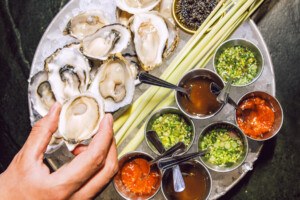
The kitchen does oysters with Cambodian black pepper mignonette, grilled saht koh with lemongrass and ginger, khao soi with noodles Phila used to pick up every week from ESO Ramen Workshop on South 4th Street before ESO closed, and a schmaltz-y chicken noodle soup.
On the floor, Rachel is huddled with the FOH staff going over last-minute things: head counts, VIP’d tables, birthdays. Anything the team might need to be aware of for the night’s service because, at Mawn, they work collectively. Rachel has four people on the floor every night — three servers with assigned sections and one floater as backup — and that’s it. It’s a small place, so everyone serves, everyone clears, everyone busses, backs, works the door, whatever. During service, Rachel runs expo. She calls every single ticket that comes into the kitchen, reads the floor, sets the tempo from a double rail of holds and fires. Most of the time, the cooks will never even see a ticket. It’s just her voice, her orders, her sense of what needs to be done when.
There’s profound trust in an arrangement like that, of ownership over the dining room, every service, and how the night goes, because working this way means a shared responsibility. It’s chaos, but a structured chaos. Chaos with a system. Servers pool tips, watch each other’s backs, pick up each other’s slack, make sure no one ends up too deep in the weeds, and everyone takes turns being the floater for one night each week because it’s the easier job, Rachel tells me. Kinda. “Or anyway, it’s the job where you don’t have to talk so much.”
On the wall, on everyone’s wrist, on everyone’s phone, there’s a clock counting. Ticking down toward service. At 4:30, the doors will open. The reservations are wall-to-wall. There are three turns of the dining room on the books, maxed out at 28 guests per turn. And all of them will be served in the next four and a half hours by a small staff in a small BYO at 9th and Catharine that, in the last days of summer 2025, is one of the best, most exciting, hardest to book restaurants in the entire city.
There are 11 people on staff, total. Front of house and back. All of them work lunch and dinner together, every night of service together. Phila and Rachel have worked hard to make Mawn special, offering good pay, dependable hours. “No one gets cut,” Phila says. “If it’s slow, that just sucks for me.” But Mawn is never slow. Their accountant once warned them that they’d need to make $3,000 a day just to keep the place going, pay the staff, keep the lights on. Now they make more than three times that, out of a 28-seat BYO, and the accountant doesn’t worry so much anymore. Mawn just started offering health insurance to its staff, which is rare in the industry. Like unicorn-rare.
“Restaurant people, we’re all like them 16-year-old street cats, you know? Just fucked up. Never seen a dentist or an eye doctor.” But now they can, and Phila is proud of that because it’s a way he can help take care of people.
“Anybody can open a restaurant,” he says. “Only some people can build a culture.”
Every night, they’re getting ready right up until the last minute. Every night, there’s more to do than there’ll ever be time for. And every night, right as the big hand hits the six, Rachel jumps up and starts the dining room playlist. It’s always the same song: “Yuvajon Kouge Jet” by Yol Aularong. Old-school ’70s Cambodian rock and roll — loud, raw, soaked in grungy fuzz and reverb — that grumbles to life with some grimy guitar licks like Van Morrison and Them doing “Gloria.”
“You ready?” Rachel asks. “Jumbo jet time! Somebody get the door.”
XIII.
Rachel remembers being worried about the space. She loved that it was on 9th Street. Being in that neighborhood? It was important to both of them. So much of their lives had happened there. But still, in those first few weeks, she was worried.
“I was like, do people even go to the Italian Market anymore? Will people come?”
I ask Phila about it later and he just laughs. “I told her, don’t worry about it. They’re coming.” And sure, that’s an easy thing to say when the dining room is full. When tables are booked out a month in advance. When everything is going your way. But back then? In the (very) early days?
“Even if this sounds cocky, I don’t care. Someone should be. I always knew.”
XIV.
Before the James Beard Award, Mawn was busy. After, it was insane.
I saw pictures of the first lunch service after the announcement. Brad, my editor, sent them to me. He was in the neighborhood, just walking by, and he texted me to say that he saw four people in lawn chairs sitting by Mawn’s front door waiting for lunch service to start. It was 9:45 in the morning.
We laughed about it a little. I mean, lawn chairs? Come on. And lunch was still more than an hour away. It seemed ridiculous.
Then, a while later, Brad texted again. He sent me a picture, this one from Philly Mag contributor Adam Erace, and the line now wound around the corner and down the block. There were so many people that it stretched out of the frame of a photo taken from the other side of Catharine Street. And now we weren’t laughing anymore. Because this? This was real. This was dozens and dozens of Philadelphians stacked up like they were expecting the Pope. Except they weren’t waiting on benediction; they were waiting on noodles. On papaya salad dusted with candied shrimp and Virginia peanuts just like Phila’s mom used to make.
About a week later, I get Phila on the phone and ask him about it. He was just as mystified as we were.
“I’m not a line guy,” he says. “I’ll wait till Star Wars shows on TBS.”
A few days later, I talk to Rachel and she tells me about the list — the handwritten list that she keeps every day of every single person in line for lunch service, when they showed up, whether they made it in or not. It’s a loooong list every day, with some names scratched out because they got a table, and some names not.
“We’re both like a hundred years old when it comes to computers,” she says. “So we do everything by hand. We handwrite side lists, hand-draw floor plans. It’s just … easier? I dunno. It’s just what we do. It works. And also, it’s our place, so fuck it. I’ll do it how I want.”

XV.
The first time Phila and I talked, he told me Sao was a couple of weeks away. Two months later, and it’s actually getting close. By the time you read this, it’ll be open. Busy, of course. Packed, most likely. Set up in another small space with just 33 seats total, it is an oyster bar, heavy on the funk and ferments, with serious Southeast Asian influences. Phila tells me they decided to open it because he and Rachel both love oysters and he was sick of getting tickets every time they tried to go to Oyster House.
“Honestly, it’s a parking thing more than anything,” he says. And he’s joking, of course. But not, like, entirely joking.
XVI.
The space he picked at 1710 East Passyunk was actually one he’d looked at back in the day, before Mawn. Remember Handstand? The hand roll place? He was thinking of putting it there. It ended up going to Ocho Rios Parrilla, but that place didn’t make it, so now it’s his. And Rachel’s. And their partner’s — ex-bartender and real estate agent Jesse Levinson, formerly of Vernick and the Dandelion. Rachel tells me that Jesse is “family, for all intents and purposes — you can basically call him my cousin,” and that his bar experience (and a third set of hands) was important in getting Sao open.
The menu is part raw bar, part Cambodian vacation party food. They didn’t hire a designer, so the look of the place is Rachel-and-Phila-make-an-oyster-house — kinda beachy and Shore-y (with a cash register at the bar that Rachel’s grandparents used to use at a motel they owned in Atlantic City), but also intensely Philly. Phila’s guy at Mawn, Dan Via (ex of Morimoto, now in his second year of working side by side with Phila) will oversee the kitchen there while Phila’s attention is on Sao, freeing up him and chef Rob Cammann to fuck around on Passyunk, doing raw fish, oysters with the Kampot black pepper mignonette that’s always on the menu at Mawn, head-on soft-shell prawns, whole fish cooked slow over charcoal. There are bar seats, banquettes, a couple of high-tops. On the night of the first test dinner, Rachel told the staff, “Treat it like a pop-up. Just have fun.” And it worked, so now that’s going to be the mantra going forward: Just have fun.
“People ask all the time, why don’t you expand Mawn?” Because it’s so popular. Because the lines are so long. Because, right now, they could make it twice as big — maybe three times as big — and still fill every seat most nights. “But part of the reason Mawn works is the attention you can get there. It’s small. It’s controllable. It feels like you’re at a party.”
And with Sao, they’re trying to re-create that — bringing Mawn’s intimacy to East Passyunk, Mawn’s warmth, Mawn’s personality. They could’ve gone bigger. That’s what most restaurateurs do when they find success: They capitalize. Open some ginormous version of the thing that made them famous. But not Rachel and Phila.
“We don’t need to make a bajillion dollars or anything,” Rachel says. “Why would we want to do that? It’s like, no one is in the restaurant business for the money. No one would want to spend their lives doing this if they didn’t, you know, have to do this. So why not just have fun? Why not make it fun? This is how we make it fun.”
XVII.
Sao was scheduled to open on Wednesday, September 10th. On September 9th, Food & Wine magazine announced its 2025 list of Best New Chefs.
This list is a huge deal. Every year, they pick 10 chefs who are, in the magazine’s opinion, about to break big. And a lot of the time, they’re right. The inaugural list, way back in 1988, tagged Daniel Boulud, Rick Bayless, and both Hubert and Thomas Keller (among others). The vast majority of really big, national, even global names you’d recognize from the world of legit celebrity chefs have been named to this list at some point (generally early) in their careers, and in the whole 37-year history of it, only 13 have been from Philly.
But this year, Phila Lorn got his name added to that list.
And then, a couple of hours after that, the New York Times tagged Mawn as one of the 50 best restaurants in America.
It was some kind of remarkable, freak-ass trifecta: the James Beard Award, the BNC from Food & Wine, Best Restaurant in America from the NYT, and all in the same year. All in the same season.
I ask Phila if he had any idea it was going to play out like this. I know he had some forewarning about the Food & Wine thing because that required a quick trip to New York, a ceremony, some meetings, photos with Daniel Boulud and a lunch with Danny Meyer. But the rest of it?
“We had no fucking idea,” he tells me, laughing, crazed, sleep-deprived already. He says they’ve had no time to process it yet because “If you’re in it, you can’t really see it,” and that, driving home from New York, he was so spaced out on everything that was happening that of course he got lost (Rachel says he’s always been terrible with directions), missed three exits, and added an hour to his trip. Which was really bad timing because that put him back in Philly at something like 3 in the afternoon and Sao was opening for its first night of service two hours later.
Because every night, that door is gonna open. And every night, you gotta be ready when it does.
XVIII.
Back on the phone again, Phila tells me, “Recently, my therapist reminded me that I run to the kitchen. When I’m stressed, I run to the kitchen” because the kitchen is his safe space. Always has been.
I once asked him what his favorite day of the week is because, among kitchen people, there are only two kinds of answers to that question, and the answer tells you everything you need to know about that person. If you’re in the industry, you either love Mondays or Tuesdays — the days you’re off or the days you’re slow, the quiet ones with no one screaming and nothing on fire — or you love Fridays, 7 p.m. First hit. Dinner rush. All the energy and all the madness, all the potential for brilliance or disaster or triumph or heartbreak, and all of it sitting right there. It’s like blowing a massive rail that goes on for four hours or five hours or however long it takes for that last table to clear. Then silence.
When I asked Rachel, she told me Friday. Friday for sure.
Phila told me Tuesday is his favorite day.
“Tuesday, it’s only me in the kitchen. It used to be me and my mom, so that was even cooler. She’s Asian and Buddhist and a genocide survivor, and she was so fucking happy in the kitchen with me. We’d just be arguing. Fighting like we’re fucking enemies. Like she won’t give me her recipe for the prohok or whatever. Because she’s gatekeeping. But it was great.”
He tells me that he just gets all Zenned out on Tuesdays. He makes the stock. Tells people he’s cleaning even though he’s really just catching up on emails. Around 1 p.m., sometimes he’ll just get in his car and drive around the city. Stop in somewhere. Look around.
The stress of getting Sao open aside, he’s quieter now than he used to be. More confident. Courageous is the word he uses, says, “You know how when you get off a roller coaster, you feel like you got superhuman powers for like a minute? We had Otis, and I felt courageous. I felt like I had superpowers. Something clicked. Otis really opened Mawn, man. Really, he did that.”
He doesn’t know what comes next. Really, he never has. His whole life has been a series of shit he didn’t see coming: restaurants, Rachel, Garces, Mawn, Otis, the awards, the lists, the crowds. He says he knew — knew — that Mawn was going to be successful, but that’s a hustler looking back on a really good score and giving himself credit for being able to see into the future. It could’ve just as easily gone the other way. I mean, he was the fucking hoagie boy at Mighty Bread, right? Who could’ve known?
He tells me he’s done after this. Two restaurants? That’s all he needs. That’s all he wants. He told me early on that he had to do something to own his own time, and that’s what Mawn was. Sao? That’s about parking. And having something in reserve in case it all goes tits-up someday.
And Rachel agrees. “I’ve always said this is it for me. Two restaurants.” She pauses. “But …”
But what?
But maybe there’s another idea out there. Something just for them. She’s not saying there is one, but she’s not saying there isn’t one either. “I’ve always been ride-or-die. I’m always like, No, no, I’m not doing that, but then, you know, okay. So I guess we’re doing it.”
“When you no longer want or need to be the best, that’s when you’re truly free,” Phila says. When you’re hungry, but no longer hungry, you know? When you’re not chasing it. Not desperate.
Because, finally, you have everything you need.
Published as “Hunger Pangs” in the November 2025 issue of Philadelphia magazine.