How Pilates Became the Trendiest — and Most Hotly Debated — Workout
Pilates has been around for more than 100 years, and yet, fitness enthusiasts are falling in love with the modality all over again, despite all the criticism it's currently facing.
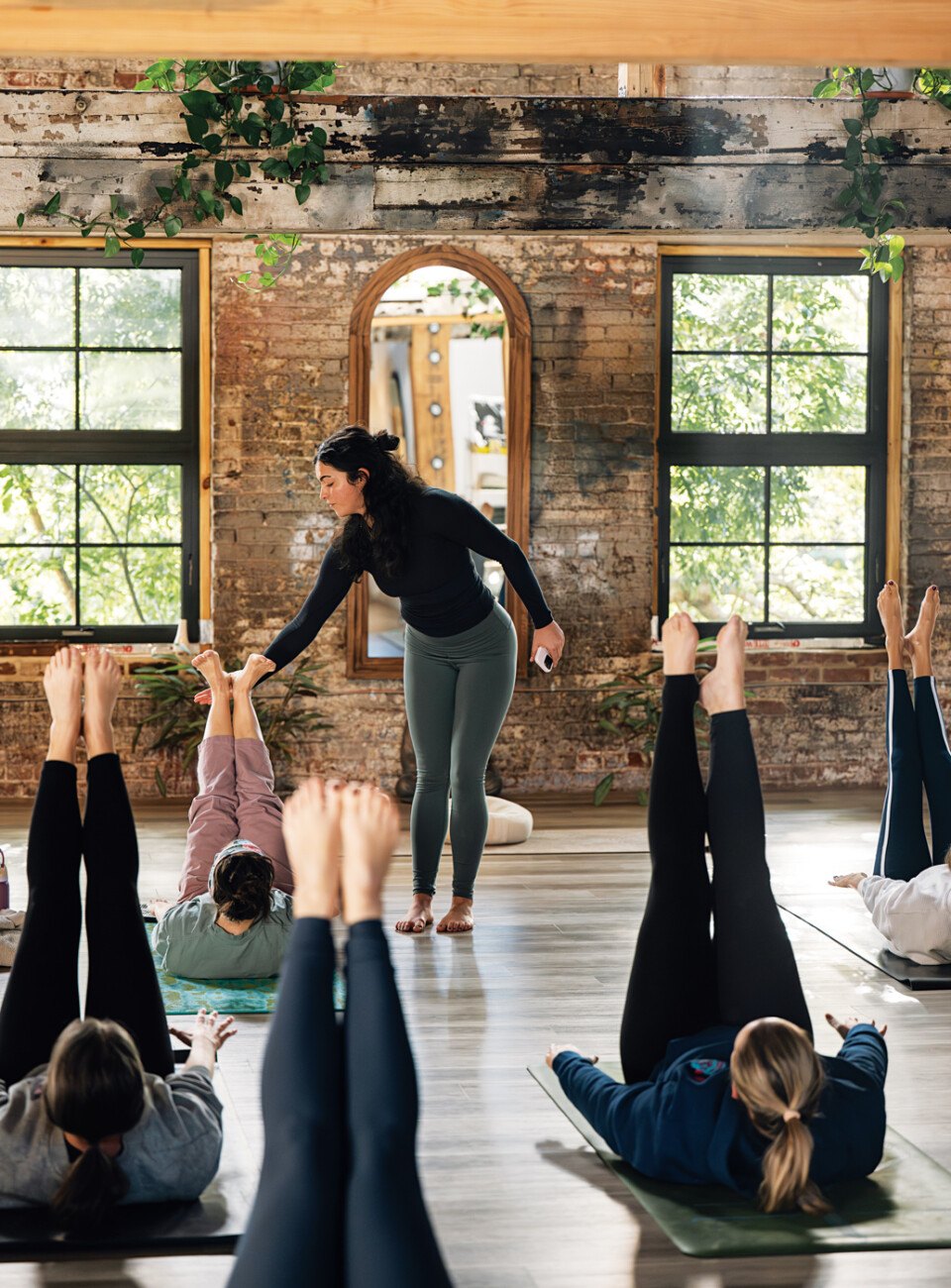
Alli Cavanagh leads a mat Pilates class at her Fishtown studio, In Flow. / Photograph by Linette Messina
In the summer of 2024, Abington resident Katie Agnew was navigating motherhood — and the physical, mental, and hormonal changes that come with it — for the first time. In light of these changes, the fitness studio owner — at the time she owned and taught at RIDE, a now-closed Southampton-based gym that offered spinning, barre, and TRX — was looking for movement that would support and strengthen her through the postpartum period.
On the day of her six-week clearance, Agnew went to a spin class, but she felt like a stranger in her own body, a new and surprising sensation. Wanting something more low-impact than the indoor cycling classes she was so used to teaching — and seeking that deep core connection she now found missing in spin — she signed up for a reformer Pilates class.
She was quickly hooked. So much so that at the start of the new year, she posted a photo of herself on her own resistance-based machine, deeming 2025 “the year of the reformer” in the caption. And she’s not the only one. Suddenly, everyone has become a self-proclaimed Pilates princess, filling up studio waitlists, donning grip socks, and even buying their own apparatuses for at-home training.
The thing is, Pilates isn’t new. The workout has been around for a long time — over 100 years, actually. It was invented by German fit pro Joseph Pilates during World War I to help rehabilitate injured soldiers and prisoners of war. He originally called his concept Contrology (today, it’s known as classical Pilates), which comprised a series of 34 exercises — from the Hundred, the intro move that sees you vigorously pumping your arms up and down as you hold a position similar to a crunch, with legs extended, to One-Leg Circle, Bicycle, and Boomerang. The moves get progressively more challenging, but all revolve around six principles: breathing, concentration, control, centering, precision, and flow. The goal? To “develop the body uniformly, correct wrong postures, restore physical vitality, invigorate the mind, and elevate the spirit,” as Pilates wrote in his book Return to Life Through Contrology.
To evolve his method, Pilates eventually designed several machines — apparatuses, as they’re called in the industry — such as the cadillac (aka the trapeze table); the reformer, which features a sliding carriage, resistance springs, and straps attached to pulleys; and the ladder barrel, a device with a curved top and small ladder that’s particularly supportive of spinal movement. (Today, the main classical Pilates equipment factory, Gratz, is located in West Philly.)
In the U.S., Pilates’s regimen went from being a complement to ballet dancers’ training — the practice was a hit with Martha Graham and her protégés — to a workout endorsed by celebrities, like Madonna, Gwyneth Paltrow, and Jennifer Aniston, in the ’90s and early 2000s. Pilates became hot, something that’d make you feel like a Hollywood star just because you were doing it. Then, as with many other fitness fads, interest faded. About 10 years ago, the “Pilatespocalypse” hit, as the modality was said to be going bust as other workouts like barre, spinning, and boot camp were taking off.
And yet, here we are, seeing the pendulum swing hard in the other direction. Pilates is now the fastest-growing workout in the U.S., with participation up nearly 40 percent since 2019, according to the Sports and Fitness Industry Association’s most recent report. (The biggest decline? Indoor cycling.)
“For years, higher-intensity cardio workouts were the be-all and end-all,” says Kate Connelly, co-owner of Together Athletics in Old City. “When we were all forced to stay home during the pandemic, I believe our community learned how to do more with less — how to rely on our body weight, gravity, and minimal equipment to train.”
With that has come a shift in perspective. Nowadays, people are viewing exercise as “a form of appreciation rather than punishment,” says Mari Silber, owner of The Balance Room in Queen Village. “I think the popular mindset used to be more ‘no pain, no gain,’ and now it’s more ‘no pain, more gain.’”
Take Levittown resident Christine Brenker, for example. Brenker started practicing Pilates in 2019 as a complement to bootcamp-style workouts, but after a health issue prevented her from continuing the latter, she stuck with Pilates. “It has helped me through a lot of pain, and I enjoy the mental focus of a 50-minute class,” says Brenker, who turned 60 this year. “I may not be lifting heavy weights anymore, but Pilates challenges me with each class — I call it a quiet strength.”
Fitness enthusiasts across generations have seemingly always wanted stronger cores, and Pilates can offer that and then some — better posture, greater flexibility, and increased range of motion, to name a few benefits. “Pilates is rooted in strength training and pays special attention to breathwork, which helps with not only mobility but also flexibility,” says Zha Dadson, who led the Pilates and Plunge series at W Philadelphia and teaches at various city studios. She, like Agnew, came to Pilates as “a way back to myself as a new mom, searching for my own womanhood at 14 months postpartum.” Three years later, the now mom of two stands by the workout, noting that its focus on the core “is an intention I haven’t felt in any other modality.”
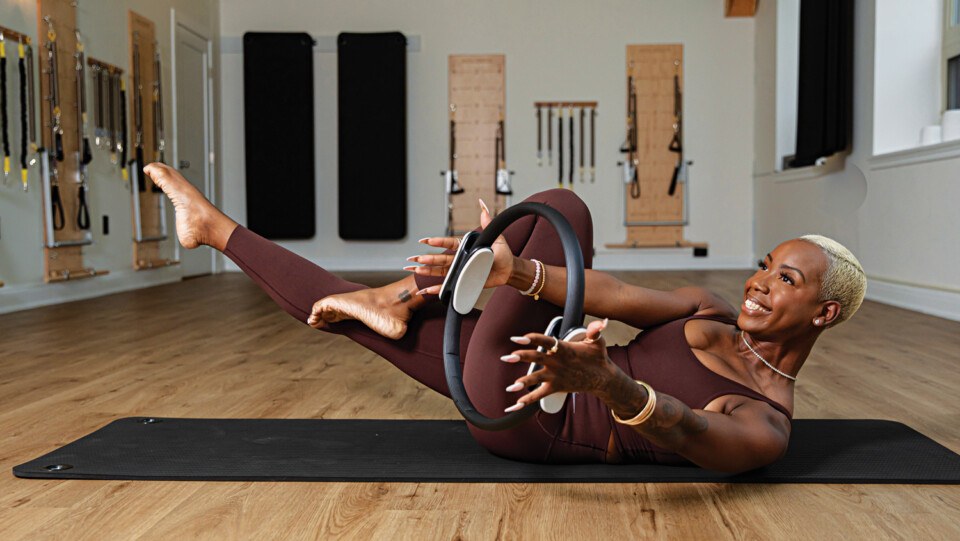
Zha Dadson practices with a Pilates ring. / Photograph by Gabriela Barrantes
Plus, there’s so much more variety than in years past. Want to build muscle and control like Joseph Pilates intended? Train at places like Star Pilates in Rittenhouse and Body Precision on the Main Line. Want resistance? Try the springboard, an alternative to Joseph Pilates’s cadillac machine that Ellie Herman invented in 2003. (Herman’s studio is in Narberth.) Or opt for any of the many reformer spots — there are at least 60 — across the region. Want to heat things up? Find hot Pilates at HPY’s three city outposts, Vision Plus Fitness’s sister studio LOVE in Conshohocken, or Focus Bryn Mawr, which debuted 104-degree Pyro Pilates in August.
Bachelorette parties are swapping tipsy trolleys for private Pilates sessions, more men are joining in on the fun — Bryce Harper does reformer Pilates three times a week — and there are even themed classes for the punk rockers. (The Hundred to My Chemical Romance? Thanks, Passyunk Pilates!)
While many people, often clad in cute matching sets, have flocked to Pilates, the modern-day movement is not free from problems or criticism. There’s in-house fighting about the watering down of a workout once created to prevent and rehab injuries, especially now that more contemporary approaches that riff on the classical method are booming; clients dishing out a lot of money in the pursuit of their newfound Pilates hobby; and critics arguing that the activity has become an exclusionary, elitist cult obsessed with being thin and disciplined.
These concerns have fueled an ongoing rift in the industry, particularly over the direction of the practice, and have sparked broader questions within the fitness and beauty sectors at large — questions that now define a deepening divide over the true essence of Pilates and what clients actually want to gain from it.
The debate over what is and what is not Pilates has become heated. (The number of “THIS IS NOT PILATES” TikToks is astounding, and the comment sections even more so.) “The word Pilates is not trademarked, nor is there one nationally or internationally recognized certification,” says Kelly Adorno, owner of Movement Source Pilates Studio in East Passyunk. As a result, anyone — with or without certs — can claim the version of Pilates they’re teaching is Pilates, which Adorno says can impact clients’ understanding of the method.
On one side is classical Pilates — the methodology created by Joseph Pilates in the early 1900s — and on the other is contemporary Pilates, which involves movements that might be inspired by the original ones, additional props (like resistance bands and weights), and/or exercises that aren’t part of the classical repertoire.
Contemporary Pilates has received pushback from folks who adhere to classical. Connelly, who teaches what she calls a “modern take on Pilates,” told me earlier this year that people have said her teaching method is not Pilates, and that she shouldn’t even be implying a connection. (Has that stopped people from booking classes at her studio? Not one bit — in fact, sessions are typically waitlisted.) “While traditionalist Pilates enthusiasts may look down on my modern approach to the method, I believe I’m simply delivering it in a way my community relates to most,” she says. “We’re hitting the basics in untraditional ways, [but are] laser-focused on results. While I highly doubt Joseph Pilates envisioned single leg stretching to Drake’s newest drop, he knew his method had the power to enhance mobility and stability.”
“I do think that many Pilates ‘purists,’ if you will, care a lot about preserving the classical work and making sure that it’s carried on as it was intended to by Joe Pilates,” says Alli Cavanagh, who teaches classical Pilates at her Fishtown-based studio In Flow. “In many ways, I am a huge advocate for that preservation … [but] I am under the belief that all forms of exercises evolve — new types are created that are inspired by original forms.”
Both Adorno and Cavanagh would love to see more specifications when it comes to what kinds of Pilates classes are on offer. A simple solution: tacking on “classical” or “contemporary” to class titles. As Adorno points out, marketing goes a long way and can inform clients’ understanding and experience of Pilates, especially if they are new to the method.
If you don’t know where to start, Dadson recommends shopping around to find out what you vibe with — classical or contemporary (or both), class type (mat, reformer, springboard, etc.), studio atmosphere, and even instructor. This might take some time, but doing so will benefit your workout and your overall Pilates experience. “The energy and the practice have to align to your personal preference, with an emphasis on quality and intentionality,” she says.
Another issue is that Pilates can be financially straining. In Philly proper, mat workouts cost around $30, with reformer sessions priced higher. (I’ve seen $43 for just one class.) “Classes are expensive because the teachers have gone through very extensive training, and machines are expensive and take up a lot of space — only so many can fit into a studio, therefore limiting class size and earning potential during that session time,” says BB Arrington, a personal trainer who also teaches mat, reformer, and prenatal/postpartum Pilates around the city. Not only does this create an economic barrier, but it contributes to what Arrington calls the “elite allure” around Pilates.

Together Athletics co-owner Kate Connelly exercises on a reformer. / Photograph by Juliet Evangelista
“Pilates has become a kind of ‘cool girl club,’” she says, noting that the physical demands of the modality combined with the “aesthetic presentation” — movements and a resulting physique that are balletic or acrobatic — are appealing and keep you coming back for more. “It’s not like one class alone does the trick,” she adds. In other words: Everyone wants in on it, all the time, insatiable for that next coveted opportunity to sculpt.
(Fortunately, there are lower-cost classes at studios such as Lumos Yoga & Barre [$10], Midsection Connection [$14], and Vibe Fitness [$8]. Also, EveryBody Movement & Wellness in University City offers sliding-scale mat and reformer sessions weekly.)
And then, of course, there are the optics. Gen Z has contributed heavily to the Pilates boom. Rather than go-hard gym culture, the always-online generation has taken to — and become obsessed with — the low-impact functional workout. It’s partly because younger people are prioritizing their health and wellness in ways their predecessors didn’t: They’re not as interested in alcohol, are more open about mental health, and are digging into longevity, focusing on what they can do now to benefit them later in life.
That’s worth celebrating, for sure. However, Gen Z has also helped create a kind of mystique around Pilates, making the century-old method out to be a trendy workout that’ll give you a perfectly snatched body. A simple search for “Pilates” on TikTok yields endless videos of mostly young, thin, white women documenting — with before-and-after footage — how Pilates “completely transformed” their bodies over the course of several months. In fact, “Pilates body” has now become an unofficial physique category in the modern fitness world. “‘Pilates arms’ (toned but not too muscly), ‘pilates abs’ (a subtle but defined four-pack), and being a ‘pilates princess’ (the complete embodiment of this beauty standard) are all actual accepted terms being used online in a normalised way,” writes culture and lifestyle reporter Ellie Muir for the Independent. It’s “another unattainable standard of beauty.”
While Pilates can and often does yield physical results — it can strengthen your core, work smaller muscles, and improve posture — presenting it as a magical cure to your fitness goals, or worse, the cult of thinness in different packaging, is not just unrealistic, but can be damaging to a person’s self-perception and body image. It also undercuts the reason Pilates was first invented: to rehabilitate after injury, improve mind-body connection, and promote lifelong health.
Over the years, I’ve learned I gravitate more toward mat- and reformer-based contemporary, going to classes with instructors who are well-versed in anatomy and physiology, can explain how movements they’re cuing relate to the muscles being targeted, provide hands-on adjustments when a client’s form is off, and offer modifications when I need to adapt. All of these factors assure me that the person leading me through class knows what and why they’re teaching — not the sequence itself, but the way muscles, bones, and joints work together for a safe, effective workout.
Like many others who are thinking about longevity, I’ve realized that Pilates alone isn’t going to support my bone density and muscle mass, both of which decrease as women age. It’s why more of us should be supplementing Pilates with strength training and aerobic exercise. While the reformer and the springboard both add resistance, they don’t fire muscles like bench presses or deadlifts do. And though you’ll likely work up a sweat during class, Pilates technically isn’t a cardiovascular workout, meaning it won’t get your heart pumping the way cycling, running, or swimming will.
If you’re someone who thrives on structure, you could try the 3-2-1 method, which calls for three days of strength training, two days of Pilates, and one day of cardio. Jade Javon, who teaches yoga at Space & Grace Yoga and Wellness in Germantown, started following this method this past summer, after dislocating her hip and desiring movement that would help “rebuild strength in the stabilizing muscles.” She began lifting at home, took up reformer classes at Drexel Pilates, and got outdoors with Hike + Heal, a community group for women that explores local trails by foot.
Over the course of just a few months, 3-2-1 changed how she felt in her body: “Strength training alone pushed my body in ways that didn’t feel sustainable. Pilates gave me stability, especially in recovery. Cardio offered stamina and heart health, and when combined with community, it also gave me joy. Together, these practices create a holistic approach, and movement feels less like a task now and more like a joyful rhythm of life.”
So, was 2025 the year of the reformer like Agnew declared? Partly, yes. But it was also the year people, no matter the apparatus or just on a mat, became more intentional with their workouts. Sure, there’s some complicated optics at the moment, but not everyone is going to Pilates solely to film their workout and grab matcha after. For Brenker, Pilates helped support her through health issues. For Dadson and Agnew, the method was what they needed to regain strength during postpartum. And for Javon, it was a missing piece in her now well-rounded workout routine.
Some will say Pilates is back; others will say it never left. But more than 100 years after its birth, people are still gaining appreciation for the low-impact exercise. We’re becoming more mindful about our bodies and how they move in concert with our breath. With every Teaser or Swan Dive, we’re actively lowering our cortisol levels — so long, stress! — and with every muscle shake, we’re not only getting stronger but boosting our confidence, energy levels, and endorphins.
That, I hope, is here to stay.
Published as “Core Values” in the 2026 issue of Be Well Philly.