Ask Dr. Mike: Do I Really Need to Go on a GLP-1?
Our reporter takes offense at the Penn doctor’s suggestion.
Dr. Mike aka Mike Cirigliano from the University of Pennsylvania tells our reporter whether he needs to go on a GLP-1 medication like Ozempic or Wegovy or Zepbound
Meet internal medicine physician Michael Cirigliano, affectionately known as “Dr. Mike” to not only his 2,000 patients, who love his unfussy brilliance, tenacity, humor, and warmth (he’s a hugger!), but also to viewers of FOX 29’s Good Day Philadelphia, where he’s been a long-time contributor. For 32 years, he’s been on the faculty at Penn, where he trained. And he’s been named a Philadelphia magazine Top Doc every year since 2008. Now, he’s our in-house doc for the questions you’ve been itching (perhaps literally) to ask a medical expert who’ll answer in words you actually understand. Got a doozy for him? Ask Dr. Mike at victor@phillymag.com.
Listen to the audio edition here:
Hey, Dr. Mike. It seems like everyone is on a GLP-1 now. In fact, last January, I came into your office, and you prescribed me Ozempic. I was kind of shocked because, while I knew I needed to lose some weight, I didn’t think it was at the level where I needed to stick a needle into my gut. I thought Ozempic was just for really fat people.
Okay, so let’s get the lingo right here. Ozempic, like Mounjaro, is for type 2 diabetics. Wegovy is the one for people who are obese or overweight. Then there’s also Zepbound for obesity.
Ah yes, and looking back over my medical notes, I do see that it was Zepbound that you tried to prescribe me.
Victor, I am not exaggerating when I say to you that this family of drugs has revolutionized how we practice medicine. I never dreamed when I started that we would have the ability to get people on medications that do so many things, not just weight loss. There are studies that show GLP-1 meds can result in a reduction in sleep apnea, heart attack, stroke, the risk of renal failure, and risk of dementia. The list goes on and on.
But it’s not necessarily these drugs directly causing some of these improvements, right? If I lose a bunch of weight, this helps with sleep apnea and I’m assuming I’m less likely to have a heart attack if I drop 30 pounds.
Now hold on. They’ve looked at that, and researchers feel that it’s more than just that. They think it has to do with the fact that all of these drugs reduce inflammation, and inflammation is a big problem that causes so many issues. Let me tell you this: I have a couple of patients who have rheumatoid arthritis, and when I put them on these drugs, they think I’m Marcus Welby because of how dramatically their pain has improved.
Is it true that these meds can even help with addiction?
Yes! There are studies showing a reduction in the desire for alcohol and narcotics. Oh, and a reduction in obsessive compulsive thoughts.
Why don’t we all just take the stuff if it’s such a miracle drug?
Well, now the issue is, who should get it? The big problem is, who is going to pay for it. And getting insurance to pay for it is a whole ‘nother ballgame. It’s been very challenging.
Yes, my insurance company denied the Zepbound prescription you wrote, and then you prescribed something else, and they denied that as well.
We can try again.
Given that these drugs supposedly help with so many serious problems, maybe it would cost the insurance company less to pay for this prescription than have to pay for big issues down the road that the drugs could prevent.
Well, if you look at it from that perspective, yes. Statistics now show that one in eight Americans are taking this. If you have any risk factors for any of the conditions these drugs can prevent, I’m going to do everything I can to get you on these medications, because to me, it would be inappropriate not to.
Let’s say a woman comes into your office who wants to lose five pounds but is perfectly healthy. Do you write her a prescription for a GLP-1?
Well, insurance wouldn’t pay for it. She could pay out of pocket. But she would have to have some risk factors in order for me to prescribe anything. I’ve never, in all honestly, I’ve never ever given one of these medications purely for cosmetic purposes. They all have to have some bona fide reason. Now, if you go to Hollywood, I guarantee you that everybody is on one.
Is it malpractice to prescribe this without real need? It’s certainly unethical.
If there is no indication for the prescription, if the person is at an ideal weight, and then they develop a serious side effect with no good reason to be on it? Yes, Kline & Specter would have a case depending on the injury. Generally, I would use the term “bad medical care” if it’s just being used to lose a few pounds to look good for a wedding. Many people follow the old adage: “It’s not how you feel; it’s how you look! And you look marvelous!”
When it comes to weight loss, how is all this working, without getting too scientific?
Essentially, the medications makes you feel full. People will say they just don’t have the desire to eat. You know who is really going to feel the impact of all this? The snack industry. People aren’t going to go to the little vending machines as much anymore, because they are on these medicines. No more Cheetos.
But they now have Baked Flamin’ Hot Cheetos with 50 percent less fat!
[Laughs] Good for them.
But this can’t all be good. Side effects, other than me not wanting to eat an entire pound of pasta by myself?
The main side effects we see are nausea, bloating, constipation, and diarrhea. Someone might have an issue with one drug and I’ll move them to another, and they are fine. It’s an individual thing.
I’m six feet tall and fluctuate between 215 and 220 pounds. Let’s say I want to get to 200. Do I stop taking it when I hit my goal?
Well, that’s another interesting question. A study just came out that showed if you stop it cold turkey, a majority of those people will gain the weight back. Not everybody, though. What some people are doing once they hit their goal is go down on the dose. So instead of doing it weekly, they might do it every two weeks.
Do I have to give myself a needle for all of these?
Wegovy has a pill form that is taken daily. The rest are the pens, which contain very, very tiny needles. It’s very simple: You wipe your belly with alcohol and put the pen there and click it and when it’s done, it’ll click again. Now, if you are paying out of pocket, you can actually get some of these in a vial where you draw it up in a syringe and do it to yourself.
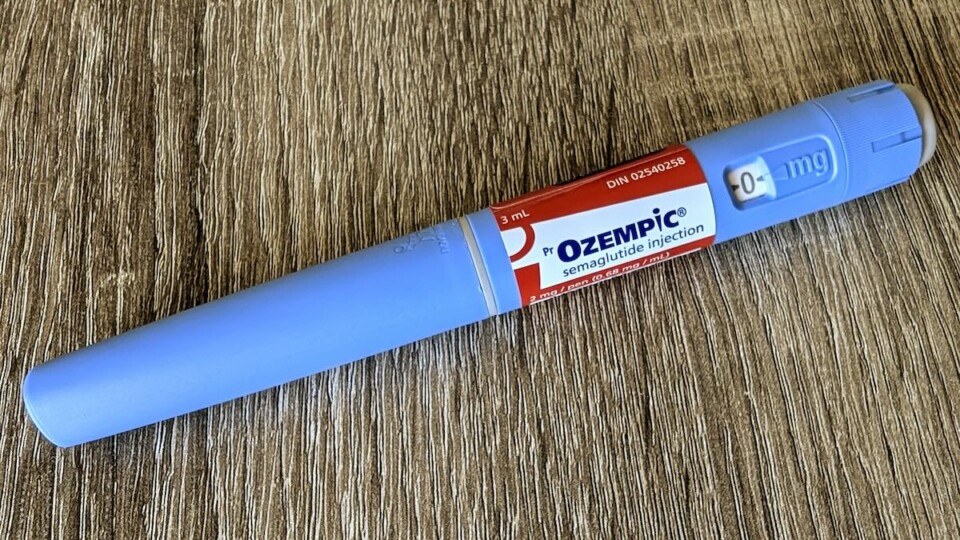
An Ozempic self-injection pen / Photograph via Wikipedia/CC
Nah, I don’t do needles.
A lot of people don’t. But these aren’t needle needles. It’s subcutaneous, meaning it’s a short needle that only goes into fatty tissue just below the skin. These are not giant needles.
Let’s get down to business. Say I’m 220 today. If I start going on one of these, can you get me to 200 in the next six months?
Oh, I am quite confident that we can get you to the promised land. I’ve had people lose 40 and 50 pounds. They are out in the waiting room and I can’t even recognize them.
But what about the fact that I just really like to eat? I just love food and the experience of eating.
I have one wonderful Italian gentleman who really is not fond of me because he really needs to be on the medicine. He complains to me that he has lost much of his desire to eat.
Sometimes you just have to enjoy life.
Well, that’s true. But it’s not all or nothing. Some people do microdose GLP-1s, but that’s less for weight loss and more for the other benefits we were talking about.
I’m already on one drug for the rest of my life due to epilepsy. I’m not so sure I want to be on another.
They just did a study that showed all of the benefits of reduction of heart attack and stroke eventually go away when you stop taking the drug. So people say, But Dr. Mike, I don’t want to be on a medicine forever. And my response is, Based on the science, you may actually want to be on these the rest of your life. And wouldn’t it be great to have that problem where your life is actually longer because you’re doing this?
I dunno. You see some people around who are quite old and don’t have a good quality of life. I’m not in favor of living longer just for the sake of living longer.
The bottom line is that there’s all this talk about longevity. But I don’t want to just live long – I want to live long and large. I want to be able to do all kinds of things when I’m in my older years. Not just bingo, even though I do love bingo. I saw a 96-year-old patient yesterday. She’s sharp as a tack, active and doing everything. Is she a little slower? Yeah. Is she going to climb Mount Everest? No. But she is an example of a super-ager, and that’s what we should all be striving for. And wouldn’t it be great if we had a means at our disposal where we might actually impact and reduce the risk of dementia and reduce the risk of cardiovascular disease while also losing weight? Well, we do. It’s here.