Male Breast Cancer is Rare, But Not Unheard of. Juan Namnun Shares His Experience with the Disease.
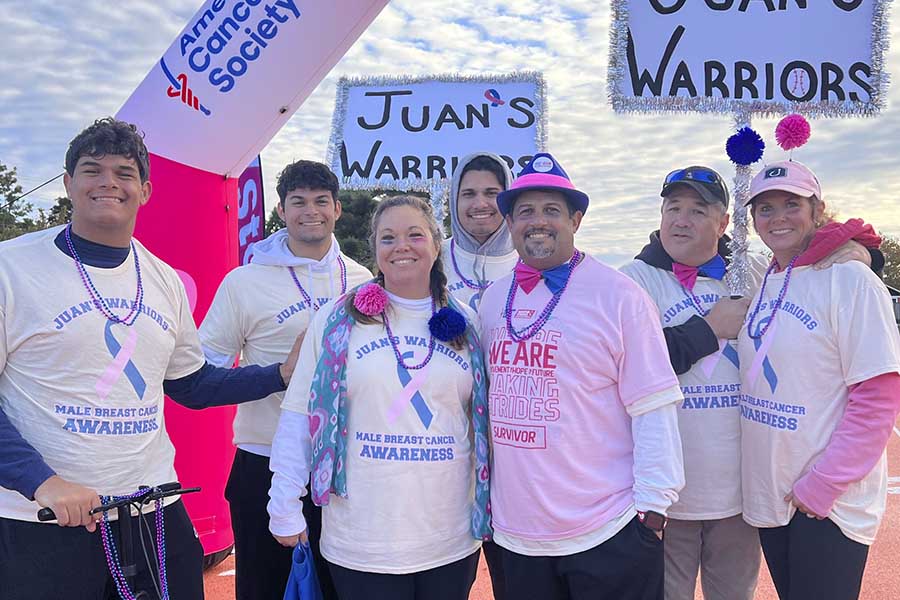
Juan Namnun knew breast cancer was a possibility for men, but he certainly didn’t think he was at risk for it. But his reality completely shifted when at age 44 he was diagnosed with Papillary carcinoma and Ductal carcinoma in situ (DCIS). A teacher at Frankford High in Philadelphia and celebrated coach of their baseball team, Namnun married his high school sweetheart, Lena, who also teaches at Frankford. The two have three boys and live in Delran, South Jersey. Today, Namnun has transformed his cancer journey into cancer advocacy, and he talks to us about his disease, treatment and mission educate young men about the risks of breast cancer.
Tell me about your breast cancer journey. How did you discover it? I found my breast cancer by complete accident, floating in a pool in early summer 2022. I felt a mass, flinging a piece of leaf off my chest, but didn’t say anything. At the end of July, my wife felt the lump, and we immediately made phone calls. The next morning, I was in my doctor’s office. That was followed by an immediate visit to a breast surgeon, then a mammogram, ultrasound and a biopsy. A week later, I got the call that I hope no one ever gets: “You have cancer.” I had a double mastectomy, followed by chemo pills, which I still take every night.
How did the mastectomy impact you? One of my lowest moments was the first time I saw myself without wrapping on. That was an emotional bomb in my head; I wasn’t the same man.
Nobody told me that I was able to get reconstructive surgery. It wasn’t until about two years later that my wife found out. I was always conscious of how I looked after my mastectomy. Growing up, I was an athlete; I was proud of my hard work and where I was as a man, and that got taken away from me. I did some research and spoke to a doctor who worked on men before. It was a massive game-changer for me mentally and physically. I can remember when I put on a dress shirt after reconstruction, and I looked like I did pre-surgery. I cried. I was so happy to have a little confidence back.
What are some of the stigmas male breast cancer patients face? My goal in all of this awareness is two-pronged—one is to get our young men understanding everything about breast cancer. The other is helping the medical community understand how their messaging and training can really impact men. Every time I went in, I would get asked if I was checking in my wife or mom, and I’d have to explain that I was the patient. Inevitably, I’d get called back, and my vitals were taken, and they would tell me I was their first male patient. And while they were being sweet, it was challenging to think I was being treated by someone who’s never done it before.
Three days ago I had to go for some scans. I went into an office, which was a very prominent South Jersey medical building, and the whole waiting room was pink everything, breast cancer everything. I really haven’t felt this way in a year because we’ve made a lot of headway in awareness, but it kind of hit me a little. This is wonderful, but I’m not thought of in this particular office. I sent a very short, sweet, caring email to the powers that be, asking that they maybe add a blue ribbon—because pink and blue is male breast cancer awareness—and I said how I felt. I heard back from a managing partner who apologized and said that they are having internal meetings, including with their marketing team, about including men in their breast cancer campaigns and welcoming rooms because sadly the numbers are growing. So that’s my goal, that kind of conversation. I’m trying to make the conversation the norm so the medical community understands how powerful their words and actions are for men to walk into a room and feel like they can trust these people.
Why do you feel it’s important to share your story? I’ve been very public with my story from the beginning. When I was diagnosed, it was in the Inquirer because I’ve been a long-time city coach with a little bit of success. I had this awakening in the middle of my journey that I have to do more. Once I figured out that I was going to be ok, I decided to make my journey about other people. Since I have a little bit of a platform in and around the city because of sports, why not use that to reach as many people as I can? I connected with the American Cancer Society, and it’s been almost a dream in how much reach I’ve had in the last year and a half.
What do you want men to know about their breast cancer risks? First: It can happen. Everybody needs to know men can get breast cancer. Second is that male breast cancer is not a death sentence. If you have any inkling that something is not right, call your doctor. We can’t wait and assume it’s nothing.
What do you want men to know about the breast cancer journey if their wife or female loved one is going through it? The most important thing, whether a man or a woman, you cannot go at this alone. You need a circle to fight with you. You have to show up for others. It may not be your spouse or relative. It could be a neighbor. The most important thing for anyone battling cancer is having someone by your side to help you through this journey. For anybody who is impacted, the most important thing is to show up, to be there, to listen.
Click here for more ways to Think Pink (and Blue).
This is a paid partnership between Think Pink and Philadelphia Magazine