The Philly Restaurant Gold Rush Is Booming. Will it Burst?
Prospectors are rushing to Philly, hoping to strike gold in one of the country’s hottest dining scenes. But will this boomtown go bust?
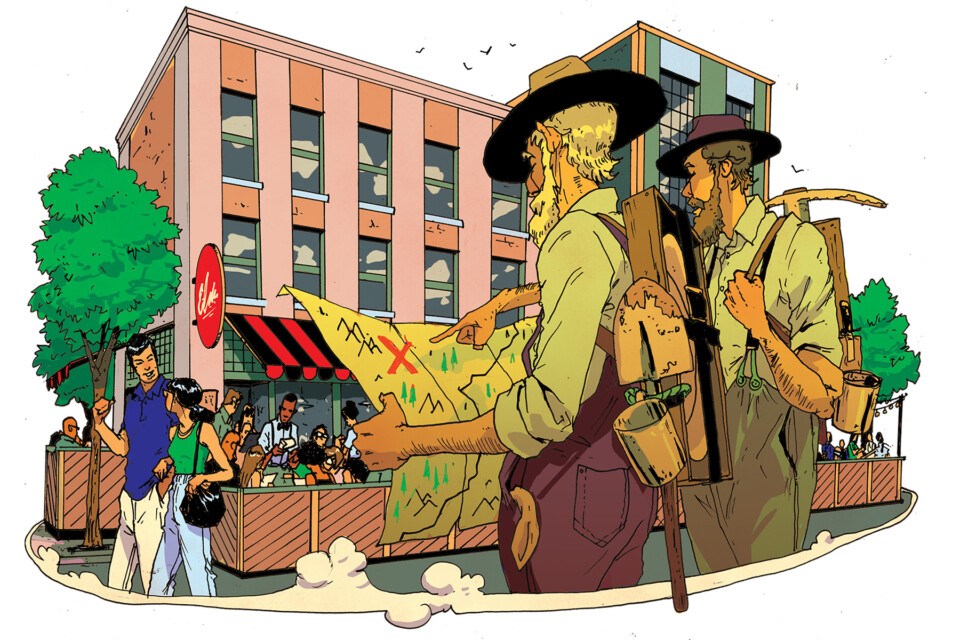
Will Philly’s restaurant boomtown go bust? / Illustration by Michael Byers
In 1875, Bodie, California, was little more than a rough mining camp carved into the Sierra Nevada foothills. It had only a handful of residents and two failed stamp mills meant for gold that had yet to materialize.
But in 1876, a profitable vein of gold ore was discovered nearby. A little more than a year later, the Bodie Mine hit another rich seam. And by 1878 Bodie had a population approaching 10,000. There were 2,000 buildings in town, several newspapers, four volunteer fire companies, a brass band, and nine stamp mills processing millions of dollars in gold bullion.
By 1880, it was over. Bodie was one of the largest gold rush boomtowns: a huge flash of wealth, a sudden explosion of relevance, and then … nothing. In 1910, the population fell to 698 people.
I’ve been thinking about Bodie a little bit lately, as it relates to Philly. Because right now, we are very much in the middle of a restaurant gold rush. Everywhere you look, people are talking about Philly. They love us for our grit and glamour, our BYOs and neighborhood haunts, our approachability, affordability, and seemingly bottomless appetite. We keep racking up awards (most recently, James Beard wins for Jesse Ito and Kalaya) and adulation in the national press. The gold is here.
So local operators in the city and the ’burbs are expanding, making long bets on the future, putting everything on the line to get in on oversized spaces on the fringes of hot neighborhoods, banking on a theory of endless expansion.
Adding to that pressure is all the out-of-town money making a play, looking to buy its way into Rittenhouse and Fishtown because that’s where the heat is. Brooklyn-based Palestinian restaurant Ayat has been trying to open in Center City for more than two years. There’s Uchi, the Texas-based sushi bar, on Sansom Street; Medium Rare (out of Washington, D.C.) is pumping out steak frites on Frankford Avenue. And even while I’m writing this, there’s news of New York City–based agave bar Mixteca taking over what was once Martha in Kensington — the same space where Top Chef veteran Leah Cohen’s New York–famous Thai/Filipino restaurant Pig & Khao was supposed to open last year. But then … didn’t.
The danger here is in trading rationality for enthusiasm and mistaking feelings for facts.”
It’s a gold rush. It’s a speculative bubble like the 17th-century Dutch tulip mania, when out-of-control demand drove prices for a single bulb — the Semper Augustus — up as high as $150,000 in today’s money. And it’s been this way for a few years now, with our recent run of successes and attention making us the prettiest, rarest flower in the garden.
It feels like Philly’s restaurant scene will never stop growing. And to not take advantage of that seems ridiculous. Like you’d be missing out on the opportunity of a lifetime. But every boomtown and every bubble feels like a rational investment until it’s not.
The danger here is in trading rationality for enthusiasm and mistaking feelings for facts. Right now, Philadelphia has all the indicators of being in a boom cycle: increased demand, desire driven by social media leading to rising traffic in certain dining rooms where there’s a scarcity of available seats (exacerbated, as with the tulips, by the value of those seats over others), and a sense of boundless potential.
The economics are harder to parse. According to the National Restaurant Association, food and labor costs have gone up 35 percent in the past five years. Occupancy costs are up 14 percent since 2019. And consumer confidence is shaky: In October, YouGov reported that 37 percent of U.S. diners are going out less than in 2024. Yet Philadelphia is looking at more than 100 new openings by the end of 2026, following a reported 125 in 2025. And while data compiled by DoorDash says roughly 93 percent of restaurants that use their service made it to the one-year mark between 2024 and 2025, even accounting for closures, that’s thousands of new seats, and filling them might be a challenge for every restaurant.
We’ve already seen some surprising high-profile failures within the past year. There was the implosion of GLU Hospitality — which owned Figo and Sushi by Bou, among others — blamed largely on rapid expansion. SIN, the avatar of “vibe dining” in Northern Liberties, managed only a year and a half before closing. Manatawny Stillworks — which opened two tasting rooms within six months — vanished with virtually no notice. Mulherin’s Pizzeria (an offshoot of Wm. Mulherin’s Sons) lasted less than a year in Market East. And I was there for one of the last services at Fleur’s — the fancy, French-ish destination restaurant in Kensington opened by chef George Sabatino and a team of local industry veterans. It lasted seven months after they placed too large of a bet for a spot on the edge of one of the hottest neighborhoods in the city.
Sabatino insists that right now location is everything. That being Philly to your bones and knowing exactly where to open (and when) helps too. “Maybe we were a little bit early,” he tells me when I call to talk about Fleur’s closure, tulips, the current gold rush, and what comes after. “Or if we had opened as a total package, with the private dining and rooftop deck, it might’ve changed things, but I don’t know.”
It’s safe to say Philly’s fate will never be like Bodie’s, with tumbleweeds rolling down East Passyunk and a museum dedicated to the glory days of $300 tasting menus. But, historically speaking, most gold rushes and all bubbles — be they Beanie Baby, dot-com, or tulip — eventually burst. They end with ghost towns and speculators left holding the bag (or $5,000 royal blue Peanut the Elephant Beanies).
On the bright side, the market always stabilizes, and the cultural shock wave often leaves behind what started the mania in the first place. Tulips now account for more than $2 billion of the Netherlands’ exports. The dot-com bubble left us with the modern internet. And all those hoping to get rich during the gold rush? They helped California become a state.
As for Philly, our restaurant scene’s true wealth was never built on out-of-town cash or outside attention. It was built on the industry’s talent and grit, its attitude and approachability, its ability to balance neighborhood vibes with national appeal — all of which originally sparked this rush. So, if and when the crash comes and the the frenzy subsides, it means more fitted-out spaces for chefs, more trained talent, and more equipment for sale at bankruptcy auctions. It means more opportunity for the folks who were always our greatest asset. And when the dust finally settles, Philly will end up keeping its gold.
Published as “The Great Restaurant Gold Rush” in the August 2026 issue of Philadelphia magazine.