
The Time to Join the Flyers Bandwagon Is Now
One of the lowest periods in franchise history is over. Take it from a lifelong fan: Now’s the time to buy into the Orange and Black.
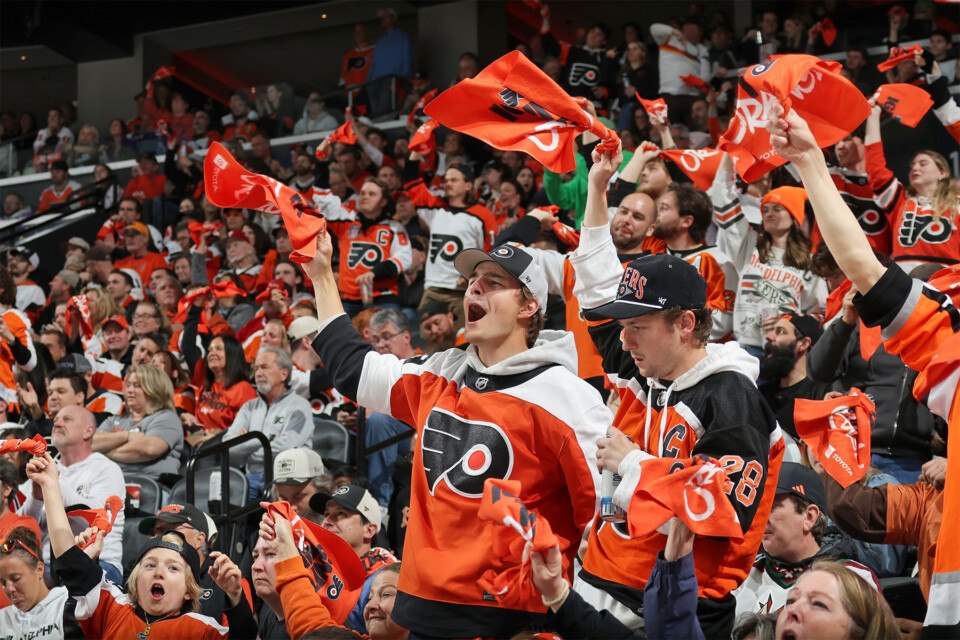
Flyers fans at the 2026 Stanley Cup Playoffs at the Xfinity Mobile Arena last May. / Photograph by Len Redkoles/NHLI via Getty Images
Listen to the audio edition here:
On May 9th, the Philadelphia Flyers’ playoff run ended the same way as all the others since 1975 — with a loss. Without a Stanley Cup. And in this particular year, the broom emoji:
But have you ever seen a team or fan base look so happy to get swept out of the playoffs? The Flyers lost its best-of-seven second-round series to the eventual champions, the Carolina Hurricanes, and while any one of those four games might have gone the Flyers’ way, the series wasn’t particularly close. But as the vanquished, disappointed Flyers skated through the handshake line, the orange-and-black diehards at Xfinity Mobile Arena showered them with love. LET’S GO FLY-ERS! LET’S GO FLY-ERS, they chanted, giving the team a standing ovation in gratitude for what they’d seen this season — and with excitement for what lies ahead.
They’d just seen the first Flyers playoff games of any kind since 2020 (the year of the pandemic “bubble” in Toronto, with no fans in the stands) and the first ones on home ice since 2018. No one was thinking about the four losses to Carolina, but rather, the fact that their Flyers went from a team with a 3.8-percent chance of making the making the playoffs on March 1st — a mathematical projection from the website MoneyPuck that head coach Rick Tocchet turned into motivation/celebration (and eventually, t-shirt fodder) — to one that had already bounced Sidney Crosby and the hated Pittsburgh Penguins from the Cup chase.
That series was something fans hadn’t seen out of the franchise in years. In Game 3, with the underdog Flyers having already won the first two games in Pittsburgh, Crosby took a high-stick from Flyers forward Garnet Hathaway, but his melodramatic crumple to the ice earned him an accompanying penalty for “embellishment” — the first of his career, much to the delight of 19,000 Flyers fans and the disgust of Penguins coach Dan Muse. The Pens still led the game 1-0 in the second period when Flyers’ leading scorer Travis Konecny conjured up the instigating ghost of franchise legend Bobby Clarke, delivering a semi-sneaky elbow to the face of Penguins’ forward Bryan Rust. The ensuing line brawl put a total of 11 players into the two penalty boxes … and the Flyers on the power-play due to Rust taking Konecny’s bait. Trevor Zegras made it 1-1, and the Flyers never trailed again.
It took until Game 6 to finish the job, with the Penguins clawing back to make it a 3-2 series. But oh, what a finish! The Flyers advanced off a long-range, blink-and-you-missed it overtime goal by Cam York that saw the defenseman launch his stick over the boards into the stands before the other Flyers mobbed him.
“I hope everyone’s okay,” York said with a sheepish smile at the post-game press conference. “Definitely don’t want a lawsuit. Just honestly blacked out. I didn’t even know what to do.” (There was no lawsuit, and York, his stick, and the fan who caught it would later meet up at the Flyers’ practice space for a photo op.)
It was arguably the highest point of any Flyers season since a similarly raucous (and penalty-filled) series win over the Pens in 2012, when current general manager Daniel Briere was still a Flyers player and current captain Sean Couturier a rookie living in Briere’s South Jersey house. But it was also only the first step in a journey that’s been years — decades, even — in the making.
The worst of it has been the recent history: not making the playoffs at all for five straight seasons, as well as nine of the last 13, while also cycling through not only coaches and general managers, but also presidents and CEOs. Still, for a long time, no matter how few wins there were, at least they were still the Broad Street Bullies. Not just tough and mean, but hard to play against, and always playing hard. They were also known for the loyal fans providing near sell-outs no matter how good or bad the hockey was. During the lowest years, that changed.
This was the year it changed back, on both counts. Even as the Flyers were doing both exactly as well and exactly as poorly as the Sixers, it was the hockey team that was exceeding expectations for the first time in a long time, while the other was not meeting them as usual. Philly was a hockey town again. (Of course, the Sixers have since found a way to reset that narrative.)
But because the franchise won its only two Stanley Cups while it was still in adolescence, and never since, that had been its own kind suffering. And my suffering. For although I spent last season covering the team, and its hopeful rebuild, for this magazine, I spend pretty much my entire life before that just like any other Flyers fan.
I like to say that I was born the same time as the Flyers, in the fall of 1967. My birthday is in late September; their first ever home game at the Spectrum was October 19th. My memories of the Broad Street Bullies are preserved in glass — a gas station souvenir glass, to be specific, with the names of every player from the 1974 Stanley Cup champions on the back. I’d read those names over and over with my chocolate milk or orange juice. Thanks to eBay, there’s now one in my South Philly house today.
My family was in the Lehigh Valley then, but what the team had done, and the massive championship parade, still penetrated my six-year-old awareness. Clarke and Parent and Schultz and Barber were, to me, like superheroes or rock stars. I can still remember tooling around the family garage with a street hockey stick and orange ball, pretending I was in Game 3 of the 1974 Cup final, when Buffalo’s Memorial Auditorium was rendered virtually unplayable by fog.
By 1978 we had moved to Cheltenham Township, where the effect of those two Stanley Cups was clear; many of my middle and Hebrew school classmates had been playing hockey at the Old York Road Skating Club. A testament to the loyalty of the fan base (and the peculiar passion of hockey folk in general), they still have an active alumni group today. I can’t say I especially remember 1980, when a blown offside call by linesman Leon Stickle helped the New York Islanders begin its Stanley Cup dynasty at the Flyers’ expense. (Whereas I can tell you exactly where I was when the Phillies won Game 4 of the National League Championship Series against the Houston Astros later that year: in the janitor’s closet at my own bar mitzvah record hop, watching on a black-and-white TV.)
But by my senior year of high school, the Flyers of Tim Kerr, Brian Propp, and Brad Marsh were possibly a deeper, better outfit than the Broad Street Bullies. That Mike Keenan-coached 1984-1985 team also had a spectacularly-mulletted rookie named Rick Tocchet, who led the team in penalty minutes and would turn into a star. That club lost to Wayne Gretzky and the juggernaut Edmonton Oilers in the Stanley Cup Final, as did the 1987 team in a seven-game classic. Hockey never truly won my dad over — he likes it fine but thinks the games should be two periods — but nevertheless he got us nosebleed seats in the tiny 300 level at the Spectrum for one of those games.
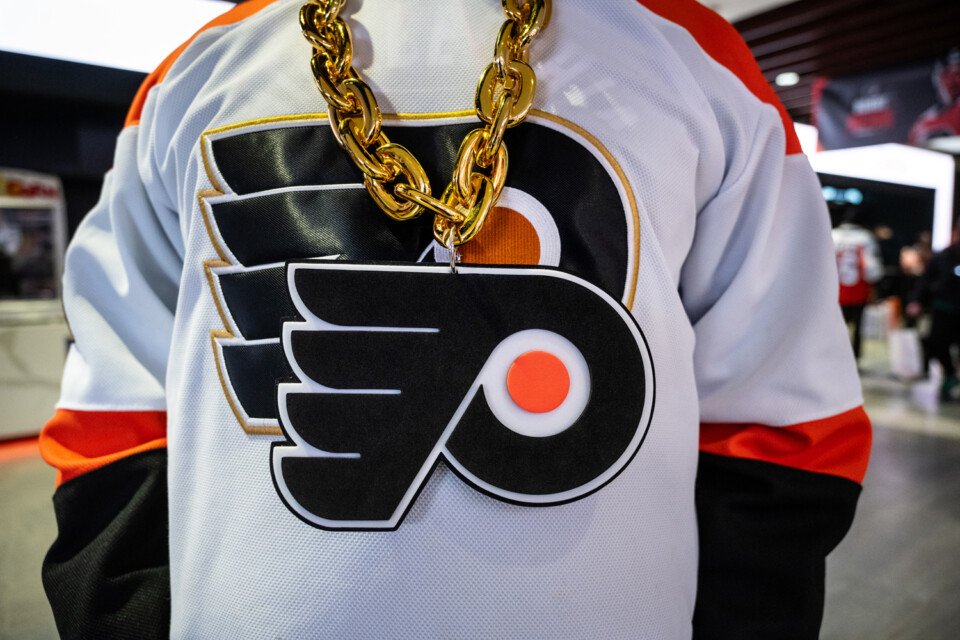
A fan shows off his style. / Photograph by Kyle Kielinski
Two years later, that now past-its prime core lost to Patrick Roy and the Montreal Canadiens in the Eastern Conference finals. I was in college outside of Chicago, watching whatever games I could on Sports Channel America, the NHL’s only national broadcaster, which didn’t even carry every game. So I would go out to my car, drive a few blocks past some trees and buildings, and pick-up 1210 WCAU’s clear-channel signal. Years later, I would do the same thing during the NHL playoffs while on a trip to England, except by then it involved dial-up and Real Player.
Until a few years ago, I hadn’t lived in Philadelphia since high school. But the Flyers were one of the things that always brought me back. (That Passover typically coincided with the Stanley Cup Playoffs was also helpful.) But to be a Philadelphia sports fan is to suffer. For Flyers fans during this time it was the exquisite pain of coming oh-so-close, rather than the recent pain of being nowhere near.
1995, 1997, 2000, 2004: I came home all those springs, often with a wedding or bat mitzvah in the mix. There was always at least one incredible experience. Eric Lindros and the Legion of Doom sweeping the hated (and defending Stanley Cup champion) Rangers in ‘95. 2000, when Keith Primeau scored in the fifth overtime against the Penguins, a 2-1 win that ended at 2:38 am. 2004, when my wife and I were able to catch a few innings at the brand-new Citizens Bank Park before crossing Pattison to jump out of our seats at Jeremy Roenick’s OT winner against the Toronto Maple Leafs
And then the inevitable heartbreaks. In 1997 I rearranged some travel to put myself in Detroit for Game 4 of the 1997 Stanley Cup Final. But by then the Flyers were already down 3-0 in the series and — especially considering the price Red Wings fans were willing to pay scalpers for a clincher — I stuck to the hotel TV, then suffered sleeplessly as Detroit celebrated. In 2000, the captain’s “C” had been removed from Lindros’s jersey while he recovered from a series of concussions, a soap opera turned tragedy when 88 came back in time for Game 7 of the conference finals, only to be steamrolled by the New Jersey Devils’ Scott Stevens. It was his last game as a Flyer.
Then there was the last really good Flyers season, 2010. My mom and I were in the stands for Game 4 of a first-round series against the Boston Bruins during my traditional spring trip home. Like my dad, she is also not a hockey fan, but went to spend time with her son, including the time spent driving from Cheltenham to Center City parking lots and then hopping the Broad Street Line to the Wachovia Center (which was about to become the Wells Fargo; it will always be the “FU Center” to me). The Flyers were down in that series 3-0, so it was just nice to see them win a game and not get swept. Then, the impossible: they became just the third team in NHL history to come back from a 3-0 hole, and made it all the way to the Stanley Cup Final against Chicago. Which — as in all the other seasons I remember more than fuzzily — they lost.
Later that night, my mom and I went to a late-night post-game dinner at Pub and Kitchen, something I can barely imagine doing myself these days, let alone with either of my eightysomething parents. Even though they aren’t superfans like me, the Flyers are my connection to family, and to growing up here. Following them is a choice. Wearing your orange hat on a December Sunday when everybody else is wearing green is a choice. Just as the Eagles fans in Silver Lining Playbook showed no signs of being aware the Phillies just won the World Series, there are Flyers fans who only bleed orange. Conversely, there are large chunks of Philadelphia who act like the Flyers don’t exist. The stereotype of the typical Flyers fan was taken to extremes on HBO’s Task, where the team logo found its way into Brad Inglesby’s Delco tapestry as an ex-con’s mobile lock screen.
Are they my favorite Philly team? The only honest answer would be “sometimes.” From 1995 to 2004, it was all Flyers. For a few years after the Phillies’ World Series win, it was split loyalty. And for the last five years, all Phillies. (The Eagles will never be more than #3 for me.)
I’ve covered sports for years, but never exclusively or regularly, and only rarely around Philadelphia. So spending the better part of four months in the press box at Xfinity Mobile last season never felt quite right. My place is in the stands. Upper-level corner or behind the net. On more than one occasion, especially in the playoffs, I had to swallow an involuntary OH! at a missed a shot, or stop my hand from banging on the table. And this was definitely the first time I’ve crossed paths professionally with not one, not two but three people whose last names have been on my back. (I own a Rod Brind’Amour #17 Flyers jersey from before he got traded, plus Brian Boucher and Sean Couturier “shirseys.”)
When Carolina was in town for the second of three regular-season games, I briefly talked to Brind’Amour, who played for the Hurricanes for nine seasons (including a Stanley Cup win in 2006) after being traded (for Primeau, in 2000). He became an assistant coach there in 2011, and has now been their head coach since 2018. Even so, Brind’Amour still remembers how hard it was to be shipped out of South Philly. “It crushed me,” he says. “I mean, I bled [orange] and did everything in my power to be the best Flyer I could.” Brind’Amour remembers Bill Barber and others teaching him what it meant to a Flyer — “This is how you are” — the same gospel Rick Tocchet preaches now that he’s the Flyers coach.
On the day before that game, Brind’Amour was out getting something to eat, and someone paid his check, telling him that no self-respecting Flyers fan would ever let Rod Brind’Amour pay for his own lunch in Philadelphia.
“Twenty-five years later,” he says. “That’s the kind of people that support this team.”
It was fitting that Brind’Amour was here for the end of the Flyers’ story this year. Even as he had the luxury of being the winning coach of the other team — and going on to win the Stanley Cup — you could also see him taking in the Philly fans’ appreciation of their Flyers. During the handshake line at the end the series, he learned into Tocchet’s ear to say something over the din of LET’S GO FLY-ERS rattling around the arena. He gestured upwards, where both his name and Tocchet’s are on a banner as members of The Flyers Hall of Fame. Of course, that’s also where the team’s two Stanley Cup banners hang. It was an acknowledgment of what they shared, and what they share with Flyers fans, even though they never played together. It felt like he could have been saying, “You’re gonna give these fans the thing they want eventually.”
But when? As Homer Simpson might say: “We want it now!” Last year’s success meant the rebuild is ahead of schedule, but certainly not over. This is a team that has only just begun to carve out its identity, and still has a few holes. In my last piece for this magazine, “It is Now Safe to Care About the Flyers,” I proposed the “Cure Auto Insurance Corollary” — that this team had been lacking the sort of signature star player that would merit one of these cheesy commercials you can’t avoid on NBC Sports Philly. But they came into this year’s training camp with a lot more candidates than they had in 2025.
To wit: it might be premature to say that Dan Vladar has ended the Flyers’ goalie curse, but he had an MVP season that also earned him a contract extension. Trevor Zegras, a bargain-bin trade acquisition, had the breakout season he never did with Anaheim and also signed a contract extension, as did Jamie Drysdale, the defenseman the Flyers got when Cutter Gauthier refused to play here. Porter Martone, who made an explosive early debut after his college season ended, is favored to be the NHL Rookie of the Year. Matvei Michkov had an up-and-down sophomore season but is still only 21 years old himself, and a possible future star. Even better, long-suffering team leaders like Couturier, Konecny, and Travis Sanheim, all of whom were the subject of trade speculation during the dark years, remain key contributors. Tocchet, with his emphasis on defense and team chemistry, turned out to be an almost-perfect hire. (He’ll be perfect once the Flyers have a power-play.)
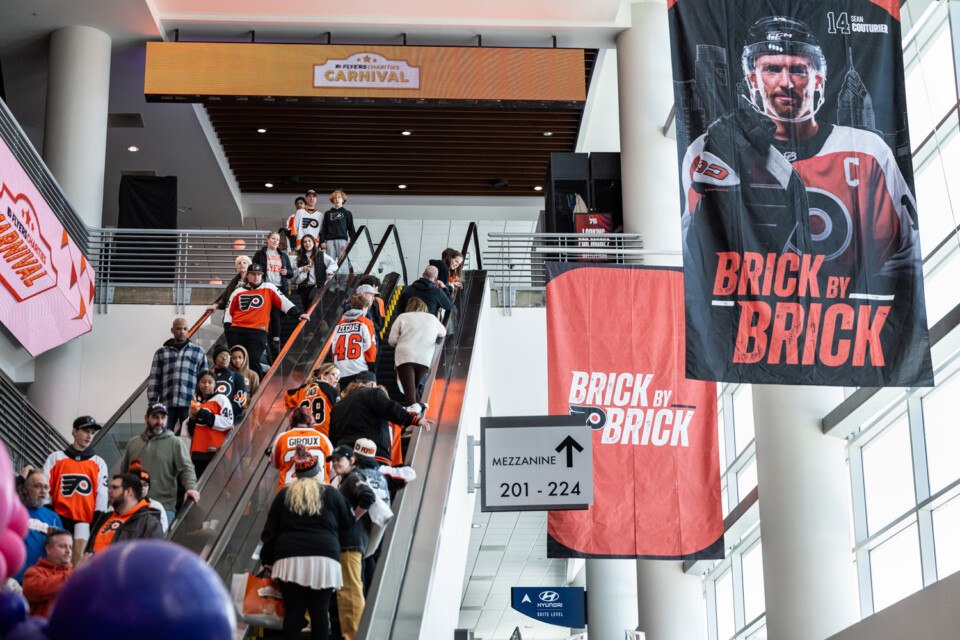
Fans at last year’s Flyers Charities Carnival / Photograph by Kyle Kielinski
It was a fairly quiet offseason, save for Briere taking a big swing at 21-year-old Leo Carlsson, offering him the most expensive annual contract in NHL history (five years, $90 million). The Anaheim Ducks matched the offer and kept Carlsson, but the move, which would have cost the Flyers four future first-round picks, announced to both the NHL and Philly fans that there’s no more “Wait ‘til next year.”
But also … you might have to wait ‘til next year. It remains a young group that needs to improve from within before more help comes from outside. And if rebuilding is hard, winning championships is even harder. (Just ask the Phillies and the Sixers.) Some stalwart Flyers players may not still be here when the team is truly ready to be great. But they’ve come a long way just since a year ago, when it seemed like last season still might have been another one of playing for the draft pick.
To lace up the metaphorical skates and put on the Orange and Black in 2026 is — hopefully — like becoming a Flyers fan in 1971, or 1991, or even 2011. Only one of those eras produced championships, and the third one largely disappointment. But there were still a lot of great seasons. Just as with the Bullies, Lindros & the Legion of Doom, and Giroux/Couturier, this is the moment to become part of what’s happening, for what’s hopefully a long run, with a new generation of players to put on the back of your jersey. And with LeBron in the building and the plan for the new arena, you also know Comcast desperately needs the Flyers to deliver. They need hockey to be relevant not just for the next few years, but in 2030 and 2035 too.
After that Game 6 wins against the Penguins, even with the time I spent in the locker room and at the press conference, the celebration was still going in the Xfinity Mobile parking lots, with big crowds waiting to get on the subway. We packed into the cars, standing room only, then got hung up for bit at Snyder after a small group of fans got off. With the train not moving, one of them began furiously tapping on the window, gesturing at us on the train. Did he get off at the wrong stop? Leave a friend behind? A few other people and I in the car finally figured out that he wanted the attention of the guy standing right next to us. The woman next to me tapped his shoulder to let him know. The man, clad in a Penguins jersey, turned to the window, where he was greeted with a pair of middle fingers on the other side. Just another way of saying: LET’S GO FLY-ERS.