
Award-Winning Comics Creator Brian “Box” Brown Returns With Two New Graphic Novels
One’s a dark and funny dystopia, the other’s a biography of Marc Maron’s WTF podcast.
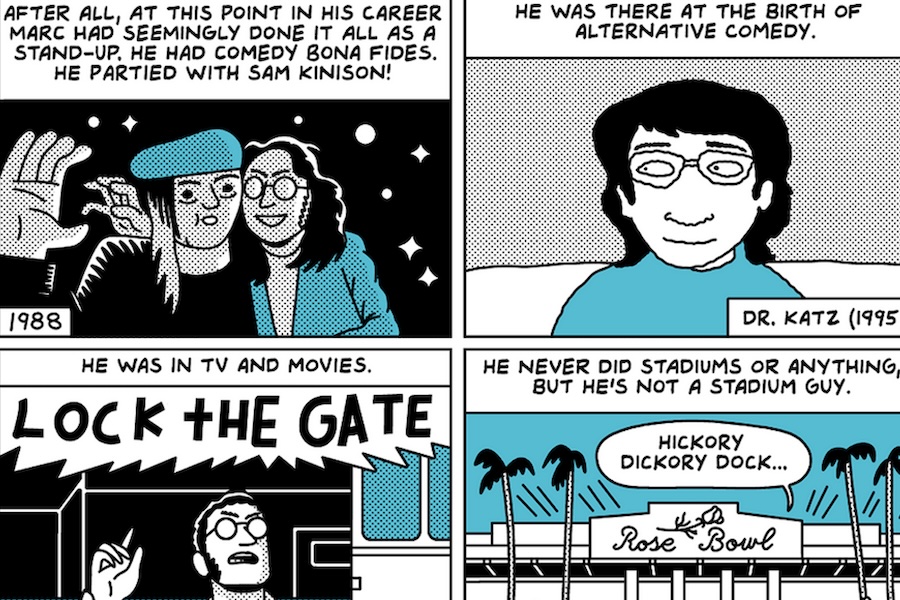
Detail from WTF is a Podcast with Marc Maron, one of two new graphic novels by Brian “Box” Brown about to drop.
Philly-based comics creator Brian “Box” Brown never planned to drop two big new graphic novels in rapid succession — it just kind of worked out like that.
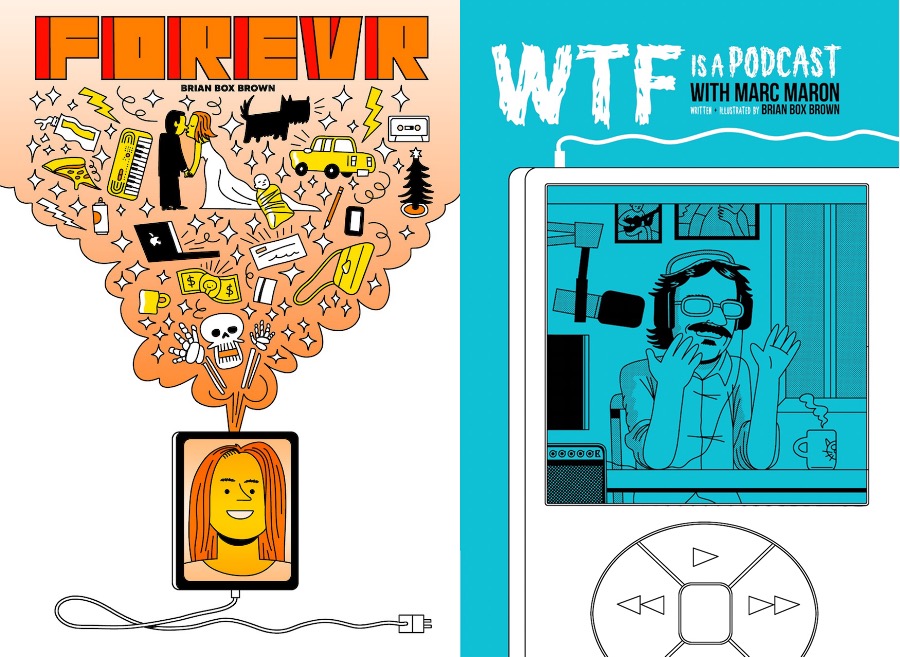
Before he’d even gotten the go-ahead for his biography of Marc Maron’s recently retired podcast WTF (due out November 3rd), Brown was already hard at work a darkly humorous dystopia called Forevr (September 8th). The schedule was grueling, but the end result is a pair of graphic novels that demonstrate the breadth of Brown’s bold approach to art and storytelling.
WTF is a Podcast with Marc Maron (Standard Edition Book) utilizes the the documentary-ish style Brown has become known for. His previous pop culture history subjects included Andy Kaufman, Andre the Giant, Tetris, He-Man, etc. To research the Maron project, he spent hours interviewing the comedian and his producer Brendan McDonald, while also digging into the podcast’s massive 16-year archive.
The more personal Forevr (Top Shelf Productions), meanwhile, imagines a near-future in which the deceased are kept “alive” by a suspicious subscription-based app. It’s witty and thought-provoking, built on family dynamics and unsettling Twilight Zone vibes — plus some escalated Black Mirror-esque cruelty. Freed from the constraints of his more journalistic approach, Brown’s gift for dialogue really shines in this one.
Brown and I talked last week about the two new books, of course — plus weed, AI, Robin Williams’s giant G.I. Joe collection, and more.
What made you want to do a graphic novel about WTF?
I’m such a big fan going way back. Marc’s story, it’s kind of cheesy and embarrassing to talk about, but it was so inspiring to me. I was listening to and watching his stuff before WTF, and he was dead on his luck— he’d been fired [from Air America] and couldn’t sell any tickets. And then he just takes a chance doing this podcast, and it ends up just growing and growing and growing, and becoming this huge thing. It was amazing to watch happen.
Had you worked with Maron before?
I had done a poster for Marc, and had been in touch here and there for a while. And [producer Brendan McDonald] followed me on Twitter, and was aware of my stuff. I would send books to Marc. And then, my other publisher, First Second, was like, You know, how about you try to get in touch with Marc and do a book with him? And I was like, I would never actually do that because it was too humiliating.
To pitch it, you mean?
To pitch it to Marc and … why would he just be like, Okay, sure, I’ll just make a commitment with this asshole? I don’t know. It’s just low self-esteem talking.
It’s a star-studded book, thanks to all to people Maron interviewed over the years: Barack Obama, Robin Williams, Gallagher, John Oliver …
The Robin Williams stuff was interesting and funny. Marc was like, “Yeah, and Robin had this collection of G.I. Joes.” But it wasn’t G.I. Joes, it was even more detailed giant soldier dolls. And Robin’s showing him all his dolls, the whole room is just all these dolls. And they start walking out of the room and Robin’s publicist, maybe, was there, and was like, “Listen, don’t bring up the dolls in the interview.”
Wild.
The most surprising thing about WTF was how much Marc’s experience with sobriety and AA specifically influenced the show, in his interview style. And the whole squashing beef thing goes directly back to AA, and the concept of making amends.
Nobody interviews the way Maron did on that show.
I had a friend in high school where, you know, we’d go into a party not knowing anybody, and in an hour he’s having a deep conversation with someone in the corner. That’s kind of what Marc does naturally. I think it’s a way to defeat boredom and small talk, to go quickly to deeper topics. It does make the conversation interesting. Marc just likes to talk to people.
So if the WTF book required a journalistic approach, what was your approach to Forevr, a work of fiction?
It’s extremely different, and painful in a way. Not super not used to it because, I don’t know, I feel like you really need to trust yourself so much. It’s hard to maintain a level of confidence. But it was a challenging experience, in a good way. And it was fun. I worked on it over the course of pretty long time, at least two years.
Is it a more personal project?
There’s some auto-bio stuff in there … I’m interested to see what happens when it comes out. It’s gonna be weird. It feels weird doing fiction, for sure.
Because it’s all coming from your head, did you have it all mapped out before putting pen to paper?
No, not at all. Whenever I do any comic, it’s more from an outline. … There’s also a lot of editing that goes on at the end, stuff getting moved around and deleted. Just being like, oh I think I was going somewhere with that, but then I just didn’t go anywhere.
Is it tough to make the cuts?
Super painful. But the more time that passes, the easier it is to edit.
Let’s talk about Legalization Nation. You’ve been publishing weekly comics about the history of marijuana criminalization in America for six years at this point. How’s the cannabis community been treating you?
Warm, I think. Warmer than comics in a way. It’s really huge — a big overall market, but also very dictated by a small scene, if that makes sense. In comics, the market is actually really, really small. It’s almost barely an industry, in a way. Everybody, every artist is struggling, etc. Every publisher struggles. We’re always trying, working on relevance and all these things. If you look at comic sales, probably more than 50 percent of it is just Dog Man.
Does the cannabis scene have any similarities to the comics world?
It’s the same type of thing where it’s a bunch of people that don’t really fit in with general society and are just, like, generally weirdos.
Since you make these deep-dive comics about pop culture subjects, I assume your work reaches people outside the usual comics audience.
It does. It’s just small in general. Even my biggest hit book, which was Andre the Giant, you know, sold 30,000 or something copies.
Did you see the Masters of the Universe movie? What’d you think?
Aside from the Jared Leto thing, I think my only criticism was that they should have made He-Man huge. There were all these CGI guys that were crazy looking, like Star Wars-style, somewhat faithful to the to the action figure stuff. But He-Man was just a regularly jacked guy. I don’t know, it took me out of it. I really need He-Man to be disgustingly huge. Like, inhuman.
Has the movie led to improved sales of your graphic novel?
I’ll find out when I get the sales thing. But I definitely have been getting a lot more emails about it lately.
There’s lots of funny dialogue and easter eggs in Forevr, but it’s also pretty dark and dystopian.
It’s definitely a dark, dark story. And it was very influenced by distaste for AI art … and other stuff too that happened before that, like the NFT craze. We saw this whole grip come and go, with nobody left standing. I feel like artists end up being on the front lines of this type of stuff. We all got our stuff stolen directly. The first and most obvious use case is all art. You don’t have to have an artist at all, right? If you didn’t have an artistic eye, you’re like, what? It’s the same thing.
Has AI done much damage to your corner of the market?
I think, if anything, it’s put a premium on real art and artists, and people wanting to do that and not use AI specifically, because it’s an indicator of shitty quality. Obviously, there’s people that don’t give a shit, and they just don’t care. But they probably wouldn’t have paid you to do their art anyway.