

New HBO Documentary Series Explores Philly’s History as a Hub of Reptile Smuggling
Tiger King creators return with crazy stories of smugglers, collectors, hustlers, zoo keepers, and federal agents — plus all the turtles, snakes, and lizards caught up in the crossfire.
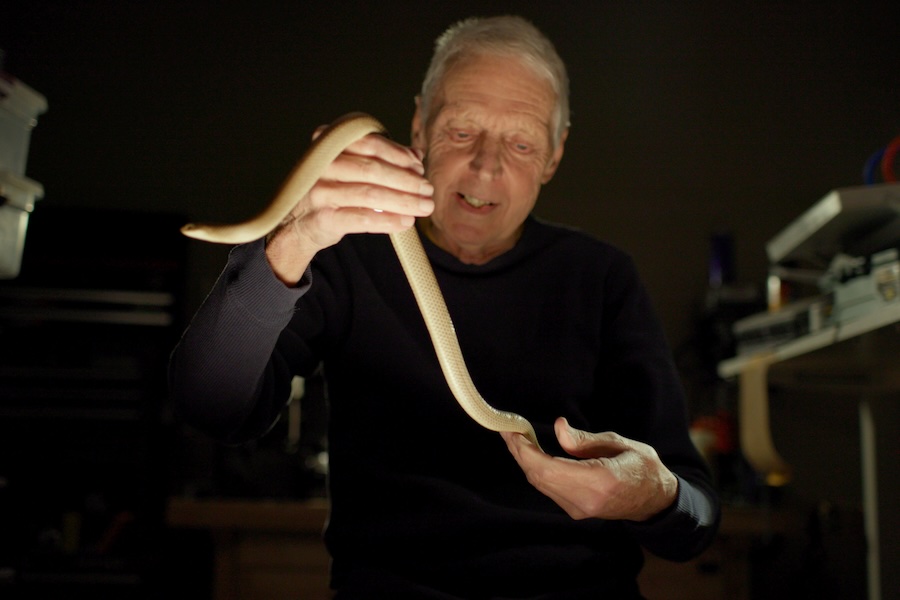
The star and villain of Monsters of God episode one: Hank Molt of the Philadelphia Reptile Exchange. / Photograph by A24/Goode Films/HBO
According to a new HBO documentary series by the makers of Tiger King and Chimp Crazy, the Philadelphia region was once a hive of international reptile smuggling. That dubious distinction comes courtesy of a rather under-scrupulous dealer named Hank Molt who just happened to grow up here and just happened to love lizards.
Well, love might be the wrong word. Reptile smuggling is dirty business. In 1977, when the feds were closing in, Molt’s helper Ed Allen took hundreds of rare animals to the Pine Barrens and buried them alive. Allen later led authorities to the site.
[EDITOR’S NOTE: A previous version of this article stated Hank Molt was involved in burying that large cache of smuggled reptiles in the Pine Barrens in 1977. However, a representative for HBO’s Monsters of God reached out to make it clear it was in fact Molt’s helpers, including former pro football star Ed Allen who buried the animals, apparently without Molt’s knowledge.]
In Monsters of God, filmmakers Eric Goode and Jeremy McBride explore this time when dealers all over the country made a living sneaking rare alligators, lizards, turtles, and other animals out of far flung locations (mostly Asia, Africa, and Australia). The first episode of the five-part series focuses heavily the industry’s Wild West period, when Molt and his Philadelphia Reptile Exchange were doing big business dealing to collectors, zoos, Hollywood, etc.
Things didn’t start to change until the District Attorney’s office in Philly starting prosecuting Molt and other wildlife traffickers. This led to the creation of the Endangered Species Act and the creation of the CITES (Convention on International Trade in Endangered Species of Wild Fauna and Flora) org in the early ’70s.
Looking back, McBride sees tiger collectors as driven by ego, whereas chimp people have more of an emotional attachment with their pets. With reptiles, it’s a different story: “There’s the obsession, which is more intense than any of the other kind of animal people that we’ve met with.” He likens the collectors in Monsters of God to people covetous of baseball cards and postage stamps. “It’s the same sort of pathology,” he says. “The rarer the species, the more desire that people have for them. Some people see them as art. Nature’s greatest design, in a way — the pattern, the beauty. It’s a very attractive quality.”
Hank Molt was something of a pioneer in this business, wasn’t he?
Eric Goode: He was getting some of the rarest reptiles that had never been in the United States ever, things that no zoo had ever seen. … In the early ’70s, reptile houses were becoming more popular attractions at zoos, and zoos in those years really wanted to outdo each other by having a Komodo dragon or the rarest big snake or whatever. It’s not that there weren’t other exotic animal dealers around the country, but there were very few that were as good [as Molt].
Which put a target on his back.
Goode: Hank Molt was one of the first people to be sentenced, actually sentenced, to prison for a wildlife crime. That was very novel back then. Wildlife crimes were typically just a slap on the wrist, a penalty, but not a prison sentence. Back in those days, in the ’70s, it was Customs that was really enforcing these laws, not U.S. Fish and Wildlife Service.
Obviously Molt was a smuggler. But he’s likely responsible for millions of people seeing these animals and probably some scientists studying and preserving them, too.
Goode: Absolutely. He brought in the first black-headed pythons that zoos started breeding. He brought in many Australian pythons that zoos had never seen before. … A lot of the animals that you see in zoos today originated from what Hank Molt brought in to his reptile store in Philadelphia.
What kind of a guy was Hank Molt?
Goode: Well, he’s alive.
Whoops.
Goode: He’s in his 80s. But it’s a really good question. We didn’t know when we started this project if he was dead or alive, and we would call different people that knew him back in the ’80s and ’70s, and they would say he’s like Keyser Söze. “He’s such a mystery. No one knows if he’s alive, if he’s dead.” But we finally found him after a couple of years of trying to figure out where he was. He’s based in Ohio today. And nobody really knows Hank Molt.
Jeremy McBride: He describes himself as unknowable.
Goode: I have to say that what he did in the ’70s was also really remarkable. He knew as much about reptiles as any scientist or zoo curator out there. And he knew how to figure out how to get them from these really difficult countries to navigate, especially in those days. … And he loved outfoxing the authorities and law enforcement. He loved impersonating zoo curators when he would go to different countries. He’d make business cards that said he was the director of the San Diego Zoo or the director of the National Zoo. He just loved the game and the sport, if you will, of smuggling animals.
It’s kind of amazing he found so many people go along with him on these adventures, and in this business.
McBride: He would recruit these people that had nothing to lose, and you can see that narrative in the show. There was a guy we never could fit in, this guy he used to call Chuck the Executioner. Really interesting guy. He was the executioner for the state of Pennsylvania on the electric chair. … And [Molt] got this one particular guy, Ed Allen, who wanted the adventure but had resources, and would bankroll some of some of Hank’s trips. Ed obviously had a much more successful life, went to Penn, had this great legacy, played for the Chicago Bears. But Ed was the one that eventually brought [Molt] down, which is so Shakespearean. The very guy he recruited kind of turned on him with the Pine Barrens story.
Ultimately landing Molt in prison.
Goode: You could argue that Hank paid a price, and the big zoos didn’t. They got get-out-of-jail-free cards because of their ties to the government, and of course the National Zoo and the Smithsonian Institute are all connected, and they’re part of the United States government. The government isn’t going to take down the government. And I just want to make it clear that this was a much easier way for zoos to fill their menageries than going out on actual expeditions.
When it comes to smuggling, reptiles seem fairly easy to transport, especially back then.
McBride: Reptiles are portable. You could go to these jungles across the world and scoop them up and put them in your suitcase and bring them back. As referenced in our show: “nature with handles.” They don’t require too much food, water, and you can travel long distances with them.
It took a lot for Molt to be prosecuted.
McBride: I think society didn’t really care. There were no laws, no protections. … But society modernizes, and we think differently about things. This is a life. Animals, reptiles have emotions. They have feelings. They have welfare issues. They need range. They need space. They need the wild more than ever. They shouldn’t be in someone’s sweater box in their closet.
I used to have a red-eared slider, but I had to re-home him.
Goode: Every kid in my generation [had them]. Every pet store in the country, including Woolworth’s, sold baby red-eared sliders, the little green babies. Everyone had their little fake palm tree, little plastic bowl — and ultimately 90 percent of them were flushed down the toilet when they died. They’re the gateway drug to becoming a reptile fanatic.
What often drives demand?
McBride: There’s this paradoxical effect of culture, where the very magazine that’s doing a story on wildlife trafficking is this prospect guide for smugglers to realize where animals are. A profile of a guy with a big snake in Nat Geo births this interest in a in a rare animal that people want. … Jurassic Park comes out in the ’90s, and then everyone wants their own pet dinosaur, and that births the entire green iguana industry. … And by the way, [Monsters of God] could have that same effect.
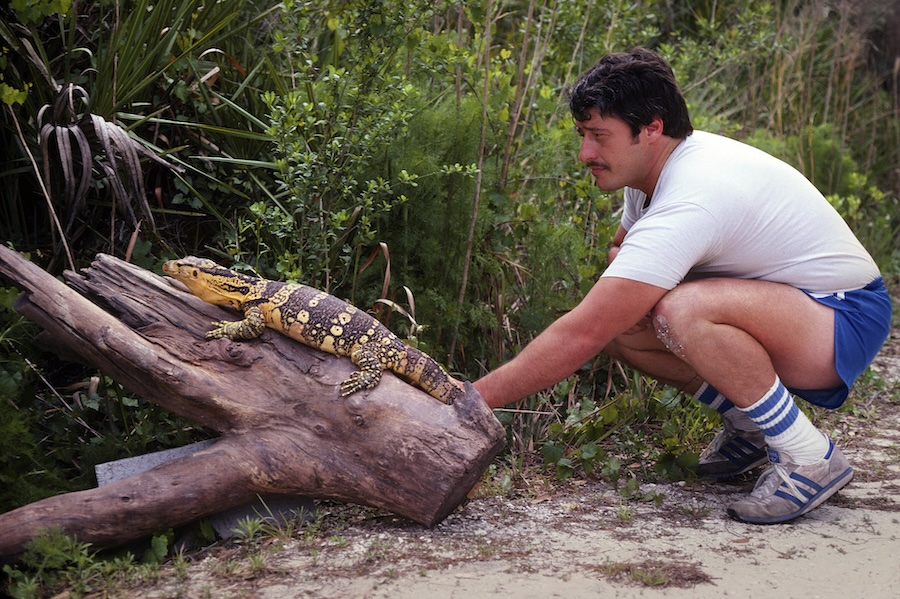
Tom Crutchfield, another reptile dealer in Monsters of God. / Photograph by A24/Goode Films/HBO
Monsters of God debuts on HBO Max on August 6th.