How Should We Memorialize Pierre Robert?
A Rittenhouse bench, a mural, and a street renaming are all in the works. What about a statue?

Pierre Robert, photographed in Rittenhouse Square on January 8, 2007 by Bill Cramer/Common History
When Pierre Robert died suddenly at his Gladwyne home on October 29th at the age of 70, the news sent shockwaves through both the Philadelphia region and the rock radio world at large. After all, this was a man who had been on the air here since 1981, a time when disco was fading away and Philly bands Hall & Oates and the Hooters — followed closely by New Jersey’s own Bon Jovi — were on the rise. Robert made 93.3 WMMR what it became: one of the most important rock stations in the entire country.
His voice and hippyesque physical presence were recognized by generations of WMMR listeners. At WMMR events like MMRBQ, you’d see Pierre posing for photos with Baby Boomers, their millennial children, and their Generation Z offspring, all of whom counted themselves as fans of both the man and the station … though probably more of the man.
After all, what was there to not like? He was a truly generous and good soul with a not just magnetic but magical personality, a person whose kindness could be felt as soon as he walked into the room. On the airwaves, his voice eschewed the typically loud and bombastic FM rock DJ quality in favor of warmth and wonder.
The New York Times and Rolling Stone both ran obituaries. Countless rock celebrities from Dave Grohl to Alice Cooper took to social media to share their reflections and condolences. It’s difficult to imagine another radio DJ receiving such a sendoff, but then, Pierre Robert was far more than a radio DJ. He was, quite simply, an excellent human being. Or, as he would put it, “a good citizen,” a phrase he probably uttered a million times in his life. He was peace. He was love. He was rock and roll.
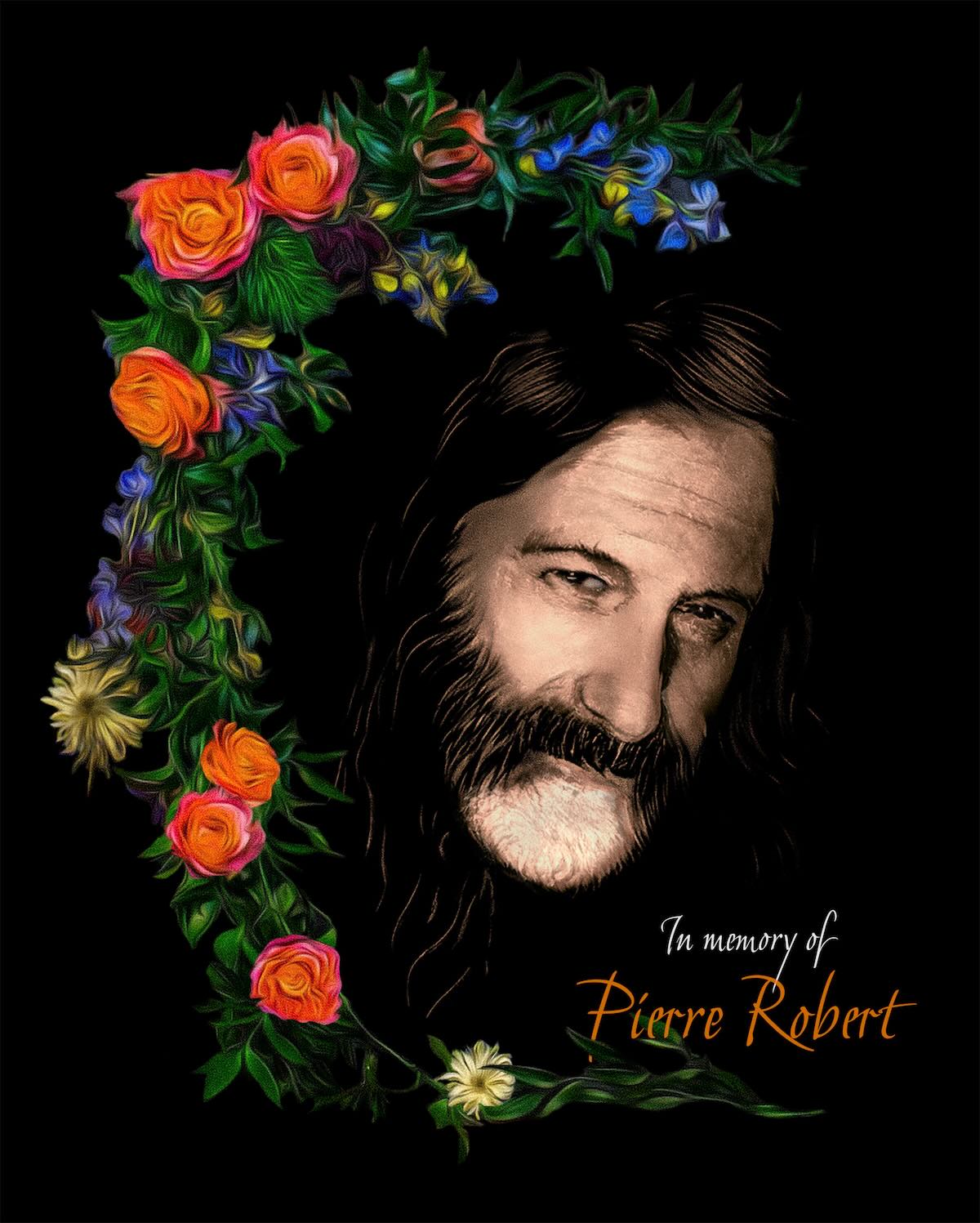
Given all of that, it’s hardly surprising that his friends and fans want to find a way to memorialize Pierre in Philadelphia, to create some kind of monument, or, in this case, at least three.
The first person to publicly suggest a Pierre Robert monument was Delco musician and longtime WMMR listener Mikeal Anthony Greto. In November, in the days following Pierre’s death, Greto posted a change.org petition calling for a statue of Pierre Robert in Rittenhouse Square, the late DJ’s favorite place in the city. (WMMR’s first studio where Pierre worked in the 1980s overlooked the park.)
Greto proposed a life-sized statue of Pierre sitting with a book and cup of coffee; the statue would sit on a bench in Rittenhouse Square. The community was enthused, and Greto quickly racked up thousands of signatures.
“I wanted to honor a very special man in any way that I could,” Greto tells me. He used – what else? – A.I. to generate what he thought the statue should look like:
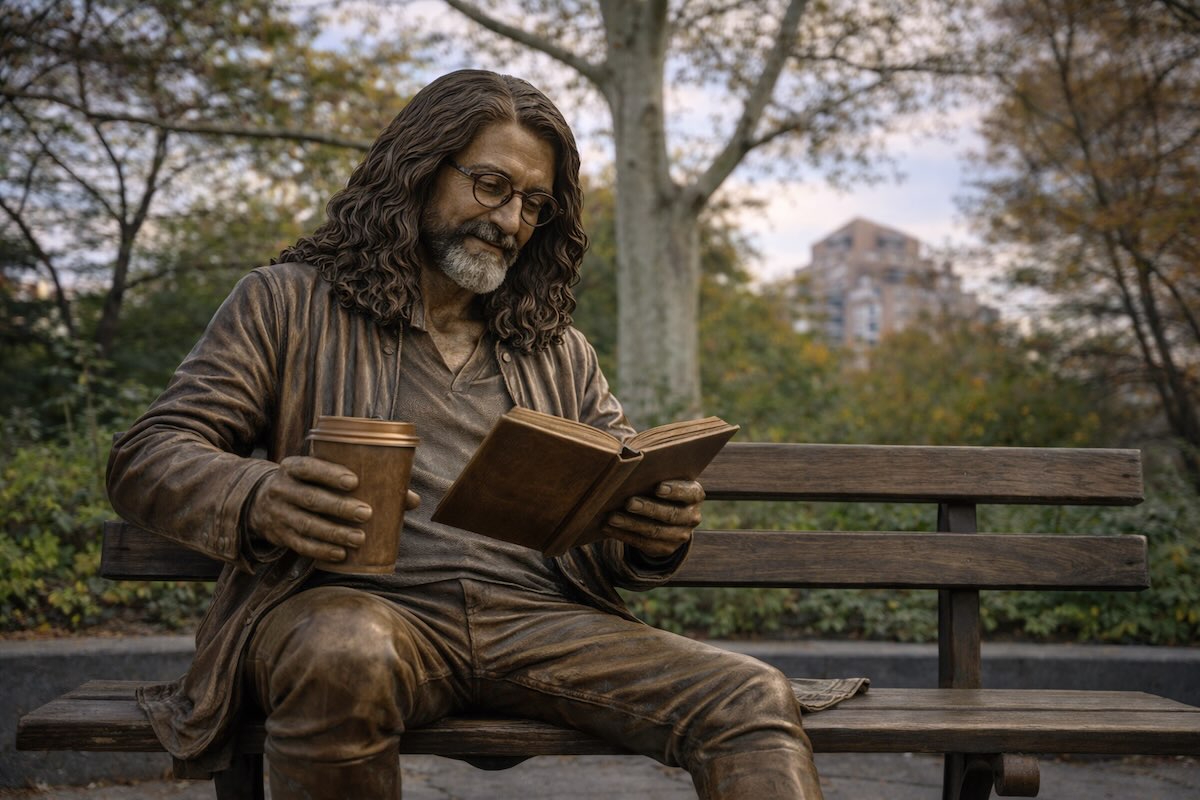
He began reaching out to sculptors to learn more about the process, including the Ohio-based company behind a similar Benjamin Franklin sculpture that sits on Penn’s campus. Greto discovered that the cost would easily exceed $120,000 and that he wouldn’t get delivery for a year or more. He also learned that some close to Pierre had ideas of their own and that the statue-in-Rittenhouse proposal, such as it was, might not actually fly with Friends of Rittenhouse Square, the organization that oversees the park. (After all, you can’t just make a statue and stick it wherever you want.)
“They saw a financial hurdle,” Greto explains, later telling me that he still supports the idea of a statue. “They also told me they had reached out to Pierre’s family and other key players to figure out a fitting memorial… then they stopped responding to me.”
Enter Dallyn Pavey Uosikkinen, wife of Hooters drummer David Uosikkinen and, more importantly for the purposes of this particular story, a very close friend of Pierre’s. She met him in 1985 when she was working for competitor WYSP and, after she got laid off from that station, landed a job at WMMR. Dallyn is spearheading the other memorialization efforts and tells me that she wasn’t even aware of the statue proposal and had no idea who Greto is, in spite of his 9,000-signatory-strong change.org petition.
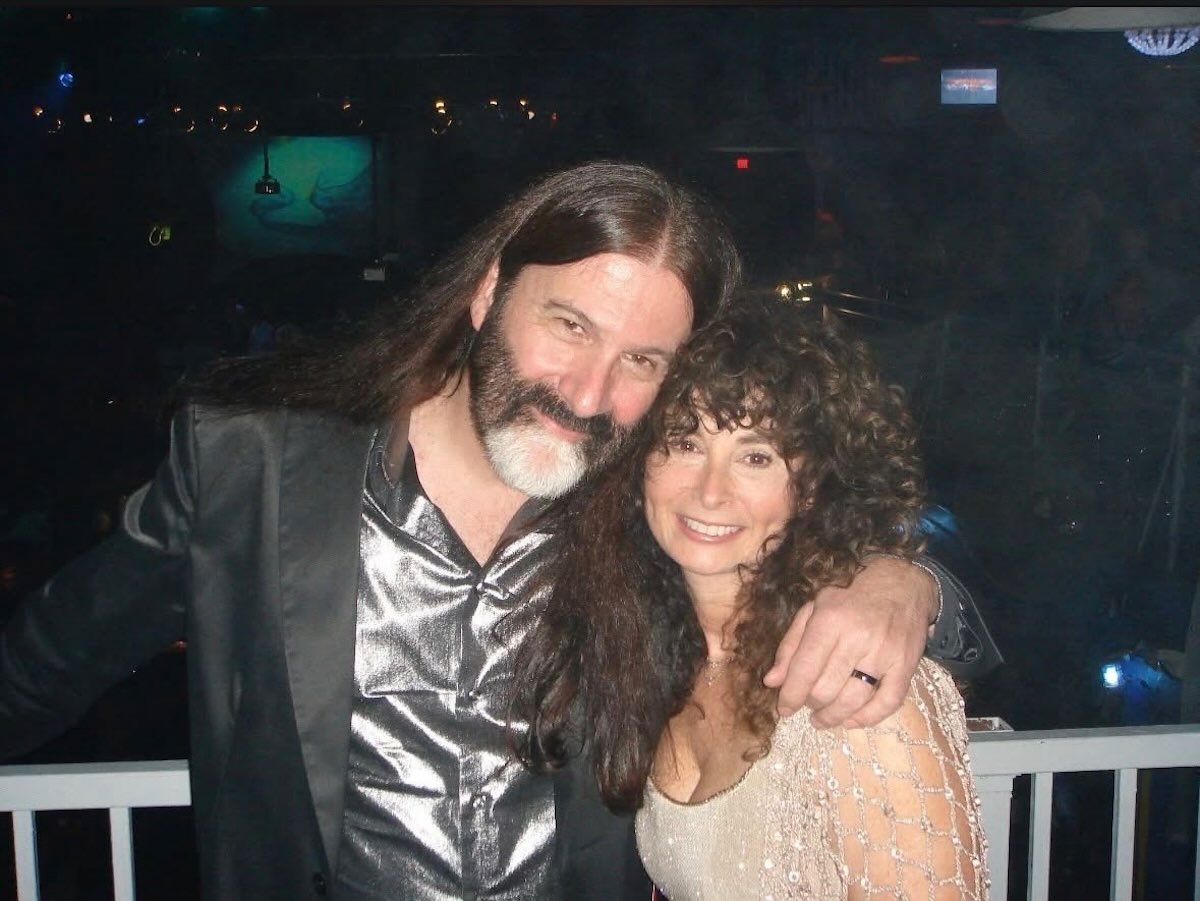
Pierre Robert and Dallyn Pavey Uosikkinen at the Electric Factory 40th anniversary party in 2008 (photo courtesy Dallyn Pavey Uosikkinen)
First up is the dedication of a park bench in Rittenhouse Square, which the Friends of Rittenhouse has confirmed is happening. It’s not just any bench. The bench was the one that Pierre preferred, and the bench he relaxed on on what turned out to be the last Sunday of his life, a moment he captured on Facebook, writing: “Sunday afternoon in Philly in my beloved Rittenhouse Square, with a great book, a cup of La Colombe, watching the world lazily drift by… pretty close to perfection!”
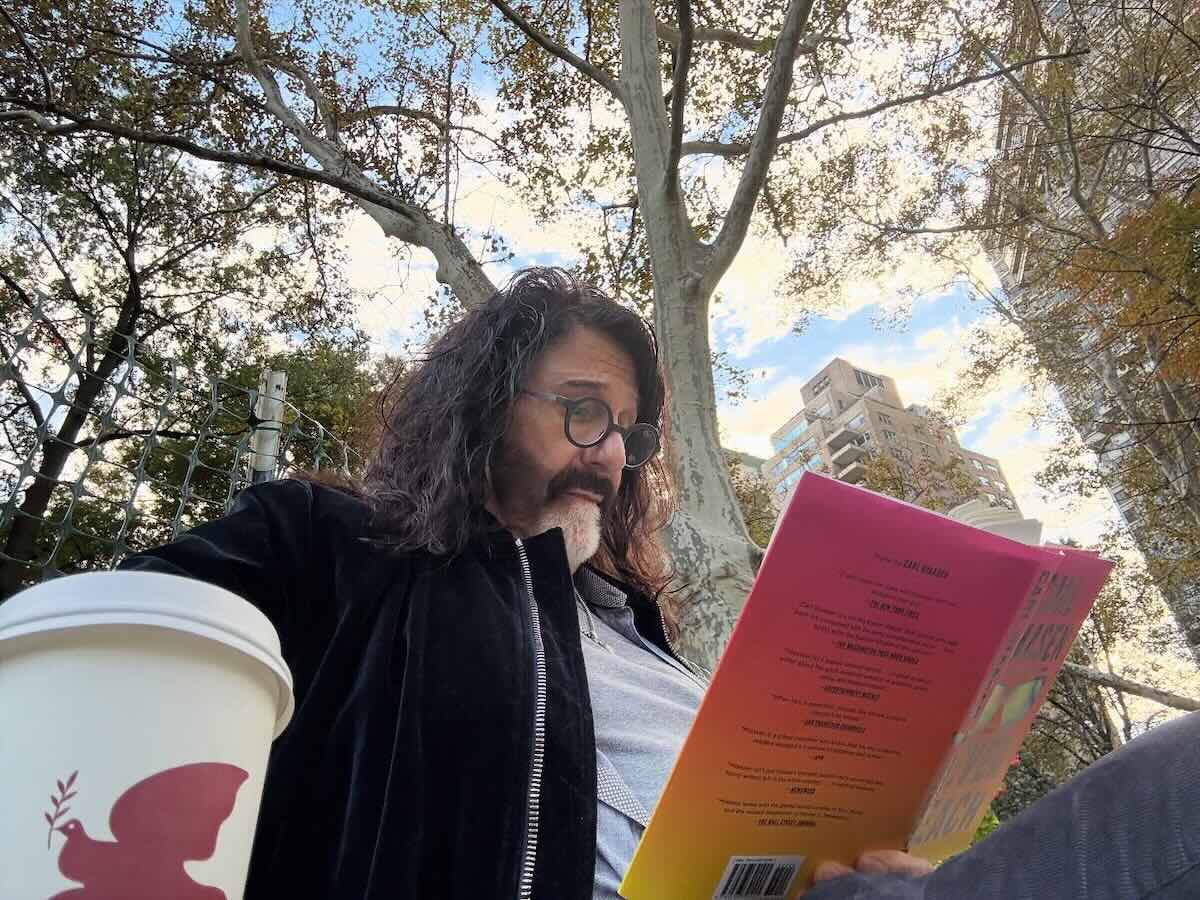
Pierre Robert relaxing on a bench in Rittenhouse Square on the last Sunday of his life (photo via Pierre Robert/Facebook)
That memorialization will consist of a plaque on that bench. As Dallyn tells it, Pierre’s favorite bench wasn’t actually available (there was already a plaque on it) but the Friends pulled some strings and made it work after more than $27,000 was raised for the cause. Dallyn says she hopes the plaque will be unveiled in late May.
Of course, pretty much anybody can get a plaque on a bench in Rittenhouse Square, assuming they or their heirs or friends have $10,000 to donate to the group. So when I first heard that the bench was how Pierre would be honored, I felt a little “meh” about it, since the vast majority of those bench dedications are to people who, I imagine, were good folks, but … this is Pierre we are talking about.
Plans are also afoot to have a small block of Latimer Street in the Gayborhood — which, as a gay man, Pierre frequented — named in honor of Pierre. No, like the scores of other blocks “renamed” for important Philadelphians, “Pierre Robert Way” won’t show up on your Waze or Google Maps, but anybody walking or driving by who looks up will see it on the street sign. Dallyn hopes for a renaming ceremony around the same time as the bench reveal.
Then comes the Pierre Robert mural. Dallyn has been in discussion with Mural Arts to erect a mural of her friend in the general vicinity of Rittenhouse Square. Since the Friends of Rittenhouse has money left over from the bench fundraising drive, the non-profit says it will donate some portion of the difference to Mural Arts. (The rest will be used for upkeep of the park, which is entirely community-funded.)
Aviva Kapust, chief development and advancement officer for Mural Arts, tells me that the organization is on the hunt for a wall for the mural. “Finding a wall is often the biggest hurdle of mural placement,” she explains. “We often post on Instagram asking Philadelphia to help us find a wall. Then we need a friendly owner and some assurance that the mural will remain in place and in view for a long time — not built in front of and not torn down.” (The organization has a number of murals painted on parachute cloth — some murals are painted directly on a wall, others on cloth and then hung — that are just sitting in storage because the group has been unable to find the right wall, Kapust says.)
Mural Arts isn’t currently fundraising for a Pierre Robert mural because until they lock down a wall, determine what repairs might need to be made to it for proper mural placement, and then figure out the dimensions of the mural, they don’t know the budget. But Kapust says a mural can cost anywhere from $20,000 to $200,000. She guesses that since they are thinking of a medium-sized mural that’s not high up in the air, they could bring a Pierre Robert mural home for under $40,000. “But it could be more,” she cautions.
Dallyn says she’s hoping to fund the mural using the money from Friends of Rittenhouse Square plus just a handful of people who have the kind of cash to make it work. “I don’t want to do a GoFundMe,” she says. “So many people have already donated to the bench project, and I think people will get fundraising fatigue.” (Hard disagree: Open up a $9.33 donation option and see what happens; plus, the fans will feel good knowing they were a part of it, as Kapust concurs.) According to Kapust, if Mural Arts can lock in a wall soon, the mural could be dedicated later this year on the anniversary of his death, or sooner.
Of course, once you find a wall and start raising money to fund it, what should a Pierre Robert mural look like? What should it say? With the help of an artistic friend, Dallyn already roughed out her own idea, though she acknowledges that hers is just one opinion of what will eventually be many:
Dallyn’s vision of a potential Pierre Robert mural, based on a photo she took of him
Kapust says the mural design will involve input from Pierre’s family and close friends as well as the community; the final design and selection of the artist will be decided by a panel at Mural Arts.
Local monument expert Paul Farber, who has an exhibition on monuments opening at the Philadelphia Museum of Art next month, says he’s fascinated watching the process of commemorating Pierre Robert.
“How do you memorialize him now, and what will this mean over time?” Farber posits. “These are the questions we have to ask ourselves.”
Farber says he quite likes the idea I poo-poo’d of the bench, actually, because it is, as he calls it, a “living monument.” “People can go and sit with him and reflect,” Farber argues. He’s also interested to see the community engagement during the mural selection process and how opinions from different entities will come into play.
“Underneath this story is both grief and love,” he says. “We have the loss of this person who felt larger than life and, in his wake, the people who loved him as a person and a figure, and they are all trying to figure out what to do with that grief, and some are clearly dealing with their grief and all that rawness through a variety of commemorative projects.”
Farber, Friends of Rittenhouse executive director June Armstrong, and Kapust all note that it’s not uncommon for lots of negative emotions and in-fighting to come out during processes like this, especially with a character like Pierre who was known and loved by so many. Who exactly gets to say how he is commemorated?
“He was bigger than life,” says Dallyn before breaking into tears. “I’m sorry, I am trying not to get too emotional. But he brought so much joy to so many people, and he deserves to be remembered. Working on it every day keeps him close to my heart and helps with grieving. I’m just not ready to say goodbye.”