

Real or Lafufu? Philly Shops Help You Navigate the Labubu Madness
The collectible toys are blowing up. So are the fakes. Here’s what Philly store owners say about spotting the difference.
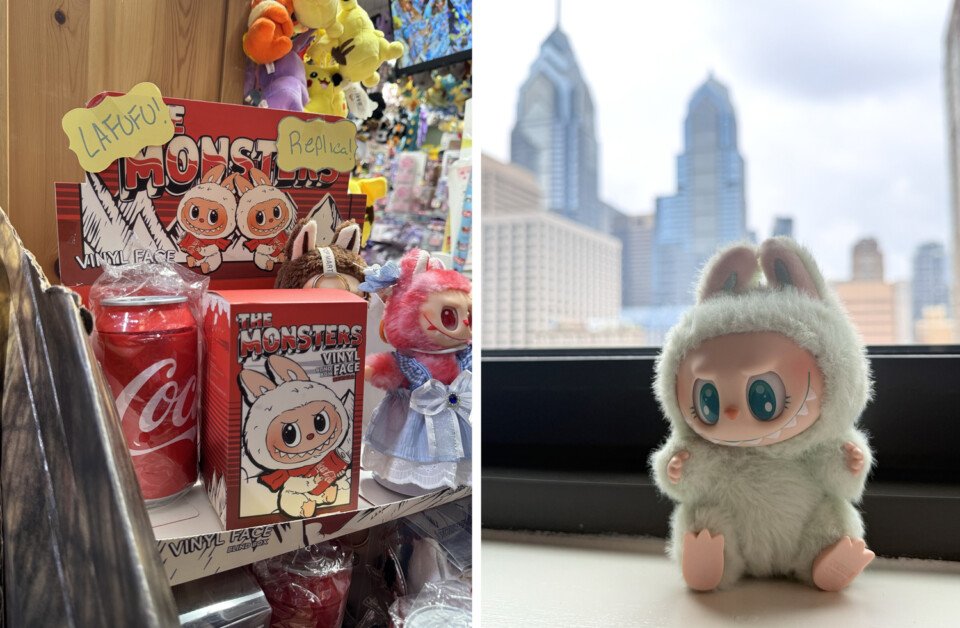
From left: Fake Labubu dolls in South Jersey (photograph by Kae Lani Palmisano); a real Labubu reigning over Philadelphia (photograph by Laura Swartz)
I was recently scrolling through Instagram when I saw a story posted by our food editor, Kae Lani Palmisano, of fake Labubus in South Jersey. “They’re called Lafufu, show some respect,” I texted her.
She’d spotted them in Cape May — rows of knockoff Labubus, their mischievous stares just slightly off, their ears a little too rounded. For those not deep in the designer toy vortex, Labubu is a wildly popular creature created by artist Kasing Lung for Hong Kong-based Pop Mart. Real ones are sold blind-box style — unboxing them and sharing the surprise on social media is part of the fun — and you’re as likely to see them hanging off a Gen Alpha backpack as you are a millennial’s designer handbag. Though they hit the market way back in 2015, it’s just this past year that they’ve exploded and captured a wide spectrum of collectors, obsessives, and imitators in their wake.
Your basic, regular-size Labubu retails for just under $30 on Pop Mart’s website, though good luck finding them for that price in real life: They sell out instantly, as resellers train bots on the latest drop. Special-edition large-format Labubus can run you into the four digits.
Or, if you’re like me — a writer whose job involves being chronically online and trend-aware — you might just pay $100 at a specialty sneaker boutique in Rittenhouse. You know, for the culture.
My daughter was thrilled. She posted a picture of her furry new friend in the group chat. But then things took a turn, as they so often do in the drama factory that is the sixth-grade group chat. Soon, someone was claiming it was a fake. My daughter shot back with telltale signs of the doll’s authenticity, making it pretty clear that her accuser didn’t actually know what she was talking about. The bully responded in the only way a fragile 11-year-old ego knows how: She booted my daughter from the group chat in a fit of sour defeat.
A week later, my daughter’s best friend FaceTimed her from the Shore, showing off a Labubu she had just gotten from the Boardwalk. “Umm … Where did she get it?” I whispered with raised eyebrows. “And how much was it?” You know where this is going. Boardwalk Labubu was just $30.
On the Hunt for Labubus

Asia Crafts in Chinatown has Labubu decals on the window. / Photograph by Laura Swartz
So, let’s go back to that $100 Labubu we bought in Rittenhouse. Yes, it was a ridiculous price. But I was paying for convenience — and authentication. I had found it at Bullseye, a highly curated streetwear boutique that opened in late June on Walnut Street. With rows of hard-to-find Jordans and Rick Owens and a midnight fuchsia Louis Vuitton Neverfull behind the counter, this didn’t seem the type of store that would risk its reputation on some dubious gremlin stuffies. If they were going to expand their offerings to include those trendy collectibles, they were going to make sure they were selling the real deal.
“We source them from people who are buying them directly from Pop Mart,” co-owner James Lattanzi tells me. “A lot of times they’re running bots on the website, a lot of times they’re waiting on release days.”
But there’s another layer that makes them hard to authenticate: A big part of the Labubu draw is the unboxing, so a retailer has to be able to authenticate the item without actually looking at it. “We’re purchasing them from people that are showing us receipts as well as matching credit card transactions, so that we’re able to actually determine that these items are coming from the retailer,” Lattanzi says. “And then we’re doing our inspections as well, same as we do with sneakers and clothing — we have a couple point inspections where we’re looking at things and keeping up with exactly what the fake manufacturers are producing, because our reputation relies on that.”
Asia Crafts in Chinatown independently verifies as well, from the box’s printing, clarity, and texture — though they wouldn’t divulge where they source from. More important, owner Debbie Law says, is the QR code on the box: Scanning it should take you to Pop Mart’s official site. Law’s seen convincing dupes go for as little as $45 (her store sells real ones from $60 to $70, depending on the series), and says for most customers, the only way to know is to scan the barcode.
The not-so-good dupes? She calls them “comical.” (There’s even a fandom who specifically seek out Lafufus — the worse the better. There’s an entire subreddit devoted to it.) Either way, Asia Crafts also sells clothing and accessories to personalize your Labubu, real or fake.

Labubu at Happy DIY must be authenticated on-site. / Photograph by Laura Swartz
Elsewhere in Chinatown, Happy DIY takes the barcode test even further when you purchase a Labubu (basic ones for $55; large ones for up to $1,200). You have to scratch off the silver under the QR code to reveal your individual doll’s serial number, then scan the code and authenticate it on the Pop Mart site in front of them. In my experience, when you see an unusual rule like that, it’s because something has happened to warrant it. So I asked Sophia Lin at the desk, as she demonstrated on a newly purchased Labubu: Had someone tried to come in saying the one they bought from them was fake? Yes, it’s happened, she told me. Now you have to verify yours with them, including if you’re lucky enough to win one from the $2 claw machine stocked with blind boxes. And, of course, all sales are final.

Sophia Lin demonstrates how to authenticate a Labubu at Happy DIY / Photograph by Laura Swartz
How to Spot a Real Labubu
So: How do you actually know if your Labubu is real? And how do you avoid getting burned by a Lafufu?
Bullseye’s Lattanzi shared the signs — here’s your guide.
Physical Features
- Teeth: Authentic Labubus have exactly nine teeth, varying in shape and size.
- Face: Look for a smooth, matte finish with crisp paint lines and airbrushed blush.
- Feet should rotate 360 degrees and be made of the same material as the face.
- UV Test: Newer models (2024 onward) show a Labubu silhouette under UV light on the right foot.
- Tags and labels: Look for high-quality fabric or paper tags with clear printing and correct formatting with centered logos.
Packaging
- Authentic packaging features a matte finish with smooth texture, embossed details, and muted pastel colors.
- Check for the Pop Mart hologram sticker with clear 3D effect.
- Look at the trash can symbol on the back: Authentic versions have rounded corners on the arrow, while fakes often have square corners.
- Scan the QR code on the box (usually in a holographic sticker). It should redirect to Pop Mart’s official verification site.
- Identity cards are always included in authentic blind boxes.
Red Flags to Avoid
- Suspiciously low prices
- Glossy or uneven packaging surfaces
- Blurry QR codes or codes that redirect to non-Pop Mart sites
- Poor stitching or visible threads
- Incorrect number of teeth or poorly painted features
- Hard, plasticky feet that don’t rotate
Lattanzi also recommends using authentication apps. LegitApp, he says, offers AI-powered comparison of your Labubu against an extensive database of authentic figures, with continuous updates tracking the latest counterfeit trends. CheckCheck — originally a sneaker authentication service — has expanded to authenticate the legitimacy of collectibles, becoming the first U.S.-based company to offer authentication specifically for Labubu figures.

How much is that Labubu in the window? Labubus on display at Bullseye on Walnut Street. / Photograph by Laura Swartz
The culture keeps moving. The Lafufus keep multiplying. And Debbie Law at Asia Crafts tells me Labubu fever is just getting started with the middle-school set, predicting they’ll blow up even more for back-to-school season.
But for all the high-concept aesthetics and clout-chasing and resale drama, Labubu is also just … fun. So sure, the boardwalk knockoffs will keep showing up. The real ones will keep selling out. Bullies will keep weaponizing status. The microtrend cycle will run its course and the algorithm will make us obsessed with something else. (Pop Mart has another blind-box darling coming for Labubu’s crown: Crybaby.) If you’ve got yourself a Lafufu but you love it anyway, hug it a little closer and buy it a cute hat in Chinatown.