Philip Korshak on the Revolutionary Act of Picnicking
After a cross-country odyssey, the bagel poet returns on a mission to build community around hot dogs, sourdough biscuits, and the joy of eating outside.
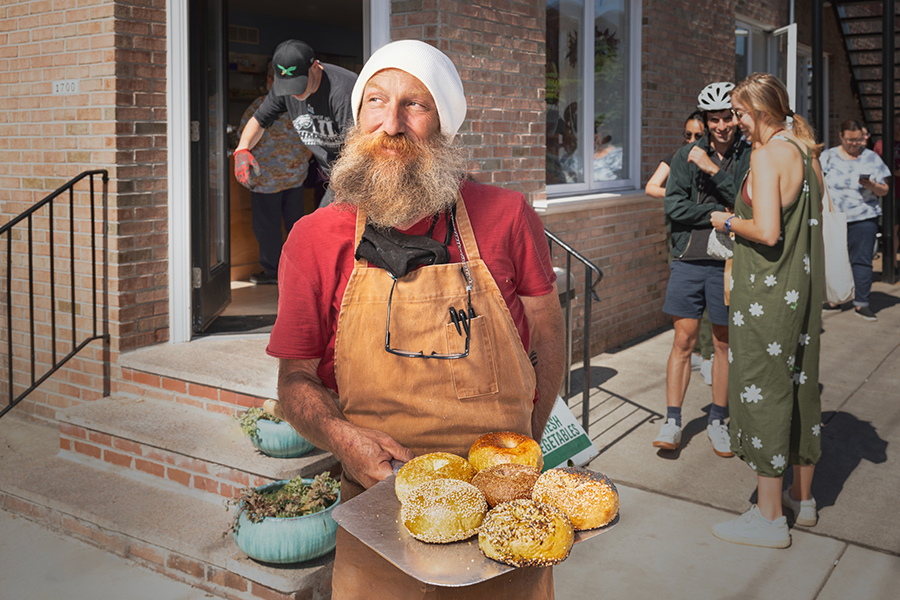
Philip Korshak outside of Korshak bagels. / Photograph by Colin Lenton
Listen to the audio edition here:
“It took me until, I dunno, May to get out of Philly …”
On the phone, Philip Korshak — formerly of Korshak Bagels — is giving me his Iliad and his Odyssey, his There and Back Again. He’s telling me the story of everything that happened in the aftermath of the closing of his little bagel shop at 10th and Morris in South Philly in 2023, where the winds blew him, and how he ended up right back here again, in Philly, trying to make magic a second time.
Yes, we’re on the phone to talk about his new venture, Korshak Picnic Provisions, but, like everything with Korshak (and me, truthfully) it takes a little while to get to that story.
In case you’ve forgotten, Korshak Bagels was a legitimate big deal just a few years ago. Huge lines, thousands of fans on Instagram, written about in the national press, and, most importantly, it served really good bagels. The shop was a phenomenon, and Korshak — with his beard and brown paper bag poems, his love for feeding people, and long, looping, discursive conversations with anyone who approached his counter — was a big part of that. He was the bagel poet of South Philly, a true character, and his shop was doomed pretty much from the moment it opened.
There were a lot of reasons. If you’re interested, you can read all about them here. But the short version is, Korshak Bagels closed in September of 2023 and it took Phil several months to close up shop, wind everything down, settle his affairs. And then he just … took off.
“I packed everything I owned into the car, and that’s … that’s an exercise, right? It’s winnowing. But I had a friend in Seattle I wanted to see, and I knew some people there from my time in the industry.”
He was a rambling man. Always on the go. He set off for Seattle. Broke down in Phoenix on the way. Tried to get a job but nothing stuck. He applied to be a toll collector on the Tacoma Narrows bridge three times and was rejected three times. Eventually, he ran out of options (and money) and ventured back east to crash at a friend’s place in his hometown of Austin, Texas.
And things might’ve ended right there for him — back once more in the place where he grew up, full circle and all that shit. It would’ve been poetic. But not long after he arrived in Texas, this guy calls him. Says he has a space in Philly and asks if Korshak would be interested in doing something with it. So once again, he packs up his things, scrapes together some traveling money, and comes back to Philly. “Just to look,” he tells me. “Just to sit in the space and do that thing I do: Being able to see stuff that isn’t there.”
The space he came to see was a former animal hospital at the corner of 13th and Reed, right across from Columbus Square. As a matter of fact, it’s the same animal hospital where he and a friend used to bring their cats when he first came to Philly. He’s got history there. And for a guy like Korshak, all of that is a sign. That’s the universe sending a message that he needs to pay attention to. So he does.
Korshak Picnic Provisions is what he’s in the process of putting into that space. Not bagels. Not breakfast sandwiches. Picnic stuff. “A small shop,” he says. “Thursday to Sunday. Not open super early. Not staying open super late. If I do it right, it should feel like Sesame Street. It should feel like Muppets are in there.”
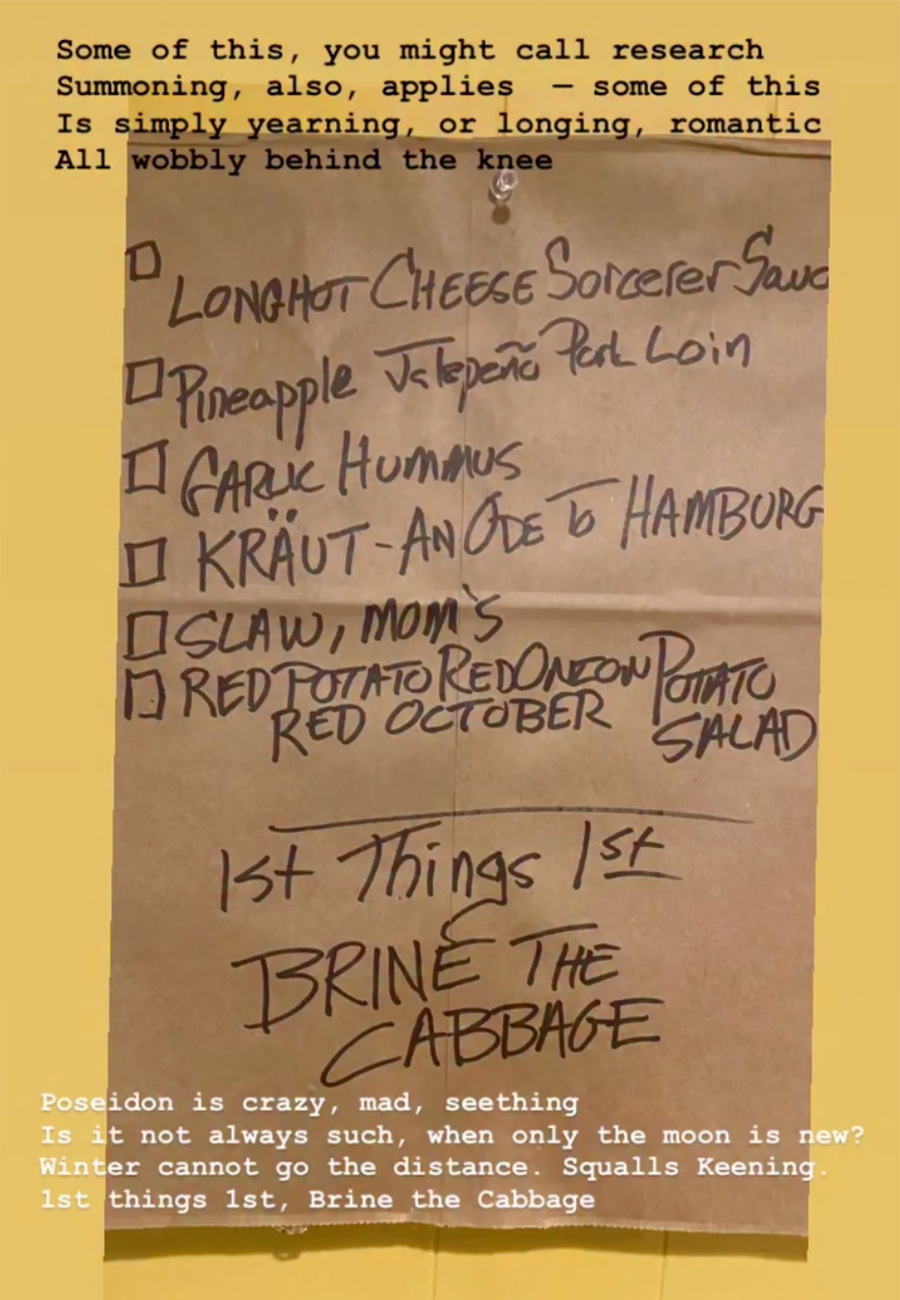
Phil’s notes for Korshak Picnic Provisions are part planning, part poetry / Photograph courtesy of Phil Korshak
Hot dogs will be the big thing. Good dogs on buns from Mighty Bread. And when I ask him why he, a baker of no small renown, isn’t doing the buns himself, he tells me, “The idea that I can make a better dough than them is dumb.”
There’ll be four kinds of dogs, probably, plus vegan options. Plain with mustard, onions, relish, served with (or without) sauerkraut. A chili-cheese dog. A cream cheese dog with an Asian-accented cabbage slaw and fish sauce-spiked ketchup. And a Chicago-style dog on a poppy seed bun with onion, tomato, a whole pickle spear, carrots and peppers, and an electric-green sweet relish that he’s scratch-making the food dye for by steeping cabbage leaves for colorant.
And for a while, we just talk about hot dogs. We talk about the “walking nature” of them — that they are a food meant to be eaten on the go, or somewhere other than where they were made. We talk about the American context of the hot dog as party food and picnic food, as ballpark-and-green-space food. And, Phil being Phil and me being me, we talk about the Council of Nicaea and its views on the trinity and Holy Communion, and the wars that were fought over a drop of wine and a little bread by people who simply couldn’t agree on what those things could mean.
I ask him why he decided on picnic foods, and he tells me about his parents. About how, when they were traveling, they never ate at restaurants. They would just pull over when they got hungry and have a picnic. Something about that really spoke to him: the memory of those days. And the extended road trip he’d just returned from, too. And the more he thought about it, the more he thought about picnicking as a revolutionary act. Disruptive by its very nature.
“Inside of a class system construct,” he says, you have to look at a picnic one way — as seen through art and painting, manicured lawns and bowered gardens. “Picnics are for fancy people, right?”
But they’re also for families out on the road. For friends at the park. For sunny afternoons away from work. And there’s a language issue at play, too: Picnic as a noun versus picnic as a verb. As a noun, it’s an event. Planned, scheduled, organized. But as a verb (to picnic), there’s an element of spontaneity. Of casual patchwork quilts thrown down on public ground; of shared food and effort and company.
“I’m there to facilitate the verb,” Phil explains. “No one gets to tell you what kind of picnic you’re supposed to have. I can offer some cool things, but your picnic is your picnic.”
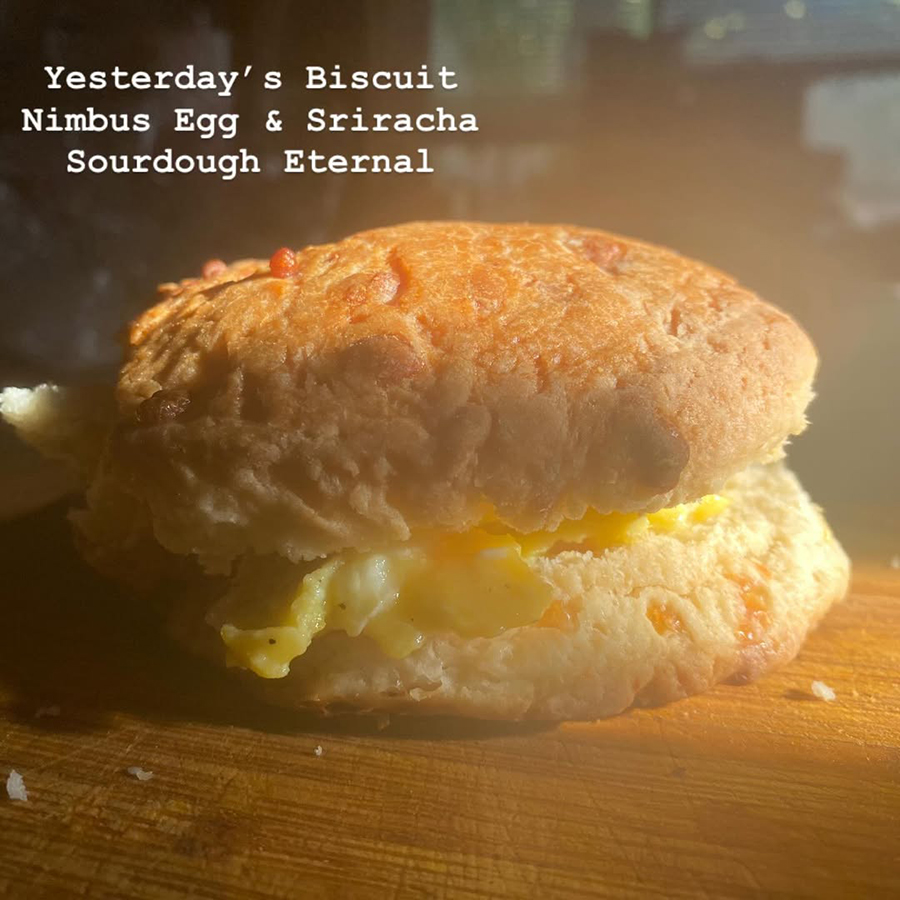
One of Phil’s homemade sourdough biscuits, a version of which he plans to put on the menu at Korshak Picnic Provisions. / Photograph courtesy of Phil Korshak
To that end, he’s planning to stock Korshak’s Picnic Provisions with hummus, coleslaw, and potato salad, with a cooler full of cheese, some chips and crackers, wacky crisps from the UK. (“Like a community college-level DiBruno’s,” he says, laughing. “Just kind of okay.”) There’ll be kites and chessboards, quilts and blankets, one barrel of soft-serve, maybe. He’s going to do sourdough biscuits with butter or honey from Green Meadow Farm because he really loves their honey, and cinnamon rolls, too, but both of those done only in limited quantities because what he doesn’t want at KPP is “big, dumb lines” like he had at Korshak Bagels. He doesn’t want to be disruptive to the neighborhood. He doesn’t want to be a nuisance.
“It should be a place that serves,” he explains. “That’s not an end in and of itself.” Meaning you don’t go to Korshak Picnic Provisions because it’s Korshak Picnic Provisions. You go because you want to have a picnic. And that’s it. And with nothing on the menu that can be fetishized the way that his bagels were, he feels like the focus here can remain where it belongs: on the experience of the picnic.
“If you go to a rock ‘n’ roll show, it’s what happens in the crowd at the rock ‘n’ roll show that really matters,” he explains. Not the act. Not the star. Not the singer. The crowd and the experience of being in that crowd — that is what matters.
It’ll be pure takeout, set up like a bodega almost (but without the cat). The space doesn’t require a lot of build-out, so he won’t go into it owing anyone a fortune. There’s no hood (and he doesn’t have the money to install one, or any interest) so that limits how much he can cook. The prep list is fairly simple and small-batch, allowing him to limit the number of employees required to probably four, which will allow him to pay an actual living wage ($25 an hour is what he’s thinking), and the service schedule means that everyone gets time off, allowing for a life outside of work. It’s small, simple, and, he thinks, sustainable.
“The more simply I can do something, the better,” he tells me.
And what about an opening date?
“May,” he says. “I think I can do it by May. That’s what I’m hoping.”
And then he pauses.
“Of course, it could all fall apart tomorrow.”