This New Art Program Is Fostering Creativity and Connection for People With Parkinson’s
Create & Connect, a new program at the Barnes Foundation, offers art classes and gallery tours for people with Parkinson’s and their caregivers.
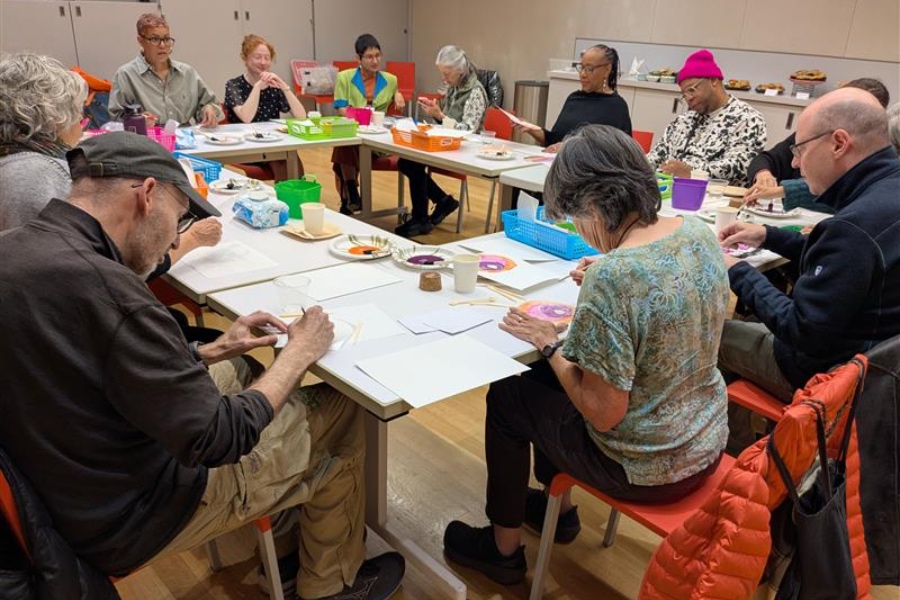
Create & Connect is a program at the Barnes for folks living with Parkinson’s. / Photography courtesy of the Barnes Foundation
Wynnewood resident Chrissy Steele has always loved art.
She trained at the Pennsylvania Academy of the Fine Arts in her 40s and, for years, she painted with both acrylics and gouache, an opaque paint that’s similar to watercolors and used to create rigid, geographical images. But she’s experimented with many artistic media, including bookmaking and printmaking.
Four years ago, when she was diagnosed with Parkinson’s disease — the progressive, neurological movement disorder that can cause tremors, stiffness, and other symptoms — she worried about how it would affect her art. Then, during a session of Living Well at Home, a series run by Penn’s Parkinson’s Disease and Movement Disorders Program, she heard about Create & Connect. It’s an initiative run by the Parkinson Council — a local organization that aims to support individuals with Parkinson’s and their care partners — and the Barnes Foundation, which offers guided gallery tours and art-making sessions for people living with Parkinson’s and their care partners.
The goal of the program, which debuted last fall (Steele was in its first session), focuses on helping participants both connect meaningfully with art and build relationships with one another. Researchers have found that art therapy has numerous benefits for people with Parkinson’s, including increased cognitive function, maintaining fine motor skills, a stronger sense of community, and improved quality of life. (You can find similar programs elsewhere, like New York Presbyterian Hospital’s Connecting Through Art, one in Maryland that combines art therapy with boxing, and Creative Connections at the Philadelphia Museum of Art.)
“When you’re creating, you’re outside of your Parkinson’s. You [might not be] thinking about your Parkinson’s,” says Wendy Lewis, CEO of the Parkinson Council. “You connect your body, your mind, [and] your hands in a different way … together as a family, in a beautiful space to create art.”
I joined participants at the most recent Create & Connect at the Barnes, on April 4th. The group is small — there’s about 14 of us, including me and Steele — but that’s intentional. Size is limited to 20 participants per session to allow for meaningful connections among attendees.
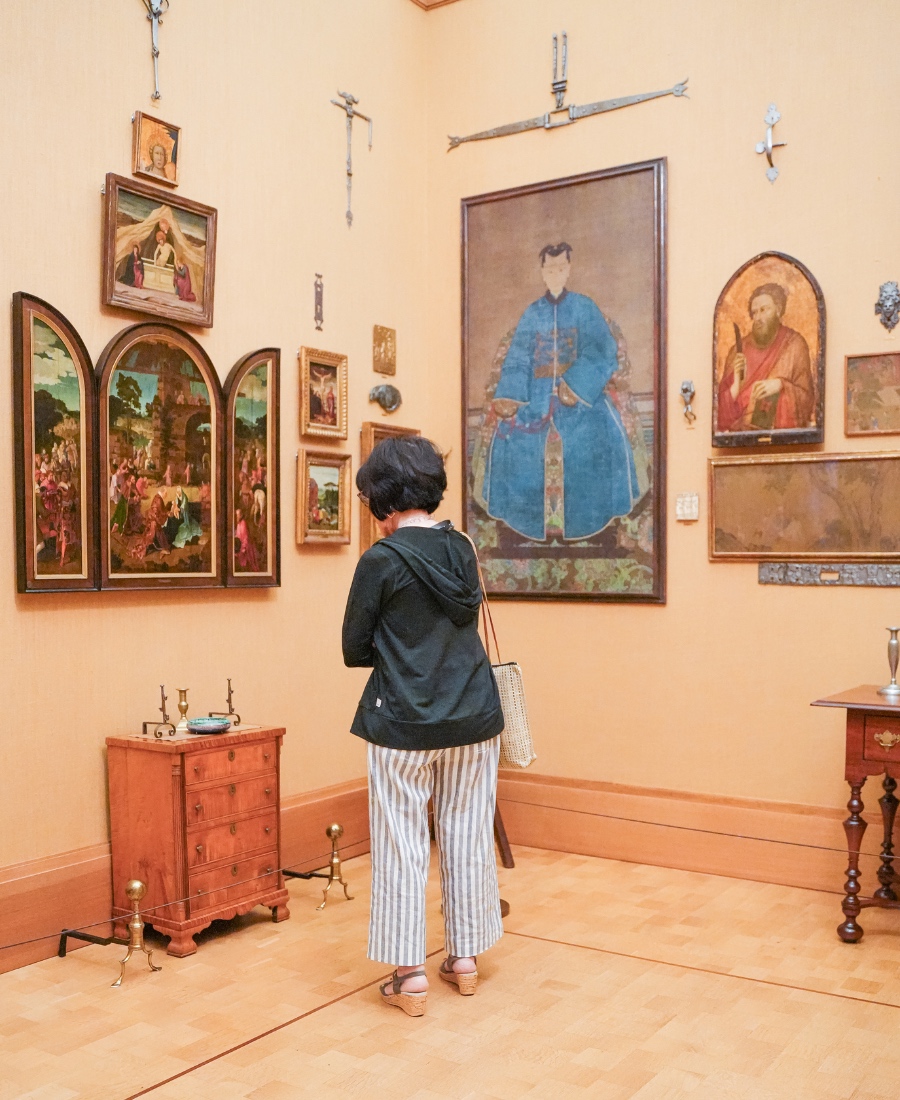
Create & Connect participants observe different works of art every session.
“These sessions are meant to be intimate by design,” says James Claiborne, the Fleischner Family vice president for engagement with the Barnes Foundation. “It’s fulfilling this very human need to be connected, to have that sense that you are not alone, and that folks walk alongside you.”
Carolina Marín Hernández, the Barnes’ senior program coordinator, gives everyone a few minutes to explore the gallery before having us gather in front of Édouard Manet’s Laundry (Le Linge), an oil painting of a woman washing and hanging laundry alongside a small child. (Participants interact with a different piece of art at every session.) For two minutes, we silently observe the painting, noticing its color, layout, texture, and composition. The painting features primarily cool tones: the blue of the woman’s dress, and the lush green of the bushes and trees that surround them.
Some participants in Create & Connect, like Steele, come to the program having studied art, but others are novices. That’s why the method is rooted in observation: Attendees look at the art, ask their own questions, and make their own observations without being guided by too much wall text or analysis from art historians. It’s an approach championed by Dr. Barnes, and the Foundation has honed it over the years, both within their health-related programs and other classes. (They’ve worked with ARTZ Philadelphia on past programming; and their own Art, Well-Being, and Medicine initiative opens up the galleries to medical students and health-care professionals with the aim of using art to foster a sense of empathy — fitting, since Dr. Barnes was a pharmacist). There are no wrong answers, allowing for free thinking and curiosity-building.
“It gives us permission to just say what we’re thinking,” Marín Hernández says. “It’s an equalizer. You don’t have to be an expert. You don’t even have to necessarily enjoy art. You can approach it however you want to.”
That open approach helps participants be vulnerable with one another. One person comments that the child seems to be mesmerized by the laundry water. Another observes, laughing, how difficult it would be for the clothes to dry in such a dense, forested landscape. One man says he recognizes the child’s curiosity, saying, “I’ve seen that expression in my grandchildren,” and the mother’s look of patient and loving listening mirrors his own responses to them.
Marín Hernández explains that Manet was between styles when he made and sold this painting, moving from more realistic depictions of people to a more impressionistic style. There are incongruities in the image — the flowers are rendered with imprecise brushstrokes while the woman and child are more true-to-life.
For Steele, the fact that Manet was showing — and eventually sold — a painting that didn’t fit perfectly into a single style was empowering. She tells me her tremors are growing more pronounced, causing her to change her own painting style because of it.
“It showed how he was experimenting,” Steele recalls, “but it wasn’t limiting him. As somebody who struggles with making art and then criticizing my own work, this [detail] was like, ‘Okay, just forget about all that. You can feel free to experiment. So what if it’s a big mess?’”
As the discussion winds down, Marín Hernández leads the group in a guided meditation. She walks around with scented oils — rose, bergamot, rosemary, geranium, vetiver, and sandalwood — meant to evoke some of the flowers that are loosely depicted in Manet’s work. Tapping into this scent is key for attendees. One of Parkinson’s earliest symptoms is the loss of one’s sense of smell and some people find benefits in olfactory training and aromatherapy.
The rest of the session feels similar to that of a yoga shavasana. Marín Hernández asks participants to close their eyes or soften their gaze and reflect on each part of the body, from the tips of their toes to the tops of their skulls, asking them to notice any places where they may feel tension, and encouraging them to wiggle as needed. In some ways, this noticing of the body mimics the careful attention participants paid to the artwork. To reawake the senses and bring folks back to their environment, she asks, “Who’s ready to make some art?” The excitement, though subdued from meditation, is still palpable.
Back in the classroom, there are glue sticks, trays of origami paper and copies of Art Forum and Art in America magazines. We’ll be engaging in collage work. Jillian Rock, the teaching artist, tries to plan the art-making sessions around the gallery works, even if the methods might be different from the artist whose work is on display. For Rock, collage offers an opportunity to think about relationships — how are you collaging different people and different interests in your life together? How does that help create a network of care? (The Manet painting we observed earlier, which many interpreted as a painting of a mother and a child, offers some of the same questions about relationships and caregiving.)
Some participants rip paper, others use adaptive scissors. One woman folds hers into origami, giving her work a 3-D element. Spring, it seems, is on a lot of people’s minds, as many create images of flowers. One student cuts a cubist rendering of a tree, evoking the freshly blooming cherry blossoms and magnolias outside. As for the participant who said Manet’s painting reminded him of his grandchildren, he creates a woman and child amongst an abstract spring scene.
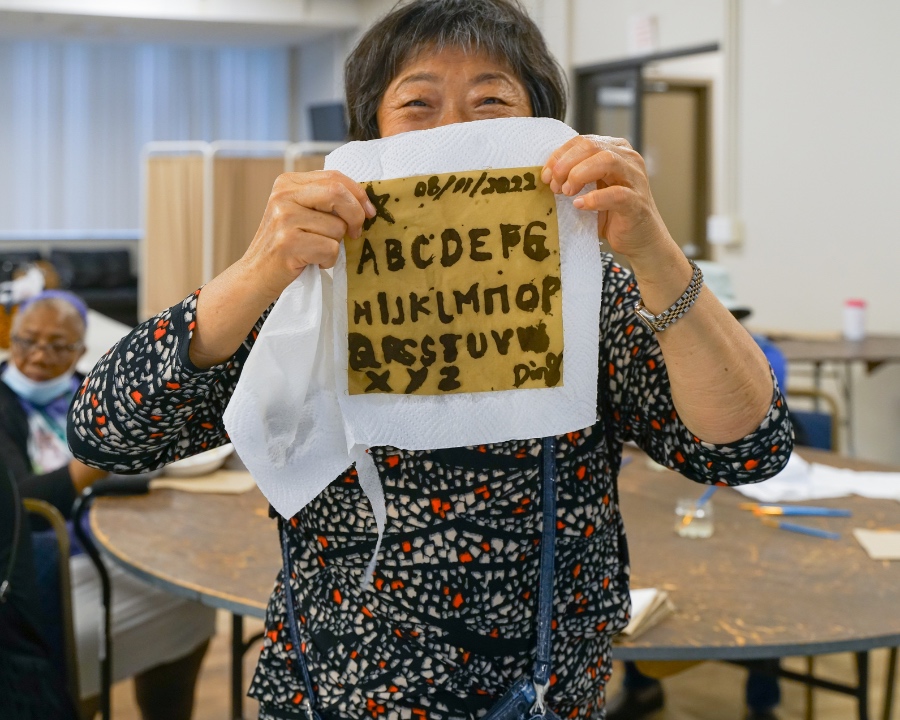
A Create & Connect attendee shows off her quilt and fabric dyeing creation.
As they work, participants chat about their lives, sharing details of their upcoming Easter plans or past visits to the Barnes. Rock finds that getting people working with their hands allows for freer-flowing conversation. She’s noticed that when you’re busy cutting out a piece of paper or shading in a sketch, it’s easier to open up to a stranger, or to create works of art that reveal something about one’s emotions or their relationships with one another. “You are focused on making something, and so your guard is down a little bit,” she says. “It allows you not to overthink something you would share, and there’s so many ways to connect the conversation to what we’re doing.”
When I speak with Steele a few days after the event, she tells me about a favorite piece she created through the program: a zine about a time when she was standing in the ocean and the waves kept knocking her down. Her grandson was there to help her up. It reminded her of the importance of her family and how they show her their love and support.
“[He] just stayed by my side and kept lifting me up,” Steele says. “He didn’t get upset or tell me to get out of the water. He just kept helping me.”
The ability to share their experiences and build relationships with one another is part of the program’s therapeutic value, says Lewis. Sometimes people with Parkinson’s will avoid going out and engaging with others because they feel anxious about their symptoms or worried about potential symptoms. The result, though, is often loneliness and isolation, which can negatively impact health at any age. Lewis has found creating deliberate opportunities for people with Parkinson’s and their care partners to connect with one another can help foster community and improve mental health. The numbers are there: According to Create & Connect surveys, 73 percent of program participants report feeling a sense of reprieve afterward the sessions, and 80 percent say they feel connected to both one another and the program facilitators
“It’s great for people who love art and have experience with it, but it’s also very good for someone who’s never drawn anything or touched a brush,” Steele says. “Everybody is really nice and supportive, and there’s no pressure — it feels so low-key and comfortable.” Plus, “when you’re doing something creative, you’re removed from your worries and self-consciousness.”
The Barnes has five more Create & Connect events scheduled for this spring and summer. The next event is this Saturday, April 25th, and will focus on a work from Pierre-Auguste Renoir. It’s free to attend, but advance registration is required.