Meet a Health Hero Finalist: Lyndsay Hoy
The Penn-affiliated anesthesiologist lives with a rare, progressive lung disease known as lymphangioleiomyomatosis (LAM). Here's how she's working to advance research and support others living with LAM.
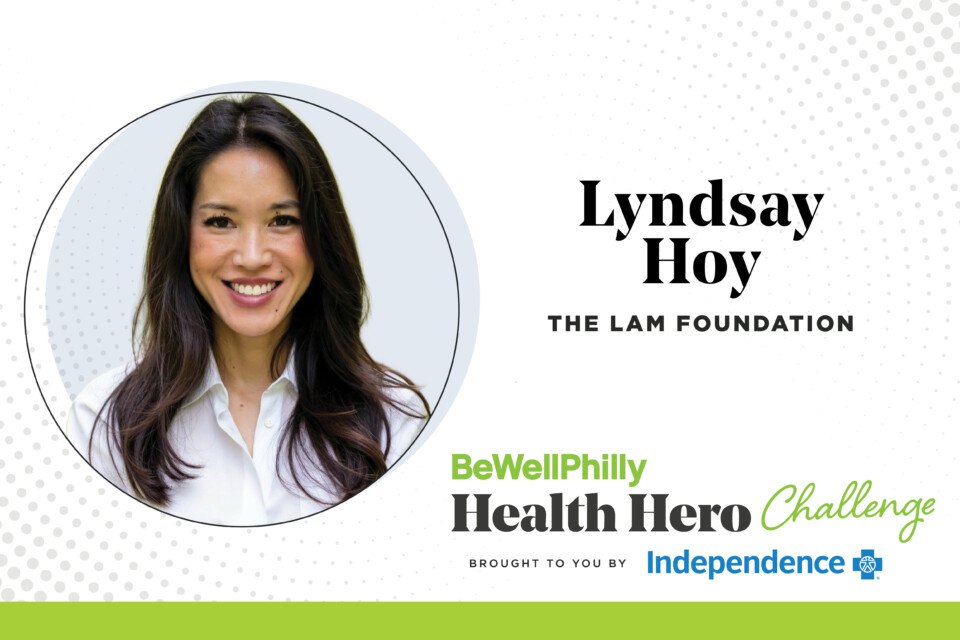
As Lyndsay Hoy laid on the operating table in 2013, waiting to have her eggs harvested so she could begin IVF, she couldn’t help but fixate on the pulse oximeter.
Hoy is an anesthesiologist, and usually, she found the machine’s steady beeping reassuring. It meant her patients were stable. But as she listened to her own pulse, she felt anxious. The sounds registered more “like a metronome, a ledger of time passing,” she says.
The journey that brought her to this moment was quick — only about six months. It began when the then 28-year-old started to feel, what she describes as, a sloshing in her chest. At first, she wasn’t concerned — she was young and in good health — but she was also a medical resident at the University of Pennsylvania, so she decided to get checked out.
Testing revealed she had lymphangioleiomyomatosis (LAM), a chronic, estrogen-sensitive progressive lung disease. Patients with the condition, who are majority women, develop cysts in their lungs. It’s a rare condition: There are currently only 2,353 cases in the United States.
The irony wasn’t lost on Hoy: “I went from learning how to keep others breathing as a physician to learning how it feels to lose my own air,” she says. She had a lot of questions — about her health, about whether she’d ever be able to be a mom. She didn’t know if she’d ever be as healthy as she was at that moment. Her lungs were “a diminishing asset,” she recalls.
So, she decided to make and freeze embryos, with the help of her boyfriend, another medical resident, of less than a year. They agreed on one round of egg harvesting, which is all they presumed Hoy’s body would be able to handle. Six months after diagnosis, Hoy was on the procedure table in the hospital’s IVF suite.
“We could not assume I would stay stable,” she says. “I did not know in that moment if we were making the right decision, if I was imperiling my health, my lungs, my future, my ability to be around long enough to even be a mom.”
Today, Hoy’s boyfriend is now her husband of 10 years. They’re busy trying to keep up with their four-and-a-half-year-old son, Colin, who they welcomed via surrogacy. (Research has found that pregnancy can lead to lung deterioration and an increased risk of lung collapse for LAM patients.)
She’s become an advocate for women living with LAM, serving as vice chair of strategy and mission for the LAM Foundation, a nonprofit that advances LAM research, with the goal of one day finding a cure, and amplifies the voices of women living with the disease.
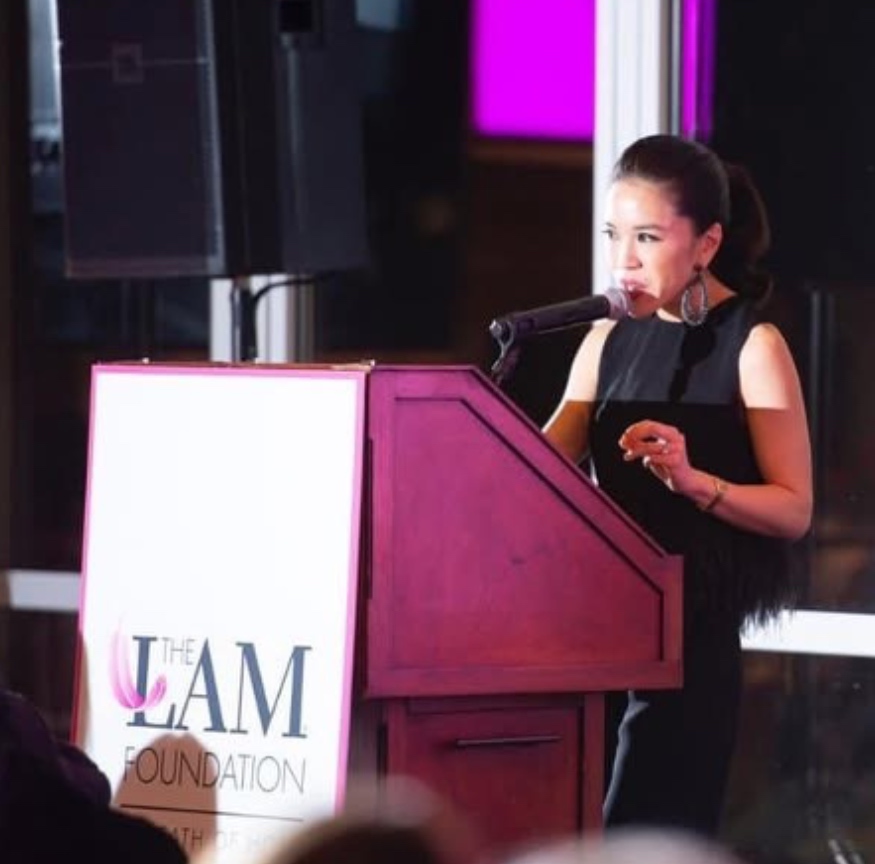
Lyndsay Hoy gives remarks at a gala for the LAM Foundation. / Photograph courtesy of Lyndsay Hoy
For her efforts to champion the needs of women with LAM and other rare diseases, Hoy has been named a finalist in this year’s Be Well Philly Health Hero Challenge, presented by Independence Blue Cross.
Voting is open for the 2026 challenge. Vote for your favorite finalist today!
One of the initiatives she championed while on the board is the LAM Patient Research Priorities Survey (LAM Prep). For years, LAM research has focused on finding a cure — there currently isn’t one — or developing more treatment options (there’s just one FDA-approved drug, Sirolimus, on the market).
There are other considerations: Some women, like Hoy, want to preserve their fertility and explore paths toward motherhood. Others have concerns about contraception usage, particularly because LAM is an estrogen-sensitive condition. Still, others worry about how they can exercise with a chronic lung condition, or what the impacts of the disease will be on their mental health.
“We wanted to find answers to fundamental questions: What is the lived experience of the patients? What is important to them, as well as to others in the community? What is important to clinicians? What is important to scientists? What is important to patient caregivers?” says Marina Holz, the survey’s principal investigator and chair of the scientific advisory board of the LAM Foundation.
The research uncovered something surprising: People with more education tended to receive LAM diagnosis and treatment more quickly. LAM patients with a bachelor’s degree were diagnosed 4.7 years sooner than those who didn’t go to college, and they were 1.75 times more likely to be using treatment for the disease.
Part of the reason for this gap might be LAM’s rarity. No prior studies have explored socioeconomic factors after LAM treatment and disease management. Hoy knows from her personal experience, however, that the disease is difficult to manage even if you are a doctor who is married to another doctor.
“We had the confidence and the competence to ask the right questions,” Hoy says. “We gathered the evidence, we read the literature, we synthesized the information that was available — and even with all of that privilege, we still felt like we were building the plane as we were flying it.”
More than 750 people — including 20 percent of known LAM patients — participated in the LAM PREP survey, taken in 2024. Holz says the findings are guiding the research and grant-making priorities in the LAM Foundation’s 2026-2031 strategic plan.
“A lot of time, grants are created by scientists, like myself, who have a certain understanding of a disease, their notions of what is important, or what they would like to study as opposed to what is really important to the patients,” Holz says. “We wanted to understand what the patients’ research priorities are so that they can primarily be driving the research program that the LAM Foundation supports.” She hopes the survey model can be adopted by other rare disease communities and used to support patient-centered research, too.
For her part, Hoy is encouraged by the broader trend toward paying more attention to women’s health issues and rare diseases in America. She’s excited to see organizations like the Society for Women’s Health Research and the American Medical Women’s Association talking more openly about the relationship between the two and elevating the need for more research.
“I don’t want us to be added as an afterthought or as an exception,” Hoy says. “I am extremely motivated to ensure that women with rare diseases like LAM are included in the broader conversation happening around women’s health at a national level from the beginning.”
Lyndsay Hoy is one of the finalists in the 2026 Be Well Philly Health Hero Challenge presented by Independence Blue Cross. The award recognizes nonprofit leaders, medical professionals, frontline health workers, nonprofit leaders, teachers, coaches, entrepreneurs, and community activists who are making a positive impact on community health and wellness.
Each year, the public nominates individuals who inspire them, then votes to select a winner who receives a $15,000 donation to the charity of their choice. Two runners-up each receive a $2,500 donation to the charity of their choice. You can vote for your favorite finalist once per day, every day until September 30th.