Ask Dr. Mike: Let’s Talk About Poop
From the color and shape of poop to something horrific-sounding called Hirschsprung's megacolon, we get down and dirty about what — um — moves through us.

Mike Cirigliano, aka Penn’s Dr. Mike, who explains explains everything we need to know about poop health, from poop color to poop shape to what it means if you are pooping blood
Meet internal medicine physician Michael Cirigliano, affectionately known as “Dr. Mike” to not only his 2,000 patients, who love his unfussy brilliance, tenacity, humor, and warmth (he’s a hugger!), but also to viewers of FOX 29’s Good Day Philadelphia, where he’s been a long-time contributor. For 32 years, he’s been on the faculty at Penn, where he trained. And he’s been named a Philadelphia magazine Top Doc every year since 2008. Now, he’s our in-house doc for the questions you’ve been itching (perhaps literally) to ask a medical expert who’ll answer in words you actually understand. Got a doozy for him? Ask Dr. Mike at victor@phillymag.com.
Dr. Mike, thank you for agreeing to talk about poop and specifically poop health. I’m going to do my best to get through this interview without laughing.
You’re in good hands, Victor. I know my shit!
OK, you’re not helping. What is it about poop that’s so funny?
You know, I don’t know. But there’s just something so viscerally funny about poop and farts.
Most of us look at poop and just see, well, poop. A turd. But in terms of poop health, what do you see?
Your poop is a treasure trove of information and gives us so much data on how the body is performing. So much of the future of medicine is in the microbiome — the intestinal bacterial milieu, if you will.
Until now, I’ve never heard someone utter the phrase “intestinal bacterial milieu.”
Well, the makeup of those bacteria can tell us so much about your health.
And what do various poops indicate about what’s going on in our gut?
Well, if you have a lot of gas, this could tell me that you have signs of malabsorption, meaning your small intestine is not properly absorbing nutrients from your food. If your stool is overly smelly, this can mean the same thing, and it might also mean that your pancreas is not functioning properly.
Someone once told me that if you have good poop health, your poop will float.
They could be wrong. If your poop is floating, it could mean that your intestine is not absorbing fat properly, which we call steatorrhea.
What does it mean if there is blood in my poop?
This is something you really need to get checked out. It could “just” be hemorrhoids — we have a huge epidemic right now of people getting hemorrhoids from sitting on the toilet for 30 minutes, scrolling through their phones. So, bright-red blood would tend to indicate hemorrhoids, but it could also indicate bleeding in the lower part of your bowels. There are horror stories where people think that blood in their stool is due to hemorrhoids, and it turns out to be colon cancer or colorectal cancer. This is something you really need to get checked out to be sure.
And if it’s darker?
If you have black, tarry stools, that could be blood that is coming from a higher part of your bowels, and this would be a medical emergency. You would need to take that very, very seriously.
Is part of what you’re doing when you perform the sadistic digital rectal exam checking for blood?
Yes. Exactly. We also have FIT tests — that stands for fecal immunochemical test; Cologuard is one of them. These tests can detect blood and colon cancer, so they’re especially important now that younger people getting colon cancer in record numbers. We’re not really sure why that is, but we think it has to do with the country’s dependence on hyper-processed foods.
You mentioned the microbiome earlier, and I’m not 100 percent sure I have a full grasp on what that is, though I hear the term constantly. Can you explain it to me like I’m a fifth grader?
This is the fancy way to refer to the family of bacteria that lives in your intestines. The amount of bacteria is astronomical, and they’re very important in terms of not only our ability to digest food, but also to maintain our general health. Research is showing that things like preservatives, emulsifiers, and guar gum (a common additive that’s used as a thickener) are affecting the microbiome and the lace-like layers of lipids that protect the intestinal wall. That old expression “you are what you eat” has a lot of truth to it — we need to take a really hard look at what we’re eating. I get nervous when I look at a food that looks the same a year later. A head of broccoli, you stick it somewhere and a year later it is not going to look appetizing, so this is a good indication that you should eat more broccoli and fewer things that can sit on a shelf forever.
Should I be taking prebiotics and probiotics?
Ah, so the prebiotic is something that essentially gives the bacteria something to chew on, something to eat, to facilitate good bacteria in the intestines. Probiotics are entities that allow the flourishing of good bacteria in the intestines. There are a lot of each on the market, but we really don’t know enough yet about the microbiome for me to tell you if you should definitely take one or which one you should take.
How often should I be pooping?
Generally speaking, I say once a day or so. If you are not going on a regular basis, this needs to be checked out. I have a couple of patients who are lucky if they go every three or four days, and that is something that certainly warrants evaluation. If you travel to a different area and eat foods from there, this can really affect your microbiome and you might suddenly have changes in your, shall we say, constitutional habits. But chronic constipation can be a real problem and we need to get to the, uh, bottom of it.
And on the other, er, end, we have diarrhea.
Right, and chronic diarrhea is something that you need to call me about. A lot of people are having diarrhea right now because it can be a side effect of taking GLP-1s. And, actually, constipation is also a frequent side effect of those drugs. Oh, and pencil thin stools? You need to call me. This can be a sign of, what we call, an “apple core lesion” in your intestine. This narrows your intestinal wall and makes your stools thin, and can be a sign of cancer.
Let’s talk about constipation a little more. It’s honestly something I’ve never suffered from.
You’re lucky! If somebody calls me and says they have chronic constipation, I want to take a look at the thyroid, because this can be a sign of hypothyroidism. Chronic constipation can also come down to you just not eating the right foods, like maybe you are eating too much heavy-duty protein. The most extreme thing with chronic constipation is something called Hirschsprung’s megacolon.
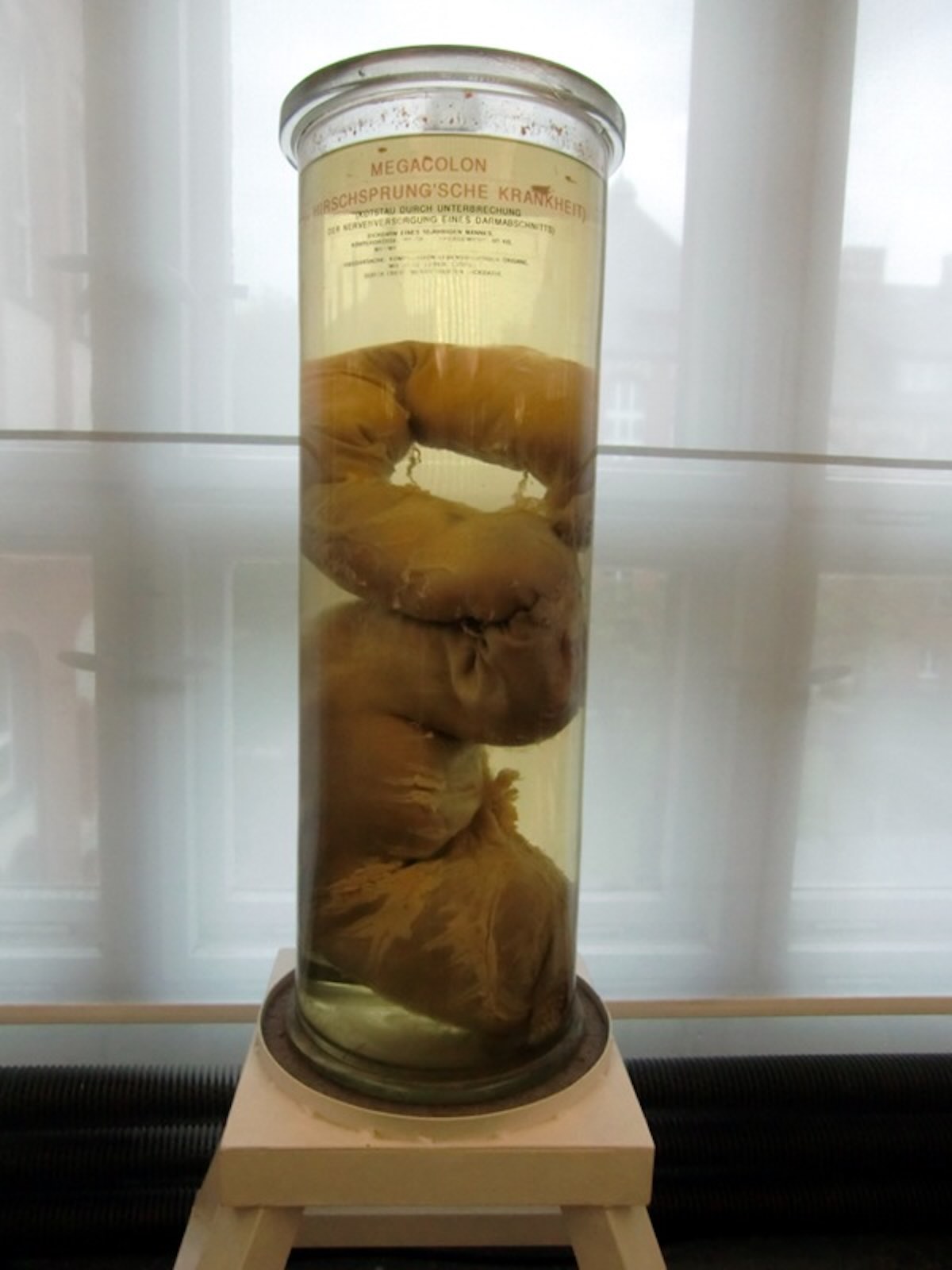
An example of a megacolon (photo by Ptqk licensed as CC BY-NC-SA 2.0 via Flickr)
I’m guessing I don’t want that.
You do not, my friend. This is a condition where the intestine just doesn’t propel the poop out. It collects in there and backs up. So the colon gets huge. They had one on display at the Mutter Museum, one from back in the 1800s that this person had, and, unfortunately, back then we didn’t have a lot to offer.
How many no-poop days have to pass before I get nervous?
In four days or so, you definitely need to call your doctor, because you’re going to start getting abdominal pain. This could be the sign of a bowel obstruction — and that’s most definitely a real medical emergency. An obstruction might be caused by a tumor or some other kind of mass; by surgical scar tissue that’s inhibiting movement inside the intestine; or by a condition called intussusception, where part of the intestine folds into another part.
We’ve talked a lot about poop and poop health today, and just for, well, shits and giggles, I thought I would ask you one question about the poop-adjacent topic of farts.
Shoot.
People say that beans make you fart, but I dunno. I can eat a whole can of garbanzo beans, a bunch of baked beans, a half pot of black bean soup and not a single toot comes out of me. Am I superhuman?
I’m sorry, but you are not superhuman, my friend. Some people have a bean sensitivity that leads to flatulence or, as you say, farting. And some of those people only have sensitivity to certain beans. Somebody might be able to eat a pound of pinto beans and be fine, but you give them a few spoonfuls of black beans and… watch out!
For this last question, I thought I would go back to the beginning of my career at Philly Mag, when I was desperate to get a few bylines. At a staff meeting, an editor asked who would be willing to get a high colonic and write about it. I foolishly volunteered. It was an interesting experience. Do you ever recommend these today?
This is going to ruffle a few feathers, but I personally do not believe in colon cleanses of any kind. What I believe in is eating good, high-quality foods and vegetables, staying away from hyper-processed foods as much as possible, and getting screened regularly to make sure your colon is doing OK.
Phew. I was worried that you were going to tell me I should go back to the “spa” and have them flush my bowels out with gallons and gallons of water.
No! Just eat more broccoli.
Thanks, Dr. Mike. Informative, as always.
This definitely wasn’t one of my shittier interviews. Am I allowed to say that?