This Philly Doctor Is Practicing the Long Game — One Family at a Time
For more than four decades, Dr. Kenneth Veit has cared for patients across generations — and knows what continuity of care really means.
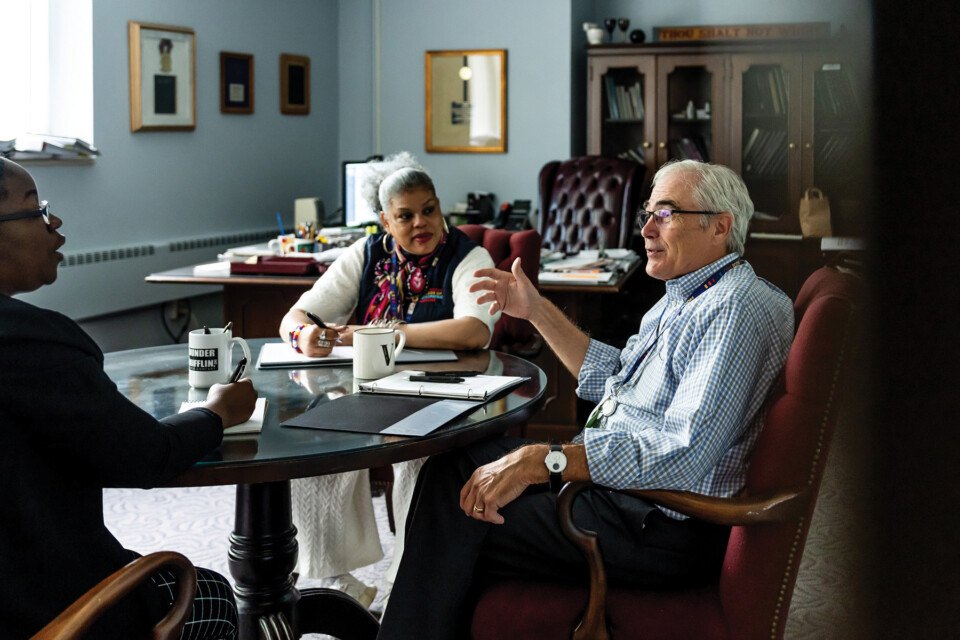
Kenneth Veit, D.O., discusses the day’s schedule with staff at PCOM. / Photograph courtesy of PCOM
Dr. Kenneth J. Veit, has practiced at the Philadelphia College of Osteopathic Medicine’s primary care centers for 42 years. He’s still seeing patients — and showing future doctors the ropes — one day a week at Hassman Family Medicine Center on City Avenue in Philadelphia. Here, he describes why he loves his job, and what it’s like to care for a child, parent, and grandparent from the same family.
What’s a day in your practice that captures this job at its best?
Every Wednesday, I see patients. According to my wife, it’s the happiest day of my week. I have patients who started seeing me 40 years ago, and then their kids, and then their kids. The more you see a patient, the more you learn about each other — this builds trust. That’s so important. You hear the criticism of health care today: It’s fragmented. “I see five doctors. Nobody knows who I am. They just look at my heart, or they just look at my stomach.” Primary care has this incredible longevity of knowledge of the patient. What’s more holistic than a family doctor?
What does it mean to know patients — and their families — over decades?
I have many patients in their 50s say, “Dr. Veit, you met me when I was 13!” One family I’m thinking of, when I first got to Philly, the gentleman had an end-stage chronic disease. He decided he didn’t want to go into the hospital anymore. So, I made house calls. I remember a young girl, his granddaughter, being in the house at the time. She is in her mid-40s now, and she remembers that first interaction with me. Her mother is also a continuing patient, and is now in her late 60s.
Patients don’t always see you for the reason they called about. How do you figure out what’s really going on?
[The chart] might say “the patient is coming here for a physical,” but often the reason they’re coming is for something very specific that they’re worried about. I give them time and ask questions to tease it out. With a male at 40, 45, it might be “I’m having sex problems.” That’s something you’re not going to advertise coming in. Or they’re too embarrassed to say they see some blood in their stool. A 17-year-old might want birth control. And if someone’s having marital problems, that can affect their health.
What does continuity of care actually look like in your exam room?
My current practice starts with school-aged kids who are coming in for immunizations or school physicals or athletic physicals. They need forms filled out. Middle-aged folks don’t routinely come in unless they’re sick or unless their wife or husband makes them come in. I’ll see them when they get a little bit concerned about preventive medicine, like colonoscopies. You’re in the lifecycle of a family. The geriatrics will pass away eventually. That’s life. Then you have their kids who are now 50, 60, going through the grief process.
You’ve said part of your job is being an interpreter. What are you translating for patients?
When specialists are involved, I coordinate and make sure the right hand knows what the left hand is doing. “Okay, now what did your cardiologist say to you last week?” Notoriously, patients see their ear, nose, and throat doctor — and come back to me and have no idea what he said. My job is to interpret all of it for them.
What do you try to teach the next generation of doctors about this work?
I tell them, “Taking good care is caring.” That’s the first attribute I try to get my students to understand. You might know everything in medicine, but if you really don’t care about the patient, so what? We take care of many underserved patients. My students sometimes get frustrated if the patients don’t come on time. I tell them, “This patient probably has to get three forms of public transportation to get here. Relax. We’re going to see that patient when they get here. We’ll fit them in.” I have patients who come in with 18 problems, and I have to prioritize very quickly. At the end of each session, I say to my students, “Okay, we saw 20 patients today. Which patient do I worry about the most? Which patient do I want to contact tomorrow?”
In an era when most patients bounce between providers, what’s the value of having a doctor who’s known you since you were a kid?
A provider knowing the long relationship between generations is unusual today. It’s incredibly valuable. Because if they saw me since they were a little kid, there’s a comfort level, when they get sick, to call my office. There’s nothing more rewarding than knowing my patients. I’m more than just the antibiotic I prescribe. This summer, it’ll be 50 years since I graduated from PCOM. I couldn’t have asked for a better career, and primary care made it happen.

This primary-care health series is made possible by a generous donation from PCOM.