How the “Michelin Bump” Changed Provenance
Six months after Philly’s first Michelin announcement, chef Nich Bazik explains what having a star has done for his restaurant.

Nich Bazik accepting his Michelin jacket / Photograph courtesy of PHLCVB
Listen to the audio edition here:
“It was completely life changing. And at the same time, nothing has changed.”
That was the first thing Nich Bazik, chef-owner of Provenance in Headhouse Square, told me when I got him on the phone to talk about what it was like to be running a Michelin-starred restaurant, six months out from when that star was first given to his restaurant.
On November 18, 2025, the very first Michelin ratings that Philly had ever been a part of were announced at the Kimmel Center. Collectively, we walked away from that night with 10 Bib Gourmands, 21 restaurants on the Guide’s “Recommended” list, one Green Star (for outstanding restaurants with sustainable practices), and three brand-new one-star restaurants. Provenance was one of those three (along with Her Place Supper Club and Friday Saturday Sunday). It had only been open for a little more than a year at that point — and more than any other restaurant in the entire city, it had been deliberately built to get the attention of the Michelin Guide.
And say what you will about ego or hubris or the big dreams of local chefs, but it worked. Bazik set out to make a restaurant in Philly, staffed by Philly chefs and full of nothing but Philly pride, that could play on an international stage. That could stand up among the best restaurants in the world, shrug and say, Yeah, we’re with them.
But what I wanted to talk to Bazik about now was what came after the circus left town. About how that shiny new star had affected his business. I wanted to know how it’d changed things — for him, his crew, for Provenance. And what, exactly, had stayed the same. And I wanted to start with the myth of the “Michelin bump” — this idea that earning a star confers an almost automatic increase in traffic.
“It’s totally real,” he told me, laughing. “We’ve had what I like to call reservation security ever since that night.”
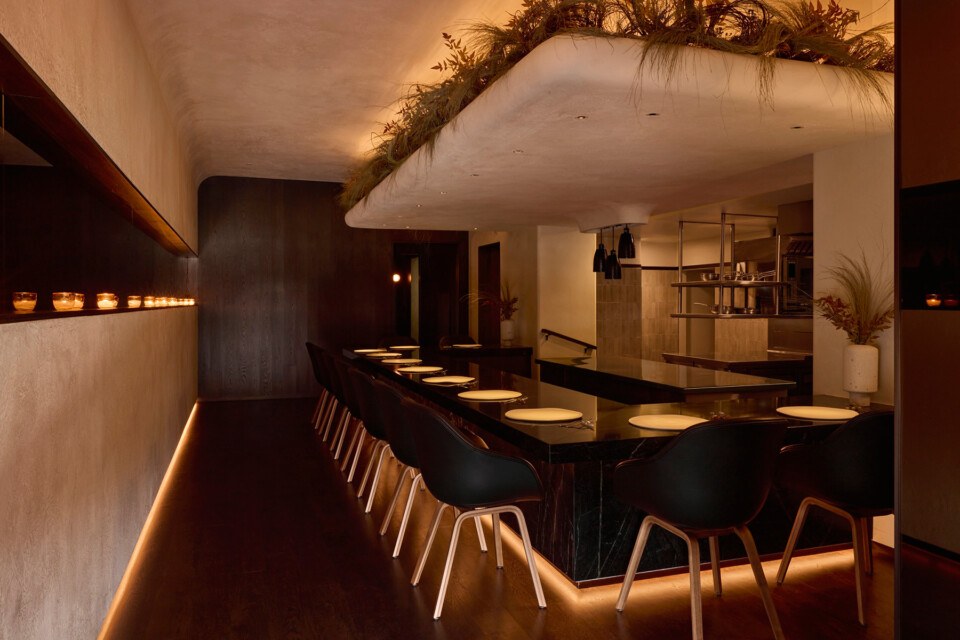
The counter seats at Provenance / Photograph by Jason Varney
In real terms, that means that Provenance is now fully booked every night. He opens up reservations for the month and they’re all snapped up immediately. And then the same thing happens the next month. And the month after that. Sure, sometimes you might get lucky and snag a solo seat, or benefit from a last-minute cancellation, but every month since November, he said that he’s been waiting to see that demand falter. “I ask myself, is this when it’s going to fall off?” But so far, that fall-off hasn’t come. It has been a sustained increase.
Which, he explained, is a pretty good feeling because things weren’t quite so rosy before Provenance got its star. The place wasn’t suffering, exactly, but it wasn’t really full either.
He had a 25-seat restaurant that, by his count, was doing less than a full turn of the dining room on weeknights and coming close to capacity on the weekends. That was enough business to get by, but not enough to be comfortable. And certainly not what Bazik considered a success. He knew he needed something to convince people that his restaurant — with its high price tag ($225 per person, not counting tax and a 20 percent service fee) and four-course, 25-plate French-Korean tasting menu — was as good as he thought it was. The reviews hadn’t done it. Getting named as one of Bon Appétit’s 20 Best New Restaurants hadn’t done it. So, he was holding out for that shot at a Michelin star.
And when he got it, it wasn’t just the guest count that changed. He told me people’s attitudes changed, too. He said that, before, no matter how happy people were when they left, he’d felt like a lot of them were coming in skeptical about the restaurant, or about what he and his team were capable of. But after getting that star and Michelin’s “erudite stamp of approval,” that changed as well.
“The attitude shifted toward people being excited to be here,” he explained. “I mean, we’re still a new restaurant, for all intents and purposes. But now they’re excited. They get it.”
Also, they’re not all locals. Pre-Michelin, the restaurant was depending almost purely on Philadelphians to keep it afloat. Now Bazik’s looking at a book that’s split almost 50-50 between locals and out-of-town guests who’ve come to eat at his restaurant. To see what he and his crew can do that’s so special.
In that, though, there’s a kind of hidden danger. A tyranny of expectation that Bazik is accutely aware of. Because once you get that star (and all the attention that comes with it), the new challenge becomes keeping it.
And while Bazik was quick to tell me that nothing about the way he works at Provenance has changed, pretty much everything has changed. That marathon of a tasting menu that used to change sometimes night-by-night? He keeps it more locked-down now, swapping out “97 percent of the menu” every six weeks, but otherwise sticking to a set tasting menu that might evolve over its lifespan, but will stay fundamentally stable.
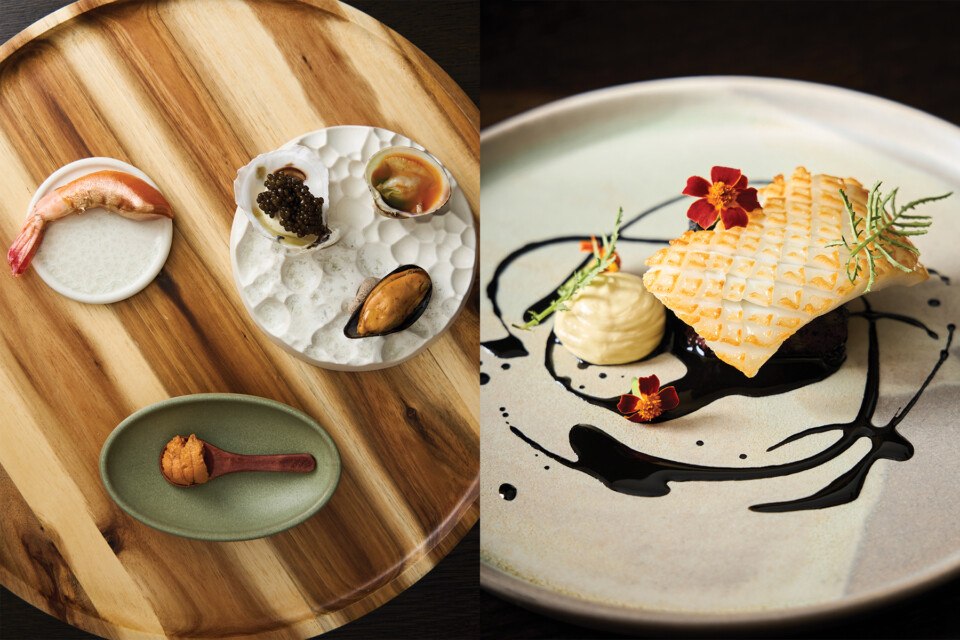
A few dishes from Provenance’s menu / Photographs by Nate Cluss
Like right now, he recently rolled out a new spring menu that, to his eye, is just four courses. But each of those courses might have two dishes. And each of those dishes might come with a sidecar. For example, he’s got some beautiful bluefin tuna on the menu, he explained, and that’s served raw. But then, in the cutting, there are a lot of tuna scraps and he doesn’t want those to go to waste, so the kitchen will find a way to utilize them as a side. And then he’s also got some really nice leeks, so he’ll use them in a gougère, and that’ll become part of the course, too. And they’re also doing whole suckling pig, and he’s using the whole animal for a single course, making everything from chicharrónes to head cheese, and serving five or six different cuts on a plate with mushroom kochi and sauce charcutière, alongside rice and cucumber broth and their house banchan, which means five or six additional bowls of pickled and fermented vegetables. And any element of this might change on any given day but, for six weeks, “Suckling Pig” will stay on the menu. Anything else that happens? That’s just a kind of riff. That’s just playing with the idea of what “Suckling Pig” might mean.
“It’s more refined,” Bazik insisted as he ran through the kinds of permutations that happen now. “More impactful. I like watching how these dishes evolve over time, and how they change, but I’m more focused now on the identity of the cuisine.”
Why? Because what he and the Provenance team are doing now is no longer proving to a skeptical crowd that they belong in a conversation about the best restaurants in the world, but showing people that that’s what they were aiming for from the start. That’s the part of Provenance that hasn’t changed at all.
“People’s expectations change,” he told me. “But we don’t. There’s been a certain amount of refinement, but that’s necessary. Refinement is good.” Because refinement, Bazik thinks, is what’s going to keep Provenance moving forward.
Which means that every night has to be better than the last one. Every service. Every table. Because, really, for everything that Michelin star brings, there’s a cost, too. Once you earn it, you can’t ever not be earning it. Because those stars? They can always be taken away.
“I tell the staff, Now we’re in the game. And now that we’re in the game, we can’t not be in the game.”
But Bazik seems happy with that. He got exactly what he asked for. What he worked so hard for.
Now all he has to do is keep it.