I Tried It: Can a Spa Fix Your Sleep?
A restless writer checks out the Four Seasons’ new sleep-focused treatment — and wakes up feeling totally refreshed.
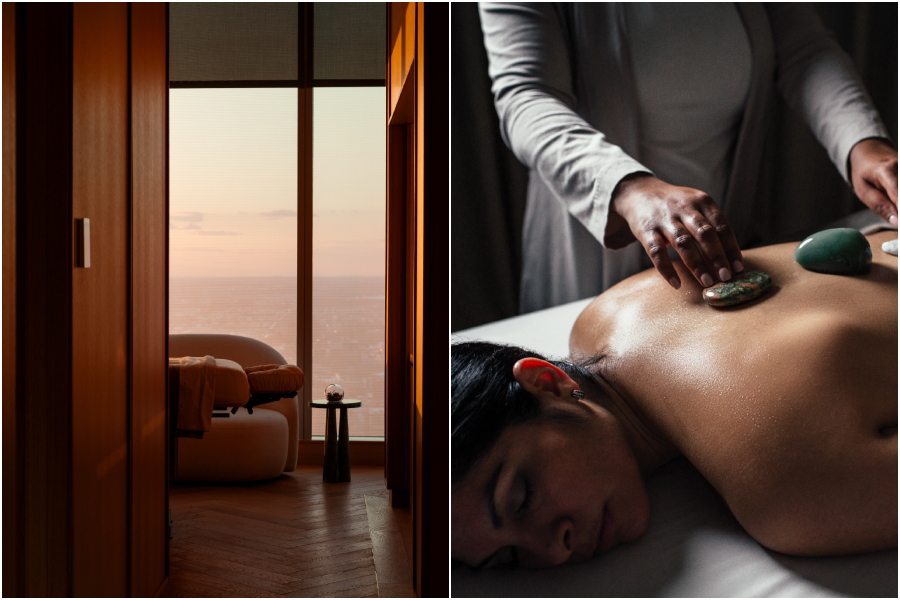
Health and wellness editor Laura Brzyski relays her experience getting a rest-focused spa treatment at Four Seasons Hotel Philadelphia’s new Sky Garden floor. / Photographs: The Sky Garden spa suite, by Joe Thomas (left); a massage treatment, by Southcote Digital
Listen to the audio edition here:
I’ve always had high sleep needs. That means I function best on 10 to 11 hours of sleep per night — and no, that’s not an excuse to get my 40 winks and then some.
While there’s little data on people like me, known as “long sleepers,” research shows that sleep duration is not one-size-fits-all and is often influenced by a person’s genetics and circadian rhythm. Many experts chalk up the problem to oversleeping — they claim that more than nine hours of sleep can make a person feel more tired or could signal an underlying medical issue — but I’ve had the tests and studies done: No sleep apnea. No low levels of iron or essential vitamins. No thyroid issues. (Though, I’ve not yet ruled out chronic fatigue syndrome, a condition that’s difficult to diagnose — Stanford scientists have created a blood test that identifies an associated biomarker, but it’s still in the pilot phase — and has no cure.)
And while I’m still trying to convince my husband of the science, studies suggest women need more sleep than men, yet our ever-fluctuating hormones — due to our menstrual cycles and the lead-up to menopause — often disrupt our ability to get quality rest.
(Also, I genuinely love catching some z’s. Sleep is, as writer Sara Protasi argues in this delightful essay for Aeon, delicious.)
During the early days of the pandemic, though, I, like many others, experienced bouts of insomnia due to increased anxiety. My sleep was so royally messed up that I eventually went on a sleep retreat to figure out how to combat my recurring tossings and turnings. The experience altered my mindset and my approach to sleep health — I learned tactics to naturally wind down before bed and to keep calm during middle-of-the-night wakings. But I’m still not completely immune from insomnia, especially during periods of high stress. It’s not just a me problem, either: According to a recent Gallup poll, U.S. adults are both severely stressed and sleep-deprived, clocking in fewer than seven hours per night.
While lack of sleep is a real problem in today’s go-go-go world, many of us forget that lack of rest — or feeling physically, mentally, emotionally, socially, and sensorially at ease and capable of refueling — is also grinding us down. So, I was intrigued when I learned that Four Seasons Hotel Philadelphia launched new spa treatments, some of which are designed to support optimal rest, at what they’re calling Sky Garden, the hotel’s never-before-used floor set on the 45th level. (The refurbished space is home to eight residential-style rooms and suites, including a killer 4,000-square-foot penthouse, and a private, one-person spa suite.)
The Four Season’s main spa on the 57th floor is one of the best in the world — it’s the only spa in Philadelphia with a Forbes’ five-star rating, a designation given to just 123 others around the world — but the treatments, like those at most spas, don’t target specific health or lifestyle needs. So, while you might leave feeling totally pampered regardless of whether you get a massage, facial, or body scrub, you may nonetheless bring home low energy, a dysregulated nervous system, or stress you’re still struggling to stave off.
The brand-new spa services at Sky Garden just 12 levels below the 57th floor spa aim to do just that. “High Vitality,” as the service menu is called, is designed around precise outcomes: stress relief through services like breathwork and yoga; more restful sleep via acupuncture, sound therapy, and Reiki; and immunity support with lymphatic drainage, IV therapy, and a comprehensive facial. (Senior spa director Stéphanie Cherbakow Baron, a believer that longevity should be at the core of the wellness industry, developed the menu after spending two decades working closely with and learning from energy healers, acupuncturists, breathwork facilitators, and other wellness practitioners across the world.)
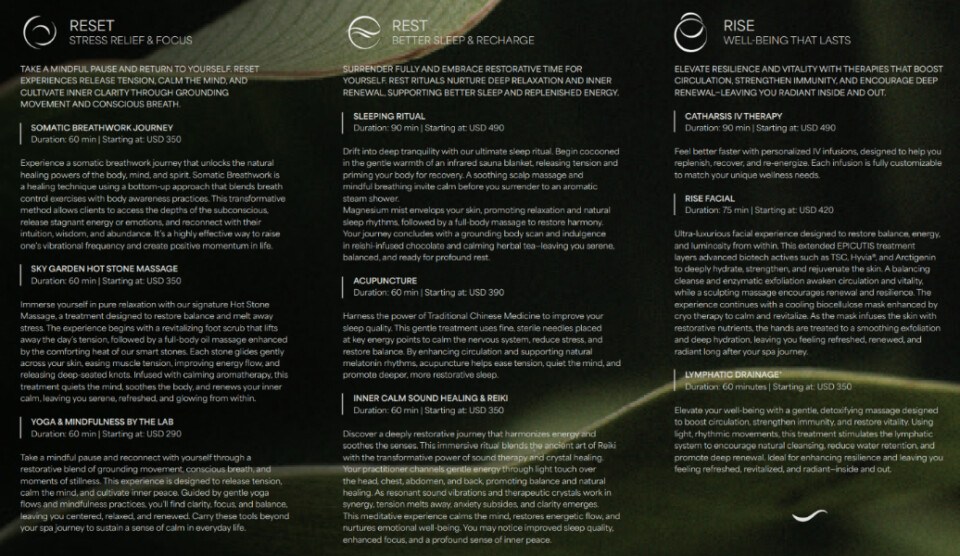
The full High Vitality spa treatment menu / Image courtesy of Four Seasons Hotel Philadelphia
It’s a shift we’re seeing globally: Many spas and wellness resorts are now tailoring their services toward longevity — which Vogue deemed one of 2026’s biggest wellness trends — and, as a result, are altering their approaches from providing temporary relaxation to results-driven treatments that aim to provide measurable, long-lasting health benefits.
Given my personal history with sleep issues and the current, universal rest deficit, I wanted to give one of the new “High Vitality” services a try.
Sky Garden’s spa suite is discreet and private, tucked in a quiet corner on the floor. The suite itself is spacious, but not too big — there’s a single-person bathroom with a shower, one massage bed, and a small sofa by the floor-to-ceiling windows that overlook Center City and the Schuylkill River. Because I’m here with rest as my goal, the curtains have been closed against the afternoon sun, dimming the room. The effect is instantly calming — I feel in the right place and headspace, and also a bit ready for bed, despite it being midday.
I’ve opted for Sleep Ritual (starting at $490), a 90-minute treatment comprising contrast therapy, two kinds of massage, and sleep-supporting refreshments — all intended to calm the nervous system and nurture deep relaxation, backed by the belief that rest is something that can be structured and facilitated.
My spa therapist and I discuss why I’ve selected Sleep Ritual — parenthood, work, and the chaotic state of the world have left me feeling tired-but-wired — and how I hope to feel after (relaxed in mind, body, and soul). There’s no other assessment for diagnosing — they aren’t prescribing meds, after all. The thought is, if you’ve chosen a rest-focused service, you likely need it.
The treatment begins with time spent in an infrared sauna blanket that’s laid out atop the massage bed. It’s more like a sleeping bag — a toasty, cozy cocoon — enveloping my body from the neck down in complete warmth and allowing my tight muscles and stiff joints to loosen.
As I let the infrared heat do its thing — it has several physiological benefits, including helping muscles to relax and supporting immune function, both necessary for getting optimal rest — I put aside any stressful or negative thoughts. I figure if my head isn’t free of anxiety, my body won’t be, either. How can I achieve rest if I’m not practicing or embracing it when the time, space, and support are all at my disposal?
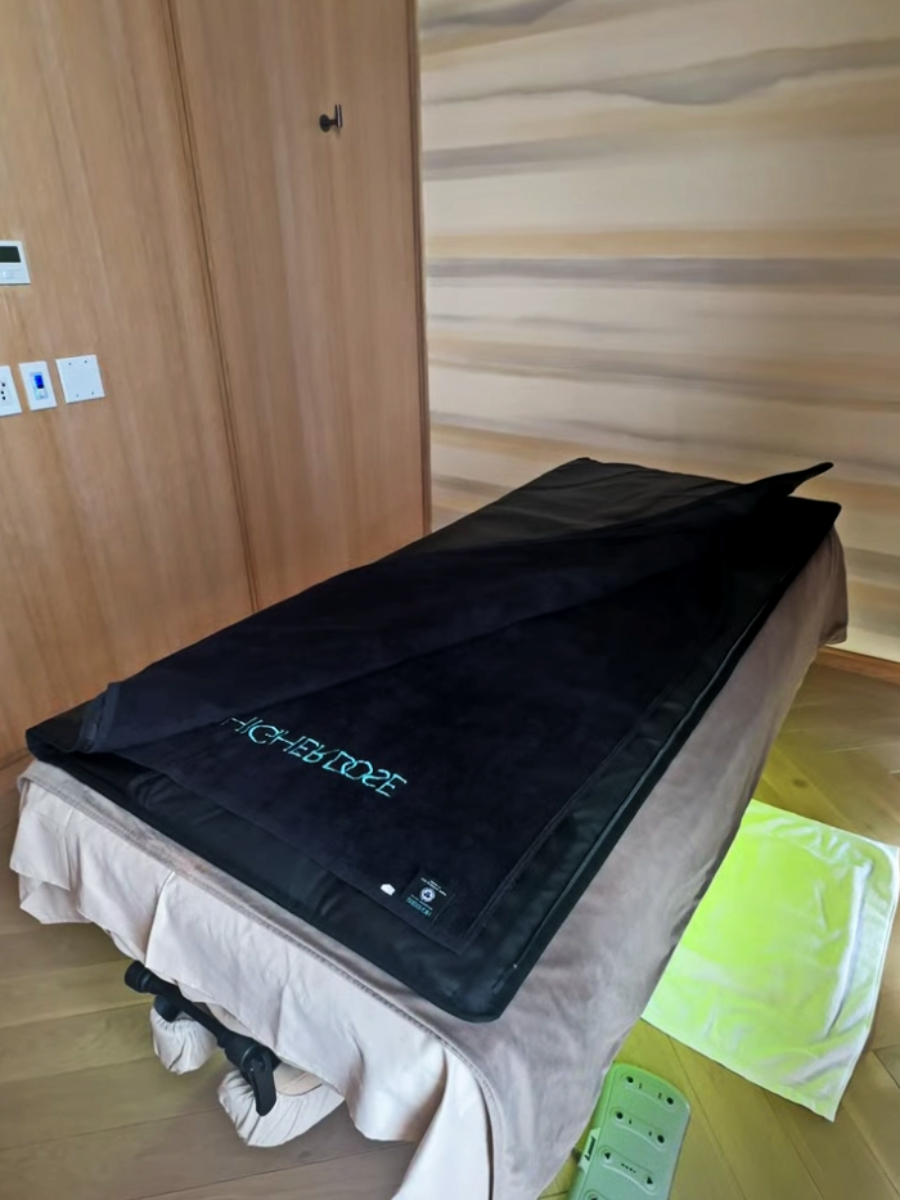
The Sleep Ritual begins with time in an infrared sauna blanket. / Photograph by Laura Brzyski
My body warms and I’m starting to sweat a bit — for some people, that feeling might not be relaxing, but as someone born during a heat wave, I am in my natural element, which puts me at ease. The therapist starts massaging my scalp, and the rhythmic nature of her hands in my hair almost cause me to doze, and no wonder: Massaging the head has been said to reduce the stress hormone cortisol and boost serotonin, a neurotransmitter that aids in the production of melatonin, which regulates the sleep cycle.
She tells me, with a whisper, it’s time for me to enter the private shower and run cool water on my body, the second part of this contrast therapy. This is surprising to me, as cold water is known to jolt the body awake — which doesn’t seem to fit with this rest protocol — but I also understand that nobody wants to be sweating for the rest of a spa service, so I oblige. The cold water hits, and I’m immediately taken out of my peaceful reverie — I’m more alert now — and it takes a few minutes for my body and mind to fall back into a relaxed state. (Later, I learn that contrast therapy has the potential to improve sleep quality — how long and how well you snooze — as raising then lowering of your core body temperature can help shift your nervous system from fight-or-flight to rest-and-digest.)
I return to the massage bed — I now understand why it’s called a “bed” — for a full-body treatment, customized to my areas of tension, like my aching hamstrings and upper-body knots. Normally, any good massage will make me a little sleepy, but this one really settles me, thanks to a magnesium mist sprayed directly onto my skin. Magnesium, an essential mineral the human body needs to function properly, is known for its sleep benefits, including improving sleep quality and reducing stress and anxiety, which often contribute to insomnia. While there’s currently little evidence to show our skin can adequately absorb magnesium via topicals — oral supplements are recommended more often — some skin experts believe non-harmful placebos can be powerful, especially when it comes to catching z’s.
As the service ends and I rise from the massage table in a way that resembles a big stretch first thing in the morning (bedhead included), I find a pot of Sleepytime tea — a caffeine-free herbal blend with calming ingredients like chamomile and lemongrass — and a piece of dark chocolate from the good-for-you chocolate brand Alice. (This particular one is made with reishi mushroom, a stress-reducing adaptogen, as well as magnesium and chamomile.) I sip some tea and decide to nibble the chocolate closer to bedtime. It’s only 3 p.m., after all.
Later that evening, as I’m lounging on my couch, I forgo my typical dessert — ice cream or cookies — and grab the chocolate that’s meant to be the final flourish of my restful experience. Though I can’t taste the sleep-supporting ingredients and don’t totally buy into the idea that this single bite will have that great an impact, I feel heavy-eyed and ready to be horizontal.
By 9 p.m., I’m in bed — oh, how Friday nights have changed — and eventually drift into what turns out to be a deep, restorative sleep. So much so that when I wake up at 8 a.m. the next morning, I don’t groan at the time on the clock. I may be awake earlier than I normally am, but I’m not tired at all. I actually feel completely rested and even energized.
There are no miracle cures to rest, and exhaustion isn’t just about sleep deprivation, but maybe what I’ve experienced — what this new spa service has to offer — isn’t a placebo after all.
I climb out of bed, relieved that, for at least this morning, my rest feels earned and not chased. I’ll take that as a win.
Four Seasons Philadelphia is located at 1 North 19th Street in Center City.