Could These New Tiny Robots Cure Cancer?
Researchers at Penn and the University of Michigan have developed the world’s smallest, fully autonomous robots. The health applications are nearly endless.
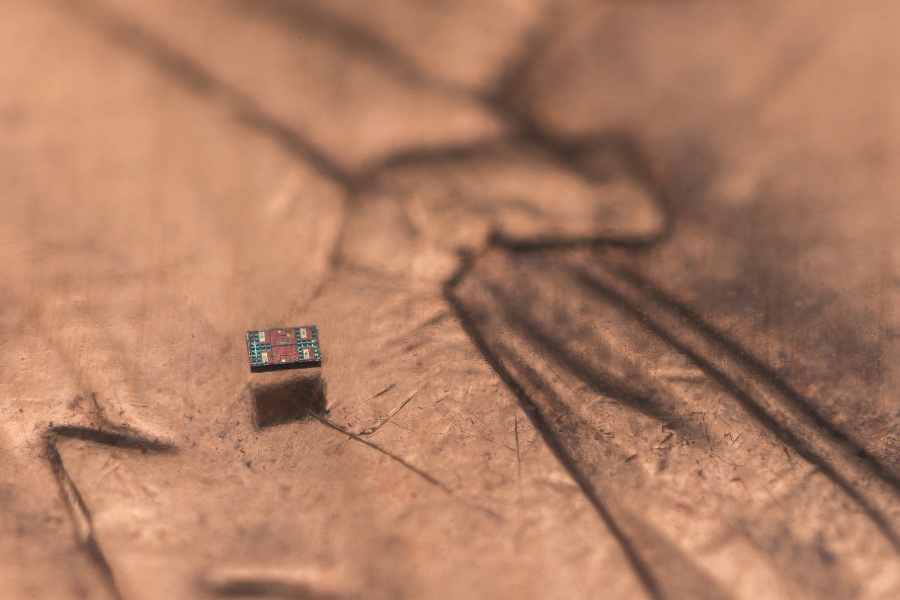
The micro robots developed by researchers at the University of Pennsylvania and the University of Michigan are the smallest, fully autonomous robots in the world. / Photograph of a micro robot atop a U.S. penny by Michael Simari
Listen to the audio edition here:
Inside a lab in the University of Pennsylvania’s Levine Hall are robots so tiny they can balance on a single ridge on a human fingerprint. At 200 by 300 by 50 micrometers, they’re the smallest, fully autonomous robots in the world.
The new, barely visible machines — developed by Penn professor Marc Miskin and researchers at the University of Michigan (a team that broke records for building the world’s smallest computers) — can sense their environment, make decisions based on what they detect, and then move on their own, all in a device so small it could fit into Lincoln’s eye in his portrait on the penny.
Miskin and his cohort of researchers are excited by the potential of these nascent devices to advance medical treatment in ways that could forever impact the (much bigger) world beyond the walls of Levine Hall. The goal? To one day deploy them inside the human body to more effectively treat conditions like nerve pain, blood clots, and even cancer.
How do micro robots work?
When it comes to robots, engineers (and sci-fi aficionados) know that, in order to perform as they’re intended, they need to “sense, think, and act.” This requirement has been one of the biggest hurdles to leap in the case of micro robots, says Miskin, noting how easily their miniature arms and legs could snap, as well as the difficulty of cramming enough computing power and onboard intelligence into a device smaller than a grain of salt. It’s why Miskin and David Blaauw, the lead on the Michigan team, have been perfecting their mini bots for five years.
Put simply, their robots take in information and make decisions about what to do with it — the “thinking” part of the equation. That decision drives its next action — perhaps to move from a high-temperature area to a low-temperature one, or to send a message to researchers. (These kinds of movements matter as, in the future, the robots may be enlisted to, say, move from cell-to-cell, determining if each is healthy or cancerous.)
Miskin’s and Blaauw’s robots communicate their findings with researchers via a “waggle dance” — a wiggly, wave-like motion similar to the action honeybees use to communicate with one another. For the robots, specific movements indicate different temperature measurements, so the researchers observing the movement could know the ’bot is on a 100-degree surface because of the way it’s wiggling.
What’s even cooler is that researchers aren’t puppeteers — there’s no joystick controlling where the robots go or what they do. They move on their own and are programmed to make decisions, like moving left or right, based on the information their sensors give them about their environment.
To keep them computing and moving, their photovoltaic solar panels — similar to how solar panels on a home power the lights inside of it — generate nano-watts of power (about a million times less than the power in a AAA battery, Blaauw says). Miskin says they could also be adapted to make use of different, already existing power sources, like acoustics, ultrasounds, or electromagnetic fields.
Each robot has its own internal computer, which holds infinitesimal amounts of code, between 100 to 1,000 lines. (For reference, a typical iPhone app contains 50,000 lines.) To manage the small memory, researchers developed a number of coding shortcuts, allowing the robots to essentially do more with less.
For example, a seemingly simple motion, like walking, could require many instructions — put the right foot down, lift the left foot up, move left foot forward, etc. — each using a line of code. The team compressed the process so it “could instruct a robot to do complex behavior with just a single instruction. It’s compact, from the memory point of view,” Blaauw says. Sort of the way the human brain allows us to walk without thinking through each step of the process.
Blaauw has spent his career making computers smaller and smaller, creating the world’s smallest computer in 2015 and then again three years later. He’s worked to make circuits “nanoscopic” and more energy efficient, allowing them to operate for longer periods of time. (The solar panels also help with that, since they’re basically tiny power plants.)
Micro robots and the future of healthcare
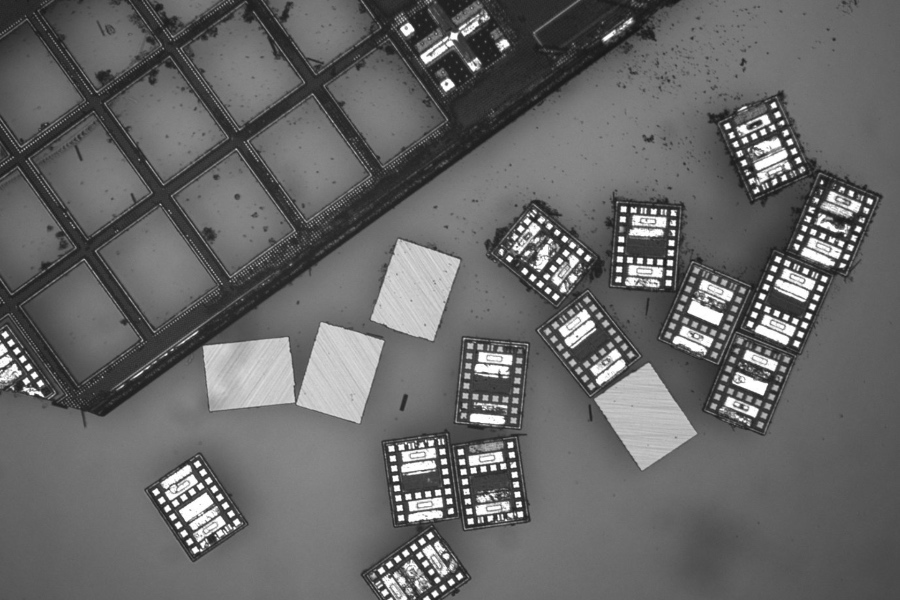
The final stages of micro robot fabrication deploy hundreds of robots all at once. The tiny machines can then be programmed individually or en masse to carry out experiments. / Photograph by Maya Lassiter
Though they sound like something from some far-off future, these micro robots are already being used in clinical trials for eye surgeries, and Penn is studying their possible application in dental care, including teeth cleaning and endodontics.
Sambeeta “Sam” Das, an assistant professor of mechanical engineering at the University of Delaware who studies the uses of micro robots in biological systems, anticipates many possible healthcare applications for micro robots in a testing capacity — swimming around petri dishes and detecting heavy metal levels in blood, for example, or measuring antibiotic resistance. This could help doctors treat conditions like sepsis more efficiently.
Micro robots “could accelerate treatment options for a lot of diseases and chronic or acute conditions that we currently can’t treat — or whose treatments come with a bunch of side effects,” she says. “These discoveries will play a huge role in improving our standard of living, general health and longevity.”
Then, there are the potential uses inside the body, what Das calls the “holy grail” — at least for her research, which in part considers the use of micro robots for the development of artificial organs. The robots could be used to remove blood clots from small arteries in the brain, and to diagnose and treat cancer.
“The fundamental building blocks of our body are small,” Das says. “If we can make something small that targets that fundamental building block, then we can treat and diagnose a lot of things much earlier.”
Miskin, who is “application agnostic” when it comes to the future uses, also sees potential in engineering, where robots could play a role in constructing other microscale devices. Part of the beauty of inventions like this, he says, is how other people create uses for them that Miskin, Blaauw, and other researchers haven’t thought of yet.
“We expect that as the micro robots become more sophisticated, we’ll uncover more and more uses for them,” Blaauw adds.
Should the thought of putting a robot inside my body freak me out?
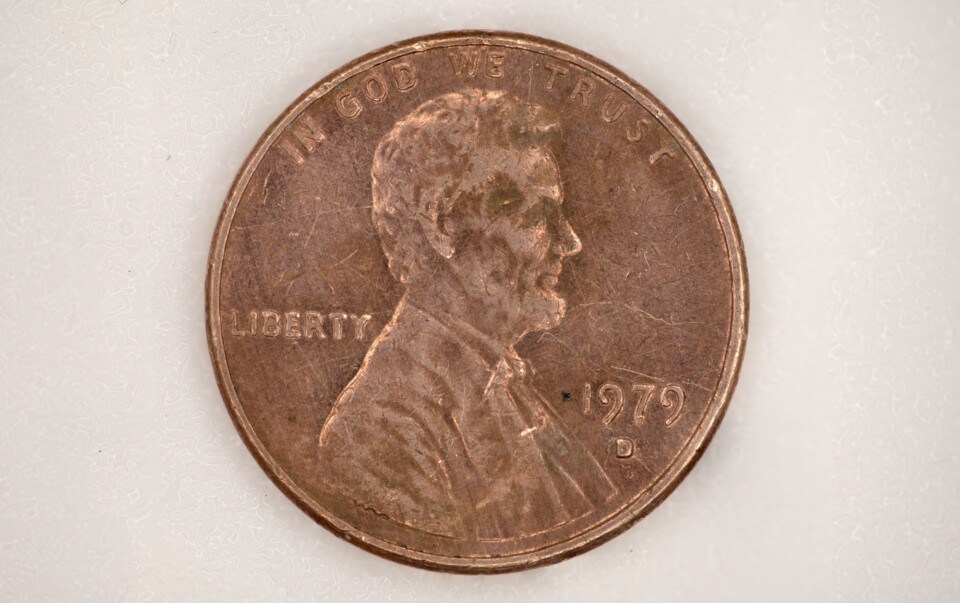
Photograph of a micro robot atop a U.S. penny by Michael Simari
We’re not all about to become cyborgs (at least, not yet). A future where robots are sent into the body to detect cancer or rewire damaged nerves is still a way off. In the lab, a modular microscope — Miskin calls it the “Lego” — is set up for researchers to test new ideas with the robots. Right now, a team is working on a way to propel them using magnetic fields, which would make it easier for the tiny automations to move through the human body, since magnetic fields can penetrate deep into the body’s tissues.
The next research focus for the team includes increasing the robots’ memory, fine-tuning their movements, and, most pressingly, improving communication. While the robots can carry out tasks and share data with researchers, they can’t talk to or coordinate with one another. Introducing that capability alone could potentially take another five years, Miskin says.
“If you’re a single cell, there’s only so much you can do in your world. The thing nature continually does to get past the burdens of being tiny is to work together,” Miskin says. “One ant is not so good. A bunch of ants — that’s a colony.”
All of this is pretty futuristic, pretty freaky, but it’s important to remember nearly every medical development comes with trepidation. The first heart transplant surgeons were compared to Frankenstein. Imagine what early surgery patients thought as they stood before a doctor wielding a knife, asking to cut them open.
Still … injecting a robot into your body? The researchers I spoke with compared it to vaccines: Some people are skeptical about getting them, but they’ve been tested, proved safe, and prevent many serious illnesses. We also see therapies that essentially “fuse” with the human body, like insulin pumps for diabetes, which supply a continuous dose of medication that keeps people alive. Anyone who uses a hormonal IUD or Nexplanon for their birth control trusts an implant to speak to the body and release chemicals at a pre-arranged rate.
“It’s very hard to imagine yourself unwell, but when you are, you’re super thankful that a treatment was developed on the other side,” Miskin says. “If I can build something that’s going to make people’s lives better, then I feel like I should do that.”
These micro robots might just be the latest iteration of this smart therapy-delivery system that becomes mainstream in a few decades — and they could save lives. After all, just steps away from Miskin’s lab is the Electronic Numerical Integrator and Computer (ENIAC), the world’s first electronic computer. The behemoth, built by Penn scientists J. Presper Eckert and John Mauchly and housed in the Moore School Building, turned 80 earlier this year. It was 1,800 square feet when first built. Today, its descendants are robots so small we might one day send them into the human body.
Progress might come at us faster than we think.