This Philly-Born Opera About Immigration and Bureaucratic Cruelty Feels More Relevant Than Ever
First staged on Broad Street in 1950, Gian Carlo Menotti’s The Consul returns to Philadelphia this week for just two performances.
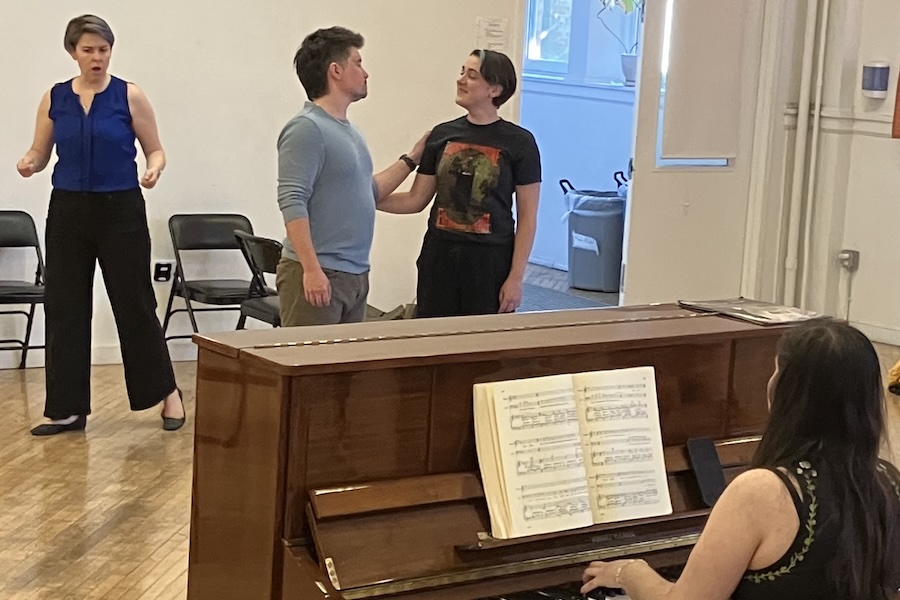
From left: Marcelle McGuirk, Robert Flora and Amanda Staub, with Andrea DeVito on piano, during a rehearsal for The Consul. / Photograph courtesy of Marcelle McGuirk
Just a year after George Orwell shook the world with his grim and futuristic novel 1984, a young composer in Philadelphia lifted the curtain on a work that better describes our modern dystopia.
The Consul, an English-language tragic opera — created by Italian-born, Curtis Institute-trained Gian Carlo Menotti — mires its characters in an inscrutable bureaucracy haunted by waiting rooms, red tape, and unchecked secret police. Where Orwell tormented his Winston with surveillance and one-on-one psyche-breaking, Menotti’s cryptic government office rules via fascistic indifference. (And, honestly, where did Big Brother find the time?)
The hero of The Consul is not the freedom fighting husband, but his intrepid wife, Magda who must navigate an obfuscating immigration process in order to get their family out of the country before it’s too late. Which country? Menotti leaves that to the imagination, lending the situation a nightmarish universality, and forcing the audience to reckon with the frustration of the situation instead of the politics.
First performed on March 15, 1950, at the Schubert Theatre (now known as the Miller) on Broad Street, The Consul immediately resonated with audiences still living out the consequences of World War II. A week later it had moved to Broadway. Within a year it had won the Pulitzer Prize for music.
The Consul has been performed only occasionally in the ensuing 76 years, but will enjoy a revival this week when local arts orgs Liberty City and Prismatic team up to stage a pair of performances, May 20th and 22nd, at Billy Penn Studios.
Fishtown-based soprano Marcelle McGuirk remembers learning about The Consul during her freshman year at Marywood University, near Scranton where she grew up. “It was the first time I had heard of an opera that was directly speaking to any kind of activist position.” (Verdi’s political messaging notwithstanding, of course.)
“To find this opera in English that was speaking to perennial political — but also human rights — problems in the American landscape was just really powerful to me. I’ve dreamed of this opera for a long time; never thought I would get to sing it.” She’ll work as a producer on the show, in addition to playing Magda at the Friday performance. The role suits her powerful, emotive voice.
It’s no surprise McGuirk is drawn to shows with an activist bent; she also works with the Archdiocese of Philadelphia’s Commission for Racial Healing, singing with Spanish-speaking immigrants. These performances of The Consul will raise money for local immigrant organizations Juntos and New Sanctuary Movements.
“We were all kind of like asking ourselves these questions, like, ‘What does it mean to be singing an opera, which can often feel like a very frivolous elite kind of art-making, if we’re not using it to say something about the current political moment?’”
Menotti’s opera had several points of inspiration, from the wave of migrants trying to escape the Soviet bloc, to individual horror stories from Ellis Island that were making headlines at the time (in particular, a Polish woman who committed suicide there rather than be sent back for incomplete documentation).
Still, one early review of Menotti’s opera questioned whether its situation would remain relevant as time passes by. Here in the future we know there’s always immigration debates and refugee crises happening somewhere.
McGuirk also detects a note of sympathy in The Consul for the people working inside the government, like the secretary who becomes a de facto foe to Magda. “Menotti is not interested in dehumanizing the folks who work for these systems of power that dehumanize others,” she says. “He’s interested in the humanity of all the characters.”
Again, she bristles at opera’s stuffy, well-dressed reputation (and blames Wagner for it). Her company, Prismatic Arts Ensemble, and producing partner Liberty City Arts aim to resonate with a younger audience than opera usually draws.
“I’m somebody who has lots of big feelings, and my whole life was told that I was too much,” says McGuirk, who grew up singing at church. With opera, she “finally found an art form where there’s no such thing as too much.”
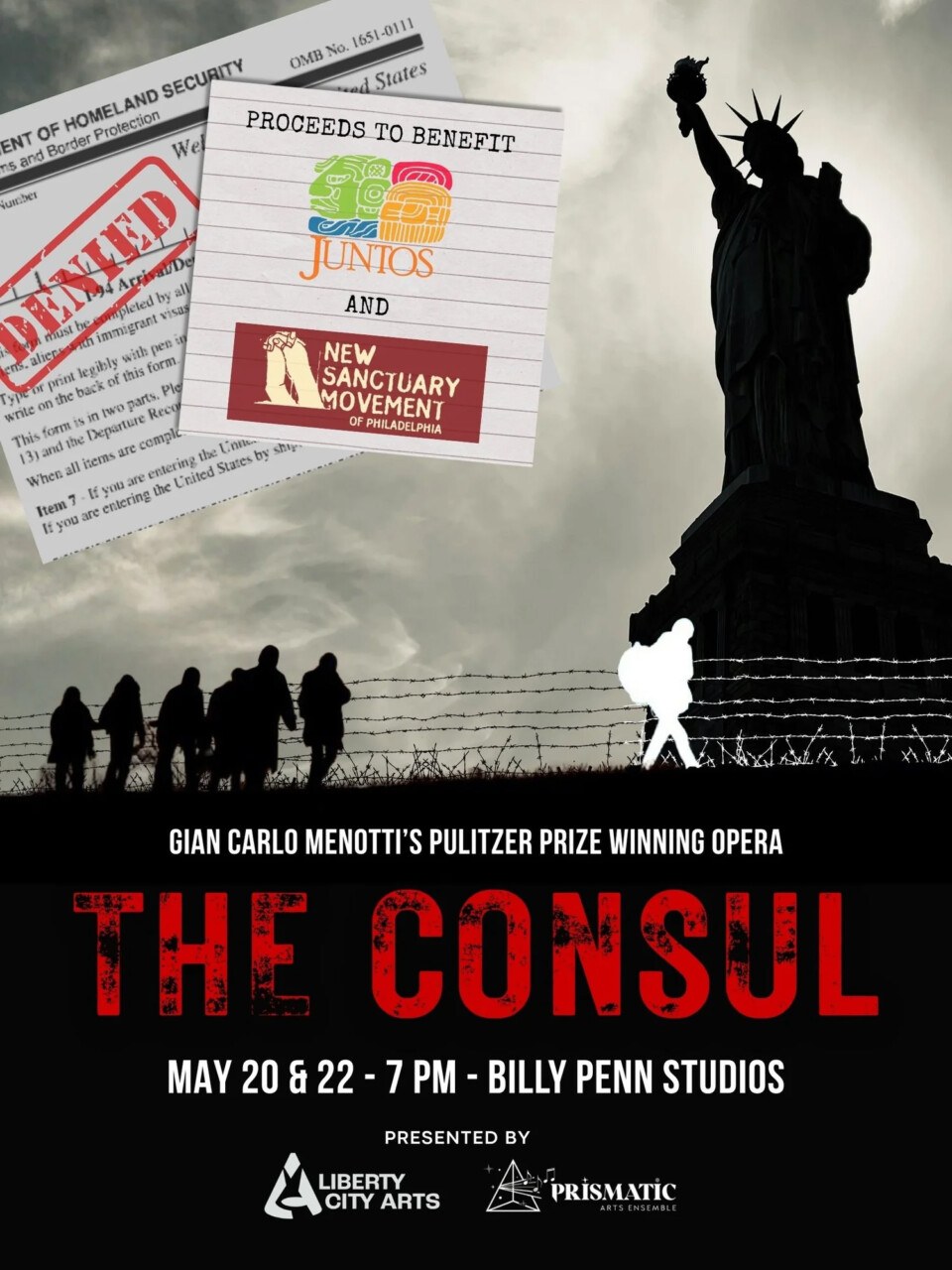
The Consul, presented by Liberty City Arts and Prismatic Arts Ensemble, May 20th and 22nd, 7 p.m., Billy Penn Studios, 1516 North 5th Street.