
This Revolutionary Technology Readjusts Your Radiation Plan Daily to Better Target and Eliminate Cancer

Do you or someone you know need radiation therapy as part of cancer treatment? If so, you now have access to a revolutionary FDA-approved technology called adaptive radiation therapy or ART–a transformative step forward in the way radiation is delivered. At the helm of the Fox Chase Cancer Center Adaptive Radiation Therapy Program is Eric Horwitz, MD, FABS, FASTRO, Chair, Department of Radiation Oncology at Fox Chase Cancer Center and Lewis Katz School of Medicine at Temple University.
“The difference between traditional radiation and ART is that with traditional techniques such as intensity-modulated radiation therapy (IMRT) or stereotactic body radiation therapy (SBRT), physicians guide an entire course of treatment based on a one-time planning blueprint created at the start of therapy. With ART technology, we re-adapt and re-plan a patient’s treatment every single day of therapy for improved accuracy and less toxicity,” says Dr. Horwitz.
Fox Chase was among the earliest adopters of adaptive radiation therapy in the region, and today it is recognized as one of the largest clinical programs of its kind in the United States. Dr. Horwitz notes, “Our team has an unparalleled depth of experience and training, and it’s become quite routine for us even though it is a complicated treatment.”
Adaptive Radiation Therapy Adjusts to Cancer in Real Time

The team readjusts a patient’s plan every day of therapy.
Many Fox Chase patients who require traditional radiation therapy for prostate, lung, or breast cancer now may have the option to undergo adaptive radiation instead. With ART, the radiation oncologist and medical physicist reassess the tumor’s size and position at the start of every treatment session, comparing the new findings to the original planning blueprint. If changes are noted, the daily plan is re-calibrated to more accurately hit the tumor and miss healthy tissue.
“For example, in prostate cancer, not only can the tumor size and shape change on an everyday basis due to therapy, but the tumor and healthy tissue also may be in a different position based on bladder volume.” Adaptive therapy accounts for these variations. For patients undergoing ART for lung, liver, or pancreatic cancer, the same principles apply, where the size and position of the cancerous tumor is affected by breathing and the bowel. “There’s so much variability in our bodies, which is all normal, and now we can take that into account and adjust for it with adaptive therapy,” explains Dr. Horwitz.
Helping Patients with Cervical Cancer
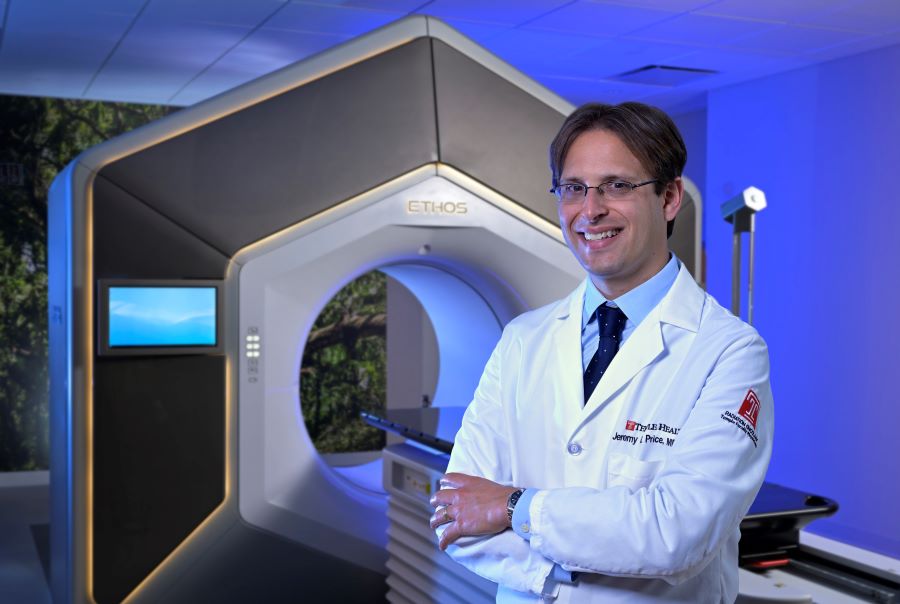
Dr. Price leads an important clinical trial for cervical cancer.
For women with cervical cancer who need to undergo radiation therapy, Jeremy Price, MD, PhD, Radiation Oncologist, wants to help them experience fewer harsh side effects. Dr. Price is leading the ARTIA-Cervix trial at Fox Chase using ART to adjust a patient’s radiation treatment plan to more accurately target the tumor, and limit the harsh and long-lasting side effects to the bowel and bladder that traditional radiation can cause. “In a 25-day course of treatment for cervical cancer that can makes a big difference,” says Dr. Price. Fox Chase is one of only five institutions in the country participating in this clinical study.
Opening New Treatment Horizons
The precision of ART also allows more patients to be eligible for radiation than was previously possible. “In the past, if the cancer was near sensitive or normal organs, we didn’t have the technology to safely deliver an effective dose of radiation. Now we can target tumors so precisely that it opens up a whole other group of eligible patients,” says Dr. Horwitz.
Other encouraging news is that with ART, if a person with prostate or other cancers subsequently experiences a recurrence or develops a cancer near where they were originally treated, they can be safely given radiation again,” Dr. Horwitz says. With traditional radiation technology, this scenario is not possible.
The extra planning that adaptive radiation requires only adds about 15 minutes to the treatment because the equipment delivers the radiation so quickly. The majority of treatments are an hour or less, with most, closer to half an hour.
More Precise. Higher Dose. Better Outcomes.

The Fox Chase Adaptive Radiation Program is the largest clinical program in the US.
“ART gives us the technology to be more and more precise as to where we can aim the radiation, allowing us to give a higher dose which can lead to a higher cure rate. It also means we’re radiating less of the patient with potentially fewer side effects and the same effectiveness. That’s a great combination,” says Dr. Horwitz. Fox Chase patients with many different cancers, including prostate, breast, lung, rectal, and pancreas who have been treated with other radiation therapy techniques now may have the option to undergo adaptive radiation instead.
“Adaptive radiation will only get better and better,” Dr. Horwitz says. The modality has very complicated software and diagnostic quality imaging that uses an AI component to redraw the target–the cancer–and all of those components are only going to improve.
“When I was training, we used to talk about someday having a modality that would treat the cancer and spare the healthy tissue,” says Dr. Horwitz. “Someday is now. We routinely do this treatment every day.”
Watch the video about Adaptive Radiation Therapy.
This is a paid partnership between Fox Chase Cancer Center and Philadelphia Magazine
