Heart of Hope: This Philly Mom Is Turning Her Story Into Lifesaving Support

Kernika Gupta’s experience with a congenital heart condition prepared her for her biggest challenge—her daughter’s heart defect.
When Kernika Gupta’s left arm went numb at age 21, she thought it had just fallen asleep. But when the symptoms worsened, she decided to go to the emergency department.
The doctors immediately started a stroke protocol and discovered Gupta had had a mini-stroke. They did a bubble study to look for defects in the heart that could have caused the stroke, and that’s when Gupta learned she had a PFO, or patent foramen ovale.
A PFO is a small flap in the upper heart chamber that doesn’t close after birth. About one in four people have one, usually without knowing it. Gupta had also been taking birth control to manage her polycystic ovarian syndrome (PCOS), and the combination made her more vulnerable to a stroke. Her symptoms resolved quickly with no lasting damage. She stopped birth control to lower her chances of another stroke and now sees a cardiologist regularly to monitor her heart health.
Years later, Gupta navigated another cardiac emergency—this time with her newborn daughter, Savera, who was born with a bicuspid aortic valve. Most people have an aortic valve with three leaflets, but in Savera’s case, two had fused together. This can cause the valve to narrow or leak and can enlarge the aorta, increasing the chance of dangerous tears and other serious complications.
“Kids who have a bicuspid aortic valve are on a spectrum, with really mild cases to very severe cases,” Gupta says. “We were lucky that she didn’t require surgery at birth.”
Remarkably, Gupta’s condition and her daughter’s are unrelated—her daughter’s is far rarer and genetic. Today, Savera is a spirited 4-year-old with boundless energy. Although she can tire more easily, her condition doesn’t affect her daily life, though she will eventually need surgery to fix it.
For both Gupta and her daughter, their heart conditions weren’t immediately detected, and Gupta cautions young people to pay attention to their bodies.
“When you are young, you think you are invincible, you think it can’t be me,” she says. “You may get dismissed by people who think: ‘Oh, you are so young, it can’t be that.’ But, being an advocate for yourself is important. If something feels off, go and get it checked out. Don’t wait!”
Supporting New Moms
Kernika Gupta knows her experience with the medical system isn’t typical.
“I come from a family of physicians; I know how to navigate the system,” she says. “I have a very good support network, but that’s not the case for most.”
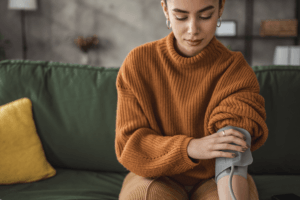
Gupta wanted to give new mothers without support a lifeline during those difficult early days—and help address Philadelphia’s alarmingly high maternal mortality rate. So she partnered with the Heart Association on New Mom Kits for those in underserved communities. Each kit has a blood pressure cuff, an infant CPR kit with a QR-linked training video and information on heart health.
The blood pressure cuffs are crucial.
“One of the biggest reasons women are dying after birth is from strokes from really high blood pressure, and they don’t even know they’re having it,” Gupta says.
Postpartum preeclampsia—marked by high blood pressure, headaches, and excess protein in the urine—can appear up to six weeks after birth and can lead to seizures, stroke or death.
The program partners with community organizations with doula networks who deliver kits and teach moms how to take their blood pressure.
“Having this built-in support network was really important to us,” Gupta says.
The kits currently reach families in North and West Philadelphia, with plans to expand to Delaware County. What began with two partners has grown to 10, with 700 kits delivered locally. And the program is now in 42 cities nationwide. Gupta hopes the ripple effect goes beyond the numbers: “Knowing that we helped avert a crisis for someone is all I need.”
For more on heart-healthy living, visit Go Red.
This is a paid partnership between Go Red For Women and Philadelphia Magazine