
What 25 Years of Teaching Our Kids Has Taught America’s Teacher of the Year Leon Smith
After a quarter century at Haverford High, 2026’s National Teacher of the Year Leon Smith shares what he’s learned about connection, critical thinking, and helping young people see what they’re capable of.
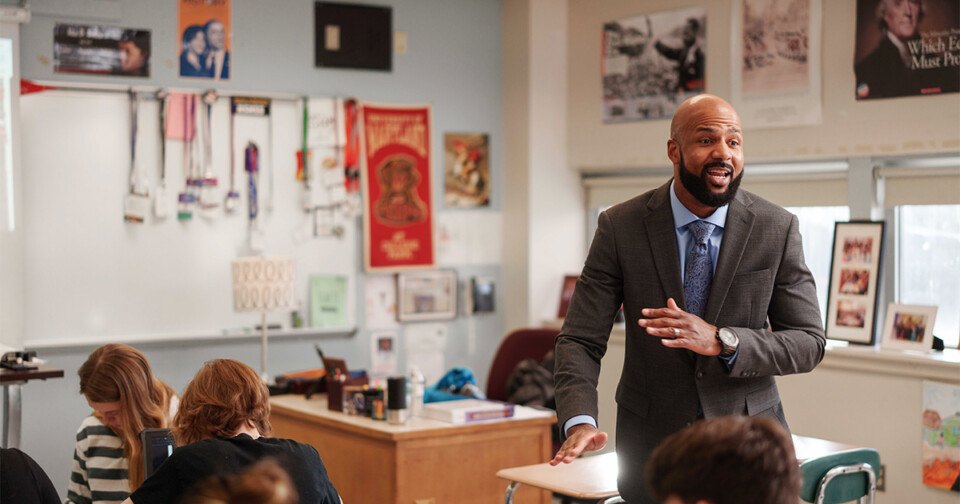
Haverford High’s Leon Smith, America’s 2026 Teacher of the Year / Photograph by Brett Sims
For more than two decades, Leon Smith, 46, has been a fixture at Haverford High School — teaching U.S. history and African American studies, coaching the freshman basketball team, mentoring the hundreds of students who have been lucky enough to sit in his class. “He believes students are most successful when their classrooms foster connections,” offers district superintendent Matthew C. Hayes, “and his impact extends well beyond the classroom. He was integral in our district’s work of dignity and belonging.”
His dedication hasn’t gone unnoticed in the wider world: In 2025, Smith was recognized as Pennsylvania’s Teacher of the Year, the first Black educator to receive the honor, and in April, he won what is essentially the Academy Award of education: 2026’s National Teacher of the Year. This catapulted the Montco native, former Upper Dublin public school kid, and dad of two into the spotlight, with a year-long press tour (including sit-downs with the likes of Gayle King and Kelly Clarkson) as the ambassador for educators across the country. On the tour, he says, “I want to elevate the voice of teachers so people understand what makes this profession great, and what we need to do as a country to ensure we’re training the next generation of teachers and giving schools what they need.”
Despite this rise to the top of the class, Smith will tell you he still has room to grow, and he will be back in the classroom after this special year. “I just finished my 25th year of teaching,” he says, “and I’m still learning.”
One of the reasons I became a teacher was thinking about the legacy of the teachers who have come before me. Teachers have played such a key role in cultivating generations of leaders. When I think about leaders of the civil rights movement, many had educators who helped them to think critically and analyze the world that they live in.
With my first-grade teacher, Ms. Mason, I felt comfort, like I was safe in her class. She had a star reward system, and when you got a certain number of stars, she would take you to Baskin-Robbins or McDonald’s. I always remember that because it felt so special.
I was very active in my church, Salem Baptist Church in Roslyn. I was in the band in elementary and middle school. I played the baritone horn and violin. When I got to high school, I focused on basketball. Now I coach the ninth-grade team, which allows me to still be around the game and to connect differently with my students. Seeing them in a different context deepens the relationship within the classroom.
In 10th grade, I had a Black male student teacher. My school was predominantly white, and I’d never had a Black teacher before. When he walked in the room, I just felt so proud. I was like, finally. I thought, If this is the only Black teacher I’ve ever had, then there must be a lack of these individuals. This could be the difference I could make.
I’ve really been focused on how we can elevate the teaching profession. About 10 years ago, when I was hearing that Pennsylvania was having challenges recruiting and keeping teachers, it shocked me. I’ve always felt that teaching is one of the most important professions. It’s one of the best things you can do to make a difference — and it’s so important to communicate the message that teachers can play a big role in shaping this next generation of kids.
One of the most challenging things about teaching in 2026 is making sure that younger and veteran teachers know that it’s okay to have other things going on, to take care of yourself. In some of my first years of teaching — and sometimes even now — I would stay up until two in the morning grading papers or writing lesson plans. That’s not sustainable. If teachers are going to leave, they do so within their first five years, so we need to help young teachers find balance, to take care of themselves physically and mentally and understand that the job is a marathon, not a sprint.
When I first started teaching, it was college or bust. But in order for our country to be successful, we need all types of people. One of the things I think is so beautiful right now is that we’re talking to young people about different pathways. How can we support you? What’s going to allow you to be your best self, and if it’s not something that we have here prescriptively, let’s develop it together. Our schools should be incubators to allow everyone to be successful.
When I think about my students, there’s no indoctrination happening. Students are not being told what to think. It’s teaching them to think critically. We look at the information; we look at a variety of sources from multiple perspectives. That is not only a necessary skill for learning about history, but a necessary skill for life.
We learn about challenging topics. In the past, they would just be like, ‘Man, that’s so frustrating.’ But what I’m seeing now is that after teaching those lessons, young people are saying, ‘Mr. Smith, what can we do? Who can we contact?'” — Leon Smith
In my African American studies class, many of my students are learning about things that they would have never otherwise learned about. It causes them to be investigators to learn about other groups. I had a student write to me this summer that they took a trip to Harlem with family, and they got to tell their family about the Harlem Hellfighters, a group of African American soldiers in World War I. The student thanked me for teaching hidden history.
Something that surprised me about our students is how civically active they want to be. Throughout my career as a history teacher, we learn about challenging topics. In the past, they would just be like, “Man, that’s so frustrating.” But what I’m seeing now is that after teaching those lessons, young people are saying, “Mr. Smith, what can we do? Who can we contact?”
What people get wrong about high schoolers is that they are young people — and sometimes we forget their humanity. They’re going to make mistakes; this is just one moment in their huge life. They’re going to ask you for advice, because they’re still trying to figure it out. I think we’re all trying to figure it out. And it’s important to give them that grace.
My term as National Teacher of the Year goes until next June 30th, so I am on sabbatical until then. I’ve had some amazing experiences. I gave a keynote at the Smithsonian, and went to space camp in Huntsville, Alabama. I was teaching at the same time, getting my students ready for the AP exam.
Every time I’ve been on national television, I’ve been surprised. In 2025, I was on The Today Show, and they brought out that student teacher from 10th grade. I hadn’t seen him in 30 years. When I was on CBS This Morning with Gayle King, they brought out Dr. J. That was a tremendous experience — I couldn’t even move. And then when I was on The Kelly Clarkson Show, they brought out one of my former students and then had my first-grade teacher on a video call. All those other times I never cried. But when Ms. Mason showed up on that screen, I just broke down.
As adults, sometimes we need to step back. We need to give our young people more responsibility. They can handle it. The more we empower them, give them the opportunity to get outside of the classroom and interact and network and present, we’re going to really see what they can achieve.
When I look at my classroom, I’m excited because I think that our students are ready to be active in our communities, our government, and our society in all different ways. I think of the importance of critical thinking, digital and media literacy, and making sure they’re able to navigate a world that has AI and social media.
There have only been five Black men that have been National Teacher of the Year. Five. And this program has existed since 1952. It is not lost on me the importance for young people of all backgrounds to see Black men in this profession, because — and this statistic is so powerful — less than two percent of all teachers in the whole United States are Black men. And we know that Black male educators have a positive effect not just on black students, but on all students. It’s important students get a variety of perspectives, teaching styles, and personalities, because we are so globally connected. Having the opportunity to interact with all types of people is going to help them to be digital citizens, to be in a workplace and a global environment.
Published as “School of Thought” in the October 2026 issue of Philadelphia magazine.