
The Biggest Game in Town: Inside the Eagles Media-Industrial Complex
30 news outlets. 250 stories (and TikToks and podcasts and posts and prognostications) a day, 24/7. Three hundred and sixty-five days a year. How much Eagles news can — or should — one city consume?
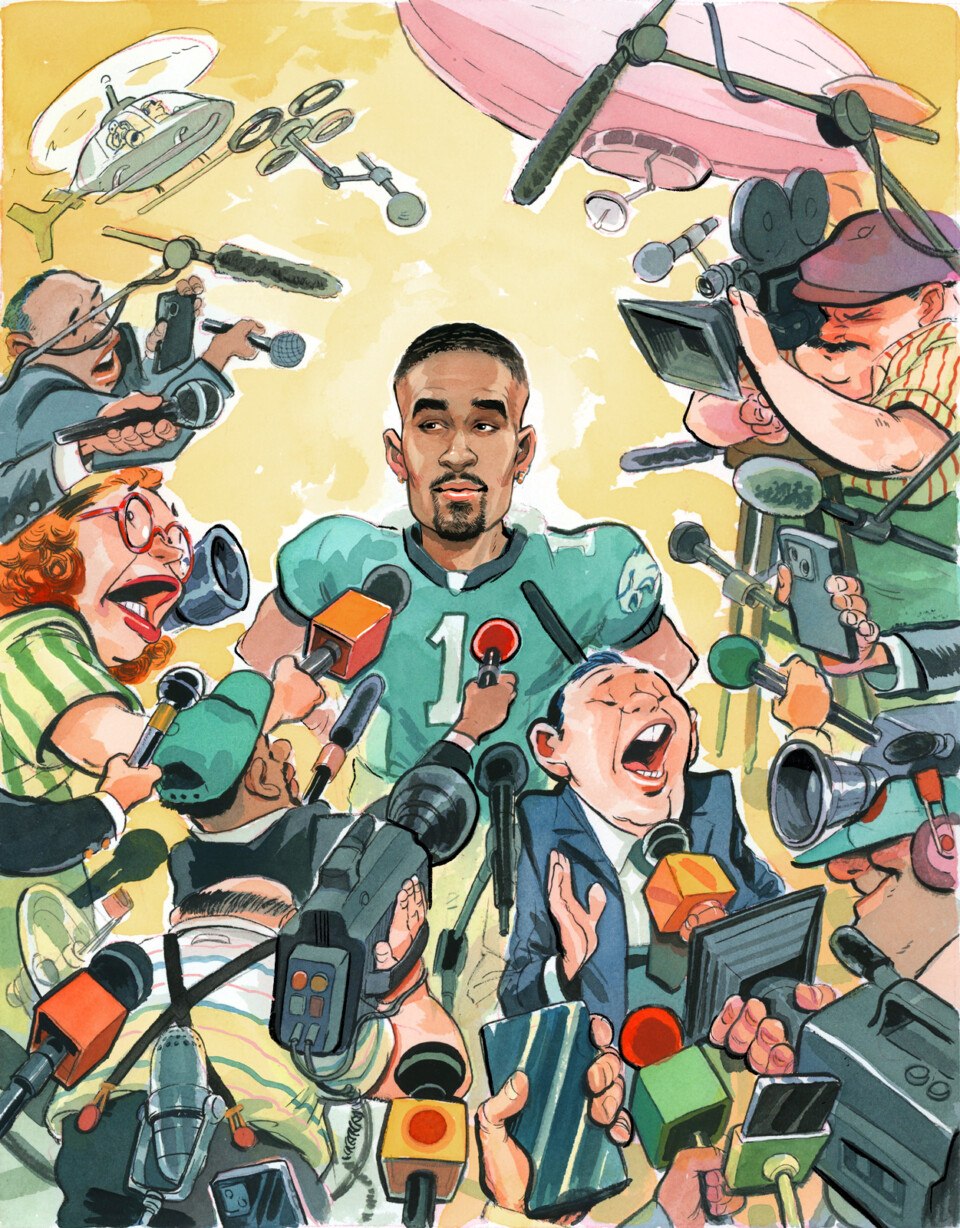
Welcome to the Eagles media-industrial complex. / Illustration by Britt Spencer
On a sunny, sultry day in late July, I’m in a throng of Eagles reporters in South Philadelphia, wondering if defensive coordinator Vic Fangio is ever going to stop talking.
I mean no shade toward Vic with this statement. He is, as any fervent Eagles fan knows, the Greatest Defensive Mind of His Generation, the creator of the famed Fangio defense, a key general in the Eagles’ march to a Super Bowl title two seasons ago. What’s more, Vic, who’s pushing 68 and sitting today in a field-side tent at the Eagles’ practice facility on Pattison Avenue, has the kind of old-school football coach vibe that reporters, and Philadelphians generally, love: Direct. Funny. No shenanigans.
All that said, I’ve come to understand that if you’re a reporter intent on mastering the art of the Eagles press availability, you need to pay extremely close attention to when the person fielding questions — player, coach, team official — is getting to the end of an answer. Because that’s your opportunity, and it’s brief, to swoop in with a question of your own, ahead of your fellow reporters. This exercise is known as the Question Face-Off, so named by Jimmy Kempski, beat writer for PhillyVoice, who once noted the moment’s remarkable similarity to a face-off in hockey (when the referee drops the puck between two opposing players and the one with the quickest reflexes thwacks it first). The Question Face-Off requires no small amount of skill. Blurt out your query before the person talking has finished answering the previous question and you risk incurring their wrath. Dither too long and you’ll surely be crushed by a journalistic competitor.
Back to Vic. A few moments ago, one of the reporters asked if an injury to Eagles edge rusher Jonathan Greenard, acquired in the offseason from Minnesota, will undercut Greenard’s ability to learn the aforementioned Fangio defense. Vic says it might, adding that Greenard “does a good job in meetings. He’s focused, watching practice. But, you know, it’s not the same.”
There’s something in the way Vic’s voice starts to fade out, or maybe in how he shifts in his chair, that subtly signals something. ESPN’s Tim McManus, a thoughtful, experienced reporter with 15-plus years on the Eagles beat, recognizes the moment.
“Do you expect him to get on the field before the start of the season, so you can get a little time to work with him?” Tim asks, smoothly but forcefully. Tim has started his question about a millisecond before another reporter, who, realizing he’s been bested, doesn’t even bother to finish what he was going to say. I half expect Tim to brush the lint off his shoulder.
“That remains to be seen,” Vic says, then stops. There’s a second-long pause before the reporters realize that this is, in fact, Vic’s full answer. A new flurry of shouting begins. Vic, do you think that …
Me? Well, I’m here not to ask Vic a question but to observe the swarm of reporters and content creators who make their livings firing questions at, and analyzing the performances of, Vic and Nick Sirianni and Jalen Hurts and everyone else in the Eagles organization.
That swarm is swarmier than ever before. These days, at least 30 media outlets in the Philadelphia region — many employing multiple reporters, pundits, and prognosticators — offer daily, or near-daily, coverage of the Eagles not just during the season, but 12 months per year. Those organizations range from legacy brands like the Inquirer, WIP, and NBC Sports Philadelphia to digital entities like The Athletic (owned by The New York Times), PHLY Sports (a two-year-old start-up), Inside the Birds (podcast-driven), and Eagles Now and The Philly Special Show (two of a growing number of YouTube channels focused on the Birds).
The amount of content they’re creating — and flooding our phones with 24 hours a day — borders on the ridiculous. On this day alone, for instance, after watching the Eagles do a 90-minute workout, the members of the Eagles Media Ecosystem will generate at least 250 pieces of content — articles, Instagram reels, TV news reports, TikTok videos, YouTube shorts, podcasts, whatever you call things posted on BlueSky and Threads.
It’s coverage, I’ll remind you, not of a Super Bowl or a high-stakes regular-season game, but of a training camp — which is to say, practice. It’s like a pack of journalists standing over your shoulder as you start working on a presentation for your job. The first two slides of McGrath’s deck look solid, but I’m really questioning the call he’s made on slide number three. And by the way, is he seriously using the same font he used in that debacle of a presentation last quarter?
There seems to be something singular about our zeal for the Eagles — and the zealotry with which our reporters reward our zeal.”
It wasn’t always this way. Ray Didinger, now mostly retired but still the most beloved football writer in Philadelphia, says that when he covered the Eagles for The Bulletin in the 1970s, there were only a handful of other reporters on the beat with him. And it was hardly a year-round job. During the offseason, Didinger did lots of other things, including covering ladies golf matches at clubs like Whitemarsh and Aronimink. (The wife of his publisher liked to play.)
Those days are long gone. “They cover it like it’s the White House,” one local sports executive says of the current media environment around the Eagles. I’m not sure he means it as a compliment.
A couple of things are fascinating about this surge. First, it’s come at a time when local journalism, both nationally and in Philadelphia, has otherwise withered. The Inquirer, now part of a nonprofit, has only a fraction of the news team it had a couple of decades ago. Meanwhile, once-robust suburban dailies like the Delaware County Times are truly zombie-like. And yet, even as the number of journalists covering Philadelphia writ large declines, we have a growing army of people reporting on our football team.
Equally compelling: whether all this media firepower is being focused on a pastime that, objectively speaking, doesn’t make the slightest bit of difference in the real world. If a proverbial space alien landed in Philadelphia and started observing all the fuss made about an Eagles game, he’d no doubt wonder what was at stake. Political power? Well, no, not really. Big swaths of land, or access to valuable natural resources? Mmm, not so much. Does football lead to important breakthroughs in health and science? Ha! No, it’s actually really bad for you.
Of course, if said alien spent just two weeks in Philadelphia, he would come to understand that what’s on the line is not nothing, but, somehow, everything.
The story of how we got here — to Peak Eagles Content — is about big shifts in both the media and Philadelphia’s obsessions. Actually, it’s about how big shifts in the media have turbocharged Philadelphia’s obsessions. Other cities have passionate fans, but there seems to be something singular about our zeal for the Eagles — and the zealotry with which our reporters reward our zeal.
A few years ago Sheil Kapadia, who’d spent time covering the Birds for two Philadelphia publications (including this one), took a new gig in Seattle, reporting on the Seahawks for ESPN. At an early press conference Kapadia attended, then–Seahawks coach Pete Carroll was finishing an answer. Kapadia, deeply schooled in the ways of Jimmy Kempski’s Question Face-Off, waited for the coach’s voice to trail off, then dove in, loudly shouting a new query.
Carroll looked at Kapadia as if he’d come from another world. Which, in a way, he had. “Why are you yelling at me?” Carroll asked.
“Oh my god, you want to go there?”
One morning in August, I’m on the phone with Emily Berman, wife of Zach Berman, the well-regarded Athletic beat writer. We’re discussing what it takes to feed Philadelphia’s ravenous appetite for Eagles information and the impact that hunger has on her husband’s sleep habits — or, perhaps, lack thereof.
“He probably averages, during the season, five hours a night,” Emily says. “Last night, now that we’re in training camp, I think he slept four hours.” Emily — who co-owns a home organizing business with her sister-in-law — is a big proponent of wellness, and she makes clear that her husband’s near-chronic sleep deprivation is not something she’s thrilled about. As she sighs to me, “It’s not a flex.”
I’m talking to Emily because, a couple of weeks ago, I interviewed Zach about the demands of being on the Eagles beat. When I saw him the following week at training camp, he called out to me: “My wife says she’d love to talk to you!” I laughed, assuming he was joking, and maybe he was. But the more I thought about it, the more it struck me that few people would have a clearer view of the intensity, if not insanity, of covering the Eagles than a reporter’s partner. And so here we are.
The Bermans have been married for 10 years, and they have a son, nine, and daughter, seven. Zach was covering the Eagles for the Inquirer when they first got together, and so Emily had a pretty clear idea what she was signing on for when she said “I do.” In fact, she leaned into it. “I wrote in my wedding vows that I would read every single article that Zach ever wrote,” she tells me. There’s a brief pause. “I definitely have not held to that.”

ESPN’s Tim McManus / Photography by Aaron Richter
Can you blame her? It’s one thing to be aware of a challenge; it’s another to live it. “I go to a lot of things by myself,” Emily continues, listing dinners with friends, family events, birthday parties. It’s unavoidable. If the Eagles are playing at 1 o’clock on Sunday, Zach is out the door by 8 a.m. and often not home until midnight. If the game is at 4 o’clock, he’s home even later. And if the Eagles play on a Sunday night or Monday night, he’s often not pulling into the driveway until 4 a.m., then frequently has to be up in just a few hours to do a radio hit or podcast spot. And these are just the home games. At least a dozen times a year Zach is on the road covering the Birds.
Not that things are much better on non-game days, or even in the offseason. “Sometimes I’ll roll over at 2 a.m. and he’s not there,” Emily says. “He has an idea for something, and he’s up writing a story.” She goes on to tell me about the piece Zach wrote from her hospital room hours after their daughter was born, as well as a long-overdue date night they had this past spring. When they got in the car, she noticed Zach’s laptop on the back seat. A.J. Brown could be traded any minute, he explained. Gotta be ready.
I should note that Emily talks about all this without any bitterness. One reason Zach sleeps so little is that he makes a point of being there for important kid things. What’s more, Emily has come to understand what makes her husband happy. “Zach is better when he’s busy,” she says simply. “He loves it. He genuinely loves it.”
For his part, Zach acknowledges that an uncommon level of dedication is required to do the job well — more so than ever. “I’m kind of dating myself when I say this, but when I started at the Inquirer [in 2012], I filed my story to the desk, and then, unless there was breaking news at night, you were off. There was nothing more to be done. But now there’s podcasts, there’s videos, there’s so many other things.” And if he’s slightly — okay, maybe more than slightly — obsessive about covering the Birds, he’s hardly the only one. Andrew DiCecco, who writes several articles per week and does a daily podcast for Inside the Birds, says he’s up every morning at 5:30, preparing for a workday that often doesn’t end until midnight.
And then there’s Jimmy Kempski. When we chat one day, he mentions that his father passed away on August 27, 2019. The date sticks in his memory not only for obvious emotional reasons, but because the next day, August 28, 2019, was the last day he didn’t publish a story about the Eagles for PhillyVoice, a streak stretching more than 2,500 articles — seven years! — and counting. He acknowledges that some of those pieces were posted while he was on a beach in the Caribbean, but the point is that there is not a day in Jimmy Kempski’s life when he’s not thinking about the Philadelphia Eagles.
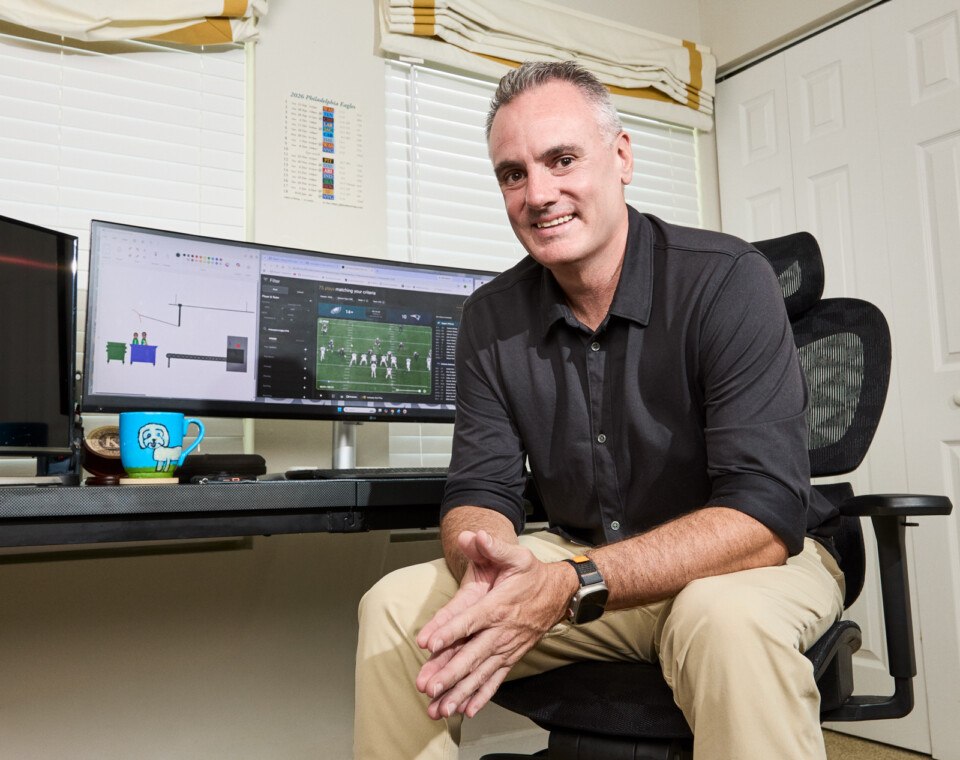
PhillyVoice’s Jimmy Kempski
What drives this? In part it’s fear: the ever-present anxiety that you’re going to be bested by one of your rivals on the beat. “Everyone in every field has competition,” says Geoff Mosher, co-founder of Inside the Birds. “But I don’t know — I don’t think the guy flipping burgers at McDonald’s cares that much about the guy flipping burgers at Burger King.” In contrast, when Mosher was covering the Eagles for the News Journal in Wilmington, “I did not go to sleep some nights because I was worried I didn’t have what someone else had.”
Competition among the Eagles reporters is fairly legendary. Sometimes it’s subtle — taking a particular seat at a press conference so that Nick Sirianni sees you, not your rival from another outlet. Other times it’s more overt. Some years ago, when the Inquirer and Daily News, though owned by the same company, still competed journalistically, there were daily screaming matches about which paper’s Eagles coverage would land on the home page of Philly.com, the website they shared. “We finally had to install a system based on which story came in first,” remembers Kapadia, who worked at Philly.com at the time. (He currently hosts two football podcasts — including one about the Eagles — for The Ringer.) “If one came in at 12:02 p.m. and one came in at 12:04 p.m., the earlier one got the home page.” Not every scrap between the papers was settled so civilly. People still talk about the literal fistfight Inquirer reporter Jeff McLane and Daily News reporter Les Bowen got into after practice one day.
But journalistic competition isn’t the only thing driving the obsession. “When you have one of these seats, there’s an obligation to the audience, to the job,” says Zach Berman. “I’m on all the time because I think that’s what the audience expects.”
All of which is to say: Eagle-eyed content creators may be fixated, but they’re not nuts. They’re simply — rationally — trying to meet the demand we’ve created. Or they’ve created.
It’s hard to say at this point.
If you’re one of those fans Berman is trying to serve, you should be aware that the job he and his colleagues are doing is, in many respects, harder than ever. To begin with, in recent years the Eagles have made access much tighter. While once media members could easily walk up to players or coaches after practice or in the locker room, today there are more predetermined, and tightly controlled, “availabilities.” And on the occasions when journalists do have the chance to get an Eagle one-on-one, it only takes about 30 seconds before some other reporter or camera crew is all up in your business.
And then, to the point Berman made, there’s the way media itself has changed — the social posts and videos and podcasts that are now an expected, though still exhausting, part of the job.
Of course, the flip side of the exhaustion is notoriety — and impact. Today, a number of the reporters covering the Eagles are brands unto themselves. John Clark of NBC Sports Philadelphia has 290,000 followers on X. WIP’s Eagles beat reporter, Eliot Shorr-Parks, has 160,000. Jeff McLane has 155,000, Jimmy Kempski more than 110,000. The point isn’t just their reach but the ability they have, on an hour-by-hour basis, to shape the way we think about a subject we care so deeply about.
They’ve become, in other words, the most powerful journalists in Philadelphia.
To understand how we got to this point — why this beat is thriving while so much other local journalism is flailing — you have to go back a couple of decades. “The heyday for the Inquirer was really the ’90s into the early 2000s,” says the paper’s current editor, Gabe Escobar, who’s served in that role since 2020. “I keep reminding people of this because very few people know it: The most profitable year for newspapers was actually 2000.”
The big dollars of that era didn’t only please the papers’ corporate owners; they paid for plenty of journalism. In the ’90s, Escobar reminds me, the Inquirer had 700 full-time staffers in its newsroom, plus a slew of part-time correspondents who helped the paper cover the suburbs. As we’ve all seen, the business model that supported all those bodies, and all the stories they produced, didn’t last. Classifieds disappeared. Readers flocked to free news sites. Big brands shifted the bulk of their ad dollars to digital. While today the Inquirer, operating as a nonprofit, has stabilized, it employs far fewer people than it once did. The newsroom now has about 200 staffers, only about half of whom are reporters covering the city and region. (The other half includes a group of people pushing content out into the world through newsletters and social media.)
The Inquirer still does good work, but there’s no hiding the lower body count. One place you see it is in the City Hall bureau. Chris Brennan, the longtime Philadelphia political reporter who’s now a columnist for USA Today, says that when he started at the Daily News in 1999, the paper had four City Hall reporters, as did the Inquirer. Not only were he and the other journalists who occupied those seats strong and seasoned professionals, but the fierce, iron-sharpens-iron competition they engaged in upped their game.
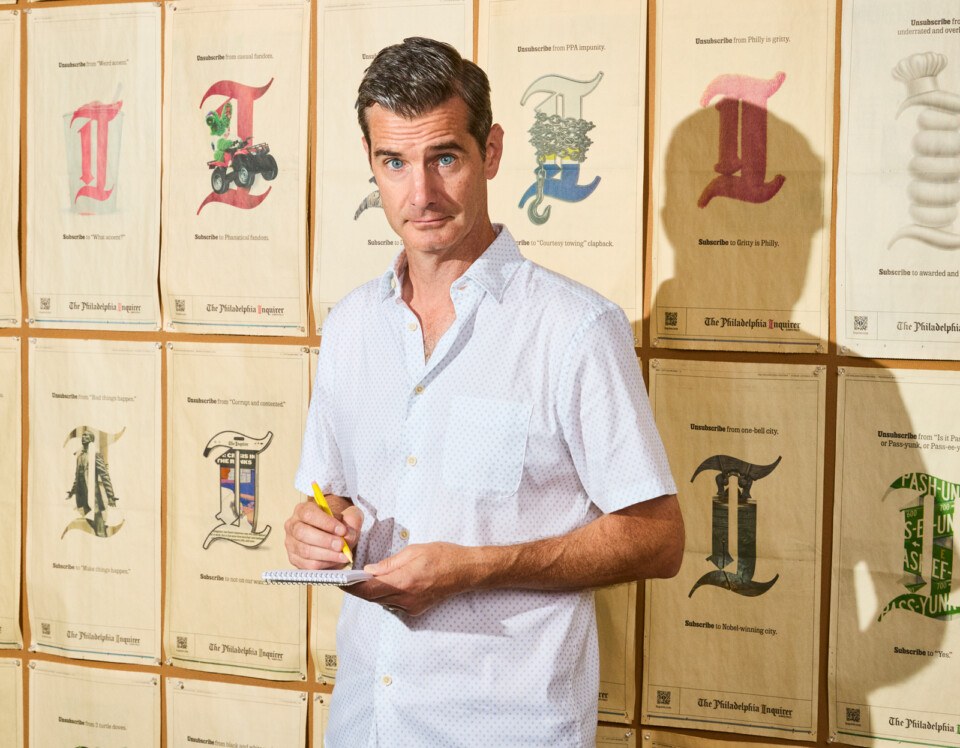
The Inquirer’s Jeff McLane
“I spent every breathing moment trying to beat the Inquirer in City Hall,” Brennan says. “That’s what I would wake up intending to do. A significant part of my morning would be to pour a cup of coffee and look at the papers side by side to see what they had.”
He wasn’t the only one. Kevin Feeley, who led communications for Ed Rendell when he was mayor in the ’90s, says the presence of so many sharp journalists kept the entire administration on its toes. “You had better be prepared, right?” he says. “You had to be buckled up with facts. You couldn’t offer an unsupported opinion. And if you said you didn’t know the answer to a question, you had better go and get the answer.”
It’s a different age. Where once the Inquirer and Daily News had eight reporters at City Hall, today the latter paper doesn’t really exist, and the Inquirer’s City Hall bureau consists of just two reporters, Anna Orso and Sean Collins Walsh. Both are good — but you don’t have to be Vic Fangio to know that eight players can cover way more ground than two.
Of course, relative to other journalistic outlets, the Inquirer is robust. The suburban papers I mentioned earlier only scratch the surface of what’s happening in their towns and neighborhoods. Meanwhile, alt-weeklies like City Paper and Philadelphia Weekly are long gone, as are many community newspapers that delivered hyper-local coverage. Yes, digital publications like Billy Penn, Philadelphia Hall Monitor, and The Citizen (Philly Mag’s sister publication, also owned by Citizen Media Group) have popped up, but there are simply fewer reporters covering the Philadelphia region today than there were a generation ago.
Not coincidentally, the forces that gutted newspapers are the very same ones that have given birth to the ever-expanding Eagles Media Ecosystem. Chief among those forces is what we might think of as the Great Unbundling. In days past, plenty of people no doubt subscribed to the Inquirer mostly because they wanted updates on Philly sports. But to get your Eagles fix, you needed to get the entire paper, the whole bundle. The internet made the bundle obsolete: If you’re looking for sports, plenty of places will give you only that. In the digital age, we get all of what we want — and none of what we don’t.
On a local journalism level, one of the first companies to successfully exploit the new reality was The Athletic, co-founded by Philly native and Silicon Valley entrepreneur Alex Mather. The Athletic’s vision — its bet — was that sports fans in cities across the country were so passionate about their teams that they’d gladly pay for first-rate local sports coverage. The insight was spot-on. After launching in Chicago in 2016, The Athletic quickly expanded into other markets, including Philadelphia in 2017; in 2022 it was acquired by the Times. For $550 million.
I’m kind of mocking all this coverage. But I should acknowledge that I only know it exists for one simple reason: I consume it, day after day after day.”
The explosion of content platforms — podcasts, Instagram, YouTube — has created even more success stories. “At the time we started, there weren’t a lot of reporter-type podcasts,” recalls Inside the Birds’ Mosher, who launched the outlet with former ESPN reporter Adam Caplan in 2017. “There were a couple of fan podcasts, but nobody was doing what we wanted to do — which was to talk football in a way that made people who were listening really understand what was going on with the team.” Turns out there are lots of those people. Today ITB produces up to a dozen Eagles-related podcasts a week, all supported by advertising, and it has a revenue-generating partnership with a South Jersey radio station and a growing base of Patreon subscribers.
The birth of these new brands has had an impact not just on Eagles fans, but on the organizations that were already covering the Eagles. Until 2009, the Inquirer had only one full-time reporter covering the team; it now has four, supplemented by three columnists who also frequently write about the Birds. When the Eagles play in London this fall, the paper will send a team of seven staffers. Excessive? Maybe. Then again, it’s a rational business decision. Eagles coverage is a major driver of engagement — and subscriptions — for the Inquirer.
As with any disruption, this one has created both winners (Eagles reporters have leveraged demand for their work into some nice paydays) and losers — or at least a smattering of people who feel a sense of loss. I reached out to Larry Ceisler, the longtime Philadelphia media and political consultant, to chat about the current state of Philly journalism. He told me that for years he talked, every single day, to those Inquirer and Daily News City Hall reporters, if only to get a heads-up on what would be in the paper the next day. Those calls, he said wistfully, don’t happen so much anymore.
So we have more Eagles coverage than ever before. But is it better?
Well, there’s certainly more scrutiny, to an almost comical level. On day two of Eagles training camp, after the press conference by the Greatest Defensive Mind of His Generation, the team takes to the practice fields. I watch as dozens of members of the media — the Eagles tell me they’ve issued 60 press credentials today — gather along the sidelines and not only chart in their notebooks what’s happening during various drills, but share the action, with photos, in real time on social media:
@EliotShorrParks. Hurts with an awesome throw. Was under center, rolled to his left, kept his eyes down the field and hit Wicks on a 50/50 ball about 30/40 yards down the field.
@AndrewDiCecco. Cole Payton picked on consecutive throws during 7v7. The first was courtesy of OLB A.J. Epenesa off a deflection. The next was by LB Chance Campbell. #Eagles
@DZangaroNBCS. Markel Bell is a large human.
I’ll remind you, again, that we’re not watching a game here. We are, in the immortal words of Allen Iverson, talking about practice.
But a detailed distillation of training camp is just one element in what has now become 24/7/365 coverage of the Birds. At the end of every season, we are guaranteed to get a slew of pieces and podcasts listing the Eagles’ biggest question marks going into next season, which, of course, will not begin for seven months. In March comes a deep dive into which free agents the Eagles might sign, followed by an even deeper dive into which players they might choose in the NFL draft in April. Then comes every reporter’s Way Too Early 53-Man Roster Projection — an exercise that will invariably be wrong because, well, the season is still months away and it is, in fact, way too early.
All of this, alas, is merely prelude to the tsunami of coverage that’s produced when the season begins in September. After every game we get endless analysis, accompanied by letter grades, of who played well and who didn’t; plenty of arcane stats and analytics; and player and coach postgame comments argued about as if they’re ancient texts. Within a day or two most outlets also provide the “All-22” breakdown — video analysis of individual plays that typically involves lots of circles and arrows. (When I mention the All-22 to Ray Didinger, who was honored by the Pro Football Hall of Fame for how well he covered the sport, he sighs. “It’s like trigonometry.”)
Okay, so I’m kind of mocking all this coverage. But I should acknowledge that I only know it exists for one simple reason: I consume it, day after day after day. It’s honestly a miracle that I still hold down a job.
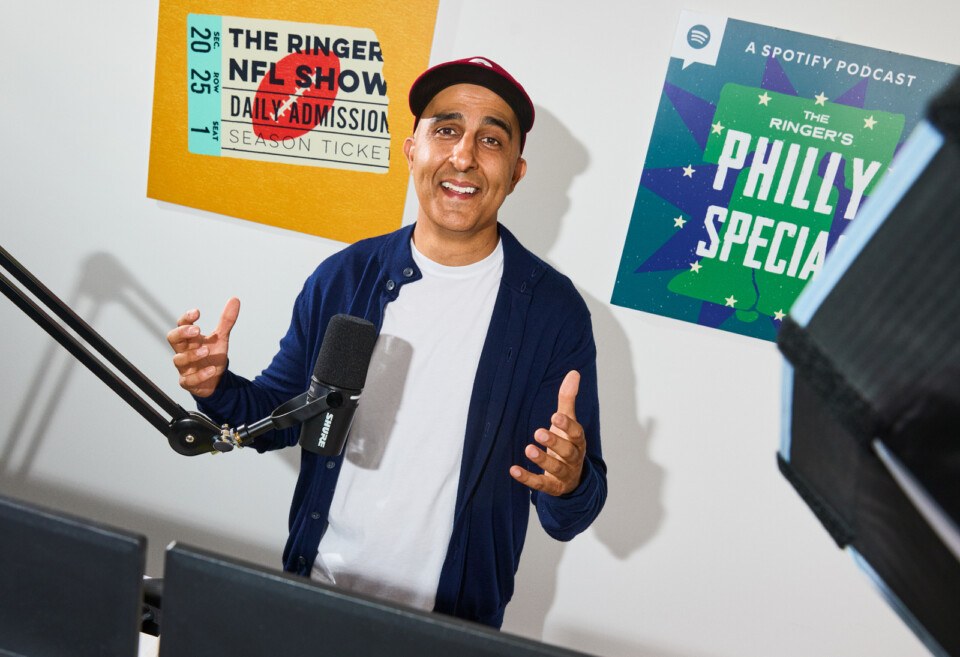
Sheil Kapadia of The Ringer
There’s a case to be made, of course, that this level of coverage has made us more knowledgeable fans. When the 2004 Eagles made it to the Super Bowl, I could name most, but not necessarily all, of the team’s starters. Today I can easily tell you who’s on the Eagles practice squad — that is, not just backups, but backups to the guys backing up the backups.
And yet, I can’t help but wonder if the kind of coverage we’re getting sometimes misses the forest for the trees. One of the most important storylines of the past couple of seasons was the rift that developed between Jalen Hurts and A.J. Brown, who were once the closest of friends. But we only learned about their split — which clearly disrupted team chemistry — because longtime Eagle Brandon Graham inadvertently spilled the tea on his WIP radio show. Yes, restricted access absolutely makes it tough for reporters to get that kind of story. Then again, maybe if they spent a little less time tweeting …
For the Eagles, the microscopic coverage is the definition of a mixed blessing. On one hand, what organization or business wouldn’t want such sustained attention? Can you imagine someone writing an article about your product every single day for seven consecutive years? The financial value of the media exposure is incalculable — and one reason the Eagles are now worth $10.3 billion, the seventh-most valuable sports franchise in the world.
On the other hand, the year-round stream of articles, podcasts, and social posts has clearly contributed to what is now, at least in my opinion, an unhealthy mania around the Eagles — with every errant practice throw by the fourth-string quarterback setting off panic, and expectations for every season so high that nothing less than a Super Bowl victory will suffice. It’s a mania, I should add, that’s built to feed on itself: Fan interest leads to media scrutiny, which leads to deeper fan interest, which leads to even more scrutiny, which leads to even more obsessive fan interest, which leads to …
Take the case of Kevin Patullo, the assistant coach who last year was put in charge of the Eagles offense. When that unit, which was playing with significant injuries on the line, got off to a slow start, there were instant calls for Patullo to be fired. By November, the attitude about him had become so hostile that knuckleheads egged his house in South Jersey. The incident was covered by local TV, including 6ABC, which ended its report by interviewing an Eagles supporter outside a convenience store. The fan agreed that egging someone’s house was over the line, though he added that Patullo stank at his job — and should be fired.
Can you imagine any other circumstance when a TV station would cover a crime — then let someone say the crime victim should lose his job?
Perhaps that’s why the Eagles have grown more restrictive when it comes to player access. The chances of something innocuous being blown out of proportion are higher than ever. “They basically play defense now,” one media member says of the team. “It’s all about, how can this hurt us?”
One reporter who’s seen all these changes — and who’s had his share of clashes with the Eagles over the years — is the Inquirer’s Jeff McLane. He started on the beat in 2009, a different age. The reporters worked in the Eagles’ main building then (they’ve since been moved to a separate facility nearby), which meant you could easily bump into a coach or team official in the hallway or bathroom. McLane remembers working late on Friday nights, finishing his story for the Sunday paper, and regularly encountering head coach Andy Reid, who was notorious for working long hours. “Andy was the type of coach who knew everything and observed everything and had immense respect for the reporters who worked hard,” McLane says. “So that became a ritual for me.”
Not that it made McLane pull his punches. When the team struggled, he was cold and blunt in his coverage, and he’s famously battled with general manager Howie Roseman.
These days, McLane (of course) has his own podcast, and he’s become known among fans for deeply reported pieces that live amid the avalanche of follow-the-ball content. A couple of years ago he wrote about why the ’23 team collapsed in the second half of the season; this past spring he wrote a long profile of Julian Lurie, Jeffrey’s son and heir apparent as owner of the team, for which he interviewed nearly two dozen people.
“Jeff covers the Eagles better than any reporter covers anything in Philadelphia,” one of his colleagues said to me. I won’t disagree, though it does make you wonder: Is this the area we want one of the city’s most talented journalists focused on?
Then again, it’s what Philadelphians care about. That podcast McLane hosts? It’s the most popular one the Inquirer produces. That story about Julian Lurie? Not only did lots of people read it, but the Inquirer’s analytics show that people read all of it — all 6,163 words.
No other beat in Philadelphia is covered this way. Honestly, it’s hard to imagine that any other beat in any other city in America is covered this way. Which of course raises a question: Why? Why are we like this?
There are plenty of theories. Maybe it’s a by-product of Philadelphia’s long-standing inferiority complex, with sports our chance to show the world that, sure, they took the nation’s capital away from us, but we can still be a contender. Or maybe it’s about our famed blue-collar grittiness. What’s more blue-collar, more gritty, than football?
Evolutionary psychology might also give us some insight into our obsession. Not long ago I came across research that said when we root for our favorite sports teams, it’s not so different — psychologically, physiologically — from when ancient tribes watched their warriors go off to battle. In fact, a couple of decades ago scientists discovered that when we watch a game, there are mirror neurons in our brains that respond as if we’re actually playing the game. Our gray matter, in other words, can’t completely distinguish between rooting for Jalen Hurts and believing we need to block for Jalen Hurts. Is it any wonder we consume Eagles content so voraciously? Is it any wonder that so much nothing feels like … everything?
Once upon a time rational, sober-minded editors — and the bundle — saved us from our own brains. Yes, we know you love sports, but we’re going to put the news news in the front of the newspaper and save the Eagles for later. Eat your vegetables, then you get dessert.
The internet changed all that. What we have now is market-driven content. If we like something, we get more and more and more of it. And what we like, it turns out, is coverage of things (sports, hyper-partisan politics) that affect how we feel, as opposed to coverage of things (legislation, sensible public policy) that affect how we are.
Does that alarm you? Yeah, me too.
Then again, maybe we should look at the bright side. We journalists sometimes justify what we do by saying that we’re holding people accountable, particularly people with influence. Well, what organization or entity in Philadelphia has been more accountable in recent years than the Eagles? Three Super Bowl appearances. Two Super Bowl championships. A run of success like no local sports team has had since the Broad Street Bullies.
Credit for that goes to the Eagles organization — to Jeffrey Lurie and Howie Roseman and Nick Sirianni and Vic Fangio, the Greatest Defensive Mind of His Generation. But who’s to say all that obsessive media coverage didn’t play a role too? Who knows, maybe all those team officials are also awake at 2 o’clock in the morning, fretting about the hell they’ll get if they let us down.
It’s enough to make you wonder what Philadelphia might look like if things were just a little different — if, alongside all that Eagles content, we also devoured real-time social posts about the people responsible for job creation, or daily podcasts about the officials in charge of schools, or All-22 analysis of what our legislators are up to. My goodness, how high a city might fly if only everything felt like football.
Published as “The Biggest Game in Town” in the October 2026 issue of Philadelphia magazine.