
The Great Analog Rebellion
We’ve “optimized” our lives to death. Can we please reclaim some joy already?
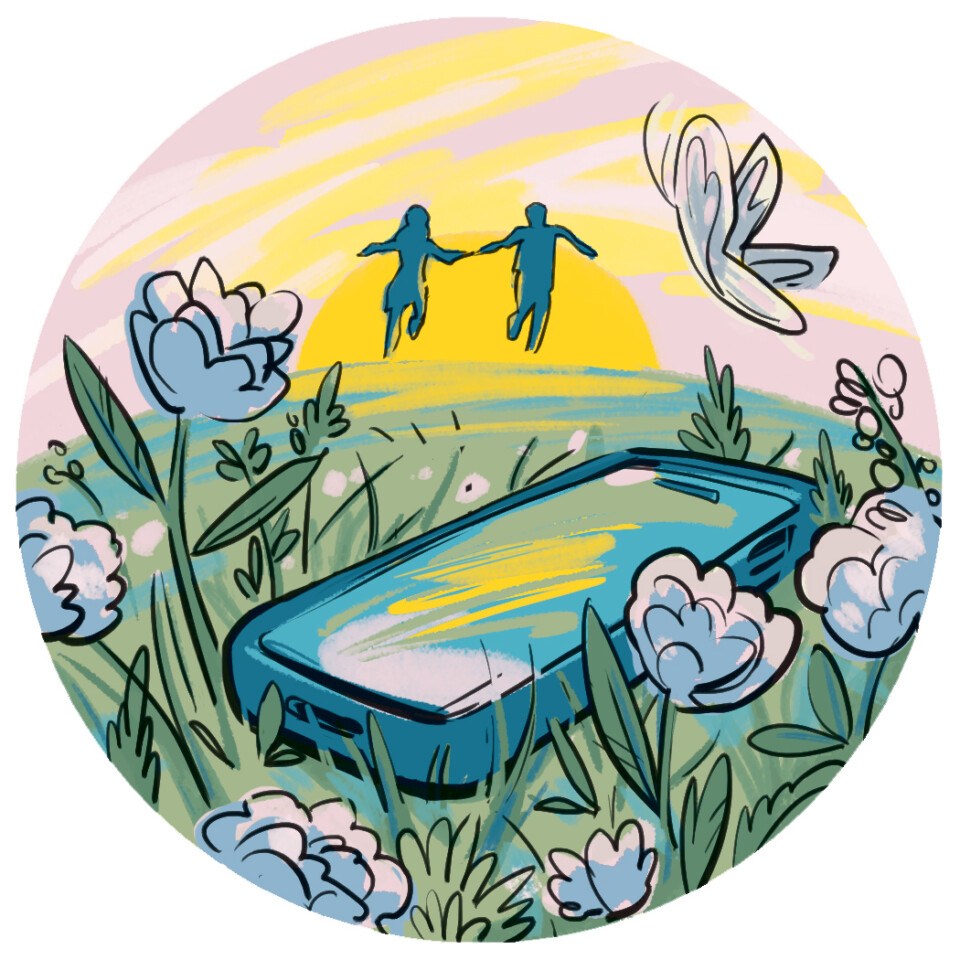
The joy of going analog / Illustration by James Boyle
Back in May, a friend asked if I wanted to see Bruce Springsteen the following night at Xfinity Mobile Arena. The Boss was closing out his Land of Hope and Dreams tour, and my friend had an extra ticket.
The free (!) seat was in a private suite that had its own bathroom, because life high on the hog is magical. And food and booze were included.
Was I interested? my friend asked.
Is the Boss the boss? I answered.
My phone soon chimed with an emailed link to an app thingy I’d use to download my ticket to the inner sanctum. The next evening, I could practically taste the frosty cocktail that awaited beyond the arena’s entrance gate as I sprinted up to the ticket guy.
“This isn’t a ticket,” he said, when his scanner failed to authenticate what I thought was my entry pass.
Was there a glitch with the app? Did I botch a link? Was the internet having feelings? I still don’t know.
What I do know is that it took another 20 minutes for two patient but increasingly frustrated box office detectives (and an increasingly impatient me) to crack the code that would open a door that was mere steps away.
The absurdity of the situation was comedy gold. I was there to see the Boss, the everyman patron saint who’s spent five decades writing songs about ordinary people just trying to get by with a little dignity. But first — even though I had a designated seat in the fanciest part of the arena! — I had to prove to a soulless digital boss that I wasn’t a turnstile jumper angling for a freebie. All because I’d believed tech’s promise of ease and efficiency: “We won’t even bother you with a paper ticket! See how simple it all is?”
I’m no Luddite. I bless Silicon Valley every time Google Maps offers an escape route from traffic hell, the pharmacy robo-texts an alert that my prescription is ready, the parking app dings with a reminder to add time to a digital meter, or the bank lets me deposit a check from my own kitchen table. When tech has our backs, what’s not to love?
But when it doesn’t, which now feels like 10,000 times a day, it actually gets between us and the lives it was supposed to enrich with mediated ease. All so we can avoid the inconvenience of living in the messy world of human interdependence — paid for with our personal data, which is mined for even more ways to bother us.
The apps in our pockets have come to co-opt life’s most pleasantly quotidian chores: buying a coffee, shopping for groceries, browsing a gift shop, writing a thank-you note and walking it to the mailbox. You know this: What’s always made these little errands and to-dos important is not just the lovely human connections they allow — a serendipitous conversation here, a smile from a chubby baby there — but the ones we make with ourselves when, say, we snag a fun hat that caught our eye while wandering a thrift shop (instead of buying the one an algorithm suggests we order based on our purchase history).
Now, despite its human bustle, even Center City can feel a little dystopian sometimes, what with the Uber Eats sidewalk bots and driverless Waymos acting all high and mighty, like they’re one of us. It’s creepy.
I know, I know: Generations ago, put-upon citizens felt the same contempt for newfangled technological monstrosities like the printing press, the automobile, and the TV.
Still. Can I get a “yikes!”?
Moreover — and this may be even worse than the sense of impending human replacement — life’s more annoying tasks (using a laundromat, scheduling a conference with your kid’s teacher, checking in at a kiosk for lab work instead of with the receptionist who is seated close enough that you can smell her perfume) have somehow been worsened by the digisphere. Each stupid interaction demands another password, another learning curve, another soul-sucking round of security questions whose correct answers we can’t remember because it’s been five years since we invented them.
Hell, we can’t even order lunch at a bar without first scanning a pixelated QR code to see what the line cook is frying.
For decades, we’ve asked whether technology could do something. Increasingly, we’re asking whether it should.”
And you know what’s rich? All that tapping and swiping is actually damaging one of humanity’s sublimest senses — touch. Research compiled at the University of Regensburg in Germany showed a connection between tech use by screen-swiping little kids and their lack of dexterity to comfortably grip simple school tools, like crayons. Meanwhile, we adults are losing the simple, grounding fine motor skills we once honed through making, building, fixing, creating, and capably writing with our own two hands. (Does your penmanship suck as badly as mine does these days? Yep, thought so.)
But, but, but! The pendulum may be starting to swing back. Because get this:
Nationally, sales of old-school pens, pencils, and sketchbooks are on a startling upswing, driving up the U.S. stationery market to more than $31 billion this year as we swap out digital calendars and diaries for analog planners and notepads. And, as surprisingly, we’re buying “dumbphones” in numbers not seen since the advent of the iPhone to replace our scrollable, brain-rotting smart ones. In fact, sales of these gadgets among 18-to-24-year-olds recently spiked 148 percent, while smartphone usage in that same Gen-Z category slipped by 12 percent.
There’s more. As my colleague Shaunice Ajiwe noted in our June issue, Gen Z has also started creating “analog bags” — totes stuffed with books, sketchpads, knitting, disposable cameras, and coloring books — to occupy themselves when they’re bored. We’re also giving Spotify the middle finger by cueing up vinyl records again, pushing U.S. vinyl revenue past $1 billion with more than 46.8 million physical albums sold. This rediscovery plays out at places like Philly’s own 48 Record Bar in Old City, which turns the simple act of sitting down and listening to an album into a soul-feeding night out.
The backlash is hitting our schools, too. Almost three dozen U.S. states now ban or limit phone use in the classroom. Pennsylvania might not (yet) be among them, but that hasn’t stopped hundreds of Lower Merion parents from pressing the district to dial back the tech and let kids do radical things like write by hand, read on paper, and look at the teacher instead of a Chromebook. They’re part of a national movement called Pencils Over Pixels, whose motto — “Screens down. Pencils up” — is turning up on lawn signs all around the township.
And listen up, bibliophiles: Even IRL book buying is back. Barnes & Noble will open at least 60 new stores this year — the most in more than a decade — and independent bookstores are flourishing, evidence of how hungry we are to convene, discover, and hang out in analog spaces.
Basically — thrillingly, subversively, thankfully — the fed-up are at last going rogue.
For decades, we’ve asked whether technology could do something. Increasingly, we’re asking whether it should. Do we really want every idle moment filled? Every errand completed with a click? Every creative task outsourced?
Those questions are being addressed in a steady stream of bestsellers — with titles like How to Do Nothing, The Sirens’ Call, and The Anxious Generation — that argue that we’ve ceded too much of what makes us, well, us to screens, algorithms, and the attention economy.
“Our understanding of experience has become disordered in ways large and small,” says historian Christine Rosen in The Extinction of Experience: Being Human in a Disembodied World. “More and more people create their own realities rather than live in the world around them. What do we lose when we no longer talk about the human condition but rather the user experience?”
Um, our very souls?
It’s time to start protecting the things that can’t be optimized, measured, tracked, and sold. Like the exercise of patience. The emotional growth that comes from braving an awkward silence. The willingness to be okay with not having all the right answers, right here, right now. The tactile, sensory, and human pleasures of communion and commingling, the serendipitous inconvenience of living in and around a city.
Oh, and joy. Remember joy?
The shift can start with a single choice — like the ones you’ll read about on the following pages — to selectively, smartly, and even mechanically swap out high-tech wizardry until technology at last occupies a right-sized place in our lives, one where humanity isn’t sacrificed for efficiency.
To quote the Boss himself (whom I did indeed get to see in concert that night, and what a gloriously unmediated barn burner it was), “You can’t start a fire without a spark.”
Well, here’s your spark. Happy disconnecting.
>> Click here to return to Analog Your Life: A Philadelphian’s Guide
Published as “The Great Analog Rebellion” in the September 2026 issue of Philadelphia magazine.