

What Do We Do About All the Trees We Just Lost in the Microburst Storm?
We asked the experts.
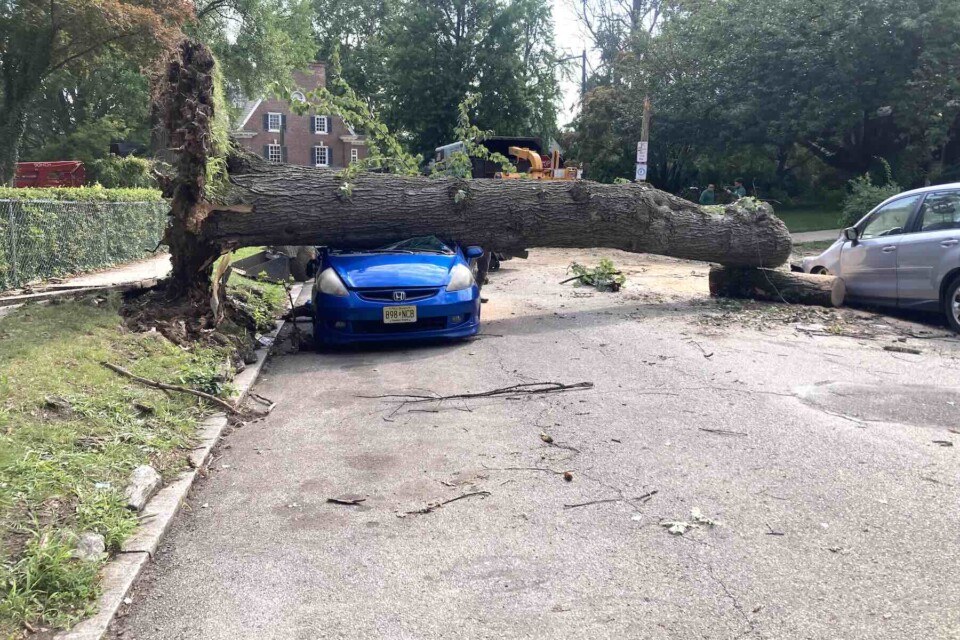
A tree that crushed this car during the microburst storm in Philadelphia remained on top of the car on Monday morning, two days after the storm / Photograph by Victor Fiorillo
When he returned to his Narberth home after trout fishing on the afternoon of Saturday, July 11th, Clint Springer remembers telling his wife how beautiful the weather was. Not 30 minutes later, “all hell broke loose,” he says. Winds of 70 mph ripped through the neighborhood. Rain came down in sheets.
Springer’s Main Line neighborhood, along with West and Southwest Philadelphia, got hit especially hard by four “microbursts” in the region that day. The wind and the rain downed power lines and flooded streets. Buildings took a beating. Nearly 34,000 area residents lost power. Lower Merion Township declared a state of emergency, and Mayor Cherelle Parker announced a Disaster Emergency. (FEMA dollars might be hard to come by, though; in the storm’s aftermath, the Inquirer reported that the Trump administration has repeatedly denied requests from large, Blue cities).
Some of the biggest casualties in the storm’s trail of destruction were hundreds of mature trees, and make no mistake: A white oak smashing through your window or crushing your car is no joke. More than 300 people reported tree emergencies during the storm, says Kiasha Huling, director of the Philly Tree Coalition, a public-private partnership housed within the Public Health Management Corporation. UC Green, the nonprofit volunteer West Philly Tree Tenders group, has also been inundated with calls for help.
The damage was especially severe in West Philadelphia. Large trees in Carroll and Malcolm X parks were heavily hit. Across the city’s border with West Philadelphia, at the Barnes Arboretum at St. Joseph’s University, director Bill Springer says three trees were lost — two of them accessioned specimens, (i.e., the arboretum maintains detailed records of their origins and life histories) — and countless branches were fractured. The arboretum had to close for five days just to assess and manage the damage.
Huling says neighbors are already missing these beautiful, old leafy pillars.
“A lot of them were very large trees that had just been a benefit to the block,” she says. “They provided shade. They added character for the neighborhoods. Then, through this terrible storm, they also delivered some really devastating property loss.”
The good news? The Tree Coalition released a guide to help neighbors deal with the storm damage, and it will be useful during future storms. If you have an emergency — a tree busted through your roof, for example, or fell and blocked a roadway — call 911. PECO handles issues involving trees and downed power lines. Non-emergency requests? Call 311 or fill out this form, which helps the city track storm damage and respond to less urgent situations.
If you don’t feel like waiting for 311 (who does?), Springer recommends hiring a landscaping company with a certified arborist. The certification matters: In the wake of a disaster, plenty of less-than-ethical contractors will pounce on an opportunity to take advantage of your fear and either overcharge you or take your money and skip town altogether. (See Pennsylvania’s state guide to avoiding contractor scams.) So if someone comes sniffing around, promising to squeeze a big insurance payout on your claims, run the other way. Hot tip: Find vetted contractors by asking for recommendations from experts. Springer’s go-to’s are Shreiner Tree Care and Bartlett Tree Experts.
In the meantime, local groups like UC Green are working one-on-one with homeowners to find the resources they need and track damage from the storm, says Merissa Herbert, UC Green’s certified arborist, who leads the organization’s community outreach. Also, the Philly Tree Coalition has secured funding for a handful of $5,000 grants to help local CDCs, nonprofits, civic groups, and faith institutions in their storm-recovery efforts. Applications opened July 20th and close on August 10th.
And if you just want to be of help, start with taking a walk through your neighborhood, says the Barnes Arboretum’s Springer: Checking trees for cracked or falling branches can help ensure the fractured limbs don’t damage more property or injure a passerby.
Once the wreckage is cleared, Huling and her associates at the Philly Tree Coalition need to figure out what the punishing microburst weekend means for the Philly Tree Plan, a 10-year initiative to equitably increase tree canopies across the city. Its goal: 30 percent canopy coverage — the leafy shade that trees provide — in every neighborhood.
The canopies are critical. Trees help cool city streets, lower energy costs, and clean the air.
Overall, Philadelphia neighborhoods with sparse tree coverage can be up to 22 degrees warmer than leafier ones.
“A lot of people don’t realize that trees are not just beautiful,” says Xiaojiang Li, assistant professor at Penn’s Urban Spatial Informatics Lab and creator of Treepedia, a project which maps tree canopies in and streetscapes from cities around the world. “They also provide other benefits — social, economic, and ecological.”
Huling is still tallying the damage to determine what the storm’s impact will on the city’s Tree Plan. But she’s worried about the loss of large, mature trees, which provide the greatest benefits.
“It’ll take at least a dozen years for young trees to get to the point where they’re casting shade that’s noticeable for the residents that live around them,” Springer says.
Once Huling and her partners know the extent of the damage, they’ll organize replanting and restoration efforts. She hopes they’ll be able to use the opportunity to plant more resilient trees — including native species — that can better withstand the stronger storms that climate change is making more common.
“I’m 36 years old, and I don’t know if I’ve ever seen a microburst,” says UC Green’s Herbert. “Instead of planting 100 trees each spring and fall, we may need to shoot for a number a little higher to get all these trees replaced.”
That work may not be easy. In the wake of so much damage, some residents are questioning whether large trees are worth the risk, says Springer. “There’s a debate going on amongst people — even in my own neighborhood — about whether or not having large trees is really the best thing to do. I would not want to see us reverse course and start taking out mature trees — because their benefits significantly outweigh their risks.”
To volunteer to help with clean-ups, reach out to the Tree Coalition or fill out this volunteer forms at UC Green.