PBS’s Geoff Bennett Revisits the “Golden Age” of ’90s Black Sitcoms in His New Book
The South Jersey-born co-host of PBS NewsHour discusses Bill Cosby, the Fresh Prince, Richard Pryor, Quinta Brunson, and his book Black Out Loud.
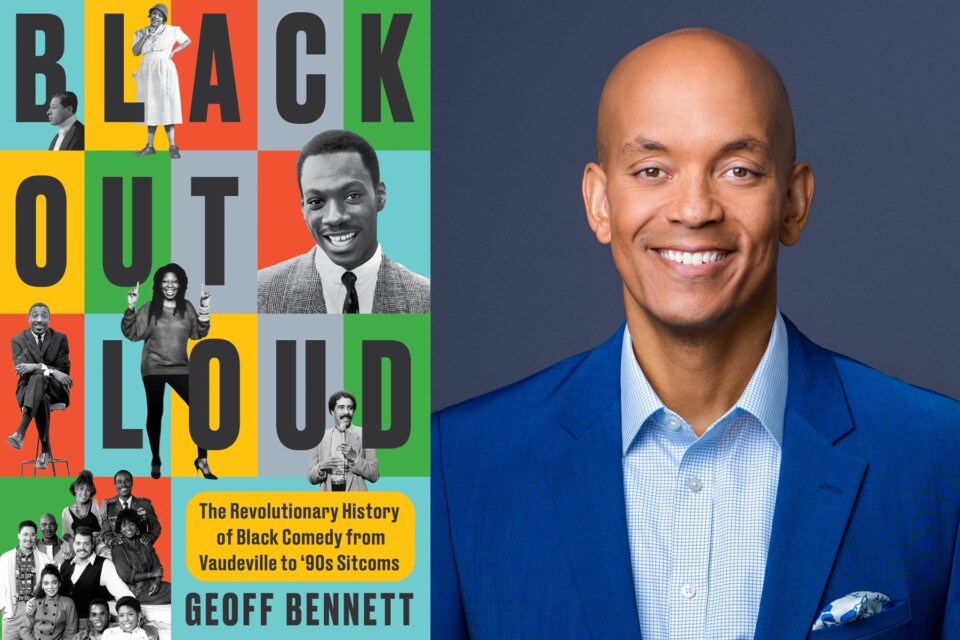
Author Geoff Bennett has been co-anchor of PBS NewsHour since 2023. / Photograph by Johnny Shryock
If your daily grind was reporting on U.S. politics, your mind would wander too. That’s partly how veteran broadcast journalist Geoff Bennett, co-anchor of the PBS NewsHour, came to write his illuminating, fast-paced documentary of a book Black Out Loud: The Revolutionary History of Black Comedy from Vaudeville to ’90s Sitcoms.
“For years I had been thinking about the television landscape I grew up with,’ says Bennett, 45, raised in Voorhees, New Jersey, but now based in Washington D.C. “One of the questions that kept resurfacing was, how did all of these shows — Martin, Living Single, Fresh Prince, In Living Color, Family Matters, A Different World — how are they all on the air, existing at the same time? And it wasn’t as if there was an isolated breakout. They were on television together, overlapping, competing, cross-pollinating.”
In researching his book, Bennett discovered it was more a convergence than a coincidence: “It was this rare moment when talent and timing and cultural urgency all lined up.” But to arrive at that golden age, Bennett had to dig deep into the long, interconnected history of Black comedy in this country, from minstrelsy superstar Bert Williams (a Black comic actor who performed in blackface), to actress Hattie McDaniel winning an Oscar for Gone with the Wind, to the rise of stand-up legends like Dick Gregory, Flip Wilson, Eddie Murphy, and beyond. Black Out Loud concludes with a chapter on Dave Chappelle, whose own struggles with the “Are they laughing with me or at me?” question is, by that point, a recurring theme. I spoke to Bennett by phone just minutes after he landed in L.A. to start a book tour which takes him to Philadelphia for a reading at Barnes & Noble on March 28th.
Did the ’90s sitcoms start something permanent, or has the moment passed?
The moment has passed. I mean, you could argue we’re in a new golden age. I think it’s fair to say we’re in a prolific age. The ’90s, to me, were golden because [pop culture] was both abundant and it was centralized. We had a monoculture. We had shared references. Today’s content creators are brilliant, but they are building silos. … There’s a lot more volume now, but volume and impact aren’t the same. In the ’90s, a single episode of television could become a national conversation because there were 20 million people, in some cases, sitting down in their living rooms watching these shows together. I went to Eastern High School. I remember the night Kris Kross was on In Living Color. They performed as a musical act, and nearly all the kids came in with their clothes on backwards.
In Living Color’s impact on the culture landscape is incredible, and not just for launching the careers of Jamie Foxx, Jim Carrey, Jennifer Lopez, Rosie Perez, and a half-dozen Wayanses. They got tens of millions of people to change the channel to watch their Super Bowl halftime special instead of the “official” one.
It’s brilliant, because before then, the Super Bowl had been kind of like a boring, pedestrian affair with marching bands. CBS was using it to promote that year’s Winter Olympics. Brian Boitano was featured. No disrespect to Brian Boitano, but In Living Color realized they could counter-program it. … More than 20 million viewers that were on CBS moved to Fox, and most of them stayed with Fox for the rest of the evening. And so the very next year, CBS got hip to the game, and booked Michael Jackson, and that’s how they ended up with the superstar Super Bowl Halftime Show.
Besides being funny, what was it about these shows that makes them so important all these years later?
For Black viewers, it was important because for the first time, you were seeing so many different versions of Black life. It wasn’t as if there was one show that bears the burden of representing the entire race. You had an affluent family with Fresh Prince; you had a middle class family with Family Matters. You had the sort of chaotic craziness of Martin. Professional women finding their way in the world with Living Single. There were all these different visions of Black life on the air simultaneously, which was huge. And they were top-rated.
You dig into the backstories of so many comedians in the ’60s and ’70s, and it seems like some of their motivations to perform come from a place of sadness. Did that surprise you?
Not necessarily, because that is such a true characteristic of comedians, to get the laugh to keep from crying. What stood out to me about so many of their stories, there was always a teacher who realized they had this rambunctious kid in the class, and they would find time to empower that student — basically just making a deal and saying, if you [behave] you can go to the front of class and tell jokes. That stood out to me as a really interesting throughline. But when you talk about sadness, I mean, look at Richard Pryor. He changed what comedy can be. Before Pryor, a lot of comedians performed safe material. It was observational jokes, funny stories about everyday life. But Richard Pryor walked straight into the truth. He talked openly about race, addiction, poverty, police violence, his own mistakes.
You mentioned how modern entertainment is very siloed — I was really amazed by how all of these comedians from different eras were connected. Sammy Davis Jr. revived the career of older comedian Pigmeat Markham with a joke on Laugh-In. Whoopi Goldberg played Moms Mabley in a stage show …
That is so true of Black cultural creation. Especially the performers who are good at what they do, they understand the craft, they understand who came before them. There’s a lot of times what you see is a paying of respect or paying homage. Even with Richard Pryor, he was was a sort of a comedic descendant of Bill Cosby. In Pryor’s early work, he tried to work as a clean comic, because he saw that Bill Cosby had success with that. And this is true of the performing arts, some of it can be have a copycat dynamic to it. And young as comics are coming up, they basically replicate what works until they find their own voice.
It surprised me to learn that people once accused young Pryor of being a Cosby clone.
Bill Cosby built his comedy on universality. It was clean, it was polished, it was rooted in storytelling that made Black life legible and really relatable to mainstream audiences. And so he opened the doors by proving he didn’t have to be profane or confrontational to be successful. And then, you know, here comes Richard Pryor, who kicked those doors off their hinges. But yes, his comedy was raw. It was vulnerable, it was explicit, it was deeply personal. So, and I always say, like, where Cosby was translating, Pryor was testifying, and there can really be tension in that contrast. The other thing, I mean, we can’t, obviously, talk about Bill Cosby without …
Yeah …
What I had to do for this book is separate the art from the man, because you can’t talk about the legacy of ’90s sitcoms without The Cosby Show, because The Cosby Show, in that context, is the foundational text. With Cosby, what you have to do is hold two truths at once. The work that he created was so culturally valuable and important, yet what he is accused of doing, what he served time for, is monstrous.
Being from Philly, I’m big fan of The Fresh Prince of Bel-Air, and was fascinated by a very young Will Smith, with his whole career on the line at that point, nailing an audition at Quincy Jones’s star-studded birthday party among the likes of Steven Spielberg, Stevie Wonder, Lionel Richie, and Brandon Tartikoff.
He’s an interesting character because he’s a bridge between the Cosby model and everything that came after. So he comes up in the late ’80s and the ’90s with a style that’s deliberately clean and charismatic and accessible.
I feel like if this book were to push deeper into today, Quinta Brunson would get her own chapter.
Absolutely. What she’s done with Abbott Elementary — she saved the sitcom. I keep coming back to this: There’s this thought — it’s true in content creation, it’s true in Hollywood —there’s this thought that if you’re broad and try to reach as many people as possible with whatever it is that you’re producing, therein lies success. But the opposite is true. If you have a very specific story and you’re committed to it, and you can tell it well, that is what really resonates. That was true with these ’90 sitcoms, and it’s the case of Abbott Elementary. Quinta wrote from what she knew.
Geoff Bennett celebrates Black Out Loud on Saturday, March 28th at 5 p.m., Barnes and Noble, 1708 Chestnut Street.