

The Zombies in This Philly Horror Flick Only Eat White People
Filmmaker David Dylan Thomas delivers a funny, gory history lesson with teeth in White Meat: Appetizer.
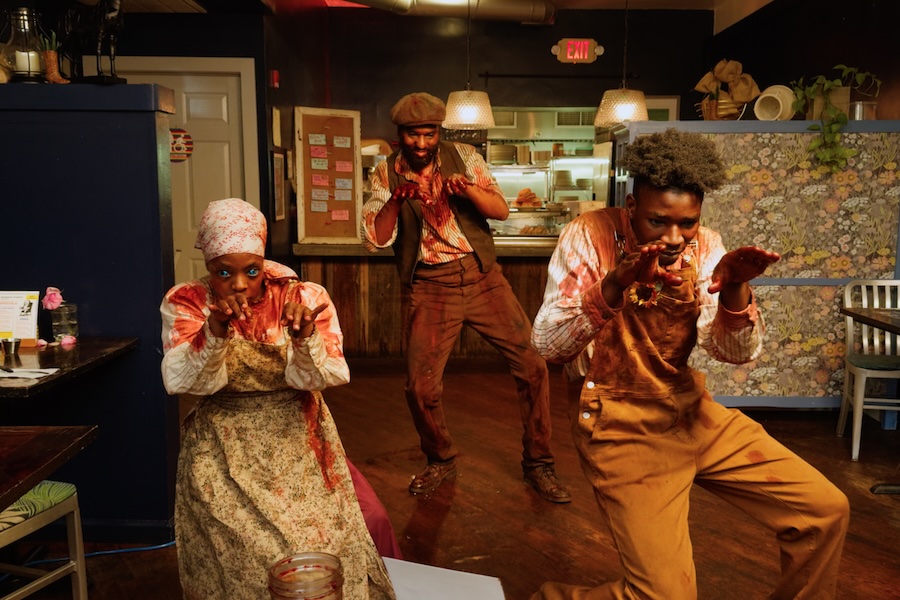
Thomas hired a choreographer to give his zombies a unique style of movement. / Photograph courtesy David Dylan Thomas
Zombies are kind of a multipurpose monster, useful for fitting whatever function a creator can dream up (see George Romero’s moaning ghouls, Edgar Wright’s lumbering dullards, Danny Boyle’s track-star psychopaths, etc.). But the undead antiheroes in White Meat: Appetizer — the provocative new short film by local filmmaker David Dylan Thomas — are something else entirely. Yeah, they’re gross and bloody, but they’re also funny and clever. And they only eat white people.
White Meat follows three formerly enslaved people, recently risen from Philadelphia’s catch-all potter’s field we know as Washington Square, wreaking havoc on the patrons of an Old City coffeeshop, to the bewilderment of the young Black influencer livestreaming the attack. Fast-paced, witty and bloody, the film features charming performances from leads Davon Cochran and Walter DeShields, but viewers should also keep an eye on the comic misadventures of the zombies and victims in the periphery. (I won’t spoil the gory details, except to say that the Armie Hammer joke is a winner.)
Thomas was able to make his 12-minute film after his ambitious Kickstarter campaign raised some $60,000 to help fund it. (Full disclosure: I threw 10 bucks into to the hat a year ago when I learned about the campaign.) The large sum would ensure not just a good looking film, but also a competent cast and crew that could be paid fairly for their work. This was important to Thomas, especially given that this is a film about people whose labor was exploited. Rehearsal and filming took place over three days in May of last year at a cafe in Media called Bittersweet Kitchen (dubbed “The Beanjamin Franklin” for the movie); editing wrapped in November.
Now, after several small local screenings, White Meat is reaching bigger audiences — including those at last week’s Pan African Film Festival in Los Angeles, and, locally, this weekend’s showing on the final night of the Media Film Fest.
I caught up with Thomas by phone last week to chat about his craft, the Black horror film genre, fascism, and fake blood.
You’ve occasionally given lectures on Black horror before screenings of your film. I’m curious: Which movies have influenced or had an effect on you?
The Black exploitation films of the ’70s are a heavy influence, just in terms of the look and the feel, and confronting certain issues head-on. So, for example, Blacula (William Crain, 1972). Not many people know this — I didn’t know this until I watched a documentary called Horror Noire (2019, directed by Xavier Burgin), which is fantastic — but Blacula begins with an African prince going to a European count and asking him to help stop the slave trade. This is like in the 1700s. For a movie to open like that, even if it’s not a horror movie, is super rare, right? So that approach — “Okay, we’re going to do things that are actually really audacious, even by today’s standards” — that was something I absorbed from those films. But also just the look and the feel. Very gritty with really vivid colors, that was something I told my cinematographer I wanted to emulate. So those would be the chief influences, but also the new wave of Black horror cinema — everything from Get Out, Sinners and everything that’s happened in between — has also been a huge influence.
Speaking of Sinners, the Oscars are this weekend. Do you think it will win Best Picture?
I don’t, if I’m being honest. It should, and I very, very much want it to, but I think One Battle After Another. My personal nervousness, really, is that there’s a great opportunity to give out the first directing award to a Black director, with Ryan Coogler, and to respect Delroy Lindo’s contribution with Best Supporting Actor — because he’s never been nominated and is one of the best actors working today.
Sinners was my favorite movie of of 2025, but I wonder how much fake blood can be in a Best Picture winner. And horror doesn’t always get the respect. Then again, horror is having a moment.
It is. And I think a large reason it’s having a moment — if you look at Substance, you look at Weapons, even a fairly obscure horror film called The Ugly Stepsister got a nod this year — I think it’s having a moment because we are living under fascism. When those sorts of forces come to the fore in this country, you see an uptick in the creation of horror films and the respect awarded horror films. One of the last big booms of horror films was the ’70s going into the ’80s, and that was a time of great turmoil in the country.
That’s interesting.
And you look at other countries that have really rich horror traditions: They’ve also been very political and very much facing restrictions from the government. So I think that mood is in the air. One way to deal with oppression is escapism, which we see a lot of. But one of the other perfectly reasonable reactions is to dive into the fear, play with the fear. And I think that’s what horror excels at.
White Meat obviously draws on a rich tradition of zombies in film. After 15 years of The Walking Dead, I appreciate seeing new kinds of zombies. Your zombies are funny, and know their history.
Yeah, zombies are inherently political. It’s funny, I’m really drawing on a very old zombie tradition. One of the things I did to prepare for this movie was to research zombie lore, and watch old zombie movies, and the origin of zombies. The term was used in Saint-Domingue before it became Haiti, [in stories] about white wizards reclaiming the souls of the dead, bringing the dead back to life to work on their plantations. And the actual first zombie movie, White Zombie from 1932 has Bela Lugosi as a guy who raises the dead to work on his plantation. Like, that’s literally the plot.
That’s super creepy.
And that version of zombies — as in the walking dead who are not eating people, who are not spreading their disease, but are just doing work — goes on for another 30 years until you get to George Romero’s then new zombies in Night of the Living Dead in the late ’60s, which completely flips the table and invents the kind of zombie you see now. So I was really reaching back, you know, almost 100 years to this original version of a zombie that is whole and intact and serving someone else and of combining it. Because they do eat people. My zombies absolutely eat people.
Have you gotten any pushback from the zombies only eating white people?
I mean, marginally. There’s like, always going to be one TikTok commenter who’s going to say, “I don’t understand, don’t Blacks have equality now?” Or, “Isn’t that reverse racism?” There’s that, but the vast majority of people are enthusiastic. And what’s really funny is white people’s reaction. It’s often along the lines of, “Yeah, we deserve to be eaten, right?” One of the top requests I got when I started telling people the premise is “Hey, can I be eaten?” In my experience, the reaction has been wholly positive and very enthusiastic.
So if this is the “appetizer,” could a feature-length film be in the works?
Oh, yeah. In fact, I wrote the feature first. We weren’t even going to do a short but it became clear we were going to need some kind of proof of concept to get donors interested and make it clear we knew what we were doing.
Your movie is very rooted in history, of course, with Washington Square and its history of being a potter’s field for enslaved people. But it’s also very timely. I’m thinking about the Trump administration’s removing the President’s House display for several weeks.
Not for nothing, but that place is the setting for a very important scene in the feature. So I already had my eyes on that.
View this post on Instagram
Not to spoil anything, but I laughed out loud at the zombie who uses a laptop to squeeze some blood from the one guy’s head into a cup.
Yes, we call that the French press. She’s actually a professional dancer. Her name is Mawu. Both of the non-speaking zombies are professional dancers. We wanted to invent a new movement for how the zombies move, because these aren’t zombies we’ve really seen before in cinema. So we splurged and got ourselves a choreographer [Lela Aisha Jones] who totally reinvented things.
White Meat: Appetizer screens March 14th, 7 p.m., at the Media Theatre, 104 East State Street in Media; part of the Media Film Festival, March 13th & 14th.