Live Aid Was Not Without Controversy – And For Good Reason
Why eyebrows were raised.
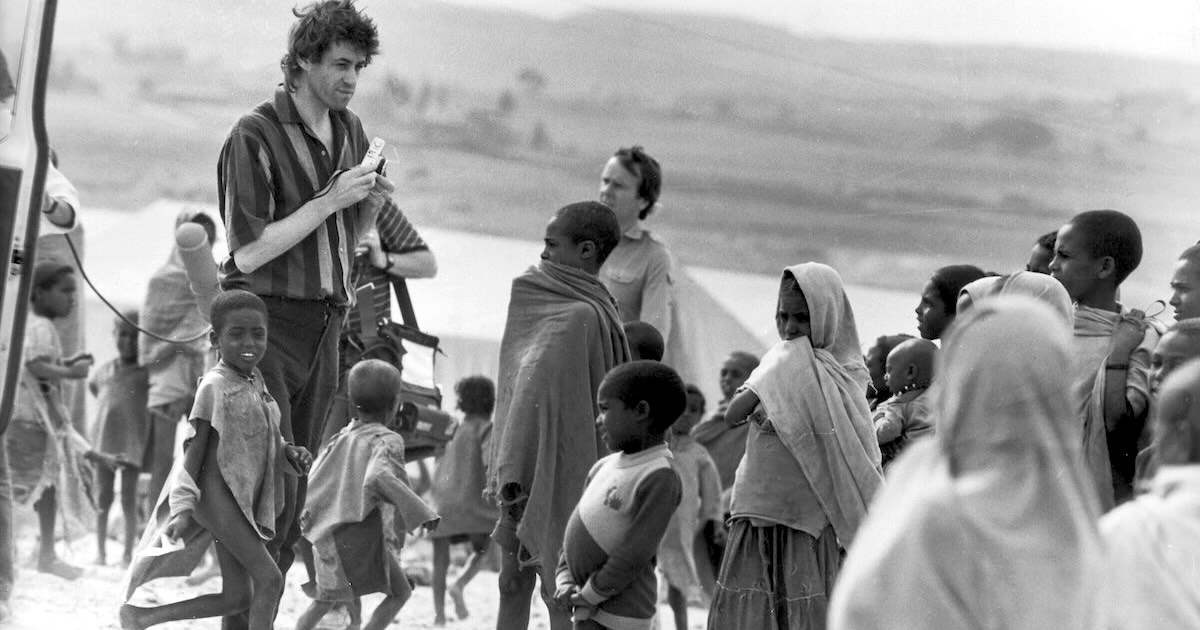
Live Aid founder Bob Geldof in Ethiopia in January 1985 before all the controversy about Live Aid emerged (Getty Images)
This story is part of our continuing coverage in honor of Live Aid Week in Philadelphia. Check back daily for more Live Aid fun.
There’s no doubt that Bob Geldof set out to do Live Aid for all the right reasons.
If you think back to the mid-1980s, you’ll remember that TV screens and newspapers were full of photos of emaciated children in Ethiopia. The famine began in 1983. It was the worst the country had seen in a century. The famine affected millions and millions of Ethiopian people, who were left to starve. It’s estimated that the famine killed as many as 1.2 million Ethiopians, orphaning nearly 200,000 children.
Geldof wanted to help. He wanted to call attention to the famine. And he wanted to solicit donations for famine relief. Live Aid viewers could donate money by calling a toll-free number or sending a check to a P.O. box that kept popping up during the televised broadcast of of the concert. Merchandise and ticket sales would also raise money.
It’s been posited that as much as $150 million was raised through Live Aid. That’s a believable number for sure, given the viewership and scope of the event. But where did all that money go?
Geldof was reportedly warned in advance by several international aid organizations to be very careful with the distribution of the funds. Specifically, they told him that whatever he did, he should absolutely not give the money to brutal Ethiopian leader Mengistu Haile Mariam, who was busy committing genocide during a civil war. But Mengistu got hold of it anyway.
“I’ll shake hands with the devil on my left and on my right to get to the people we are meant to help,” Geldof said of his involvement with Mengistu.
It’s unclear how much of the money raised actually benefited starving people in Ethiopia. But a 1986 exposé in SPIN magazine alleged that the answer was very little.
“By this time, we had all seen the pictures and TV footage of Bob Geldof … bear-hugging and playfully punching Mengistu in the arm as he literally handed over the funding for this slaughter,” SPIN publisher Bob Guccione Jr. would write in a 2015 reflection on that piece. “It was on TV now alright, but as an endless, relentless reel of heroic Bob Geldof highlights. He drenched himself in adulation and no one begrudged him it, until our investigation exposed the holocaust that Live Aid’s collection donations had helped perpetrate.”
Geldof claimed the exposé was filled with lies. He said it was simply payback because he hadn’t granted SPIN an interview.
Later, when Geldof faced accusations of having a white savior complex, he said that was “the greatest load of bollocks ever,” adding, “Are the only people allowed to react to an African famine Black?”