Why Philly’s Best Mezcal Bar Only Stocks Five Bottles
At La Jefa, Dan Suro’s agave program is built on restraint, with fewer bottles, deeper knowledge, and a more thoughtful way to drink mezcal.
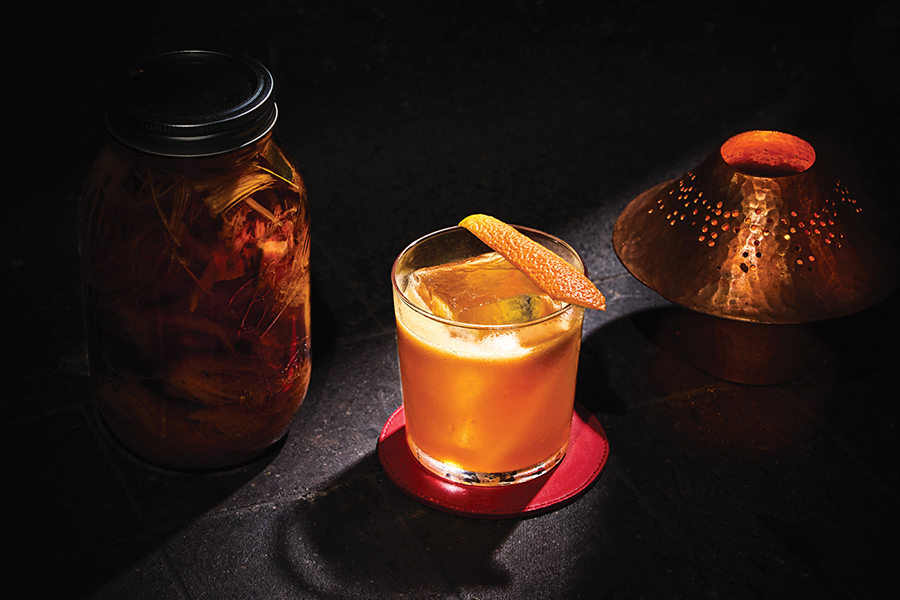
La Jefa’s Agave cocktail / Photograph by Michael Persico, originally published in Shaking Things Up in the November 2025 issue of Philadelphia magazine.
When a kitchen fire shuttered Rittenhouse mainstay Tequilas in early 2023, owner David Suro and his son Dan used the closure as an opportunity to reimagine the space. They would reopen Tequilas but replace a back dining room with a separate all-day cafe and nighttime cocktail bar. During a trip to Mexico in 2024, researching for the new project, Dan pitched his father on one more idea: Instead of a sprawling mezcal list for the bar, he wanted just five bottles, give or take. David, who founded Tequilas in 1986 and has spent decades building one of Philadelphia’s most serious agave spirits programs, wasn’t sold. “Why limit yourself?” he asked.
“I think that makes us more of a mezcalería, by having less of it,” Dan answered. With only five bottles in rotation at a time, “we can get more creative with them,” he says. “We can really hyper-focus on five and do things that we couldn’t really do with a giant collection.” His father eventually came around.
La Jefa opened in May 2025 as a Guadalajara-inspired cafe and cocktail bar. It’s not a speakeasy, exactly, but with entrances off sleepy Latimer Street or through Tequilas, it feels a little like a secret. By day, the menu includes coffees, hibiscus and blackberry conchas, a chilaquiles omelet, and house-made fermented sodas. By night, the vibe shifts. In back of the brighter front room is Milpa, a dimly lit lounge tucked behind blue velvet curtains, with a cluster of low tables, a bar lined with vintage tiki vessels and a selection of spirits that includes that tightly curated collection of mezcal.
Suro chooses them with intention. He’s not trying to assemble the rarest back bar he can manage, though some bottles are vanishingly limited. He aims to create contrast and tell a story. “A lot of it has to do with balancing out what you have,” he says. “I want to show diversity in the spirit.”
That might mean thinking about region, producer, or production style — how one bottle will read next to another. If one mezcal leans funky and savory, he doesn’t want something similar beside it. Sometimes the lineup is driven by what becomes available: a producer he trusts, a small-batch bottling, a family-run operation with a tiny allocation that would get lost on a longer list. Some batches are as small as 60 liters, total.
A shorter list also means the staff can know each bottle intimately, and guests tend to be more curious, gravitating toward the mezcal precisely because the bar is so clearly emphasizing that one category. “The point of having five is not really for something that’s so esoteric,” he says, “but that we can really dig into it.”

Dan Suro at La Jefa / Photograph by Ed Newton, originally published in La Jefa: Where Guadalajara and Philly Meet
That emphasis lands at a significant moment for the spirit. In Mexico, mezcal production rose from about one million liters in 2010 to more than 11 million liters in 2024, fueled largely by export demand from the U.S. But as mezcal has spread across American cocktail menus, it’s often approached through a familiar lens — the same way a drinker might think about their favorite whiskey, locking in on a trusted label and sticking with it. That works for spirits built around consistency, but mezcal is something different. Much of it is still made through labor-intensive, artisanal processes — agave harvested by hand, roasted in earthen pits, naturally fermented, then distilled in ways that vary from producer to producer and batch to batch.
Its variability is one of the things Suro loves most about mezcal. Because the distillation process is far less controlled than for most spirits, each bottle is ephemeral. “There’s a very good chance that this mezcal will be the only time I ever try it,” he says. “You should definitely be open to what else is out there. It’s inconsistent in a very good way.”
Suro brings that same respect for the spirit to his cocktail menu. It appears in just two drinks on Milpa’s cocktail menu, each calling for only one teaspoon of the spirit. The Sierra Tepe is akin to a Vesper martini, made with Mezonte Tepe mezcal, Tequila Ocho, and Cocchi Americano. The Zacate Limon combines tequila, a mezcal distilled with lemongrass, house-made beet shrub, and lemon, plus a fortified quinine aperitif wine “that really blows up agave flavor,” he says. The restraint is partly practical — mezcal is distinctive, and a little goes a long way. But it’s also philosophical. He wants every measure to feel intentional.
He also sees that restraint as an ethical one. Mezcal’s global boom has brought real consequences, including deforestation, water stress, and the spread of monoculture farming of espadín — the most common agave used to make mezcal — which threatens the biodiversity and ecological balance that traditional production depends on. “We should be drinking less and paying more for the spirit,” he says.
In the end, Suro wants guests to leave with a deeper appreciation for mezcal. “You may never taste this exact batch again,” he says, “which gives you more of an intimate connection with the producer.” The scarcity, the specificity, the single batch that may never be replicated — it’s all part of it.
“Those types of experiences will stick with people more so than just trying a bunch of mezcal,” he notes. “I think that happens pretty often here.”