

Philly’s Robot Dogs Are Here. What Could Possibly Go Wrong?
Meet the next generation of man’s best friend — brought to you by Philly’s brightest tech minds.
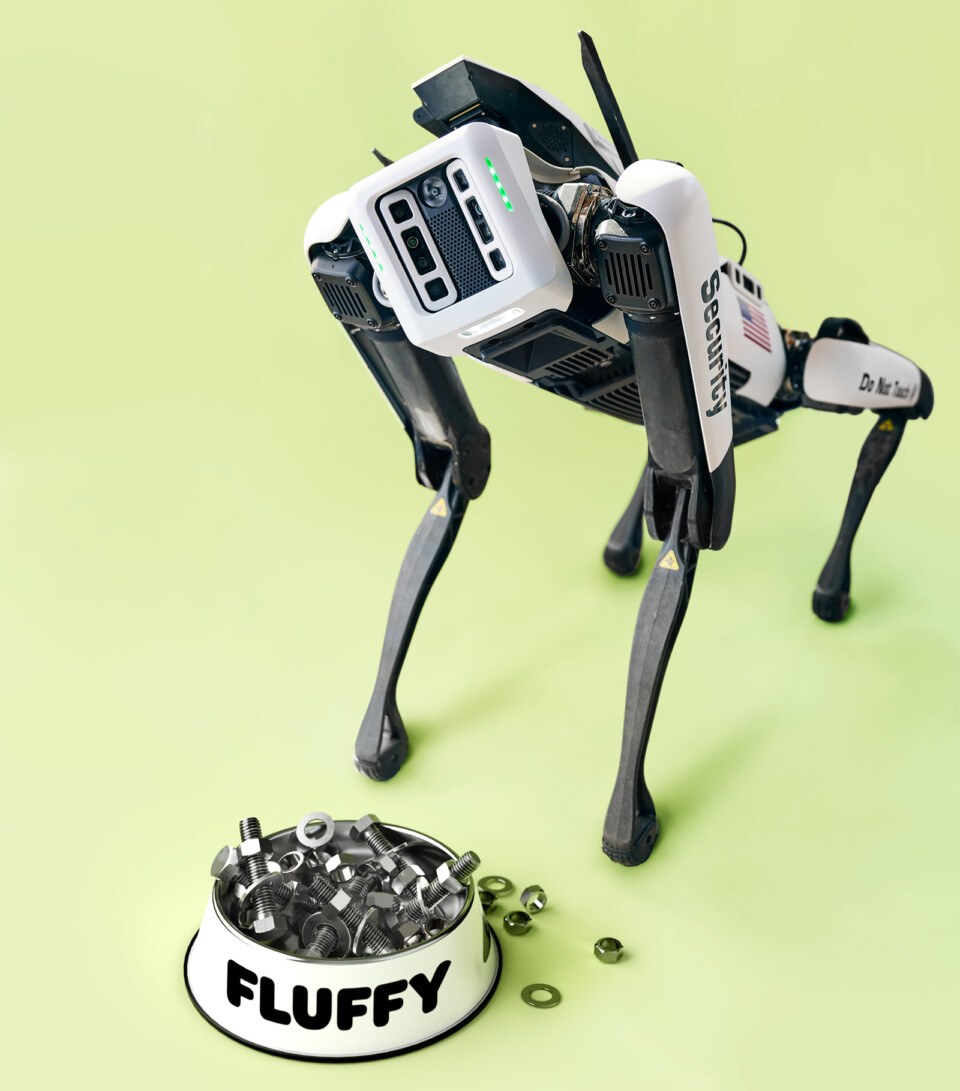
Sit. Stay. Good bot. / Photography by Andre Rucker
In chaotic conflicts like active crime scenes and urban warfare, closed doors can be as dangerous as explosives. The officers or troops who barge in first, often not knowing what will greet them, are vulnerable to whatever might wait on the other side of the door. The military calls this choke point a “fatal funnel.” Going through it is one of the riskier acts a human being can undertake.
So some guys in Philly created a robot dog to do it.
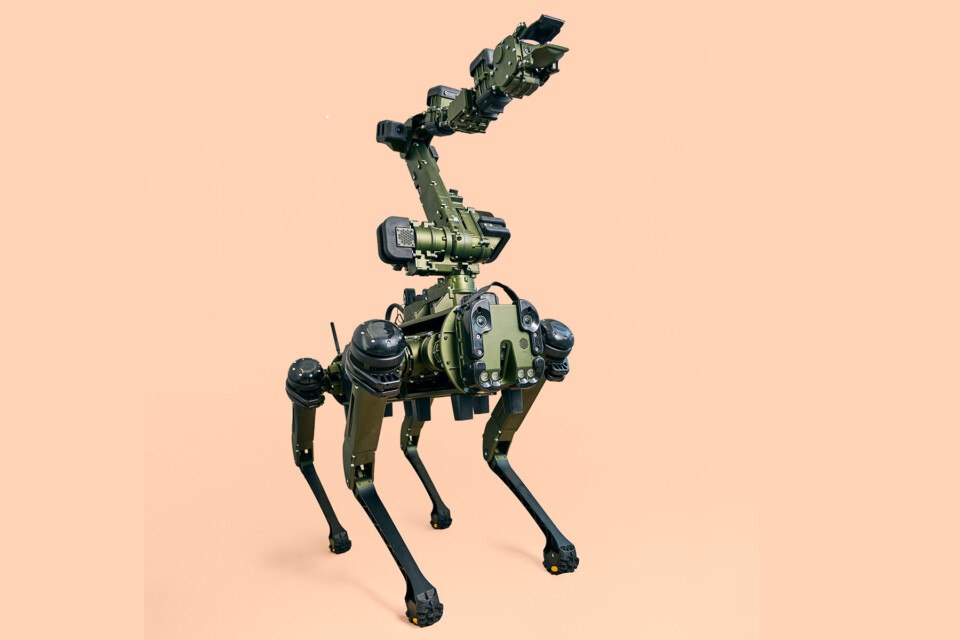
The Vision 60, made by Philadelphia-based Ghost Robotics, has four powerful motorized legs, camera lenses for eyes, microphones for ears, chemical and thermal sensors, and a GPS that’s accurate to within five centimeters. In special configurations, a bonus arm on its back can reach to turn a doorknob or rise as a periscope to peep through a window. The Vision 60 can climb stairs, get into a closed room, and snoop around while people at a safe distance steer it remotely, using the dog’s video feed and other sensors to gain situational awareness.
Like a lot of emerging technology that is endowing machines with human-like powers, this mechanized pooch is wondrous to behold, a dazzling symphony of futuristic hardware and software — and also, on some primordial level, kind of completely terrifying. Especially if you can’t forget that episode of Black Mirror where robot attack dogs are unstoppable killing machines that hunt down the last humans left alive.
“It’s pretty big and heavy, yeah. You could drive it into walls,” says Gavin Kenneally, CEO and co-founder of Ghost, as we examine one of his company’s creations, which has just marched over. We’re outside a conference room at Ghost’s Philly headquarters, in what a critic of the company, in early 2025, called “an undisclosed location” (for reasons I’ll explain later). But I am cleared to tell you: It’s at the Philadelphia Navy Yard. In an undisclosed building.
Vision 60, which costs in the $160,000 range, is a little bigger than most dogs, 105 pounds and 27 inches tall. Its legs, each with three motors, bend backward to resemble real dog legs, but Ghost didn’t go out of its way to make it look like the family pet.
“This was the most efficient way to pack all the components together,” explains Kenneally, who is an engineer and Canadian, so not prone to overstatement. The dog has a military-green aluminum body and a flat top to accommodate attachments like the extra arm or chemical sensors. Internal fans, cooling the dog’s motors as it stands before us, whir quietly, almost like a dog panting. I point out to Kenneally that the two black radio antennas that stick up from Vision 60’s rear — to enable remote control and communication — do look like cute little doggie tails.
“That is funny. I didn’t … yeah … the tail thing,” he says, like he’s just noticing it, before walking through reasons why that’s just the optimal antenna placement.
Vision 60’s face, if you can call it that, is as flat as an anvil — for good reason. Occasionally it smashes into things. One Saturday night in August 2025, Pennsylvania State Police arrived to assist local officers who were trying to search a home in Wilkes-Barre, based on a report from a hospitalized physical and sexual assault victim. The suspect inside was armed. A standoff ensued. “The police took our robot and drove it around the house, basically started ramming into the back door with it,” Kenneally recalls. The distraction helped police enter the home safely.
The Ghost dog is a quadruped. That is, it travels on four legs, as opposed to wheels or on two legs, like those humanoid robots we see on YouTube trying to moonwalk like Michael Jackson. Robot dogs are essentially computers that can walk. Their form lets them do certain things other machines can’t. They can traverse terrain, like grass, sand, mountainsides, and stairways, that might hamper wheeled machines. They’re a fast-growing sector of the robotics industry, projected to be a $7 billion global market by 2033, driven by industrial inspection, security, and defense needs.
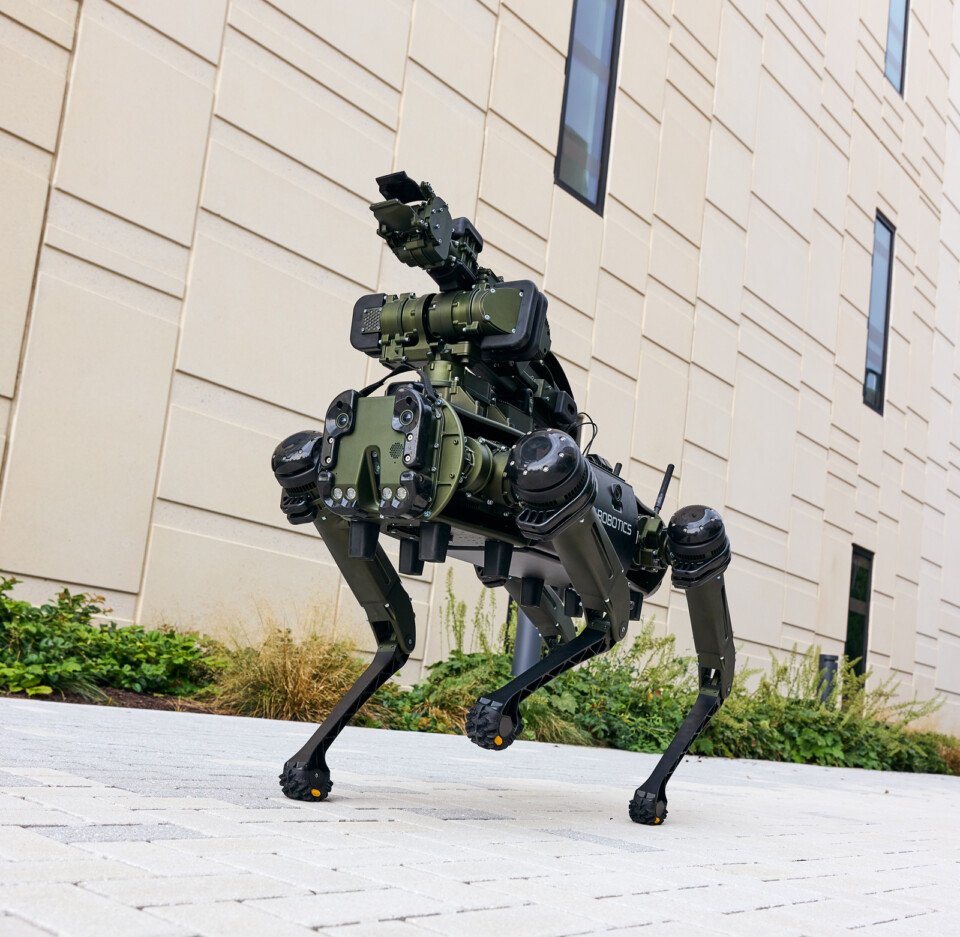
The Vision 60 robot dog from Ghost Robotics
And Philly is a huge part of the growth. Ghost Robotics trails only Massachusetts-based Boston Dynamics in U.S. market share. Ghost, whose valuation is somewhere over $400 million, spun out of research begun in the University of Pennsylvania’s engineering department. Its customers range from the U.S. Department of Defense to local first responders around the world and operators of data centers that need 24/7 security.
There’s also Asylon Robotics in Norristown, founded by engineers who worked on classified aircraft at Boeing’s Phantom Works in Ridley Park. Asylon sells a security service that puts its DroneDogs on patrol as tireless watchdogs at customer sites like warehouses, sports stadiums, and corporate campuses. Asylon grew 80 percent last year and is on track to about triple this year.
(Fun fact: Both companies were founded in 2015, the year Philadelphia made national news by violently demolishing HitchBot, a jolly hitchhiking robot that was on a cross-country trip from Boston to San Francisco. HitchBot had enjoyed warm greetings elsewhere but received the Philly Special in Old City. Someone decapitated it near historic Elfreth’s Alley.)
Ghost and Asylon are part of a regional robotics business ecosystem that also includes Exyn in Point Breeze, whose software lets robots build 3D maps of uncharted spaces, and Burro in Northern Liberties, which makes carts that can pull heavy loads and follow humans around without a driver.
At the core of much of this action is Penn’s General Robotics, Automation, Sensing, and Perception Laboratory, or GRASP Lab, one of the country’s top robotics programs. Ghost, Burro, Exyn, and other start-ups began as projects there, and the GRASP Lab is aggressive about commercializing its research. Vijay Kumar, dean of the university’s engineering school and head of GRASP, co-founded Exyn, which raised $19.4 million in a public offering this May.
“Together, these companies demonstrate the virtuous cycle that makes a technology hub successful,” Kumar says. “World-class research attracts talent, talent creates companies, and those companies create opportunities that bring the next generation of innovators to Philadelphia.”
The same machinery that can help save a hostage or search a structure no human should enter is also becoming part of a new generation of military technology, one that can both protect human life and potentially destroy it.”
Many of the robot dogs do virtuous work. They crawl into hazardous spaces, inspect dangerous structures, and go where sending a human being would be foolish or deadly.
In April, when a section of an under-construction Children’s Hospital parking garage collapsed, the Philadelphia Fire Department contacted Ghost, which sent an engineer with a robot dog that crawled into a sublevel too perilous for rescuers to search. The dog used lidar laser imaging to build a map of the structure. “This was day two, when we were still trying to confirm the location of the two trapped workers, and trying to confirm that there’s nobody else there,” says fire battalion chief Devon Richio.
Other robot dogs are being used in global conflict zones. That means the same machinery that can help save a hostage or search a structure no human should enter is also becoming part of a new generation of military technology, one that can both protect human life and potentially destroy it.
Obviously, there’s nothing new about machines being used in war zones. We’re not surprised when we see them: A missile looks like a missile. A tank looks like a tank. They’re impersonal objects built for impersonal purposes, and nobody expects anything more from them.
A robot dog, though, feels disturbingly different. It mimics a living, breathing being we know well and idealize. Dogs are faithful, loyal, and guileless. We call them our best friends, trust them with our kids. Their very dog-ness has come to represent a kind of unconditional devotion we rarely expect even from one another. As late fiction writer Thom Jones once noted, “Dogs have a way of finding people who need them and filling an emptiness we didn’t ever know we had.”
At Asylon, up in Norristown, I’m about to meet a kind of lovable dog robot. I’m flipping through the March issue of Uncrewed Systems Technology magazine in the reception area of Asylon’s Robotic Security Operations Center when one of its DroneDogs trots out. It tilts its kind-of-a-face cutely like it’s checking me out. I’m tempted to pet it.
Asylon (pronounced ACE-a-lon; it means “safe harbor” in ancient Greek) doesn’t manufacture its own four-legged robots. Instead, it sells a high-tech watchdog service built around Spot, a robot dog from Waltham, Massachusetts–based Boston Dynamics (which just signed a contract to supply its Spot Dogs to U.S. Immigration and Customs Enforcement). Asylon runs its own software on the Spot units, allowing the dogs to work in conjunction with flying drones to let humans remotely monitor properties for trespassing, vandalism, and theft. They patrol places like military bases, the tunnels of Indianapolis Motor Speedway, and the campus of vaccine maker Moderna in Massachusetts. Customers like to give them pet names. Moderna’s DroneDogs are called Vax and Spike. They pose for photos with smiling kids at employee outings.
You see a robot dog walking around a facility in the middle of the night, and if I’m a robber, I don’t know if that thing has lasers on it. People don’t know what they can do.” — Asylon CEO and co-founder Damon Henry
Asylon CEO and co-founder Damon Henry, who greets me along with chief technology officer and co-founder Adam Mohamed, says they lean into the dog act as a way to put people at ease. Spot comes with “choreographer” software that can be used to build custom doggie movements.
“We leverage the choreography licenses that Boston Dynamics has for Spot to kind of mimic a friendly dog action,” Henry says. “We’ve done stuff with our defense customers where the dog can stand up on its hind legs and salute.”
Here at Asylon’s darkened Robotic Security Operations Center, technicians watch, 24/7, a wall containing dozens of screens to keep an eye on what the dogs and drones observe at client sites as far away as farms in Hawaii. The watchdogs’ routes are programmed, and they can trot from one checkpoint to another by themselves, avoiding obstacles. They’re able to determine when an object is a person or a vehicle. Asylon operators take control of a robot if needed, using an Xbox controller.
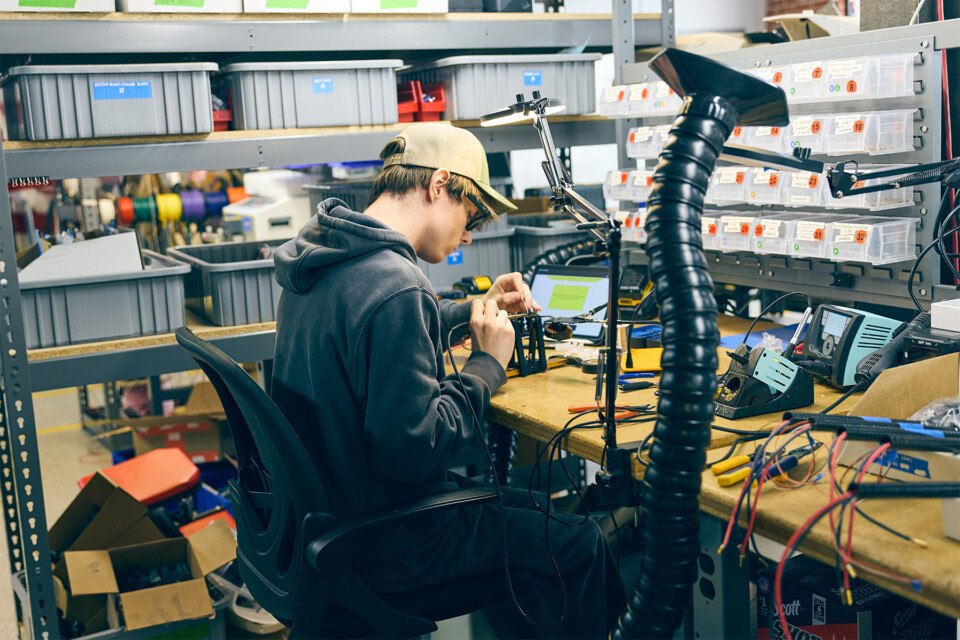
Asylon technician Nick Viscusi
Asylon’s DroneDogs won’t attack any bad guys, but their presence alone can deter criminals.
“You see a robot dog walking around a facility in the middle of the night,” says Henry, “and if I’m a robber, I don’t know if that thing has lasers on it. People don’t know what they can do.”
Henry and Mohamed, both 38, met as undergrads at the Massachusetts Institute of Technology studying aerospace engineering. By 2013 they were in Philly working on cool aircraft designs at Phantom Works, Boeing’s advanced prototyping division. In 2015, around the time Amazon started testing delivery drones, they attended an aviation conference where “there were like hundreds of vendors, and everybody was building drones. We said, ‘We have to do this now,’” Henry recalls. They quit Boeing almost immediately to start Asylon, joined by MIT classmate Brent McLaughlin.
Asylon’s first contract was setting up drones to patrol Ford’s parking lot for new Mustangs in Detroit, where vehicles fresh off the assembly line sit with a quarter tank of gasoline and keys in the car — ripe for the taking. “Within a month, we drove the theft to zero,” Henry says. In 2020, the U.S. Air Force asked for a system that combined air and ground patrols to respond to alarms at Hanscom Air Force Base outside of Boston, which led Asylon to integrate dogs into their system.
Ghost has a similar origin but has expanded in different directions. Kenneally and co-founder Avik De, both 37, met doing PhD work at Penn, experimenting with robots that had various numbers of legs. When they focused on building quadrupeds, finding they had an ideal mix of power, agility, and battery life, other researchers asked if they could buy one. Ghost got early seed funding from the state-funded Ben Franklin Technology Partners and StartUp PHL, a partnership between the city of Philadelphia and private investors. Ghost set up at Penn’s Pennovation Works in Grays Ferry, an incubator space for start-ups. Their first robot dog customer was the U.S. Navy Seals.
“We built it based on our first guess of what might be useful, then went to an event with them in California,” Kenneally recalls. “The robot took, like, two steps, flipped over, broke. It was very embarrassing for us, from an engineering perspective.”
Then came years of refining prototypes as their dog evolved to its current imposing shape and size. They immersed it in water for 30 minutes at a time. They built modular legs that could be swapped in the field. Vision 60 got heavy and powerful, rugged enough to venture ahead of people in dangerous scenarios. When an earthquake hit Japan in 2024, the Japanese Self-Defense Force sent in Ghost Robotics dogs equipped with radiation sensors to scout evacuation routes for vulnerable residents. The British Army has tested Vision 60 dogs, equipped to deploy by parachute, as “eyes and ears” on the ground for air-assault team paratroopers.
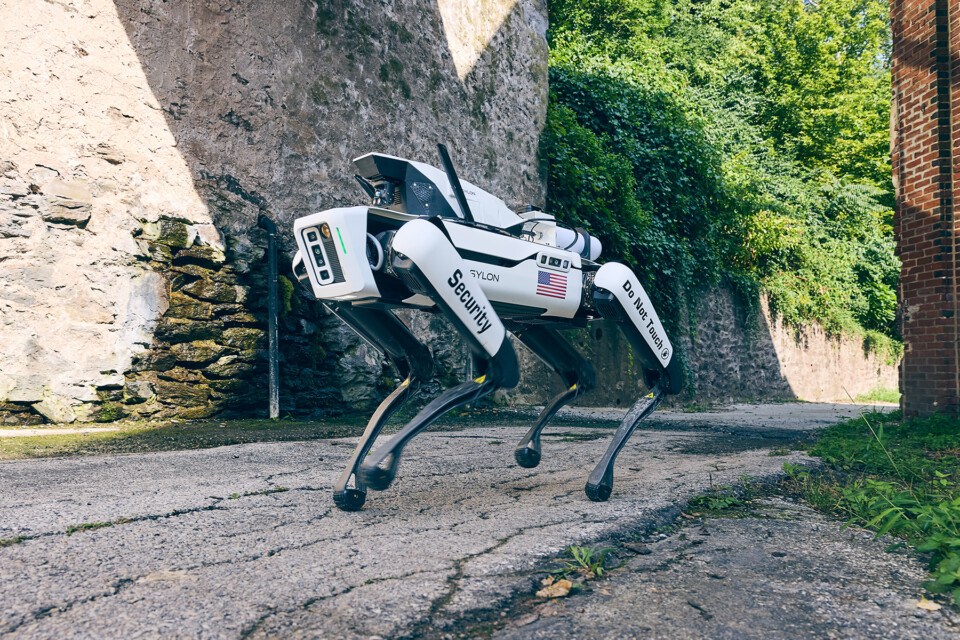
Asylon DroneDog
“Every time there’s a robot at the tip of the spear like that, it means that there isn’t a person in harm’s way,” Kenneally says.
(I ask Kenneally if he ever watches the TV show BattleBots and feels smug, confident that his menacing robodog could kick all their asses. He says a legged robot might not fare well against those buzz-saw bots, but he’d put a Vision 60 in the ring against a Spot from Boston Dynamics. I suggest a pay-per-view.)
The Vision 60’s brain is a powerful Nvidia chip, the type that is powering the AI explosion, but the dogs don’t currently use AI to make any decisions beyond basic obstacle avoidance, Kenneally explains. “If you have a special forces operator dealing with a potential nuclear radiation source, you can’t have the robot second-guessing you and hallucinating.”
Ghost and its customers explore new applications continually, chief growth officer Michael Subhan tells me. “We had a golf course contact us because they wanted the robots to chase geese away,” he says. But probably the biggest growth area for these metal mutts, and the most controversial, is military use.
Real dogs have been used in wars forever, “in every imaginable capacity, and some that were unimaginable,” journalist Susan Orlean wrote in her 2011 biography of Rin Tin Tin, the celebrity German shepherd. Dogs have delivered battlefield messages and medicine. They can sniff for survivors amid carnage (in fact, the renowned Working Dog Center at Penn is training some of the most elite noses and K-9 stars in the world). They have been involuntary suicide bombers. The ancient Romans trained war dogs to kill enemy soldiers. During World War I, a pit bull named Sgt. Stubby became a hero in Europe by alerting U.S. troops to a gas attack and supposedly helping capture a German spy! He eventually met three U.S. presidents.
In late 2023, shortly after the October 7th Hamas attack in Israel, The Wall Street Journal reported that Israel’s military was using robot dogs to explore Hamas tunnels. It was around the same time that protests flared up at Penn about the Gaza war. Online stories began suggesting that Israel’s dogs were supplied by Ghost Robotics.
It didn’t help that anybody searching online could find images — including on an Israeli TV news report — showing Ghost’s Vision 60 dogs with assault rifles attached to them. And in 2024, a Korean conglomerate now called LIG Defense & Aerospace acquired 60 percent of Ghost in its push to be a leader in global defense tech. The acquisition accelerated Ghost’s already avid pursuit of military customers in both the U.S. and allied countries. Students demanded that Penn cut ties with Ghost. That summer, someone spray-painted “MURDERER” and “GHOST ROBOTICS KILLS” on Kenneally’s house.
Kenneally doesn’t deny that Ghost Robotics did, in fact, send robot dogs to Israel.
“We had sold [dog robots to] the Israeli government, basically for tunnel applications,” he explains. “They were sending soldiers into the tunnels, and Hamas had put poison gas and booby traps, explosives [there], and the soldiers were going down — just horrible, right? They were getting blown up. The idea was, send the robots into the tunnels, hit whatever makes the tunnel unsafe to be traversed by a person. At the same time, you’re looking for hostages, because this is where Hamas had hidden them. We don’t know too much of the details, obviously.” He didn’t want to talk about the protests (he reiterated that Ghost works with the U.S. and allied governments) or the creative graffiti on his house.
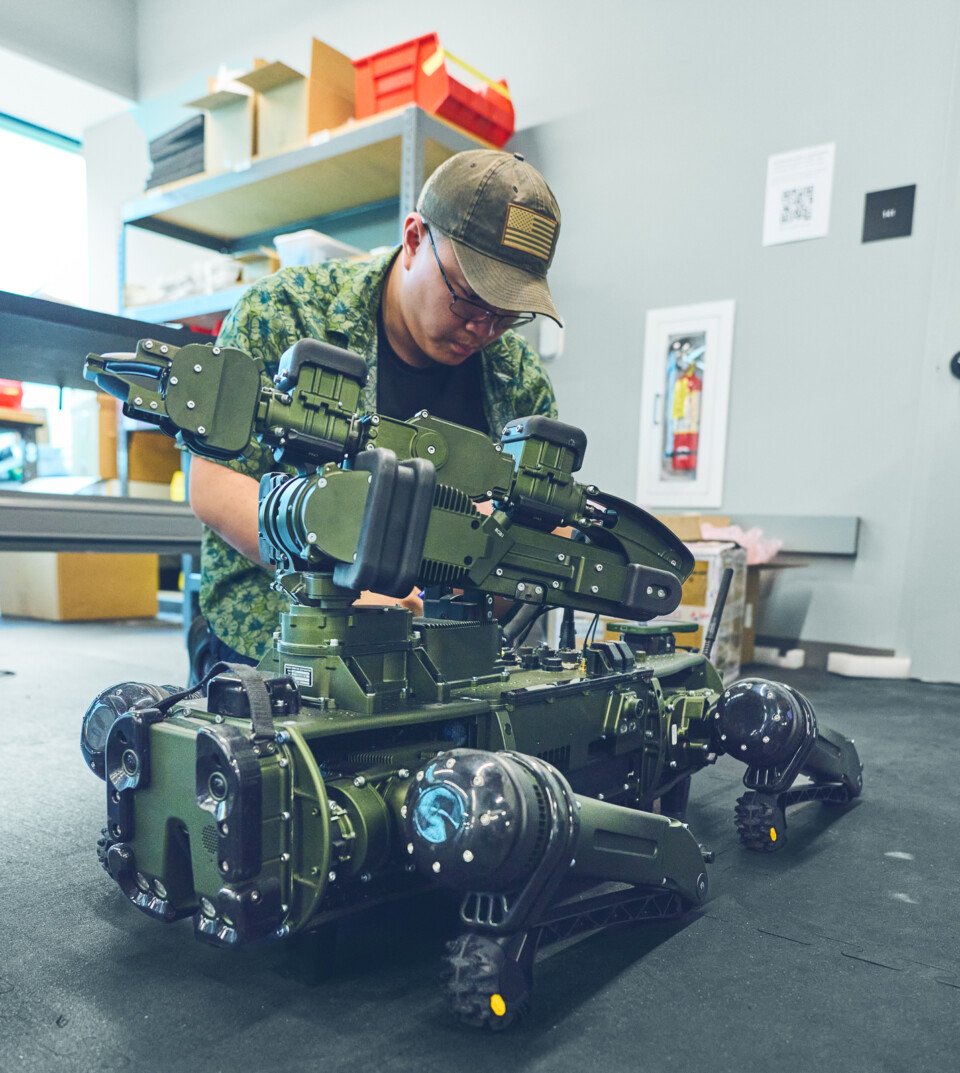
Ghost Robotics engineer Tristan Huang
In early 2025, Ghost left Pennovation Works for the Navy Yard. A Substack newsletter that exposes tech companies’ military connections suggested they were “in hiding.” Kenneally says they needed more space.
In any case, it’s pretty normal for tech companies to do business with the military. Brands we use every day, like Microsoft and Meta, supply battlefield technology. Some surprising companies got started making weaponry, like DuPont (gunpowder) and Wawa (cannonballs). And defense projects have spawned a million innovations: the internet, semiconductors, GPS, duct tape. Today, tech companies like Palantir and Anduril are building the arsenals of the future: weapons systems that are unmanned, predictive, and increasingly autonomous. Some can identify and engage targets without direct human intervention. They’re changing warfare, for good or evil, depending on who you talk to. Ukraine’s use of AI-enabled drones has enabled a vastly outgunned country to intercept Russian attacks and retaliate.
Ghost hasn’t supplied dogs to Ukraine, Kenneally says, but with China often threatening Taiwan, “we see that Taiwan might be the next forefront for a similar conflict — a small democracy being attacked by a much larger, nearby authoritarian regime.” The Chinese military has released pictures of robot dogs made by Chinese manufacturer Unitree rigged with rifles and rocket launchers. Ghost has been working to equip Taiwan with “a layer of robotic defense, so there isn’t this kind of horribly asymmetric attack.”
It’s all still unsettling, of course. “I think there is something specific about putting a gun on Fido that makes people feel uncomfortable, for obvious reasons,” says Michael C. Horowitz, director of Perry World House, Penn’s global policy research center.
Horowitz worked in the Pentagon during the Biden administration and updated U.S. policy around autonomous weapons that could fire without asking anybody for permission. (Because the only thing scarier than a robot with a rifle is a robot with a rifle that can track you and decide when to shoot.) And the engineers and businesspeople behind these innovations don’t have much incentive to slow down. For what it’s worth, though, Horowitz thinks robot dogs will have limited use in combat. Drones and tanks are more effective in most scenarios. But, he adds, “history suggests that if arming a robot dog is necessary for militaries to be effective, we will eventually get there.”
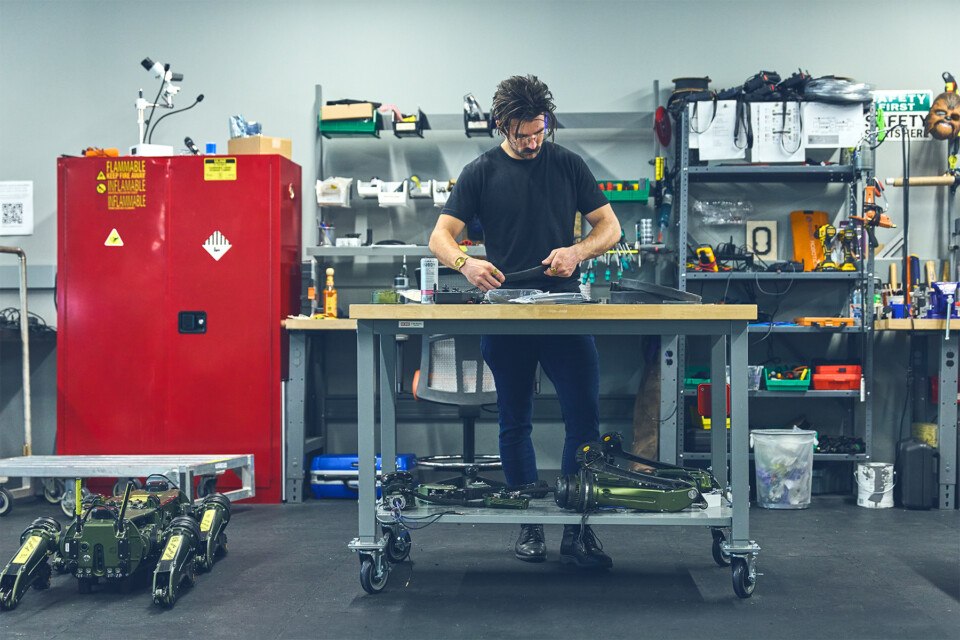
Ghost Robotics engineer Michaiah Douglas
When I think about what getting there might mean, I can’t stop thinking about Terminator 2, when Arnold Schwarzenegger, as a cyborg from a future in which machines have taken over, says, “My CPU is a neural-net processor, a learning computer.” That feels like one way things could go. AI has swallowed the ocean of information that’s been digitized, stolen it from its original creators, and presented it back to us in ways we didn’t think of. It has accelerated scientific research and nudified celebrities. Even AI researchers don’t know how it all works or what it will do next.
Now robots are giving computers legs to walk around, and eyes and ears to ingest how everything in the world that’s not digital works. They will develop spatial intelligence, building not just language models but models of the physical world. What this will give us, and what it might take away, is unknowable. I don’t think we’re on the verge of Terminator. But as I tell the guys running these Philly robot companies: We’re counting on you guys to make sure it doesn’t happen.
Asylon’s Henry tries to comfort me. “I think anybody that works on robotics today, we’re the only people that aren’t afraid of Terminator, because it’s hard enough to make a robot walk some days,” he says.
Kenneally cogitates on it. “I think we’ll end up in more of a Star Wars universe than a Terminator universe,” he says, “where there’s lots of different robots in different helpful roles, different morphologies, different specializations.” Meet me at the Mos Eisley Cantina for some Jawa Juice!
Robots are already coming for us, in many shapes and sizes. They will have their revenge for HitchBot. I have an ambitious (or lazy?) neighbor who installed a six-inch-high picket fence around the perimeter of his yard to contain his robot lawn mower, which is like an outdoor Roomba. At Giant supermarkets, a bulky, googly-eyed robot very slowly patrols the aisles, alerting staff to spills (its name is Marty, short for Mobile Autonomous Robot Technology). On the streets of Center City, rolling food boxes deliver orders for Uber Eats, and Waymo self-driving taxis are on their way.
And one thing that seems inevitable for robodogs, besides going to war, is that they’ll get cheaper and land in people’s homes, like the internet and other advanced technologies have. Asylon counts a few high-net-worth individuals (it won’t name them) as customers for its security service. Ghost doesn’t have a consumer model of its robodog, but the Chinese sell one. Here in Philadelphia, Violet Whitney and William Martin live with a lovely real dog, a Shiba Inu named Isamu, and a Go2 robotic dog made by Unitree, the same Chinese company that makes hardened models the Chinese military is arming. A Go2 costs around $4,000, like a gadget you’d order from the Sharper Image catalog when you were high. It’s the size of a little bulldog. Whitney and Martin pasted googly eyes on it.
Visiting them to see their robotic pooch next to the real one reminds me once again how much we adore dogs. Our relationship with them is the opposite of technology: an instant bond, an unconditional trust. Simply because of the friendly form they take, robot dogs appeal to us in a way, say, a robot spider wouldn’t.
I meet up with the couple, whose Old City neighborhood has a teeming canine population. As we walk the dogs down 3rd Street, with Whitney carrying Isamu in a puppy backpack and Martin controlling the robot via his phone (it’s not autonomous), local pooches have varied responses. A black labradoodle recoils and growls. A feisty terrier won’t stop yapping. Maybe it’s like an AI backlash for dogs, I suggest.
“Yeah,” Whitney jokes. “The dogs are like, You’re taking our jobs.”
Whitney and Martin are designers who created exhibits for the Ministry of Awe, the new interactive gallery on 3rd Street where visitors experience “programmable spaces.” They also teach around a concept called “spatial computing,” Whitney in Penn’s design program, Martin at New York’s School of Visual Arts and in Columbia’s architecture department. It’s the idea that, as computing jumps off screens into the real world — the way it does with delivery robots and smart buildings — designers need to devise new user interfaces that make it feel natural to interact with. They use the dog in some of their classes, letting students vibe code it and experiment with this kind of physical computing to get a feel for the future.
On Market Street, we come upon an Uber Eats delivery robot resting on the sidewalk. Martin makes his robodog raise a paw and shimmy as if coaxing the foodie bot to play, but the squat box seems to be saying, “Don’t bother me, I’m on break.” Martin and the dog move on.
As we stroll Old City’s bustling sidewalks, people ogle and take pictures. I had expected more jaded disinterest and anti-tech scorn. Whitney says they encounter it occasionally. She recalls one time there was a little boy who waved hello at their robot dog, and his suspicious parents stepped in to intervene. They scolded the kid: Don’t wave at that!
But of course he waved at the cute little toy machine. I’m still thinking about that. Robot dogs can be irresistible — all the adorableness, none of the poop bags, whining, or dog-sitters. It’s our instinct to reach out and pet them. I mean, Whitney and Martin’s robodog is pretty cute. But on some primordial level, I really do understand where that kid’s parents were coming from.
Published as “Sit. Stay. Good Bot.” in the October 2026 issue of Philadelphia magazine.