
How Specialized Asthma Care in Philly Helps Patients Move Beyond Daily Symptoms

To most people, asthma is seen as a condition that can be easily managed with an inhaler. While that may be true for many, a significant number of adults experience symptoms that are far more complex, persistent, and disruptive, interfering with nearly every part of daily life.
“For a lot of asthma patients, asthma is easy to control, and they’re stable on their chronic inhalers,” says Dr. Kartik Shenoy, a pulmonologist at the Temple Lung Center. “But there’s a good slice of the population throughout the Philadelphia region that lives with severe persistent asthma where their symptoms are not well controlled.”
For these patients, asthma isn’t just occasional wheezing. Symptoms interrupt sleep, limit physical activity, affect work, and create a constant awareness of breathing.
“I lived in a bubble,” shares Sherry, a retired nurse from Lansdale. She struggled with severe, persistent asthma for much of her adult life. Her symptoms made it difficult for her to walk and talk, spend time with family who owned pets, or even go outside to see the first snow of the season.
When standard asthma treatments fall short, it signals that something deeper isn’t being addressed, explains Dr. Shenoy.
“Individuals who develop asthma later on in life actually tend to have more severe symptoms that are poorly controlled despite using their inhalers,” he says. “Those individuals really need specialized care to figure out what pathways are driving their asthma, what other comorbid medical conditions like sleep apnea, acid reflux, chronic rhinosinusitis, or being overweight could be driving their symptoms.”
When asthma treatment isn’t one-size-fits-all

Asthma isn’t a single condition with a single solution. It exists across a spectrum, with different underlying causes and triggers that vary from person to person. In some cases, what appears to be symptoms of asthma may actually be driven by a different underlying condition.
“With every patient I see or who is referred to me for asthma, the first thing I determine is whether they truly have asthma,” explains Dr. Shenoy. “Many patients carry that diagnosis but are actually dealing with other conditions such as pulmonary fibrosis, emphysema, or connective tissue-related inflammatory lung disease.”
That variability is one reason some patients struggle to find relief with standard asthma therapies alone. At Temple, care begins with a deeper understanding of each patient’s specific conditions. Through advanced diagnostics and comprehensive evaluation, physicians work to identify the factors driving a patient’s symptoms, an essential step toward improving long-term control.
And when cases are particularly complex, collaboration becomes a key advantage.
“Since we’re often starting at square one, we have a lot of depth and breadth of consulting physicians to help us work through each person’s specific conditions,” notes Dr. Shenoy.
That collaborative mindset ensures patients aren’t treated through a single lens, but rather through the combined expertise of an entire care team.
For Sherry, that approach carried through to her experience participating in a clinical trial at the Temple Lung Center, where care felt just as personal as it was advanced.
“It gets me very emotional, but being a part of this clinical trial really allowed me to have a quality of life that was lost for years,” she says.
Advanced treatments that target the root cause
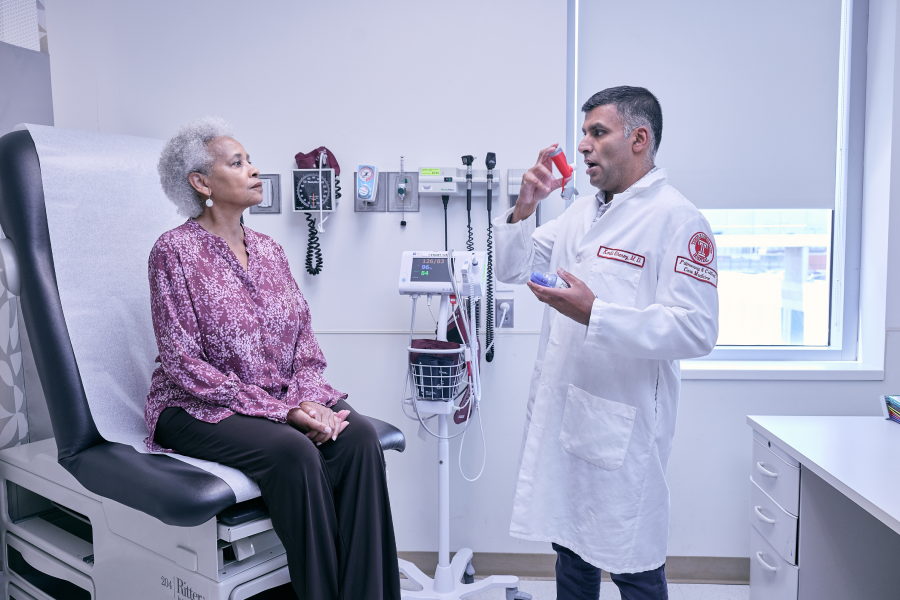
For patients whose asthma remains uncontrolled, newer therapies are changing what’s possible. Biologic therapies are designed to target specific inflammatory pathways that drive asthma symptoms rather than simply managing flare-ups after they occur.
“An inhaler is basically a ‘catch-all,’” notes Dr. Shenoy. “Biologics, on the other hand, get down to a level where they can treat the most specific mechanism of your asthma.”
By interrupting immune responses that drive airway inflammation, these therapies offer a more precise, personalized approach to care. Biologics are injectable medications that target specific causes of that inflammation, with dosing that can range from every two weeks to once a month or even less frequently. For the right patients, that can mean fewer flare-ups, improved breathing, and less reliance on rescue medications.
Sherry’s relief was life changing.
“I still take my medications, but I’m living life again,” says Sherry. “I don’t have flare-ups. I’m not in and out of the hospital.”
Instead of cycling through treatments that only partially relieved her symptoms, Sherry’s new medication addresses the underlying cause of her persistent asthma—opening the door to better, more sustainable control.
“It allowed me to walk and talk again at the same time, which I could not do prior,” she says.
Ensuring patients can access these advanced treatments is a key part of care. At Temple Health, an in-house specialty pharmacy works directly with both physicians and patients to streamline the process, from insurance approvals to medication delivery.
“Our pharmacists work to make things accessible and affordable,” he notes. “We’ll ship it directly or send it to whatever pharmacy so it’s easier and more affordable for the patient to get the medicine they need.”
That level of support can make a meaningful difference, especially for patients who might otherwise feel overwhelmed by cost or access barriers.
Access to what’s next in asthma care
Another defining aspect of care at Temple Health is the Temple Lung Center’s leadership in pulmonary research and clinical trials. For patients, this means access to emerging therapies that may not yet be widely available elsewhere.
“I think research trials offer two things,” says Dr. Shenoy. “I think it offers the fact that we’re on the cutting edge of whatever field is being researched and gives our patients access to what’s next.”
When Sherry was approached to participate in a trial, it felt like a natural next step in addressing her persistent symptoms.
“If people don’t participate in clinical trials, they’re not going to know what medicines work and which don’t,” she says. “It brought me so much joy knowing I was doing this for the study for the Temple Lung Center—for Dr. Shenoy, Dr. Criner, and all the wonderful doctors.”
Beyond access, research also enhances how physicians approach care.
“Our team has a larger depth and breadth of knowledge across specialties because of the research we do,” he adds.
A multidisciplinary approach is often part of the conversation in healthcare, but at Temple Health, it’s a defining part of the patient experience. Pulmonologists, allergists, radiologists, ENT specialists, and researchers work closely together to deliver more coordinated, comprehensive care.
“When you come in to see one of us, you’re seeing all of us,” says Dr. Shenoy.
That level of coordination not only improves clinical decision-making, it also eases the burden on patients themselves.
“You need a team that’s cohesive to address whatever problem you have and its root causes,” says Dr. Shenoy. “And I think that that’s really what our team is about. We work really well together.”
For patients still struggling to control their symptoms, that level of coordination can make a meaningful difference. And if something still doesn’t feel right, Shenoy offers simple advice:
“If you feel you’re not getting the best care, or if someone tells you to ‘just live with it,’ it’s time to get a second opinion.”
To learn more about advanced asthma care, including personalized treatments and clinical trial options, visit Temple Health.
This is a paid partnership between Temple Health and Philadelphia Magazine