
Game On: Why Now Is the Moment for Women’s Sports in Philly
With a WNBA team on the way, celeb backing, and a growing roster of fan spaces, Philly has the chance to build something much bigger than a franchise.
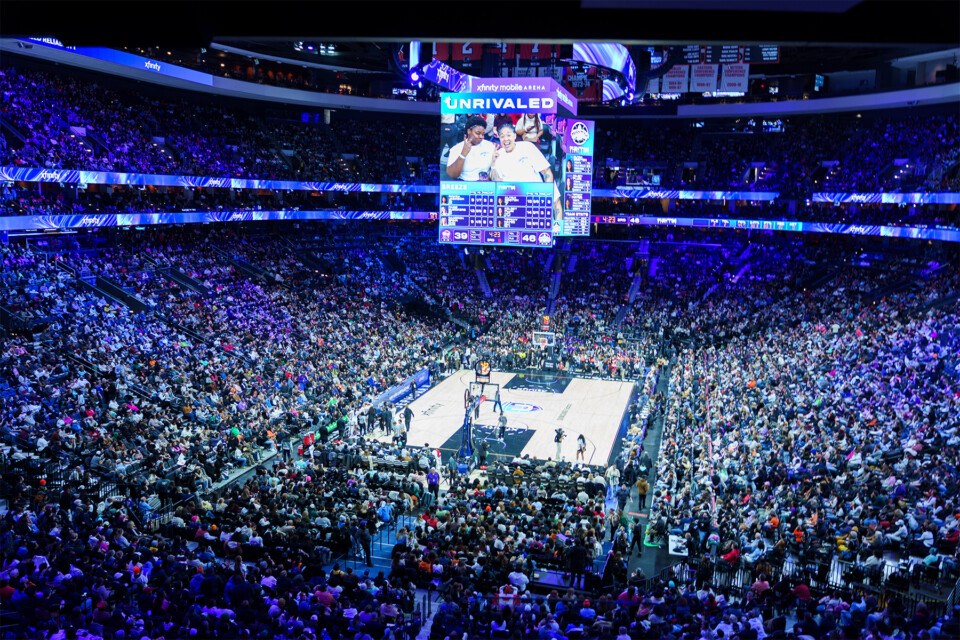
Unrivaled’s inaugural tour stop in Philadelphia on January 30, 2026. / Photograph by Quinton Davis for the City of Philadelphia
To understand why so many Philadelphians are convinced the city is about to become America’s epicenter of professional women’s sports, you need to go back to the evening of January 30, 2026.
It was an absolutely freezing night in the city, with snow piles lining the streets and gusting winds that, for most people, made being anywhere but home feel like a very bad idea.
But the fans who braved the bitter chill to get to Xfinity Mobile Arena in South Philly were not most people. Inside, adults were screaming and cheering, little kids (up past bedtime!) were waving handmade signs, and totally psyched athletes alternated between sinking shot after shot, laughing and dancing for the Jumbotron cameras, and even crying tears of joy on the court. The din was deafening, and the 21,490 attendance was breaking arena records previously held by Michael Jordan’s final game against the Sixers in 1998 (21,305) and the Backstreet Boys in 1999 (21,424).
This time, these thousands of attendees (including Philly hoops star Dawn Staley, Good Morning America’s Robin Roberts, and city royals Kylie and Jason Kelce) had made a journey from around the region and across the country to witness something unseen in Philly for almost three decades: women playing professional basketball — the first such event in Philadelphia since 1998.
On this night, WNBA stars were playing two back-to-back games in a lone stop by Unrivaled Basketball, the three-on-three league founded in January 2025 by WNBA players Napheesa Collier and Breanna Stewart. Their idea was simple: Give WNBA players a way to keep competing — and getting paid — during the offseason without having to leave the country. For years, many had little choice but to spend their winters playing basketball overseas to supplement salaries that are a fraction of what NBA players earn. And the idea worked: In only its second season, Unrivaled generated $45 million in revenue, with ticket sales up 204 percent over the first year, and games were viewed more than 1.2 billion times digitally.
Shockingly, though, Philly — America’s most die-hard sports town — wasn’t even on Unrivaled’s radar as a potential site for their league event until the Sisters Sports Group got involved. Sisters, which helps communities across the U.S. build thriving, locally led women’s sports networks, was co-founded in 2020 by French business pro Alex Niedbalski-Sykes and her wife, actor/comedian Wanda Sykes, who live in suburban Philly, along with health care attorney Ashley Lunkenheimer and businesswoman Starla Crandall. All four are major sports fans and hated having to leave town to see women play. (Alex and Wanda were ticket holders for the Sparks in L.A.)
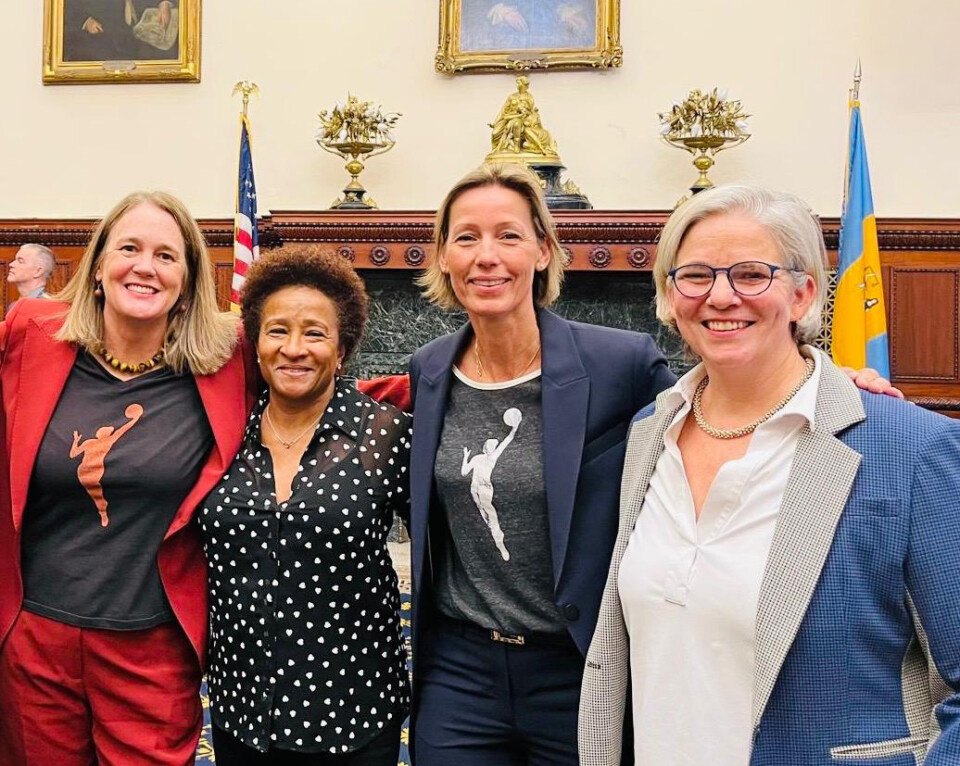
The Sports Sisters in the Mayor’s Reception Room at City Hall. Left to right: Ashley Lunkenheimer, Wanda Sykes, Alex Niedbalski-Sykes, and Starla Crandall.
“I kept asking Wanda, ‘Why don’t we have a team here in Philadelphia?’” says Niedbalski-Sykes, president of Sisters. “She just got tired of hearing me and said, ‘Do something.’ I said, ‘Actually, it’s a good point.’ Next thing you know, this is my mission. And I already had a full-time job, twin kids, a whole life. We started very slowly.”
And so, over the next five years, the Sisters successfully rallied the NBA, the WNBA, city and state officials, and local investors and sponsors to bring a WNBA team here, culminating in the June 2025 announcement that Philly was getting a franchise. Lead owner of the as-yet-unnamed team is Harris Blitzer Sports & Entertainment (HBSE), which also owns the Sixers and the NHL’s New Jersey Devils. (Every sports league is an exclusive club, and the “expansion fee” charged for Philly’s membership in the WNBA was a record $250 million.) Comcast, which holds a minority stake in the new WNBA team, is also partnered with HBSE on a new $1.5 billion arena in South Philadelphia that will be home to the Sixers, the Flyers, and the WNBA team when they hit the hardwood in 2030.
This was — and is — a huge win.
For years, the loudest voices championing women’s sports came from fans, athletes, and grassroots advocates. Now members of the city’s political and corporate establishment are making the argument too. Mayor Cherelle Parker, who had long pushed for a WNBA franchise, called women’s basketball a force that can “excite a city” and “unite a city.” HBSE co-founder (and billionaire) Josh Harris described the WNBA as one of the world’s “fastest-rising” leagues and said a city with Philadelphia’s basketball pedigree should finally have a place in it.
Philly currently has no professional women’s sports teams. Not a damn one. Even Norwich-freaking-Connecticut has a team. It’s embarrassing.”
Their endorsements reflect a broader shift: Women’s sports are no longer being treated as a niche amenity or civic nice-to-have, but as a serious investment in Philadelphia’s economy, identity, and future.
This is especially monumental when put in this context: Philly currently has no professional women’s sports teams. Not a damn one. New York and the Bay Area, on the other hand, have four each. Los Angeles, Seattle, and Indianapolis have three apiece. Even Norwich-freaking-Connecticut has a team. It’s embarrassing.
It’s also incredibly shortsighted: According to Deloitte, women’s sports are projected to become a $3 billion global industry in 2026 — up 340 percent from 2022 — fueled by surging sponsorships, media rights, ticket sales, and merchandising. The U.S. market alone is expected to reach roughly $2.5 billion by 2030. And yet here we’ve been, America’s best sports city, sitting it out.
The irony was not lost on WNBA commissioner Cathy Engelbert when she announced the Philly deal here last summer.
“It’s only fitting that this iconic sports town is finally home to a WNBA franchise,” said Engelbert (a Collingswood native whose dad, Kurt, is in the Big 5 Hall of Fame for his All-American career at St. Joe’s). “From neighborhood courts to historic college arenas, basketball runs deep in Philly — and we’re proud to bring the W to a city that’s ready to embrace it.”
But a lot can happen between now and when the WNBA gets here in 2030. To keep the momentum going, last fall the Sisters began lobbying hard for Unrivaled to come to Philly, and were stoked when the league signed on. Still, the women were jittery in the hours before the October press conference in LOVE Park to announce the win. What if, after all this work, Philly didn’t turn out? What would that mean for the success of Philly’s future WNBA team?
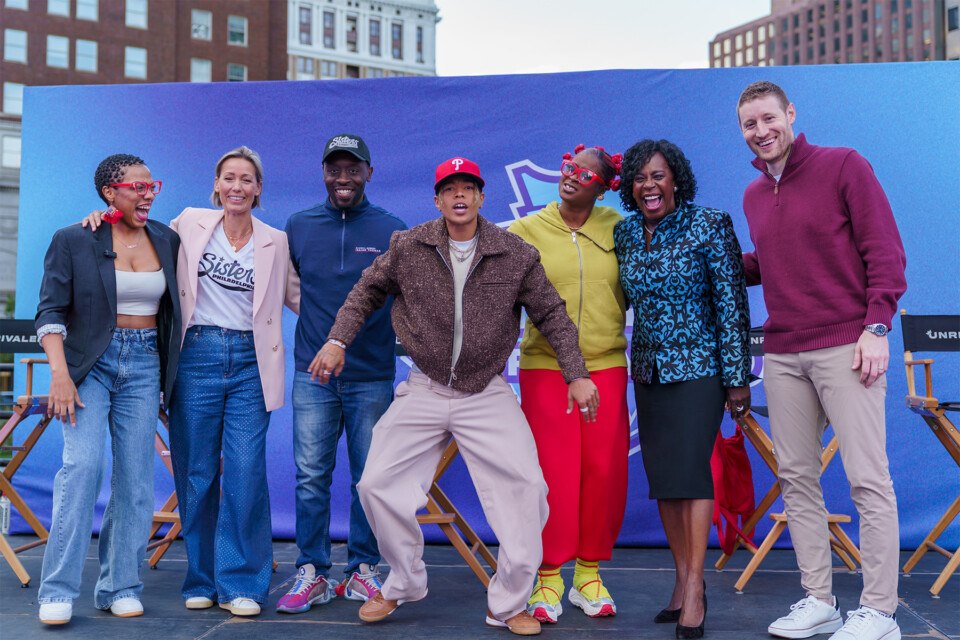
Unrivaled press conference at LOVE Park on October 2, 2025. / Photograph by Quinton Davis for the City of Philadelphia
“We’re 30 minutes before the press announcement and there’s nobody in LOVE Park,” says Lunkenheimer, vice president of Sisters Sports (and a standout athlete herself — in 1998, she was the first-ever captain of the U.S. Women’s Under-23 National Rugby Team).
“We’re like, are they going to come? Next thing you know, a thousand people came — more people attending this press conference than the Philly announcement for the World Cup!” she says. “The energy’s rocking, and we’re on the stage, and we get a text about Unrivaled that says, ‘We just sold 5,000 tickets.’ We’re not even off the stage! We’d done no advertising other than our tapping into the veins of women’s sports fans in Philly all these years. So then we’re like, oh my God, this is happening. We could sell the place out. We know women can’t just come in and do ‘fine.’ We can’t be just ‘fine.’ We have to be better.”
Well, they were: The Philly Unrivaled games set the all-time attendance record for any event in the arena’s history. They also did better than any professional women’s basketball game in the regular season, including the Indianapolis Fever games, where superstar Caitlin Clark regularly packs the house.
“If anybody questioned if the Philly market was ready for women’s sports and they went down to Xfinity Mobile and saw Unrivaled, they wouldn’t question it again,” says former Philadelphia Eagle Connor Barwin, now head of development strategy for the team. (Disclosure: Barwin is a founding donor of Citizen Media Group, Philly Mag’s parent company.) “It was such an unbelievable environment. It felt like you were part of something cool and special that was happening, but also just watching the basketball was absolutely unbelievable,” he says.
The success of the Unrivaled tour has a lot of people predicting that Philadelphia will be the new frontier of women’s pro sports. Which sounds like just another adorably grandiose Philly brag, given how — need we say this again? — Philly has no professional women’s sports team.
Except that the buzz is not … nothing. Consider:
This month, thanks to the efforts of the Sisters, the city will welcome the Philadelphia Tennis Classic from August 23rd through 29th, the first tour stop here by the Women’s Tennis Association since 2005. Then there’s Love City FC, the preprofessional women’s soccer club (with a new division-three team in the Women’s Premier Soccer League) that’s methodically building a player pathway toward higher levels of competition. And Philly continues to produce elite, homegrown female athletes who command national attention, like baseball prodigy Mo’ne Davis, who this year signed contracts with the L.A. and Indianapolis teams of the Women’s Professional Baseball League; WNBA stars Kahleah Copper and Natasha Cloud, who’ve brought Philly hustle to the Phoenix Mercury; and, of course, the GOAT of 25th and Diamond — Dawn Staley.
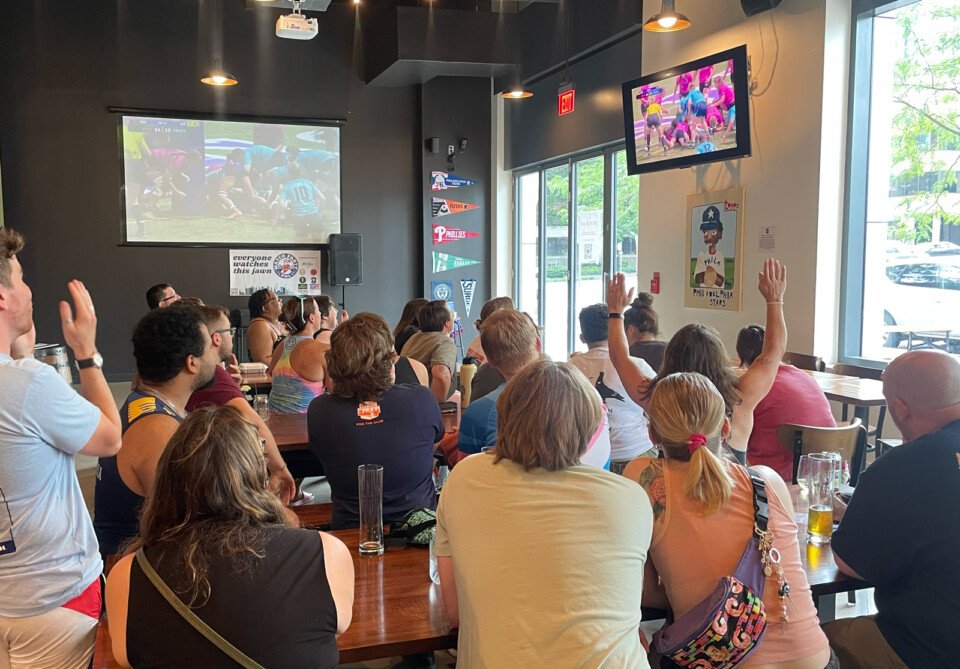
A Stoop Pigeon watch party / Photograph courtesy of Stoop Pigeon
That enthusiasm is tracked — and amplified — at places like Marsha’s, the women’s-sports bar that opened on South Street last fall, and through Philly Watch Party, the organization founded by Jen Leary (a firefighter and former player on the now-defunct Liberty Belles women’s pro football team) that hosts gatherings at venues around town for hundreds of fans to watch a range of women’s sports, including soccer, hockey, rugby, tennis, and volleyball. The events have become so popular that Leary is opening a permanent home for them: Stoop Pigeon, a 2,500-square-foot sports bar and cafe devoted to women’s sports, at Broad and Pine.
Taken together, the teams, tournaments, watch parties, and gathering places suggest something larger than a fleeting trend: the beginnings of a bona fide women’s sports ecosystem in Philadelphia.
“This movement fits Philly perfectly,” says Sykes. “This city respects toughness, authenticity, and people who work for everything they get. Philly loves an underdog story. That’s a big part of why women’s sports feel so natural here. People are finally realizing women’s sports aren’t niche anymore. The talent has always been there. Now the audience is catching up.”
The women’s sports industry, adds Niedbalski-Sykes, “is only going to grow because the demand is so high — women’s sports is a huge untapped investment. I want Philadelphia to be the capital of women’s sports.”
For that to be more than wishful thinking, Philly’s civic, sports, political, and business leaders will have to act more like … Indianapolis?
In 2024, Indy was at a similar inflection point with women’s sports. The city had had a WNBA team — the Fever — since 2000 and even won the WNBA title in 2012. But it wasn’t until 2024, when the Fever drafted University of Iowa point guard phenom Caitlin Clark, that Indianapolis got serious about women’s sports. That season, the Fever set the WNBA single-season home attendance record with 340,715 fans, fueling the so-called “Caitlin Clark effect” that transformed the franchise into a national phenomenon, bringing record crowds, nationally televised games, soaring merchandise sales, new sponsorships, increased tourism, and millions of dollars in economic activity.
Basically, lightning had struck Indianapolis — and city and state leaders pounced to capture it in a bottle. In 2024, they hatched 2050 Vision, a sweeping plan to make Indiana “the sports capital of the world.”
The 25-year statewide strategy is built around five pillars: sports events, sports tech, sports academia, sports business leadership, and women’s sports. The effort is civic, corporate, and institutional, all at once. Indiana Sports Corp (the nonprofit formed in 1979 to recruit major sporting events to boost the Indianapolis economy) is coordinating the strategy; Pacers Sports & Entertainment is building the $78 million, 100,000-plus-square-foot arena downtown. And the city has already hosted — or landed — major events including the 2025 WNBA All-Star Game and the 2028 NCAA Women’s Final Four. The plan also links women’s sports to universities, sports-tech companies, and new leadership pipelines like W.E. Are Next, which aims to develop 100 women executives (the W.E. part of the title). Mel Raines, president and CEO of Pacers Sports & Entertainment, has called these public–private partnerships the “secret sauce” of 2050 Vision.
The goal, said Sarah Myer, chief strategy officer of Indiana Sports Corp, is to ensure that “women’s sports is not just a moment, it is a movement.” After all, the Caitlin Clark effect can last only as long as Clark does. (Indeed: The once-record attendance at Fever games now lags behind that of the Golden State Valkyries.)
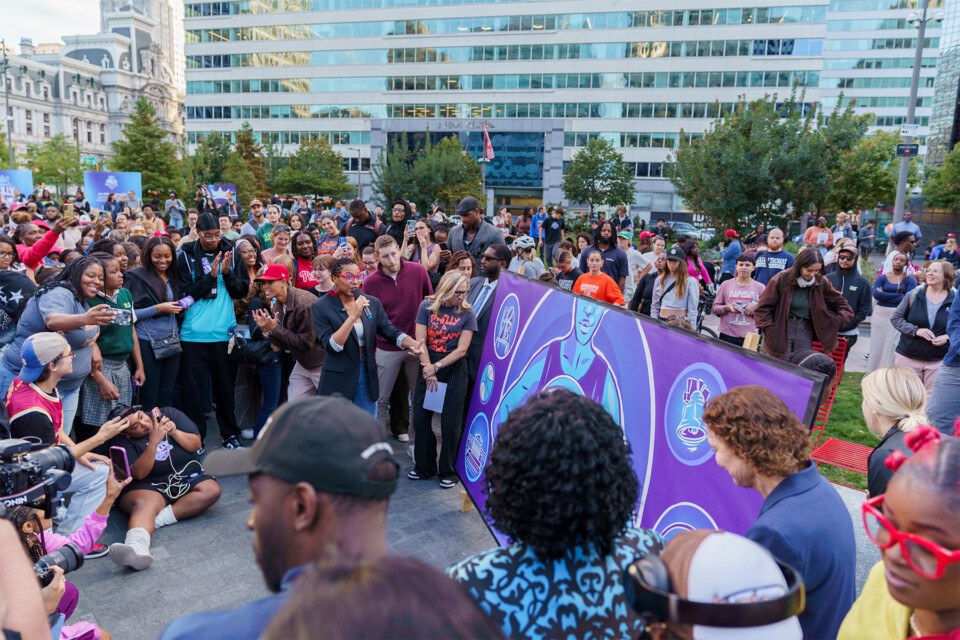
Unrivaled press conference at LOVE Park on October 2, 2025. / Photograph by Quinton Davis for the City of Philadelphia
That’s why Philly shouldn’t rely on the presence of our 2030 WNBA team to sustain women’s sports here. We need a pipeline of collaborative events and initiatives to bring athletes, fans, sponsors, and national attention to the city year after year.
Niedbalski-Sykes gets it. A former international sports executive who worked with the French Open and Wimbledon, as well as the French Basketball Federation (“which is basically the French NBA in Paris,” she says), she sees this month’s Philadelphia Tennis Classic not as a one-off, but as a foundation for Philly to build on.
“We know we have the tournament for two years for sure, and maybe an extra year,” Niedbalski-Sykes says. “But we want to make sure that we grow it.”
That means securing the investors and sponsors needed to turn the Classic into a permanent fixture; the Sisters are lobbying for that, just as they did to bring the WNBA and Unrivaled here. The tourney will debut as a WTA 125 event — a smaller professional stop with a modest prize purse and fewer ranking points — but the Sisters hope to elevate it to a WTA 250, which attracts stronger fields and greater media attention and can make a bigger economic impact.
The same conviction is driving Love City FC’s ambitious climb up the women’s soccer ladder with the WPSL. Founder and CEO Jami Dansingburg says she has already done the hard part: building the infrastructure. “I’ve professionalized the standards, the operations, and the corporate structure so that we’re creating an easy opportunity for much larger investors,” she says. The next step — a division-two women’s team — will require “millions and millions of dollars.” The Sisters are already supporters, and Love City is courting additional investors. But Dansingburg has no doubt where the road ultimately leads. A National Women’s Soccer League team in Philadelphia, she says, “is inevitable. It’s just a matter of when.”
Kansas City, Missouri — home of the NWSL’s Kansas City Current — offers a glimpse of what can happen when a city treats soccer as an investment rather than a novelty. In 2024, it opened CPKC Stadium, the Current’s home base, the world’s first venue built specifically for a women’s professional sports team. A 2022 study projects that the stadium and surrounding development will generate nearly $49 million a year in economic activity and $1.24 billion over three decades.
If a city with fewer than 500,000 people can make women’s sports a cornerstone of its identity (KC also has women’s pro fast-pitch softball and tackle football teams), what could a sports powerhouse like Philadelphia — the nation’s fifth-largest media market — accomplish with a much larger sports fan base, corporate footprint, and resources?
The Eagles’ Barwin sees nothing but opportunity, and it goes far beyond ticket sales. Philadelphia sits at the heart of the Northeast Corridor, with nearly 40 percent of the U.S. population within an eight-hour drive. “Somebody is going to put their stake in the ground on the East Coast,” he says. “I don’t think New York or Boston has done it. I’m hopeful that it’s going to be Philadelphia.”
And the payoff could be enormous, says Wharton professor emeritus Kenneth Shropshire, founder of the Wharton Sports Business Initiative, a research hub that explores the intersection of data science, statistics, and the business side of sports.
“Within a city, you have a fixed set of leisure dollars,” he explains. “But when you get people coming in from outside, not only do you get them to make that extra spend on the event, but they also hopefully spend at restaurants, hotels, and all that sort of thing.”
But the opportunity is cultural too, and it starts long before fans buy season tickets — in neighborhood gyms, school fields, and the everyday joy of girls discovering that sports belong to them, too.
I think we’ll be able to hold the old-school tradition of Philly sports while embracing and attracting the next generation. The sky’s the limit.” — Jami Dansingburg, founder and CEO of Love City FC
“I sort of lost my mind the first time I watched a WNBA game,” says Mount Airy resident Olivia Muenz. “It made me remember who I used to be as an athlete when I was younger — the power I felt in my body and myself at the time.”
That’s the philosophy behind Skilladelphia, the youth organization that began by teaching basketball skills to girls and nonbinary kids and has since expanded into sports like lacrosse, field hockey, and volleyball. The mission is both to nurture the kids’ athletic abilities and to keep them playing, competing, and developing a lifelong relationship with sports.
This is critical, says Shropshire, noting that the United States has historically lagged behind Europe in understanding that connection.
“What we don’t have is this idea of participation in sport for the lifetime value of it, not for the aspiration of being a professional in that sport,” he says. Those participants may grow up to buy tickets, wear jerseys, coach their kids, and see women’s sports as an ordinary — and indispensable — part of the fabric of civic life.
Women’s sports can also reach a younger, broader audience that has been priced out of traditional Philadelphia sports.
“Having season tickets to Eagles games is out of reach,” says Love City’s Dansingburg. “A regular family can’t afford that.” Expanding women’s sports, she says, opens the door to “a much larger population and demographic” — young professionals, students, families, and fans of all genders who can hop on public transit for a Wednesday night game. “I think we’ll be able to hold the old-school tradition of Philly sports while embracing and attracting the next generation. The sky’s the limit.”
For Barwin, the future is obvious. “I think Philadelphia can become the epicenter of women’s sports in this country,” he says. “It’s the greatest sports town in this country right now, and as we bring women’s sports here, it will be the same.”
One of the hottest slogans printed on T-shirts these days is “Everyone Watches Women’s Sports” — an aspirational declaration of what many fans believe the world should look like. If all of Philly — rabid fans, elected leaders, civic visionaries, and smart corporate executives — works together to build the kind of ecosystem that makes the rest of the country pay attention to women’s sports, that slogan could become something even better:
It could become true.
Published as “Game On, Philly?!?” in the August 2026 issue of Philadelphia magazine.