
Danny Simmons Jr. Belonged to the People
The artist, who died on June 14th, was an advocate for creatives across Philadelphia and a voice for the underrepresented.

Danny Simmons Jr. speaks on stage during a Rush Philanthropic Arts Foundation benefit in 2017. / Photograph by Jason Kempin/Getty Images for Rush Philanthropic Arts Foundation
Listen to the audio edition here:
Danny Simmons Jr. carried a presence you couldn’t miss. It started with the measured way he looked at you, sharpened by the streets of Hollis, Queens — he possessed an uncanny knack for spotting what was real and what was performance.
But that watchfulness wasn’t the whole story. Give him an artist with an honest spark, or someone who truly believed art could pull a community together, and the guard dropped, the seriousness softened, and out came a smile or words of encouragement. After more than three decades of writing about him, I watched his actions serve as a lifeline for young artists and poets, offering the kind of plain, unmistakable approval that told them to keep going.
On June 14th, the prolific visual artist, poet, philanthropist, curator, and producer died in Philadelphia at age 72, following a short illness. He leaves behind a legacy defined by his commitment to creativity and community.
While his family name — he was the older brother of hip-hop impresario Russell Simmons and Joseph “Rev. Run” Simmons of Run-DMC — certainly granted him access to hip-hop royalty, Danny used his platform to champion those without such advantages. A founding architect of the Def Poetry Jam movement, he notably co-produced Russell Simmons Presents Def Poetry Jam, a project that evolved into an HBO series and a Tony Award-winning Broadway production, forever altering the landscape of spoken word in American culture.
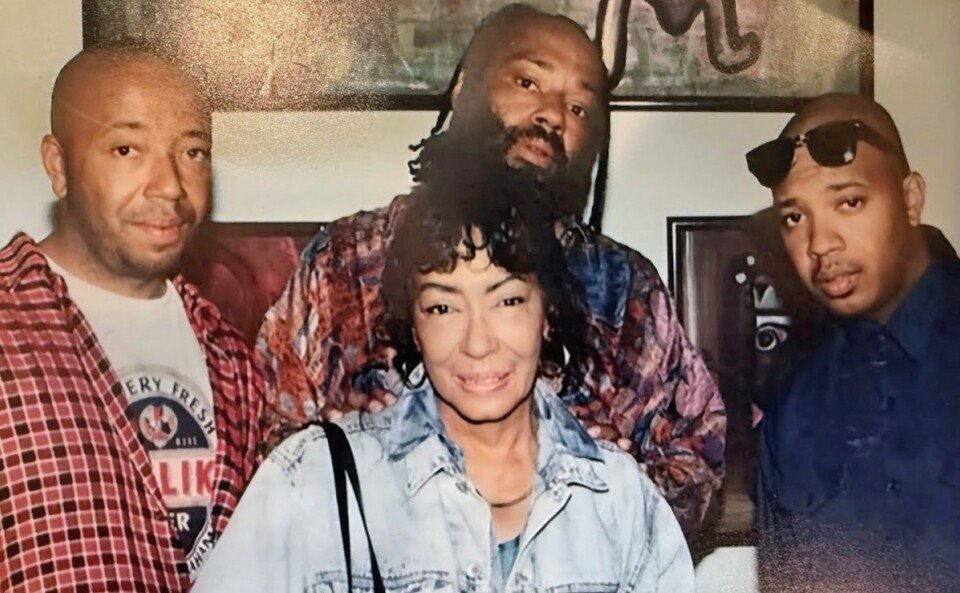
From left: Russell Simmons, Danny Simmons Jr., Evelyn Simmons, and Joseph “Rev Run” Simmons pose for a family photograph in an undated image. / Photograph courtesy of the Simmons family
In 2022, Westwood Gallery NYC became the sole representative for Danny’s artwork — a dynamic painting style, which he described as “Neo African Abstract Expressionism” — marking the partnership with a dedicated solo show. He had recently visited Youngstown, Ohio in support of “Danny Simmons: Visual Expressions,” a selection of original prints, at The Butler Institute of American Art, running through June 28th. Westwood Gallery NYC is also set to present another solo exhibition this September 2026, curated by James Cavello. That show had been mapped out earlier with Danny to align with the 2027 unveiling of a three-year public art project in his New York City hometown.
Danny leaves behind a body of work and a web of human relationships that together tell the story of what it looks like when an artist decides that community is the point.
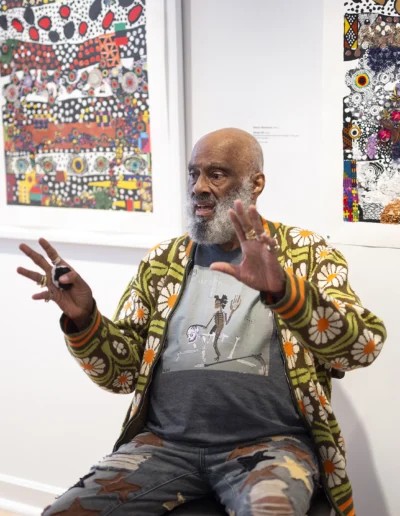
Danny Simmons at the opening reception for his solo exhibition, “Visual Expressions,” in May at the Butler Institute of American Art in Youngstown, Ohio / Photograph courtesy of the Butler Institute of American Art
Upon Danny’s 2016 relocation to Philadelphia and immediate launch of Rush Arts Philadelphia — a branch of his New York Rush Arts Foundation — I confess I observed him with the skepticism of a local writer accustomed to seeing newcomers attempt to claim the city while merely pushing their own agendas. The carpetbagger concern is real here; Philly has its own creative class, its own hard-won institutions, its own long memory for who showed up and who just passed through.
Danny did not pass through. What he did instead was set the New York sensibilities aside and dig into the infrastructure of Philadelphia’s creative community with genuine curiosity and, most importantly, heartfelt thoughtfulness. He became an advocate for minority artists of every kind, having a place in the conversation not as a talking point but as an operating principle.
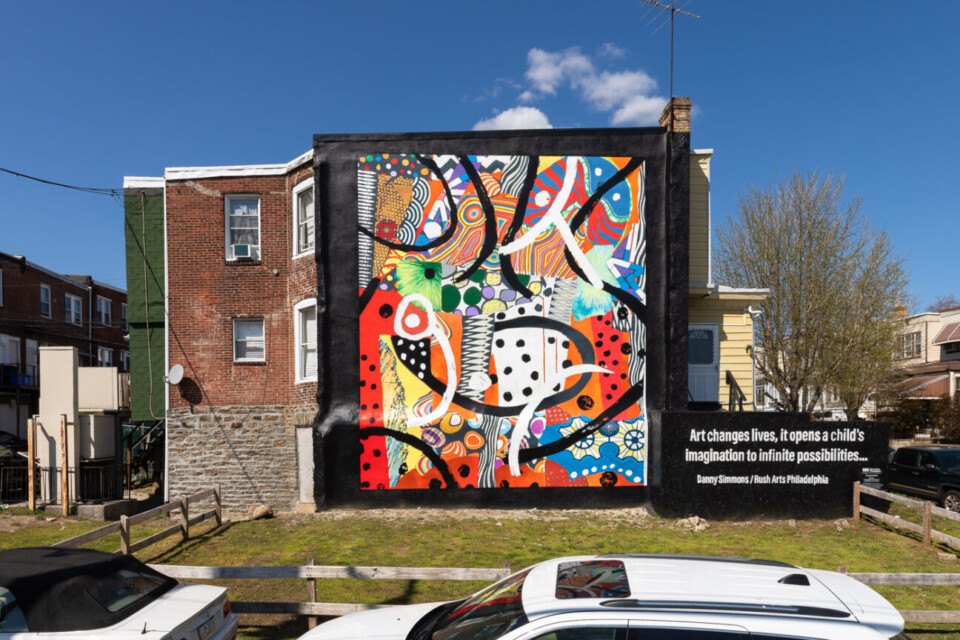
This Deep Desire, a mural designed by artist Danny Simmons Jr. and painted by Gabe Tiberino, is located in Philadelphia’s Fern Rock neighborhood. / Photograph courtesy of Mural Arts Philadelphia
Rush Arts Philadelphia became a gallery and an education program that fostered art instruction to young people from neighborhoods that don’t typically appear on the city’s cultural map. In 2019, he was appointed to the African American Collections Committee of the Philadelphia Museum of Art. He served on the Mural Arts Philadelphia board from 2022 to 2025 and worked as lead artist on four mural projects in Germantown and North Philadelphia neighborhoods that knew something about being overlooked by the institutions that were supposed to serve them. His work entered the permanent collections of the Woodmere Art Museum and the Pennsylvania Academy of the Fine Arts.
Most importantly, he earned Philly’s respect. And in this city, that’s not for nothing.
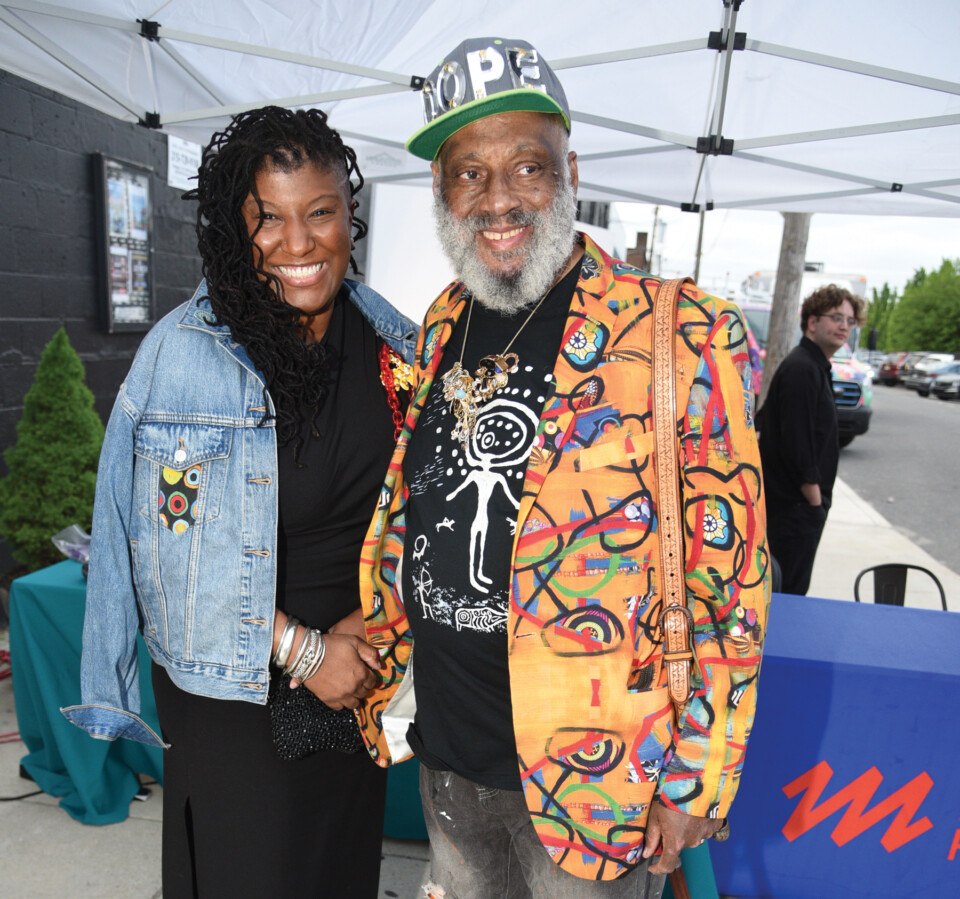
Keia D. Carter Simmons and Danny Simmons Jr. at Mural Arts Philadelphia’s Wall Ball in 2024 / Photograph by HughE Dillon
Rapheal Tiberino, a painter and teaching artist who worked alongside the Rush Arts program here, knew that dimension of Danny’s work firsthand. I talked with Tiberino last week, and he spoke about what it meant for Danny to give young people from difficult circumstances a creative gateway with art classes and teachers who showed up for them. He recalled the final weeks of Danny’s life with the plain loyalty of a man who had been showing up to sit beside his friend of over 20 years, sometimes just watching him sleep.
“You knew it had to be bad when he didn’t feel like working,” Tiberino said. “He pretty much painted every day.” And then, searching for the frame that explained all of it, he found the simplest one available: “That’s what friends do, you know.”
Ursula Rucker, Philadelphia’s essential spoken-word voice and cultural conscience first came into Danny’s orbit in the 1990s through the legendary poet Sonia Sanchez, and their relationship deepened into what she calls comradeship.
“He would always call on me, and I would call on him as well,” Rucker said, and named his defining characteristic without hesitation. “He was always about bringing all of us together … his mission was love made into action. That was the work that he did. He did the work for us to be alright.” In grief she offered the kind of assurance that carries communal weight. “We’re going to be good. We’re not good, but we will be.”
Danny’s widow, Keia D. Carter Simmons, associate director of Temple Contemporary, described a 10-year partnership built not on ceremony, but on recognition. “He looked at me one day and said, ‘I like us; we’re good together,’” she recalled.
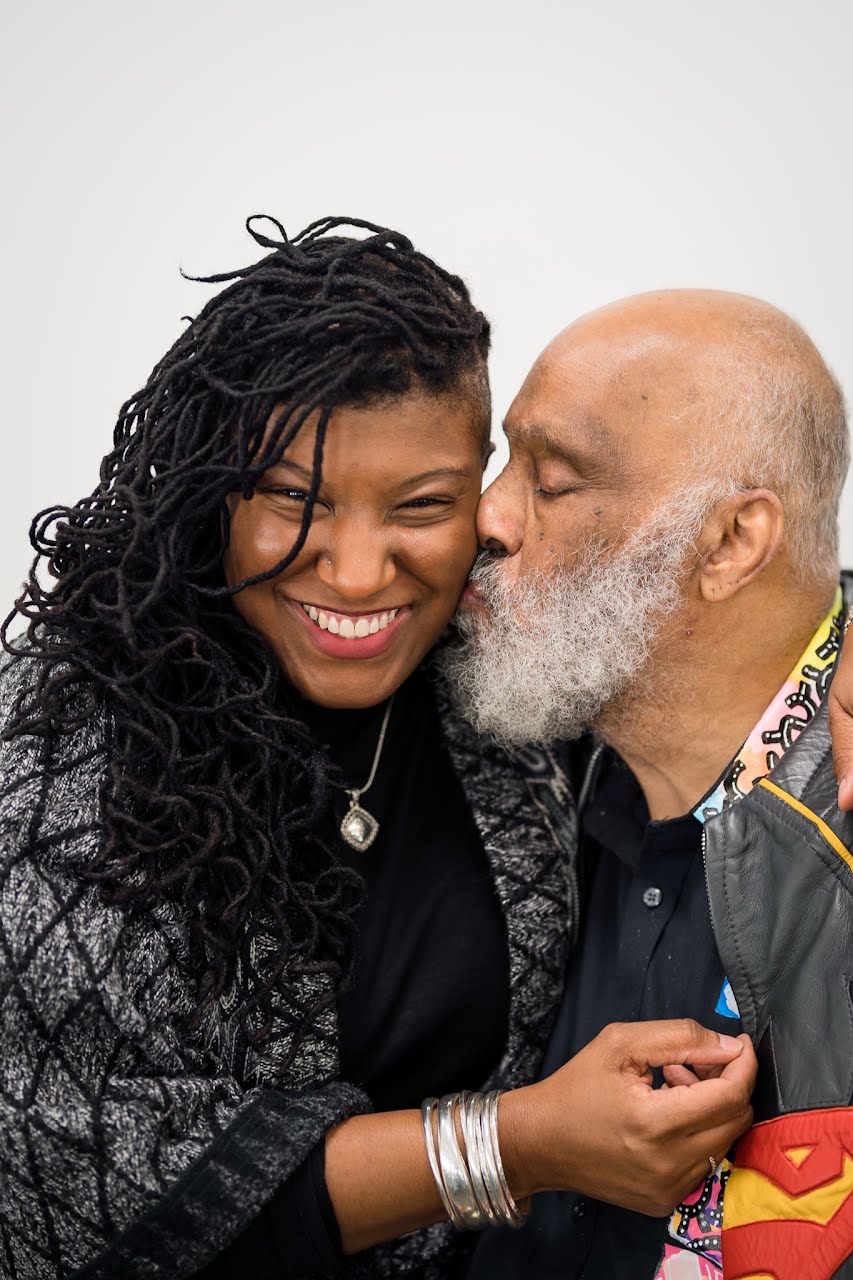
Artist Danny Simmons Jr. shares a moment with his wife, Keia D. Carter Simmons, during an undated family photograph. / Photograph courtesy of the Simmons family
Thus they traveled together, laughed together, and built a life together that she describes had the ease of two people who figured out early that they were on the same side. In his final days he prepared her, she said, in his quiet way. He told her he had a beautiful life.
“I’ve had a hell of a ride,” she recalled him saying. “I’m good with that.”
Now as she moves through their home, she notices the chair is still turned the way he left it, and feels special meaning in every object he collected. “I don’t feel alone,” she said. “It’s good memories.”
Keia then said something that clarified what I already knew but hadn’t yet put into words. “He was just my person,” Keia reflected, adding however that: “He wasn’t mine — he belonged to the people just as much as he was mine.”
That was Danny Simmons Jr. The look that read you. The smile that confirmed you. Thirty years of watching him work, and what I keep coming back to is not any single gallery opening, television credit, or poetry stage. It is the image of an artist who understood that the greatest use of whatever platform you’ve been given is to widen the door behind you.
And in his own way, he belonged to everyone.