Philly’s Economy Is Growing — But People’s Lives Aren’t Getting Better
When it comes to creating well-paying jobs that grow and support a middle class, Philly has lost the plot. Now, some leaders are hell-bent on rewriting the story.

Why is Philly so behind in economic mobility? / Image via Dan Saelinger/Trunk Archive
In October 2024, a who’s who of Philadelphia’s business, civic, education, and philanthropic leaders filed into the National Constitution Center — invited by a collaborative that included Comcast, Bank of America, Pew, and both the William Penn Foundation and the Philadelphia Foundation — to face the music.
Just a few months earlier, an alarming study from Harvard economist Raj Chetty — the brains behind Opportunity Insights, which uses big data to paint detailed pictures about economic health around the country — revealed an unsettling truth: However sunny some of the top-line numbers in Philly might look (poverty down, unemployment down, median income steadily rising), the reality was actually much darker. One of the most important metrics for quality of life in a city — upward economic mobility — was lagging behind those of every other major metro (49 of them!) Chetty looked at. In Philadelphia, his research showed, people born into low-income families weren’t just failing to climb the economic ladder and make better lives for themselves than their parents had — they were falling even farther down its rungs.
It wasn’t just poor folks, either: The same was true for those born into privilege. The backsliding was consistent across class lines. And across races. And across county borders.
In short? As a region, the study showed, we have been failing to deliver on the most fundamental promise of the American experiment: opportunity. The chance to create a better, more prosperous life for our children.
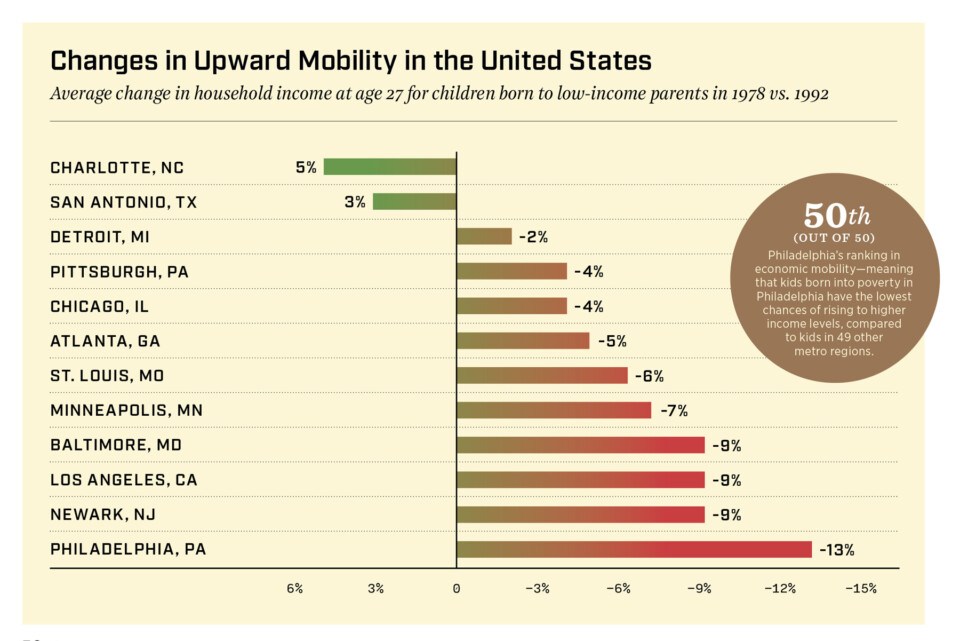
Philadelphia ranks 50th in economic mobility — meaning that kids born into poverty in Philadelphia have the lowest chances of rising to higher income levels, compared to kids in 49 other metro regions.
The 200-person crowd that gathered that night on Independence Mall listened to Chetty detail Philadelphia’s woeful descent over the past decade to the bottom of his economic mobility rankings. But the doom and gloom wasn’t the point of the gathering, says Dalila Wilson-Scott, Comcast’s executive vice president and chief impact and inclusion officer and president of the Comcast NBCUniversal Foundation. The point was to galvanize the region’s thinkers, doers, and connectors to a newly urgent cause: to turn it all around. To give Philadelphians a shot. To build new ladders.
Because the way Chetty told it, the region’s ranking wasn’t set in stone. Panelists that evening included corporate leaders from Charlotte, North Carolina — a city that had placed last in Chetty’s previous report, issued a decade earlier. In the years since that report, that city had turned it around and is now knee-deep in an economic renaissance — helping Chetty make the case that meaningful change is possible … if leaders can rally behind a cooperative, strategic approach to fixing the underlying issues. “It was a great source of inspiration for those in that room,” says Pew senior director Elinor Haider.
To be fair, that may not sound like much. But for years — decades — Philadelphia has languished as its own economic island, as have the surrounding counties. It’s lacked a singular call to leadership. While other major metros have tapped into the power of collaboration and cross-county planning, southeastern Pennsylvania has instead competed against itself for jobs, headquarters, talent, federal and state money, and the like, even though there’s a natural fluidity across borders. (Some 38 percent of workers in the region cross counties in their daily commute.) And this has held us back, Chetty’s research showed. Not that this was news to everyone: Anyone tasked with the work of attracting national employers or funders to the region would tell you the same. Wilson-Scott says she’s heard it a lot: You guys don’t collaborate. You don’t play well in the sandbox together.
But now, the tides are seemingly turning. Some 18 months after that day’s call to action, not only have civic, business, and philanthropic leaders begun to step into the breach rather than waiting for the government alone to solve the problem — they’ve also started a new cross-sectional collaboration dubbed, yes, the Southeastern Pennsylvania Economic Collaborative.
“It’s the most intentional process I’ve been a part of,” says Michael Grigalonis, who has been at the Chester County Economic Development Council for 26 years. “It’s by far the most thoughtful, consistent, truly regional approach I’ve seen.”
Truthfully? It’s about time. And the stakes couldn’t be higher. This isn’t just a matter of the livelihood of future generations, of the city’s livability for its people. It’s nothng short of the chance to restore the American dream for Philadelphians, right here in the city where it was born.
Chetty’s visit may have been a turning point — the rallying cry — for the problem of lagging opportunity for Philadelphians, but it wasn’t all exactly breaking news: The Pew Charitable Trusts, which has long conducted nonpartisan studies on Philly’s health and economic well-being, had been throwing up red flags for years. Yes, as reports showed, our job growth looked solid. Yes, we were even outpacing our peers. But too many of us faced economic insecurity nonetheless. (Nearly half of Philadelphia, according to a report from the Federal Reserve last spring.) Too many new jobs they were tracking, Haider says, weren’t middle-wage jobs — those that produce a livable income and don’t always require a bachelor’s degree. Pew’s post-pandemic research showed that most of the job growth of the past decade had been concentrated among the very lowest and very highest incomes, with virtually no gain in that vital middle-wage work. As other regions were growing those jobs in booming industries, Philadelphia fell behind.
At the end of 2022, Pew began forming public–private partnerships to address this problem, slowly building relationships across county lines. Then came 2024 and Chetty’s powerful, mobilizing presentation. Now, with Pew as a facilitator, the Southeastern Pennsylvania Economic Collaborative includes the city’s Department of Commerce, the Chamber of Commerce, Visit Philadelphia, and economic and workforce development agencies for Philadelphia, Bucks, Chester, Delaware, and Montgomery counties. Comcast, Vanguard, and the William Penn Foundation have also invested money and brainpower in the planning process.
The Brookings Institution, the powerhouse think tank, is the organization’s research engine, working to understand why Philly has lagged while others have raced ahead, and how we might catch up. It started with an in-depth regional analysis, published last summer.
Our economy isn’t working to create those opportunities for people, even if they had the training, childcare, and access they needed.” — Marek Gootman, nonresident senior fellow at Brookings
Here’s what Brookings found: While our job growth has been mostly concentrated in sectors that don’t offer stability, let alone mobility (hospitality and food service, for example), our forward-thinking peer cities (Boston, Atlanta, Phoenix) have been adding jobs in what Brookings calls “tradeable” industries. These are areas whose products and services reach beyond the region’s borders (think manufacturing and technology), with the middle-wage jobs Haider talks about — jobs that offer the opportunity to outpace our parents’ generation and maybe even find some comfort along the way.
By failing to keep pace with national growth in these types of tradeable industries, Philadelphia missed out on adding some 104,000 jobs between 2013 and 2023, the Brookings report detailed, falling roughly 13 percentage points short of expected growth in those areas. Charlotte, meanwhile, added about 69,000 tradeable jobs, beating its own expected growth by 16 percentage points, while other major metros like Atlanta, Dallas, and Denver outperformed their targets by similar margins. Of the tradeable jobs we missed, according to Brookings data, 70 percent would have delivered on the promise of financial self-sufficiency — largely without the need for a four-year degree.
Our problem, says Marek Gootman, a Brookings nonresident senior fellow and co-author of the report, is that our region’s economic reliance and laser focus on meds and eds (mainly hospital and university jobs) has come at the cost of strength in other areas. Because we’ve put so many eggs in that basket, in short, “our economy isn’t working to create those [other] opportunities for people,” Gootman says, “even if they had the training, childcare, and access they needed.”
But in its report, Brookings identified three industry segments that play to our strengths and can help turn things around with more family-sustaining jobs — the kinds with true career paths, reliable incomes, and growth. This is another major first for this region, in terms of the specificity. The areas they called out? Enterprise digital solutions (business-to-business software tools and services), precision manufacturing (metalworking, machining, and fabrication for electronic instruments and communications systems), and biomedical commercialization (businesses that focus on diagnostics, therapeutics, and medical devices to harness new technologies in the life sciences). These are the industries and types of businesses the region would do well to invest in, the Brookings report suggests, in terms of schooling, training, and luring companies here.
So. Growth opportunities thusly identified … what happens next? Mustering the investments necessary to pull it off. That means building the behind-the-scenes infrastructure, including both region-wide staffing and more state-wide investment, to execute on a growth strategy that can support local companies while also attracting new ones. It will require funders ready to back the turnaround, state and local governments that understand what’s at stake, and businesses showing up to put jobs on the table. To that end? Comcast’s vocal support for the plan is a step toward rallying the business community. But it’s just the beginning.
There are models out there the Philadelphia region could emulate, at least in some respects. Gootman points to Syracuse, New York, which had stagnated for decades as the manufacturing jobs that powered the region dwindled to nothingness. According to Brookings, from 2013 to 2023 it ranked 55th out of 56 large metro areas for job growth. But behind the scenes, a collaborative effort among regional and community partners took shape. By 2022, building on a state-wide investment in semiconductor competitiveness, the partnership pounced on federal legislation aimed at promoting chip production with tax credits and manufacturing and research funding. The result? Micron Technology committed to building a semiconductor plant in the Syracuse suburbs with a $20 billion investment by 2030 that could stretch to $100 billion. The company’s projections also point to 9,000 well-paid jobs at the factory and 40,000 more in the community.
Another region that has managed to pull itself together to boost the local economy is our friends out west. The Allegheny Conference on Community Development won some attention last year as a cross-sector collaboration for the Pittsburgh region, helping secure 21 major business investments and “creating or retaining” some 18,500 jobs. Gootman points out that they didn’t do well in terms of tradeable jobs — missing projections by an even larger amount than Philly — but the vision of regional collaboration to power the economy going forward is worth studying.
You’ve got to put some quick wins on the board that show the collaboration is intentional.” — Dalila Wilson-Scott, chief impact and inclusion officer and EVP at Comcast
And then, of course, there’s Charlotte — at the bottom of Chetty’s economic mobility rankings in 2014, the same lowly spot Philly now holds. Similarly stunned by Chetty’s findings, local leaders in that city jumped into action, pulling together a county-wide task force led by U.S. Bank executive Dee O’Dell and family medicine doctor Ophelia Garmon-Brown, who together created 100 recommendations for improvement across three key areas: early childcare and education, college and career readiness, and family and child stability.
In 2017, the nonprofit Leading on Opportunity formed in Charlotte to align the nonprofit and business communities behind those goals; it quickly secured $10 million in investments from Bank of America and chemical company Albemarle Corporation to fund work in the priority areas. Sherri Chisholm, the organization’s executive director — one of the speakers at the Constitution Center event — said her region has invested $1 billion in community initiatives since 2014, including a housing trust fund, a racial equity initiative, pre-K education, and job training. Thanks in part to this funding fire hose, the city made enormous strides in Chetty’s latest economic mobility report, rising from the bottom into the top 10 across most race and class segments. It finished first for progress among low-income white children — a category in which Philadelphia ranked 50th out of 50.
The approach to a turnaround may differ from region to region, but over and over, we see a blueprint of sorts: Diagnose the roots of the crisis, then commit to the long work of addressing it collaboratively. Hearing Charlotte’s story at the Chetty event offered proof of what’s possible, offers Wilson-Scott — a narrative that was “both motivating and validating,” she says. “It helped build momentum for the work now underway here.”
So now, the billion-dollar question: Can we do it? Can we revive the idea that here, in the Philadelphia region, there’s a pathway to a stable life for anybody, something better than what we’ve known — or what our parents knew?
We can, Gootman thinks — in time. And with still more effort. But already, green shoots have begun to push through: During the pandemic, a group of civic leaders led by businessman Michael Forman (a founding donor of Citizen Media Group) and labor chief Ryan Boyer convened the Equity Alliance to address the wealth gap in Philadelphia. Mayor Cherelle Parker put $10 million toward training residents for municipal government jobs and external workforce programs for high-demand sectors; that investment was matched last spring by a private and philanthropic group led by Comcast and the William Penn Foundation. Momentum is gathering. “Economic mobility should not be the exception. It should be the expectation,” Parker said in a speech to the Chamber of Commerce in February.
The Philadelphia School District also announced plans to replicate in North Philadelphia the cradle-to-career success of the Harlem Children’s Zone, a model that deploys extra resources and a longer school day and year, as well as social service supports, to break the cycle of poverty. Comcast backed the initiative and provided seed funding to help local organizations implement the model as part of its broader work to address the roots of economic immobility. “You’ve got to put some quick wins on the board that show the collaboration is intentional,” Wilson-Scott says.
Economic mobility should not be the exception. It should be the expectation.” — Mayor Cherelle Parker
Governor Josh Shapiro’s economic development strategy — the first in the state in nearly two decades — has also, as the Chamber of Commerce’s Claire Greenwood noted, added to the momentum building for more collaboration and stoked optimism that we can actually pull this off. The Southeastern Pennsylvania Economic Collaborative has briefed the state legislature on its aims and its needs, acknowledging that it will require investment from state and local leaders to get this right, and the regional partners are aligned on the industries to target and on reworking their approach to workforce development accordingly. A regional mindset really does seem to be taking hold. To wit? When a grant opportunity developed to promote local manufacturing, the five counties applied jointly, rather than independently, Gootman says. And Montgomery County Community College recently opened up its biomedical manufacturing curriculum to other institutions.
It will still take much more, though, to realize the type of change we’ve seen in places like Syracuse and Charlotte. That includes targeted investment from local businesses and philanthropies invested in the effort, organized around jobs that offer real opportunity — the ones Brookings identified. With improved technical assistance and better training (and retraining) programs, the region can compete in precision manufacturing, Gootman says. By developing C-suite talent, investing in medical device development, and connecting companies to health care systems for clinical trials, the regional biomedical industry can expand. Some of this work is underway; more will be needed.
The early action to date — Chetty’s call to action, the collaborative’s formation, the investments in workforce development and career-minded education — was necessary to get the ball rolling. And sure, our historical tilt away from teamwork — and a history of lots of talk and not much action — might leave people doubting whether this new plan can work. All the more reason to keep pushing, Wilson-Scott says: “Performance is the only way to kill skepticism.”
This spring, the regional partners will publish a plan to serve as a short-term road map for what’s next — tasks and timelines in service of a new strategy to take what began with Pew’s findings and coalesced that October evening at the Constitution Center and turn it into good jobs. Into change. Into the return of the American dream. If it does, other cities might look here for inspiration a decade from now. If not, it’s the next generation who will shoulder the burden.
“This is our home. And this is our future,” Grigalonis says. “We need to come together. I shudder to think of what the alternative would be.”
How Philly Stacks Up
Our poverty rate hovers just under 20 percent — the smallest percentage in decades. As of 2024, we’re no longer the poorest big city in America (now that’s Houston) … but we still have some 300,000 of us living in poverty.
1. What We Earn
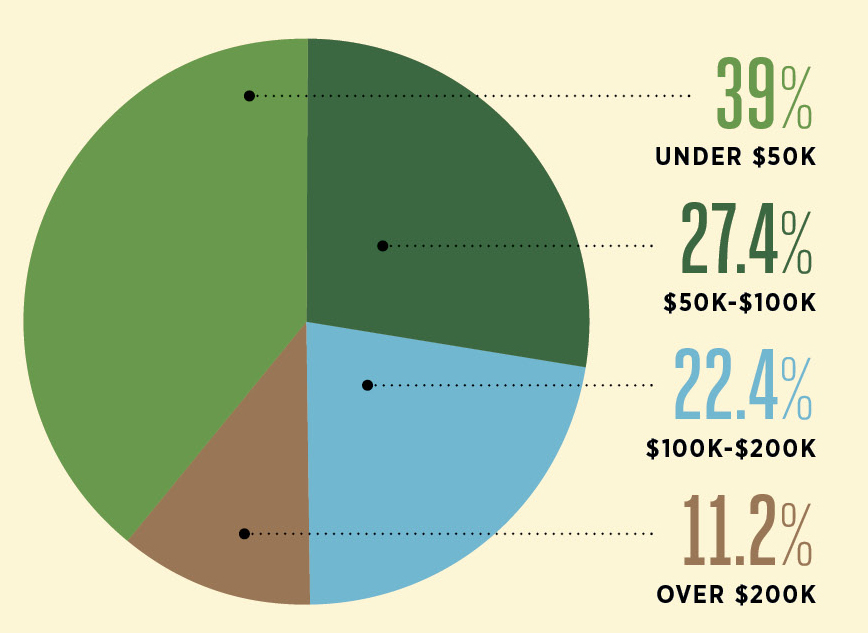
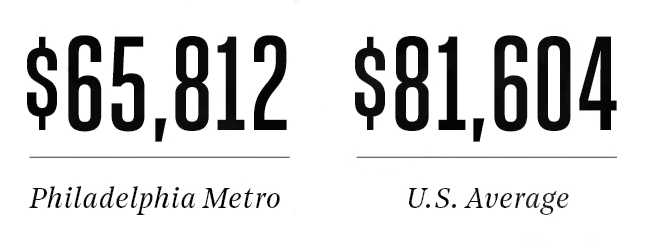
Median Household Income
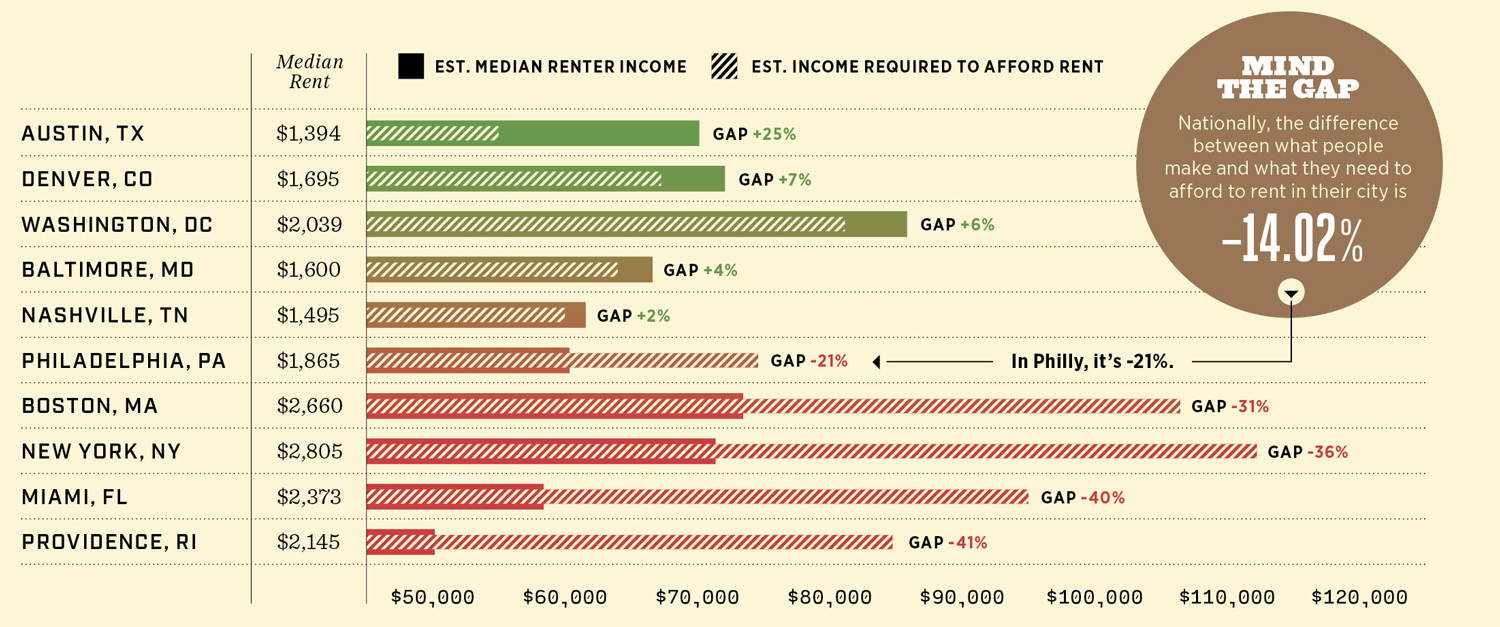
2. How Affordable Is Our Rent?
What we make vs. what housing costs
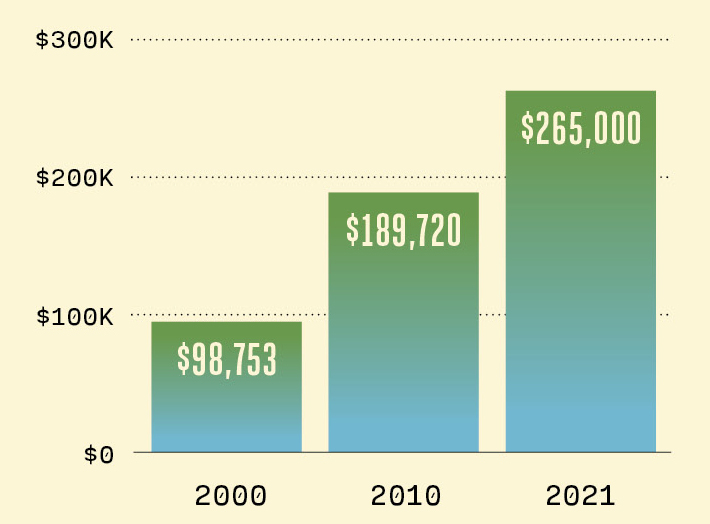
3. Median Home Prices in Philadelphia from 2000 to 2021
4. Home Ownership Rates by Race from 2000 to 2021
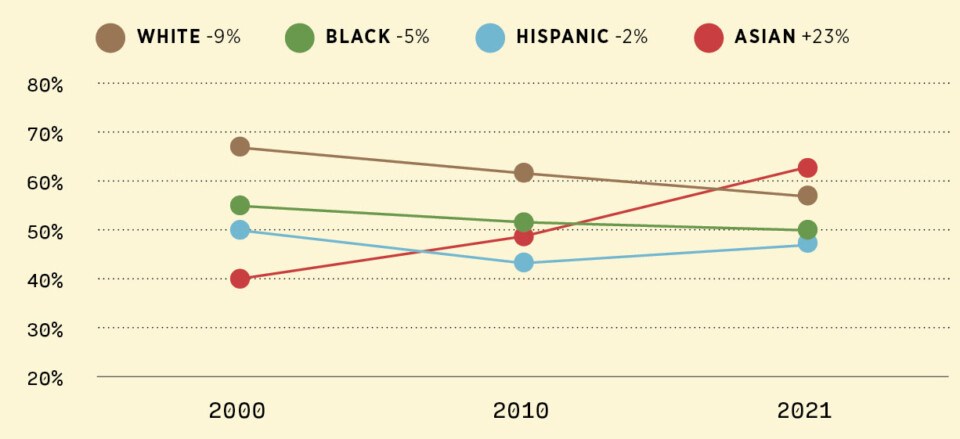
Charts by Hillary O’Connor. Sources: 1. censusreporter.org; 2. redfin.com/news/rent-affordability-2025; 3-4. pew.org; chart 3, prices for traditional homebbuyers, adjusted for inflation
Published as “Philadelphia and the Incredible Shrinking American Dream” in the April 2026 issue of Philadelphia magazine.